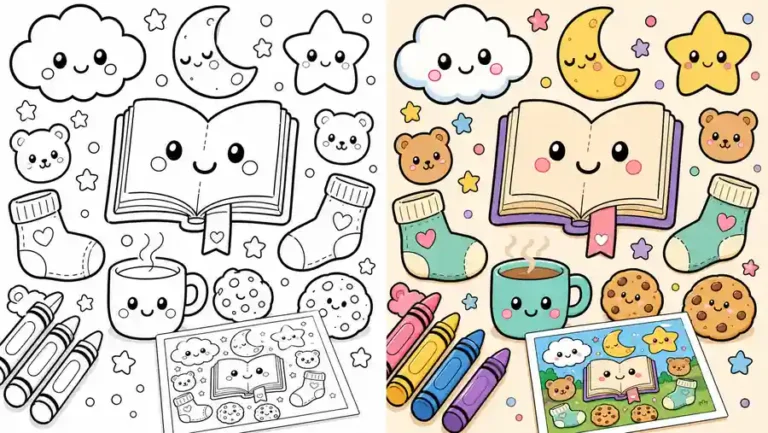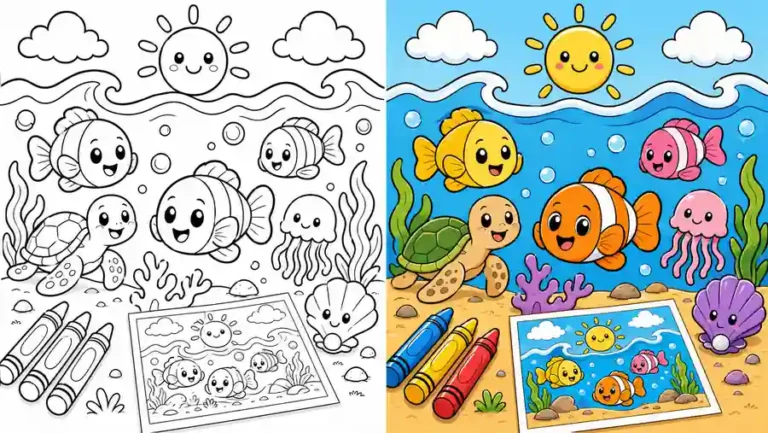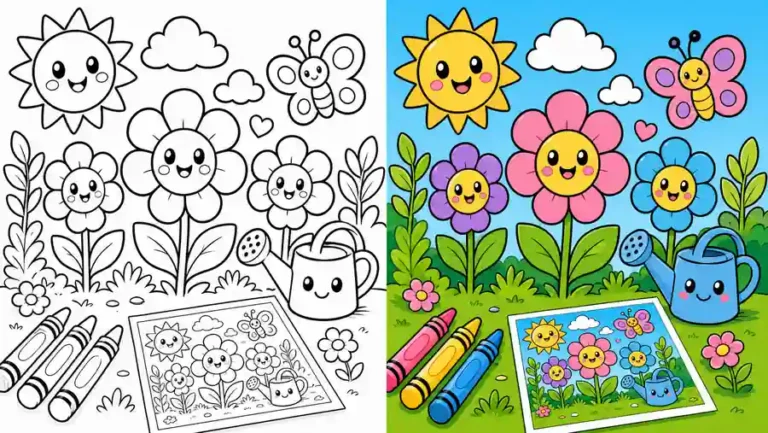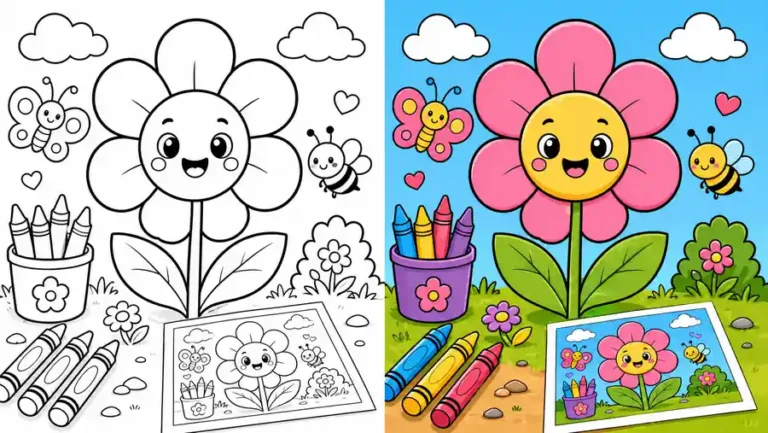

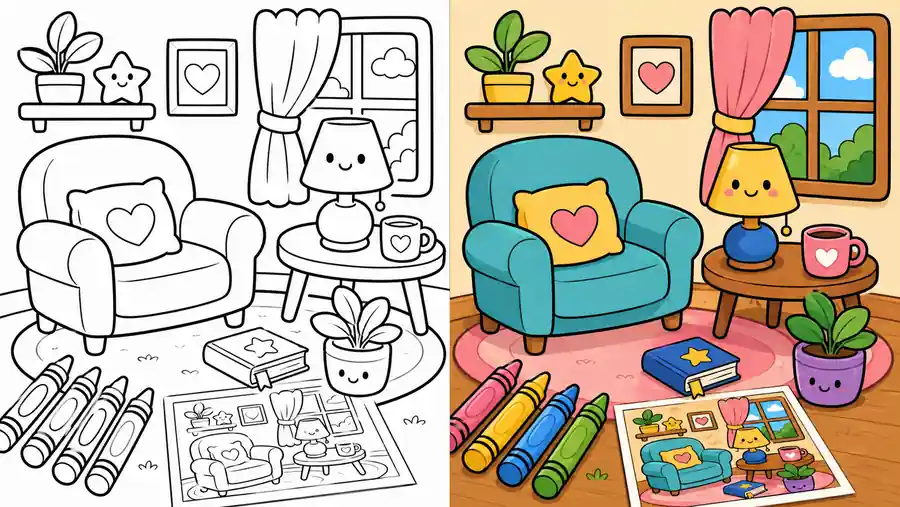
This is not a collection of blank room diagrams. Each of the 22 scenes is a specific kind of moment: a cushioned window seat with a view of rooftops outside, a stack of books with a lit candle casting shadows behind them, a teapot and cups arranged on a side table, a bicycle leaning against a wall beside a hanging plant, a fireplace with logs and a mantle, a record player surrounded by potted succulents. The details are recognizable — book spines, windowpane grids, ceramic shapes, throw pillows — but not so fine that they demand a professional coloring hand. Outlines run around 2 to 3 millimeters, which requires a bit more control than the toddler-oriented pages in the Bold & Easy line, but still reads clearly as an accessible design rather than an adult coloring book.
The “little corner” concept — one quiet, well-arranged spot in a home — gives each page a focused composition that rewards slow, careful coloring. There are no complex action scenes and no characters to identify. The subject is the space itself, and coloring it well means thinking about which wall color complements the furniture, whether the plants should be all green or vary in tone, how to make the warm lamplight feel different from the cool window light. That kind of color thinking is more engaging for older kids than it sounds. Everything here is free to download and easy to print.
Free Printable Bold & Easy Little Corner Coloring Pages
This collection includes 22 printable little corner coloring pages featuring a window seat reading nook with a landscape view, an armchair beside tall windows, a bay window with cushions and plants, a bedside table with a lamp, stacked books with a candle, a tea set with cups and a teapot, a desk with art supplies and a cactus, potted plants on a table, an open book, a panoramic window view, a floor lamp with a bookshelf, a fireplace with a wood stack, a desk with pencils and school supplies, a bicycle against a wall, a bed and nightstand corner, a writing desk with papers, a windowsill row of potted plants, a tea tray arrangement, a vinyl record player with succulents, a plant display shelf, and a simple bedroom corner. All pages download as PDFs for A4 or US Letter printing.


Who Are These Little Corner Coloring Pages Best For?
Early elementary kids, roughly ages seven and eight, can handle these pages if they are comfortable with moderately detailed coloring and have moved beyond chunky crayons. The window pane grids and book spine lines require staying in relatively narrow spaces, which is genuinely more demanding than the typical bold-outline kindergarten page. A child who finds their current coloring books too easy will find these a satisfying step up.
Teens are the strongest match. The interior design subject matter resonates with older kids and pre-teens who are developing aesthetic preferences — someone who cares about how a room looks will instinctively engage with these scenes differently than a younger child would. The 2 to 3 millimeter outlines work well with fine-tip colored pencils, which are the tool of choice for most teen colorers. These pages also serve as a genuinely calming activity rather than just an educational exercise.
For an art class setting, this set works well as an introduction to interior perspective — discussing how objects in the background appear smaller, how window light differs from lamp light, and how a limited color palette can give a room a coherent mood.
Creative Little Corner Coloring and Craft Ideas
Mood Palette Choose one color family — all blues, or all warm oranges and creams — and color an entire room scene using only shades within that family. See how a unified palette changes the feeling of the space.
Dream Room Design Color the window seat or armchair scene as you would actually want your own reading nook to look — specific wall color, specific cushion fabric, specific plant species. Turn it into a design proposal.
Time of Day Study Color the same page twice: once set in morning light (cool blues and whites from the window), once at evening (warm amber lamplight, dim window). Compare how drastically the mood changes.
Book Spine Titles On the bookshelf or stacked books pages, write actual book titles you have read on the spines — in tiny handwriting if needed — and color the covers to match the real books.
Plant Identification On the potted plant pages, try to identify which species are depicted based on leaf shape. Then look up the real colors of those plants and color them accurately rather than imaginatively.
Interior Color Theory Exercise Pick three pages and apply a different color theory rule to each: complementary colors (orange and blue), analogous colors (yellows through oranges), or neutral with one accent. Label which rule you used.
Vinyl Record Playlist On the record player page, write a made-up album title and artist name on the record label. Then create a playlist of three songs that would fit the mood of the scene and write the song titles somewhere on the page.
Tea Time Setting After coloring the tea set page, actually set up a real tray with tea or hot cocoa using similar arrangement. Compare the real setup to the coloring page and notice what details were simplified in the illustration.
How to Print These Little Corner Coloring Pages
Each page downloads as a PDF for A4 or US Letter paper. These pages work best with fine-tip colored pencils or thin markers rather than chunky crayons, since some of the interior details — window panes, book spines, ceramic shapes — have areas under 5 millimeters wide. Standard 24 lb copy paper or card stock both work well. Printing at the highest resolution your printer allows will keep the detail lines crisp.
Explore More Activities Coloring Pages
If you enjoyed these pages, you may also like:
Bold & Easy Cozy Fall Coloring Pages
Bold & Easy Comfy Pattern Coloring Pages
Bold & Easy Floral Coloring Pages
Activities Coloring Pages