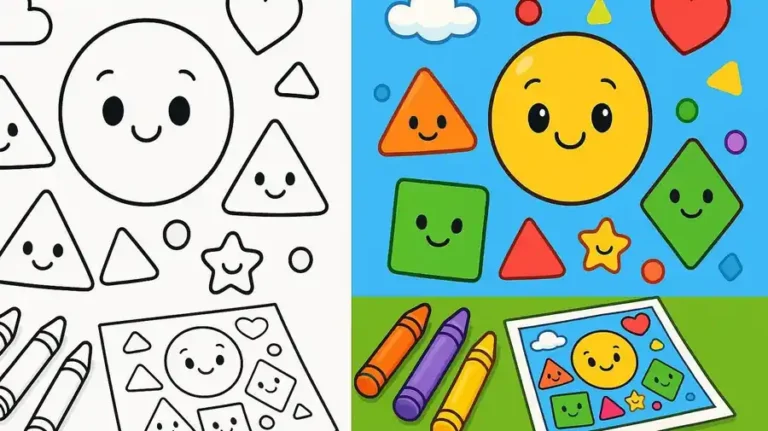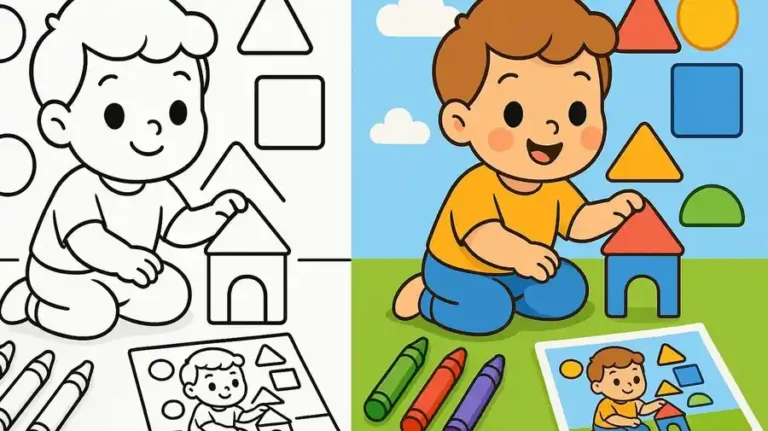

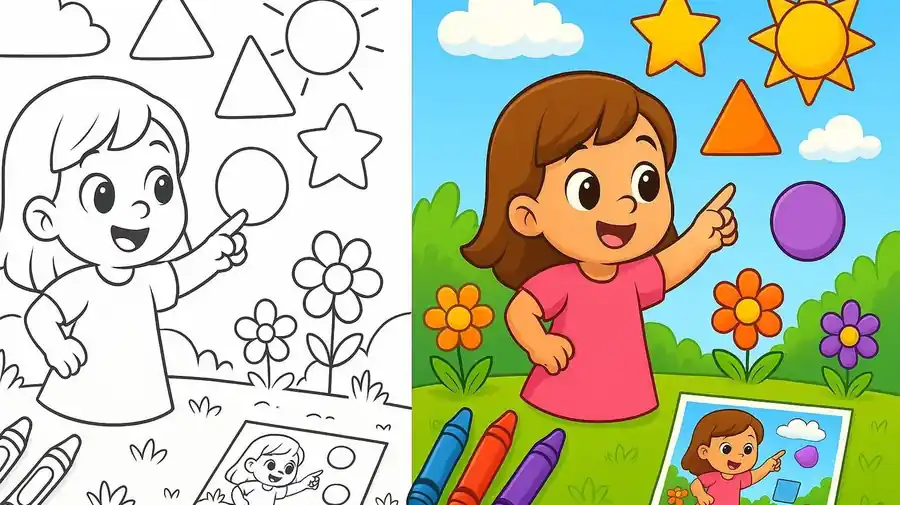
Each page in this set follows the same format: the name of a shape appears at the top, and scattered across the rest of the page is a mix of shapes that the child must sort through, identify the correct ones, and color them in. A friendly monkey character anchors each design and makes the activity feel like a game rather than a worksheet. The scattered shapes are drawn at various sizes and orientations, which adds a useful layer of difficulty — a triangle rotated 45 degrees still needs to be recognized as a triangle, and that rotation requirement is where a lot of the real learning happens.
The shapes covered span basic 2D forms and one 3D shape: heart, circle, triangle, rectangle, star, diamond, square, hexagon, pentagon, and cube. That range is more thorough than most preschool shape packs, which tend to stop at the five or six most common shapes. Everything here is free to download and easy to print.
Free Printable Find and Color Shapes Activity Pages
This collection includes 10 printable find-and-color shape activity pages, one for each shape: heart, pentagon, rectangle, star, triangle, circle, diamond, square, cube, and hexagon. On each page, children scan a field of mixed shapes and color only the ones that match the target shape at the top. The cartoon monkey character on each page adds a playful element that keeps the activity from feeling like pure drill work. Every page prints as a clean PDF on A4 or US Letter paper.


Who Are These Find and Color Shapes Pages Best For?
These pages are designed for preschoolers who are actively learning to recognize and name basic shapes — typically ages 3 to 5. The format works well for this age because it separates the two cognitive tasks: first, identify the target shape; second, find it among distractors. That scanning-and-matching process is exactly what shape recognition exercises should be building. A child who can point to a triangle when asked but still hesitates when a triangle appears rotated among other shapes is exactly who this activity is for.
Kindergartners already fluent in basic shapes (circle, square, triangle, rectangle) will still find the pentagon, hexagon, and cube pages genuinely challenging. A hexagon looks enough like an octagon to a five-year-old that carefully counting the sides before coloring is a real exercise in attention. The cube page, which introduces a 3D shape represented as a 2D drawing, adds a layer of visual reasoning that stretches beyond the typical preschool curriculum.
In a preschool or kindergarten classroom, these work well as independent seat work while the teacher works with small groups. The self-contained format — one page, one task — makes them easy to explain and easy to complete without ongoing instruction. Each sheet works as a quick formative check: count how many of each shape the child colors and whether they correctly excluded the non-matching shapes.
Interesting Shapes Facts to Share While Coloring
Hexagons are the most efficient shape for packing space. Honeybees build their combs in hexagonal cells, and this isn’t by accident — mathematicians proved in 1999 (confirming what was long suspected) that regular hexagons are the most efficient way to divide a flat surface into equal areas using the least possible total perimeter. Bees effectively solved an optimization problem that humans needed calculus to verify.
The circle is the only shape with no corners. This sounds obvious but leads to a useful question: why do wheels have to be circles? Because any other shape would create an uneven ride — an ellipse, for example, would make a wheel that rocks up and down as it rolls. The circle is the only shape where every point on the edge is exactly the same distance from the center, which is the property that makes smooth rolling possible.
Stars in “star shapes” have specific geometry. The five-pointed star — the most common shape on flags and drawings — is a pentagram, and its proportions are directly connected to the golden ratio. The ratio of the long diagonal to the short diagonal in a regular pentagram is approximately 1.618, the same number that appears in spiraling shells, flower petals, and many other natural growth patterns.
The cube is one of only five “perfect” 3D shapes. A cube has six identical square faces, eight corners (vertices), and twelve edges. The ancient Greeks identified exactly five solids where every face is the same regular polygon — called the Platonic solids. The cube is the most familiar, but the tetrahedron (four triangular faces), octahedron (eight), dodecahedron (twelve pentagons), and icosahedron (twenty triangles) round out the full set. No others are possible.
Creative Shape Activity and Craft Ideas
Color-code each shape type After completing the find-and-color activity, go back and use the same color for each shape across all pages — all circles are blue, all triangles are red. This reinforces the shape vocabulary through a second pass of active sorting.
Shape hunt in real life After coloring the hexagon page, do a room scan: find five real hexagons anywhere nearby — floor tiles, pencil cross-sections, pattern on a ball. Connecting the worksheet shape to physical objects is where shape recognition actually sticks.
Shape collage Cut out each finished page, then cut out the individual colored shapes and arrange them by type on a separate sheet to create a shape family collage. Label each group.
Wrong-shape detection challenge Have the child complete one page, then swap with a sibling or classmate and check each other’s work. Did they color any shapes that weren’t the target? Missing any? The checking task is actually more cognitively demanding than the coloring task.
Shape book Print all 10 pages, complete them, and staple them together in order. Add a cover page that says “My Shape Book” with the child’s name. It becomes a reference they can actually use — flip to the triangle page to check what a triangle looks like.
Tally and graph On a separate sheet, draw a simple bar graph with ten columns — one for each shape. After coloring each page, count how many of that shape appeared and fill in the bar. An accessible introduction to data recording for kindergartners who are ready for it.
How to Print These Find and Color Shape Pages
Each page downloads as a PDF that prints on standard A4 or US Letter paper. These are black-and-white worksheets intended for coloring, so plain copy paper is the right choice — cardstock is unnecessary. Print all 10 at once and staple them as a packet, or print individual pages as needed. For classroom use, grayscale mode uses roughly half the ink without affecting the content.
Explore More Learning and Education Coloring Pages
If you enjoyed these pages, you may also like:
ABC Alphabet Coloring Pages
All Learning & Education Coloring Pages