
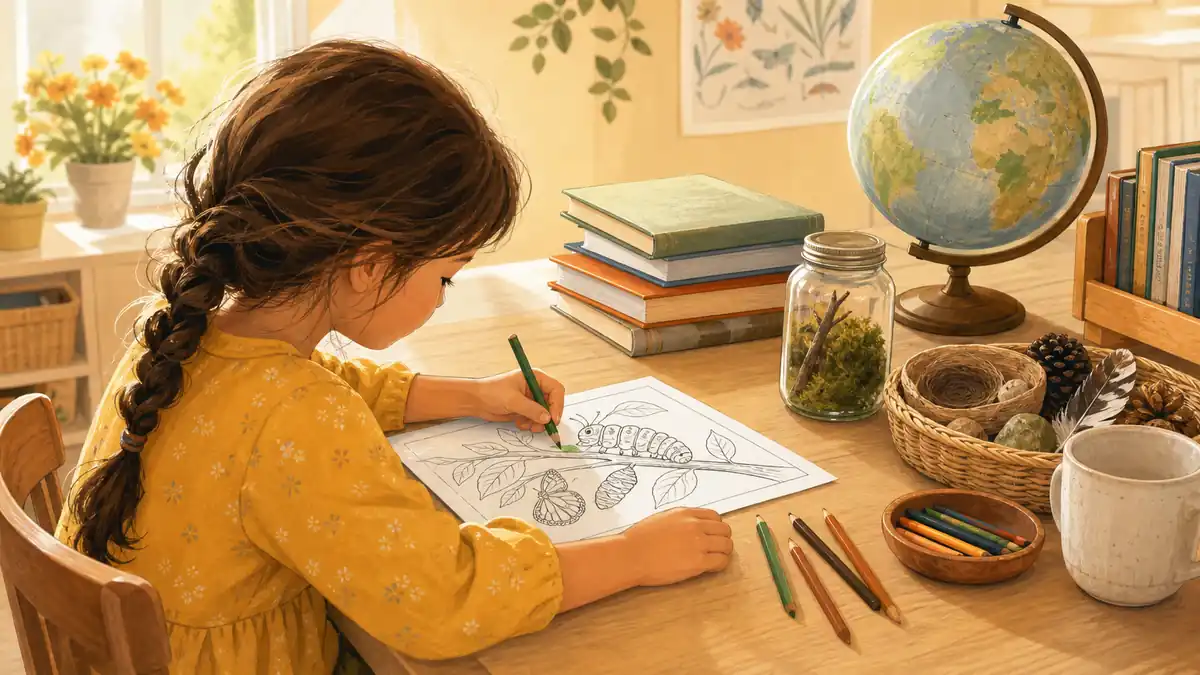

Homeschool coloring pages and printables are one of the most flexible, low-cost, high-engagement tools in the homeschool toolkit — they work as morning basket enrichment, unit study visual anchors, nature journal illustrations, narration scaffolding, and fine motor practice simultaneously, often from a single well-chosen page. Unlike classroom coloring, which operates within tight schedule constraints, homeschool coloring can unfold at the child’s pace, connect to live outdoor observation, and integrate with the broader curriculum in ways institutional schooling rarely allows.
Why Coloring Pages Work Especially Well in Homeschool
Homeschool families have structural advantages over classroom teachers when it comes to coloring as a learning tool. The flexibility to connect a coloring page to a live nature observation, to let a child spend 45 minutes on a single detailed page, to use a finished diagram as a narration prompt rather than a graded product — these are uniquely homeschool possibilities that make coloring pages significantly more powerful than their classroom equivalent.
Three homeschool-specific factors amplify the value of coloring pages:
- Real-time curriculum connection: In a homeschool setting, a life cycle coloring page can be used on the exact day the child observes caterpillars outside or reads about metamorphosis — a connection that institutional schooling rarely achieves with this precision
- Paced engagement: Homeschool children can spend as long as needed on a page without a bell or transition interrupting the learning — a child in flow with a detailed science diagram may spend 30–45 minutes and produce a reference artifact they return to for months
- Cross-subject integration: A homeschool butterfly life cycle page can connect to biology, art, nature journaling, writing, and even math (how many days in each stage?) in the same session — the same page that takes 20 minutes in a classroom can take 90 minutes in a homeschool and cover five subjects
Homeschool Coloring Page Uses by Context
Morning Basket
Morning basket — the Charlotte Mason-inspired opening time when the family gathers for reading aloud, poetry, music, and enrichment — is one of the most natural contexts for homeschool coloring. A child who colors while a parent reads aloud is not distracted from listening; for many children, the motor engagement of coloring actually improves listening comprehension by giving restless hands something to do while the mind attends.
Morning basket coloring works best when pages connect to the current read-aloud or theme: a nature page during a nature story, a historical scene during history reading, an animal page during an animal study. The page becomes an illustrated artifact of the morning’s content.
For a complete approach to morning basket with coloring pages, see our guide to homeschool morning basket ideas with coloring pages.
Unit Study Visual Anchors
Unit studies — the homeschool approach of organizing all subjects around a central topic — benefit enormously from coloring pages as visual anchors. When a unit study on butterflies includes a life cycle coloring page, the child has a visual-spatial representation of the entire concept before reading begins. That visual scaffold makes all subsequent reading, narration, and discussion more accessible and better retained.
Unit study coloring page applications:
- Pre-reading visual exposure: Color the diagram before reading about the concept — visual pre-exposure improves comprehension of the text that follows
- Illustrated unit notebook: Each unit’s coloring pages become the illustrated pages in the child’s hand-assembled unit notebook — a record of the year’s learning that children often keep for years
- Vocabulary anchor: Label a diagram together before instruction begins — the child writes the terms in context rather than as a disconnected vocabulary list
See our detailed guide to homeschool unit studies with coloring pages for unit-by-unit approaches.
Nature Journal Illustrations
The Charlotte Mason tradition of nature journaling — observing the natural world and recording it in illustrated notebooks — pairs naturally with coloring pages for children whose drawing skills haven’t yet caught up with their observation skills. A child who observes a caterpillar outside, then colors a detailed caterpillar coloring page, and writes their observation notes beside it has produced a richer nature journal entry than a child who attempts to draw from scratch and struggles with the representation.
Nature journal coloring works best when the coloring page is used after the observation — not instead of it. The sequence is: observe first, draw what you can from memory or observation, then color the printed page as a reference comparison.
Our nature coloring pages, flowers and plants pages, and science and nature pages provide the most commonly observed species for elementary nature journaling.
Narration Scaffolding
Charlotte Mason narration — the practice of having a child tell back what they’ve learned in their own words — is more accessible when the child has a visual reference. A colored and labeled diagram gives the child something to point to and organize their narration around. “I see the egg here, and then the caterpillar comes next, and then the chrysalis…” is a more complete narration than an unaided verbal recall attempt.
The coloring page as narration tool works at multiple levels:
- Oral narration: Child narrates while pointing to their finished page — most appropriate for ages 4–7
- Written narration: Child writes sentences about each labeled section — appropriate for ages 7–10
- Extended narration: Child writes a detailed description of the entire process depicted — appropriate for ages 10+
Independent Quiet Time
For homeschool families with multiple children, structured independent quiet time — each child working independently on their own activity — is essential for the parent’s ability to work with other children or simply to have a focused adult block. Coloring is the ideal quiet time activity: it’s independent, absorbing enough to last 20–45 minutes, requires no adult involvement once the page is selected, and produces something the child is proud of at the end.
A dedicated quiet time coloring basket or box — stocked with the child’s current interests and refreshed weekly — is one of the most effective homeschool management tools available.
Homeschool Coloring Pages by Subject
Science
Science is the highest-value subject area for homeschool coloring pages because the visual-spatial knowledge produced by coloring a diagram is more durable than knowledge acquired through reading or listening alone. A homeschool student who colors and labels every life cycle diagram in the elementary science curriculum has a visual library of scientific processes that provides context for all subsequent science learning.
Essential homeschool science coloring categories:
- Life cycles: Our life cycle coloring pages cover butterfly, frog, plant, chicken, and other species central to elementary science
- Nature science: Our science and nature pages cover ecosystems, weather, Earth science, and biology concepts
- Plant science: Our flowers and plants pages connect to plant anatomy, botany, and garden science
For STEM-integrated homeschool coloring approaches, see our guide to STEM activities using coloring pages.
Early Literacy
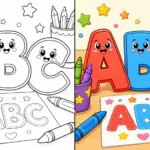
Alphabet coloring pages are the most evidence-backed early literacy use of coloring in homeschooling. The letter-name-sound-picture connection reinforced through coloring is the phonics foundation that formal reading instruction builds on. For homeschool families using an explicit phonics curriculum, alphabet coloring pages provide the visual-kinesthetic reinforcement that worksheets rarely deliver with the same engagement.
Our alphabet coloring pages provide one page per letter with picture cues, available in any order to follow the sequence of your phonics curriculum. For a complete phonics integration approach, see our guide to how to teach letters with coloring pages.
Mathematics
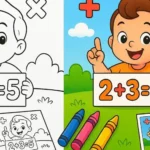
Math coloring pages in the homeschool context work best as concrete reinforcement of abstract concepts the child is currently learning. Color-by-number pages require correct number identification. Counting pages embed one-to-one correspondence in a creative activity. Pattern pages make repeating sequences visible and colorable.
Browse our math coloring pages for number concepts across the preschool through early elementary range.
Art
Homeschool art instruction benefits from coloring pages as technique studies — a child learning about warm and cool colors can practice color theory by coloring the same page twice with different palettes. A child learning shading can practice on a black and white coloring page before applying the technique to original work. Coloring pages provide a low-stakes, achievable structure for practicing techniques that might feel too challenging on a blank page.
Seasonal and Nature Studies
Homeschool nature study — observing and recording the natural world through the seasons — is one of the most broadly applicable uses of seasonal coloring pages. Monthly seasonal pages connect the indoor learning environment to the observable world outside, making coloring feel timely and connected rather than generic.
Our seasonal coloring pages are organized by month for easy integration with nature study calendars and seasonal unit planning.
Coloring Pages by Homeschool Philosophy
Charlotte Mason Homeschool
Charlotte Mason homeschooling — with its emphasis on living books, nature study, narration, and the habit of attention — is the most naturally coloring-friendly homeschool philosophy. Coloring pages support the CM approach as nature journal illustrations, narration anchors, and morning basket enrichment. The key CM principle that governs coloring use: the page should serve the learning, not replace it. Use pages after observation and reading, not instead of them.
Classical Homeschool
Classical homeschooling organizes learning around the trivium — grammar, logic, rhetoric — with the grammar stage (ages 4–10) focused on absorbing facts and information. Coloring pages are most useful in the grammar stage as visual fact-encoding tools: life cycle diagrams, geographical maps, historical timelines illustrated visually, and science diagrams that make abstract content concrete.
Eclectic Homeschool
Eclectic homeschoolers — who draw from multiple approaches and curricula based on individual child needs — have the most freedom to use coloring pages where they fit. The priority is matching the page to the child’s current learning and interest rather than fitting it to a philosophical framework.
Unit Study Homeschool
Unit study approaches integrate all subjects around a central topic — and coloring pages are natural multi-subject tools for this approach. A single butterfly life cycle page touches biology (life stages), art (color and pattern), literacy (vocabulary labels), and even math (counting days, sequencing) simultaneously. Unit study homeschoolers typically build illustrated unit notebooks from finished coloring pages.
Setting Up a Homeschool Coloring System
Organizing Your Page Supply
A well-organized page supply removes friction from coloring integration — when the right page is immediately accessible, it happens; when finding and printing the right page takes 15 minutes, it often doesn’t. A practical homeschool organization system:
- Current unit folder: Pages relevant to the unit currently in progress, printed and ready
- Morning basket folder: 2–3 weeks of morning basket pages, rotated with the read-aloud theme
- Quiet time box: Open-interest pages (animals, food, characters) for independent quiet time
- Reference archive: Completed, labeled pages filed by subject as reference materials for future units
Choosing the Right Pages
The most effective homeschool coloring pages share four qualities:
- Educational content that’s visible and clear: A diagram where the learning content is the primary visual feature, not buried in decoration
- Appropriate complexity for the child’s current fine motor level: Too simple loses engagement; too detailed creates frustration
- Space for extension: Room to add labels, write facts, or extend the image
- Connection to current study: A page that reinforces what the child is currently learning produces exponentially more learning than an isolated, generic page
Building the Habit
Like any effective homeschool tool, coloring pages deliver the most value when used consistently rather than occasionally. A simple monthly coloring plan:
- Weekly morning basket page: Connected to the current read-aloud or theme
- Monthly unit study diagram: One labeled science diagram per unit as a visual anchor
- Seasonal nature page: One seasonal page per month for the nature study record
- As-needed skill reinforcement: Alphabet or math pages when a specific concept needs extra practice
This structure produces approximately 48 completed educational pages per year — a year’s worth of illustrated learning that children often keep and refer back to.
No-Prep Homeschool Coloring Activities
One of the most consistent benefits homeschool families report is that coloring pages require essentially zero preparation beyond printing — a significant advantage on days when planning time was limited or the day’s plans fell through. No-prep homeschool coloring activities:
- Print any life cycle page + ask child to color, label, and narrate — complete science lesson in 30 minutes
- Print a seasonal nature page + do a 10-minute outdoor observation beforehand — science + art + nature study
- Print an alphabet page for the current phonics letter + do the before-during-after literacy sequence — complete phonics reinforcement session
For structured no-prep approaches, see our guide to no-prep homeschool activities using coloring pages.
How to Start Homeschooling with Coloring Pages
For families new to homeschooling, coloring pages are often one of the first successful educational activities — they work immediately, require no special equipment, and produce visible results that build parent confidence in the homeschool approach. For a complete introduction to homeschooling that situates coloring pages within the broader curriculum framework, see our guide to how to start homeschooling.
Frequently Asked Questions
Are coloring pages a legitimate homeschool activity or just busy work?
Curriculum-connected coloring pages — particularly science diagrams, alphabet pages, and life cycle pages — are legitimate educational activities that produce measurable learning outcomes through multi-sensory encoding. The “busy work” reputation comes from disconnected, generic pages used without instructional intent. A labeled butterfly life cycle page used the same week as a butterfly unit study is an educational activity; a random animal page handed to a child to fill time is busy work. The distinction is in the connection and the intent, not the activity itself.
How do I integrate coloring pages into a Charlotte Mason homeschool?
Use coloring pages after observation and reading, not instead of them — they reinforce and illustrate content already encountered, rather than replacing first-hand experience. Best CM applications: nature journal illustrations (after outdoor observation), narration anchors (color and label before narrating), and morning basket enrichment (color while listening to read-aloud). Avoid using coloring pages as the primary content delivery mechanism; CM philosophy privileges living books and direct observation over worksheets, including illustrated ones.
What age is best for homeschool coloring pages?
Ages 3–10 benefit most directly, with peak educational value in the 4–8 range when fine motor development, early literacy, and concrete science concepts are all actively developing. From age 10 on, coloring remains useful for complex science diagrams and art technique studies, but the primary fine motor and basic content benefits plateau. The activity scales with the child: simple bold pages for 3-year-olds, detailed labeled diagrams for 8-year-olds, complex technical illustrations for 10-12-year-olds.
How do I use coloring pages for homeschool science?
Use science coloring pages as unit study anchors: before the unit, color the diagram and label what you can from prior knowledge; during the unit, add labels and correct any initial guesses; after the unit, use the completed labeled page as a narration reference. Life cycle pages, ecosystem diagrams, and anatomy pages produce the strongest learning when used this way rather than as one-off activities disconnected from ongoing study.
Can coloring pages replace a formal curriculum in homeschool?
Coloring pages can supplement or support nearly any curriculum, but they work best alongside structured content instruction rather than as a standalone curriculum. The exception is early fine motor development (ages 2–4), where structured coloring is among the highest-value pre-academic activities available. For ages 5 and up, use coloring pages as enrichment and reinforcement alongside your core curriculum rather than as the primary content delivery mechanism.
What are the best homeschool coloring pages for unit studies?
Life cycle pages (butterfly, frog, plant, chicken) are the most universally used in unit studies because they encode biological sequences visually in a way no other elementary activity matches. Science and nature pages — ecosystems, weather, earth science, and biology diagrams — are the next most valuable. For history and geography unit studies, maps and cultural pages provide the visual anchors that living books describe but can’t show. Browse our life cycle and science and nature pages for the highest-value unit study coloring content.
Homeschool coloring pages are most valuable when treated as an intentional learning tool rather than an activity to fill time — connected to current study, paired with observation or reading, and archived in an illustrated notebook that becomes a record of the year’s learning. Browse our full library of life cycle, science and nature, alphabet, math, and seasonal coloring pages at coloring.media, and visit our Tips & Techniques hub for homeschool-specific guides.