
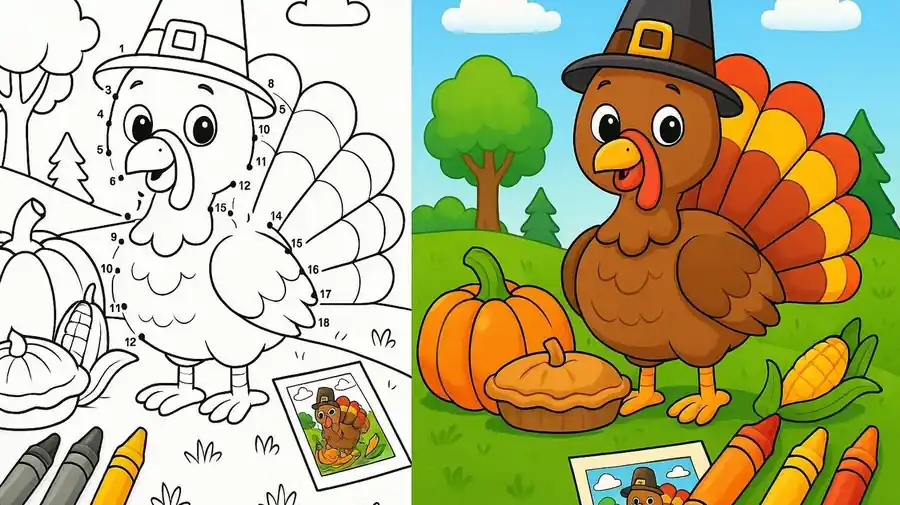
Turkeys show up in several poses across these 20 pages — standing, with fanned tail feathers, from the side, from a three-quarter angle — which keeps the most iconic Thanksgiving subject from feeling repetitive even when it appears multiple times. The rest of the set fills in the classic harvest spread: pumpkins, ears of corn, a slice of pie, a cornucopia, cranberries, an owl, and a pilgrim hat. The dot placements use simple, readable cartoon shapes with clear spacing between numbers, so the Thanksgiving subjects emerge quickly and leave plenty of time for careful coloring in autumn browns, oranges, and reds.
These work particularly well as the weeks before Thanksgiving arrive in November — classroom morning work, a quiet activity while family gathers before dinner, or a take-home alternative to screen time during the break. The 20-page count is enough for daily use throughout November without repetition. Everything here is free to download and easy to print.
Free Printable Dot-to-Dot Thanksgiving Coloring Pages
This collection includes 20 printable dot-to-dot Thanksgiving coloring pages featuring turkeys in multiple poses, pumpkins, corn cobs, pie, a cornucopia, cranberries, an owl, and a pilgrim hat — all in a friendly cartoon style that reveals a colorable outline once the numbered dots are connected. Every page downloads as a PDF sized for US Letter or A4 paper.


Who Are These Dot-to-Dot Thanksgiving Coloring Pages Best For?
Kindergartners are the best fit for these pages. The dot counts are manageable for a five or six-year-old who can count reliably to around 25, and the Thanksgiving subjects are already familiar from family celebrations and classroom lessons — a child who knows what a turkey looks like will feel the shape coming together well before the last dot is connected, which keeps motivation high through the tracing step.
First and second graders move through the dot-to-dot portion quickly and then settle into the coloring, where the familiar autumn palette of burnt orange, deep yellow, cranberry red, and warm brown gives kids a built-in reference point for color choices. The different turkey poses mean older kids can try to color each one differently — a bronze turkey on one page, a fantastical purple one on another — without the pages looking identical.
In classrooms and homeschool settings these fit naturally into a November unit on harvest, food traditions, or community gratitude. One page per school day from November 1st through the 20th covers the whole set and arrives right at Thanksgiving week. They also pack well into holiday bags for children to use quietly during long family gatherings.
Interesting Thanksgiving Facts to Share While Coloring
Wild turkeys can fly, but domesticated ones generally cannot. The turkeys raised for food have been bred to be so large-breasted that they can’t sustain flight. Wild turkeys, though — the kind seen in forests and fields — are capable fliers, reaching speeds of up to 55 mph in short bursts, and they roost in trees at night to stay safe from predators.
A cornucopia is also called a “horn of plenty.” The symbol comes from ancient Greek mythology — it was said to be the horn of a goat that suckled the infant Zeus, which had the power to produce an endless supply of food. The overflowing basket or horn filled with fruits and vegetables became a symbol of harvest abundance that’s been used for thousands of years.
Pumpkins are nearly 90% water. Despite their solid, dense appearance, pumpkins have a very high water content. They’re native to North America and have been cultivated here for thousands of years — archaeologists have found pumpkin seeds in Native American sites dating back over 7,500 years, long before European settlers arrived.
Cranberries bounce when they’re ripe. Harvesters have long known that a fresh, fully ripe cranberry will bounce if dropped. Modern cranberry harvests use this property in grading machines. Cranberries are also hollow inside, which is why they float — cranberry bogs are flooded at harvest time so the berries rise to the surface and can be gathered easily.
Corn was one of the most important crops in early American history. Indigenous people of the Americas domesticated maize from a wild grass called teosinte over 9,000 years ago. By the time European settlers arrived, corn was already a staple food across the continent, and it was Indigenous people who taught early colonists how to grow and prepare it.
Creative Thanksgiving Coloring and Craft Ideas
Thanksgiving Place Cards Print the turkey or pumpkin pages on cardstock, complete the dot-to-dot, color it, and fold the bottom edge up to stand on the table as a place card with a family member’s name written on the back.
Gratitude Journal Pages After coloring each page, write one thing you’re grateful for on the back. By the end of November, the collected pages become a small gratitude booklet to keep or share.
Autumn Palette Challenge Limit colors to the classic Thanksgiving palette: burnt orange, deep yellow, chestnut brown, cranberry red, and olive green. No blues or purples — a fun constraint that produces a cohesive collection.
Turkey Feather Counting After completing the turkey pages, count the tail feathers in the finished outline and compare the number across the different poses. Record the count on the back of each page.
Classroom Feast Wall Each student completes a different page, colors it, and cuts it out. Arrange the finished images on a bulletin board “feast table” backdrop for a Thanksgiving display with contributions from the whole class.
Harvest Nature Walk Match Before coloring, take a short walk and collect real autumn items — an acorn, a pinecone, a leaf. Find the closest matching page and try to color it to match the real object’s exact colors.
Story Starters After coloring the turkey page, write or dictate a story from the turkey’s point of view about what it thinks Thanksgiving is — a fun creative writing prompt for first and second graders.
How to Print These Dot-to-Dot Thanksgiving Coloring Pages
Each page downloads as a PDF and prints on US Letter or A4 paper at standard printer settings. Plain copy paper works for crayons and colored pencils; cardstock is a good choice if you plan to use these as place cards or cut them out for display. Use a pencil for connecting the dots so mistakes can be erased before coloring, and print at 100% scale to keep the dot numbers at a comfortable reading size for young children.
Explore More Connect-the-Dot Coloring Pages
If you enjoyed these pages, you may also like:
Dot-to-Dot Autumn Coloring Pages
Dot-to-Dot Christmas Coloring Pages
Dot-to-Dot Winter Coloring Pages
Cute Animals Dot-to-Dot Coloring Pages
All Connect-the-Dot Coloring Pages