
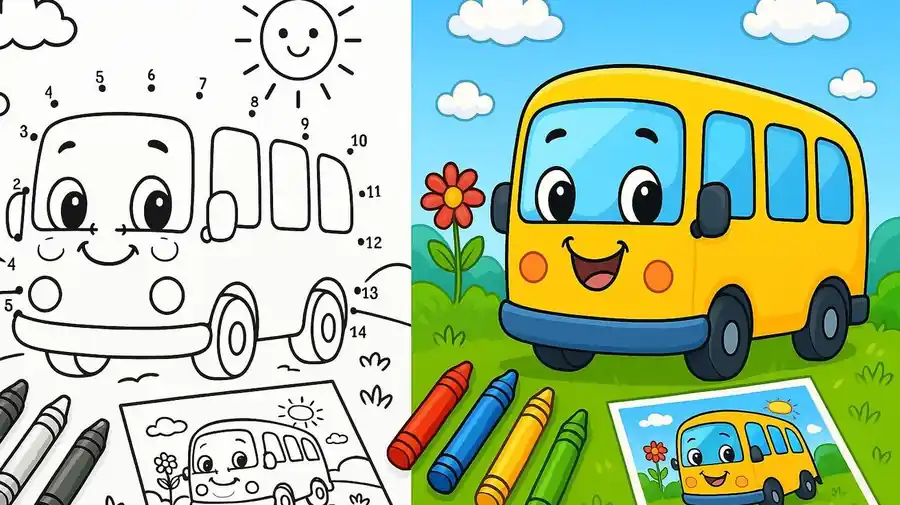
The 20 vehicles here span land, sea, and air — fire trucks, ambulances, school buses, and police cars alongside airplanes, sailboats, fishing boats, construction equipment, and an RV. The variety matters: kids who are obsessed with emergency vehicles get several pages that hit that interest specifically, while the airplane and sailboat pages offer something different for kids drawn to transportation more broadly. The dot placements capture the distinctive silhouettes of each vehicle type — the angular boxy shape of a fire truck, the elongated form of a school bus, the curved hull of a boat — so the finished outline is recognizable and satisfying to color with the vehicle’s characteristic colors.
Vehicle dot-to-dot pages have a natural audience overlap: kids who love transportation subjects tend to be detail-oriented about the vehicles they’re interested in, which makes them willing to work carefully through the dot sequence to get a clean outline. The coloring step then becomes an opportunity to apply specific knowledge — fire trucks are red, ambulances are white with markings, school buses are yellow. Everything here is free to download and easy to print.
Free Printable Dot-to-Dot Vehicle Coloring Pages
This collection includes 20 printable dot-to-dot vehicle coloring pages featuring a fire truck, ambulance, school bus, police car, airplane, sailboat, fishing boat, RV, construction vehicle, and more — each as a single-vehicle numbered dot puzzle that reveals a clean cartoon outline once connected. Every page downloads as a PDF formatted for US Letter or A4 paper.


Who Are These Dot-to-Dot Vehicle Coloring Pages Best For?
Kindergartners with an interest in vehicles are the core audience. A five or six-year-old who already knows the difference between an ambulance and a fire truck will bring real enthusiasm to the dot-to-dot step, since they’re watching a vehicle they recognize take shape with each connection. The angular, boxy outlines of trucks and buses require slightly more careful dot-to-dot tracing than rounded subjects like animals, which makes these pages a modest step up in pencil control for kids who’ve already done simpler puzzles.
Early elementary kids in first and second grade complete the puzzle portion quickly, but the vehicles open up interesting coloring choices: accurate emergency vehicle color schemes with carefully placed stripes and markings, or imaginative custom paint jobs with flame decals and unusual color combinations. Kids who are particular about vehicle details will want to add things like door handles, license plates, and windows that aren’t part of the outlined shape — pencil details they can add before coloring.
In homeschool and classroom settings, these work well alongside a community helpers or transportation unit. The emergency vehicles pair with lessons about first responders; the sailboat and fishing boat pair with water safety; the school bus is a natural conversation piece at the start of a school year. Older students can sort the finished pages into land, sea, and air categories as a simple classification exercise.
Interesting Vehicle Facts to Share While Coloring
Fire trucks carry their own water supply. Most fire engines hold between 500 and 1,500 gallons of water on board, which is enough to start fighting a fire while firefighters connect to a nearby hydrant. The large hoses you see on fire trucks can pump water at up to 1,500 gallons per minute — enough to empty an average truck’s tank in under a minute at full flow.
School buses are the safest form of ground transportation. Per mile traveled, school buses are significantly safer than family cars — in part because of their size and construction, and in part because their bright yellow color (officially called “National School Bus Glossy Yellow”) makes them highly visible at dawn, dusk, and in poor weather. The distinctive color was standardized across the US in 1939 at a national conference on school transportation.
Ambulances were first used during wartime. The concept of a vehicle dedicated to transporting the injured dates back to the Napoleonic Wars in the early 1800s, when French military surgeon Dominique-Jean Larrey developed horse-drawn “flying ambulances” that could quickly reach and evacuate wounded soldiers from the battlefield. Civilian ambulance services followed decades later.
Sailboats can travel faster than the wind. A correctly trimmed sailboat moving across the wind at an angle — called “reaching” — can actually exceed the wind speed by using the sail like a wing to generate aerodynamic lift. Racing sailboats and modern foiling vessels have reached speeds several times greater than the wind speed driving them.
Airplane wings work the same way as sailboat sails. Both generate lift through a curved shape that causes faster airflow on one side than the other, creating a pressure difference. The Wright Brothers were bicycle mechanics who understood this principle and applied their engineering instincts to design wings that could generate enough lift to carry a person — their first successful flight in 1903 lasted just 12 seconds and covered 120 feet.
Creative Vehicle Coloring and Craft Ideas
Accurate Color Schemes Research what each vehicle actually looks like — fire truck red, ambulance white with orange stripes, school bus yellow, police car black and white — and challenge kids to color as accurately as possible using reference images.
Custom Paint Job Design a fictional fleet: pick a color scheme and apply it consistently across all 20 vehicles as if they all belong to the same company or city. Green emergency vehicles, purple school buses — entirely the kid’s call.
Land, Sea, Air Sort Complete and color all pages, cut them out, and sort them into three categories. Glue them onto a large sheet divided into land, sea, and sky sections to create a transportation world map.
Vehicle Details Add-On After completing the dot-to-dot in pencil, lightly draw in additional details before coloring — add windows, door handles, a license plate, a flashing light on the fire truck roof, an anchor symbol on the boat’s hull.
Emergency Vehicle Sound Match Complete each emergency vehicle page, then practice the sound that vehicle makes — fire truck siren, ambulance wail, police car chirp. A silly but memorable way to reinforce which vehicle is which.
Vehicle Speed Ranking After coloring all pages, have kids rank the vehicles from slowest to fastest (construction vehicle, fishing boat, school bus, police car, ambulance, airplane). Discuss what makes some vehicles faster than others.
Community Helpers Booklet Pair each emergency vehicle page with a written sentence about the people who operate it — firefighters ride the fire truck, paramedics drive the ambulance, a captain steers the boat. Staple the pages into a community helpers booklet.
How to Print These Dot-to-Dot Vehicle Coloring Pages
Each page downloads as a PDF and prints on US Letter or A4 paper at standard settings. Plain copy paper works well for crayons and colored pencils. Use a pencil for the dot-to-dot step — vehicle outlines have more straight lines and angles than animal shapes, so a pencil makes it easier to correct a missed dot before the line becomes part of a colored area. Print at 100% scale to keep the numbered dots at a readable size.
Explore More Connect-the-Dot Coloring Pages
If you enjoyed these pages, you may also like:
Dot-to-Dot Animal Coloring Pages
Dot-to-Dot Summer Coloring Pages
Cute Animals Dot-to-Dot Coloring Pages
Dinosaurs Dot-to-Dot Coloring Pages
All Connect-the-Dot Coloring Pages