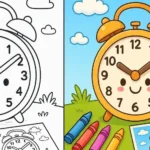

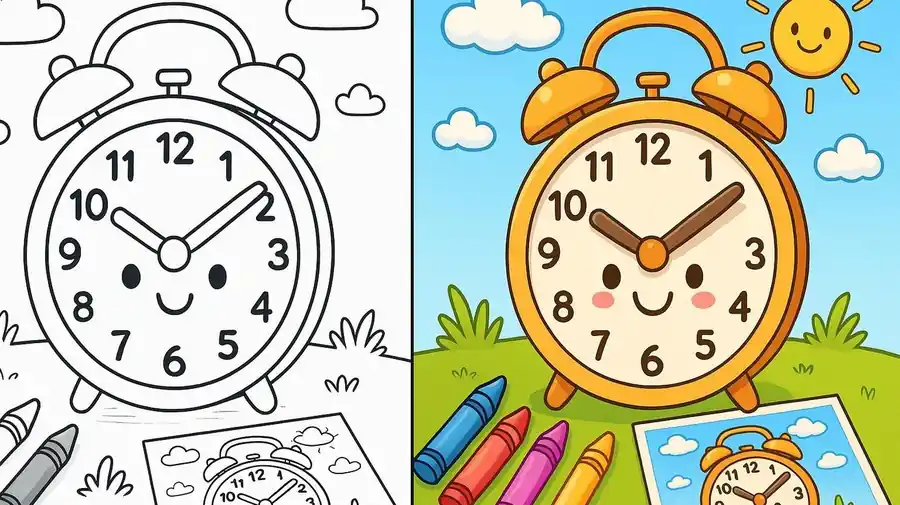
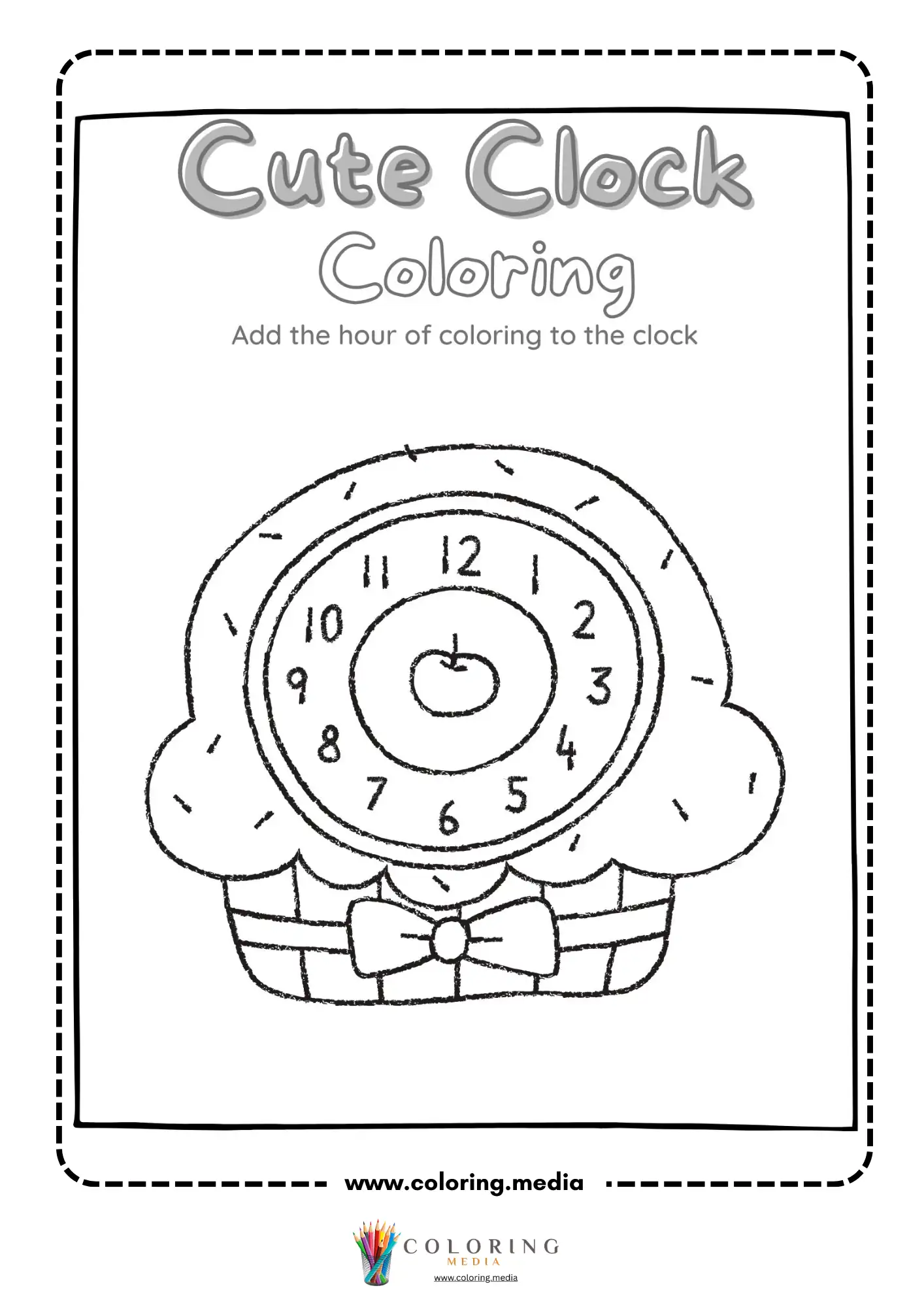
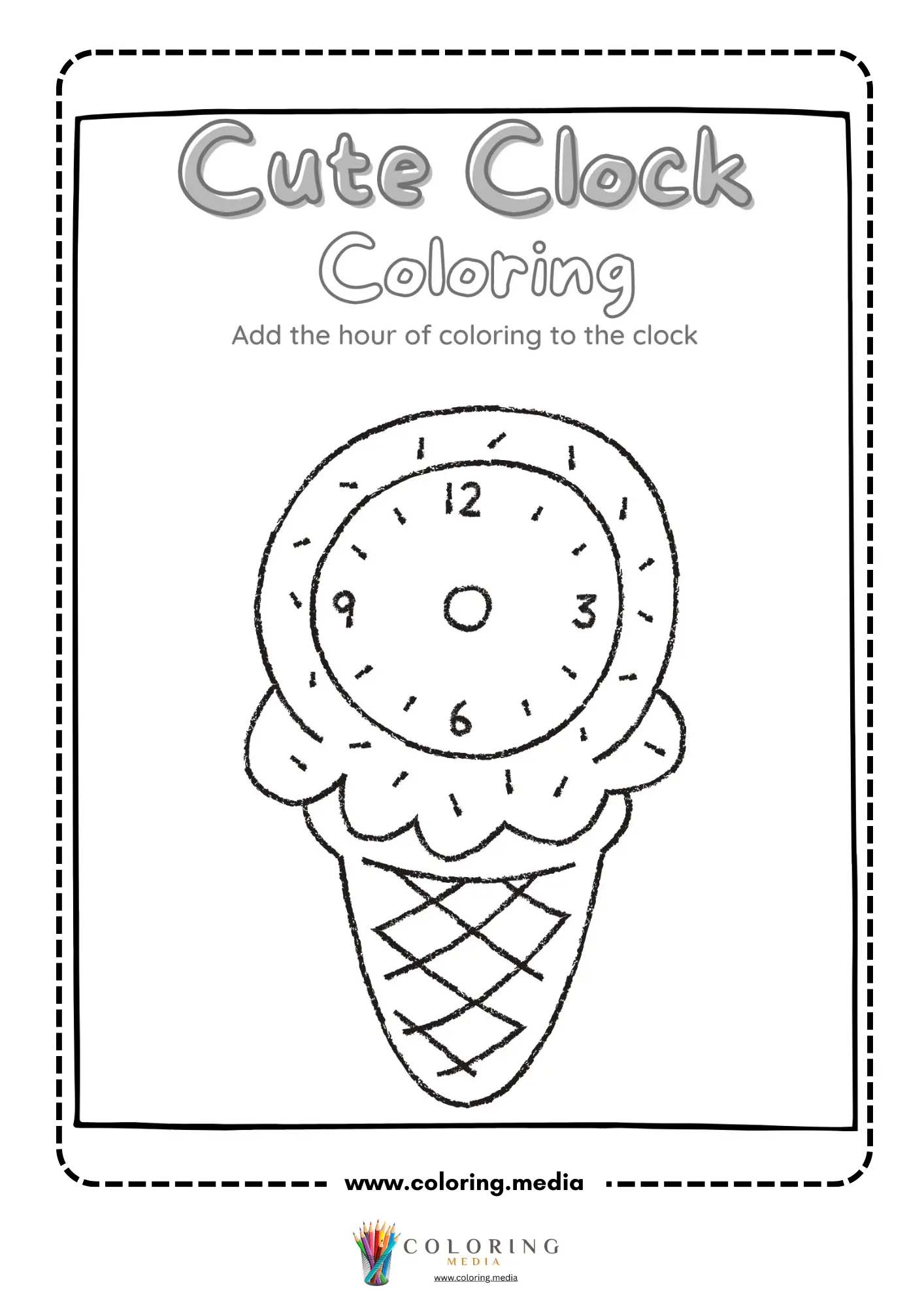
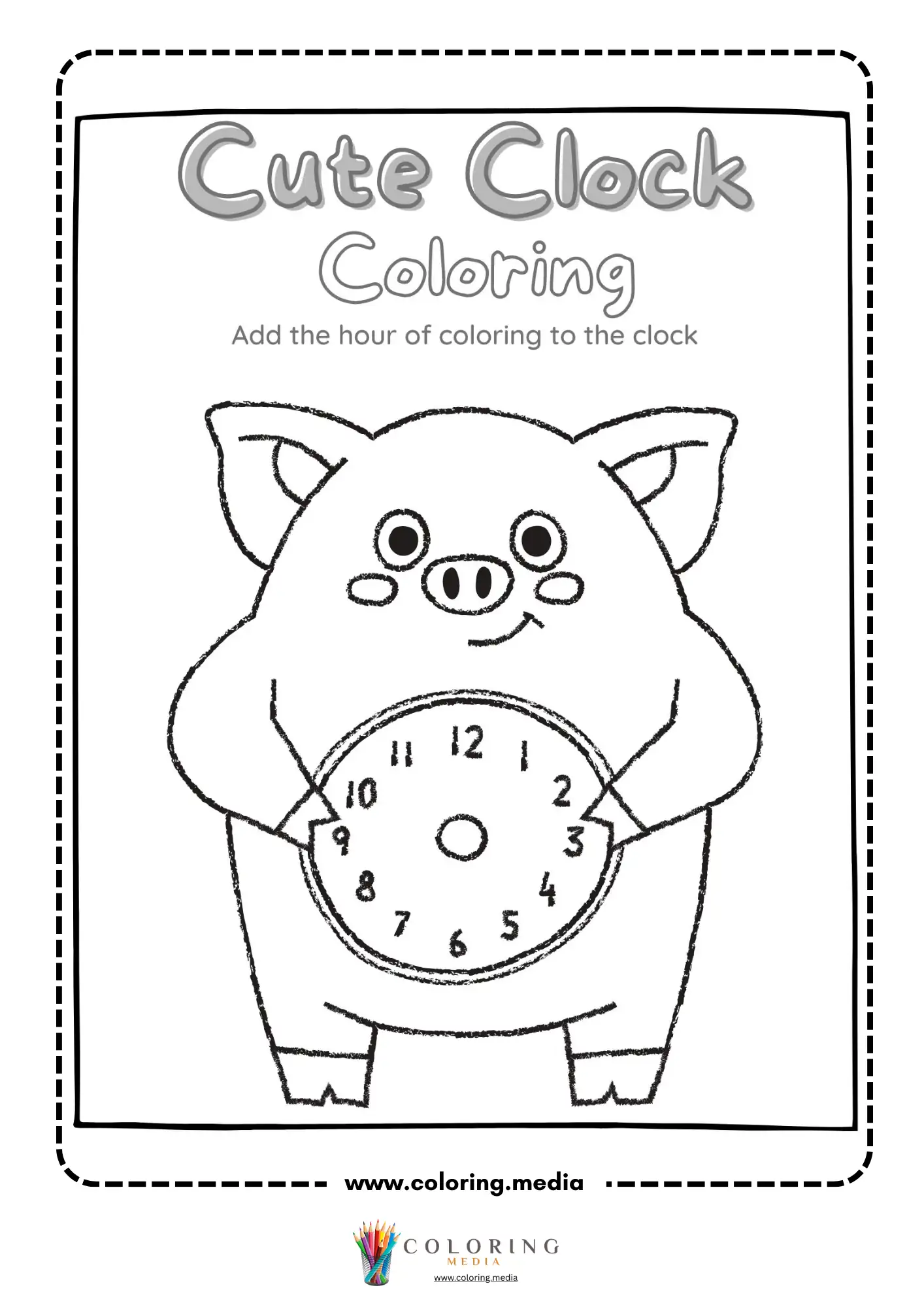
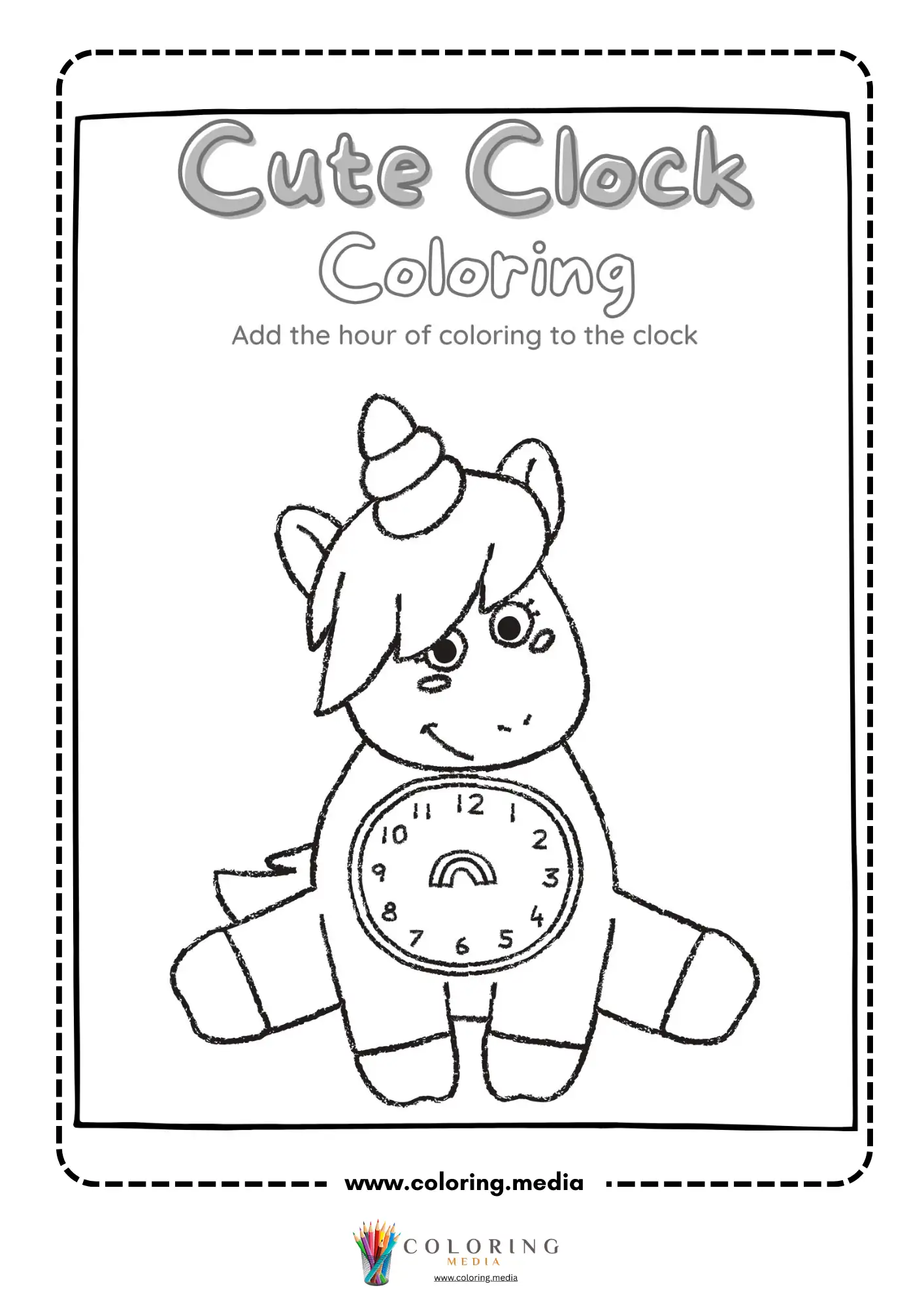
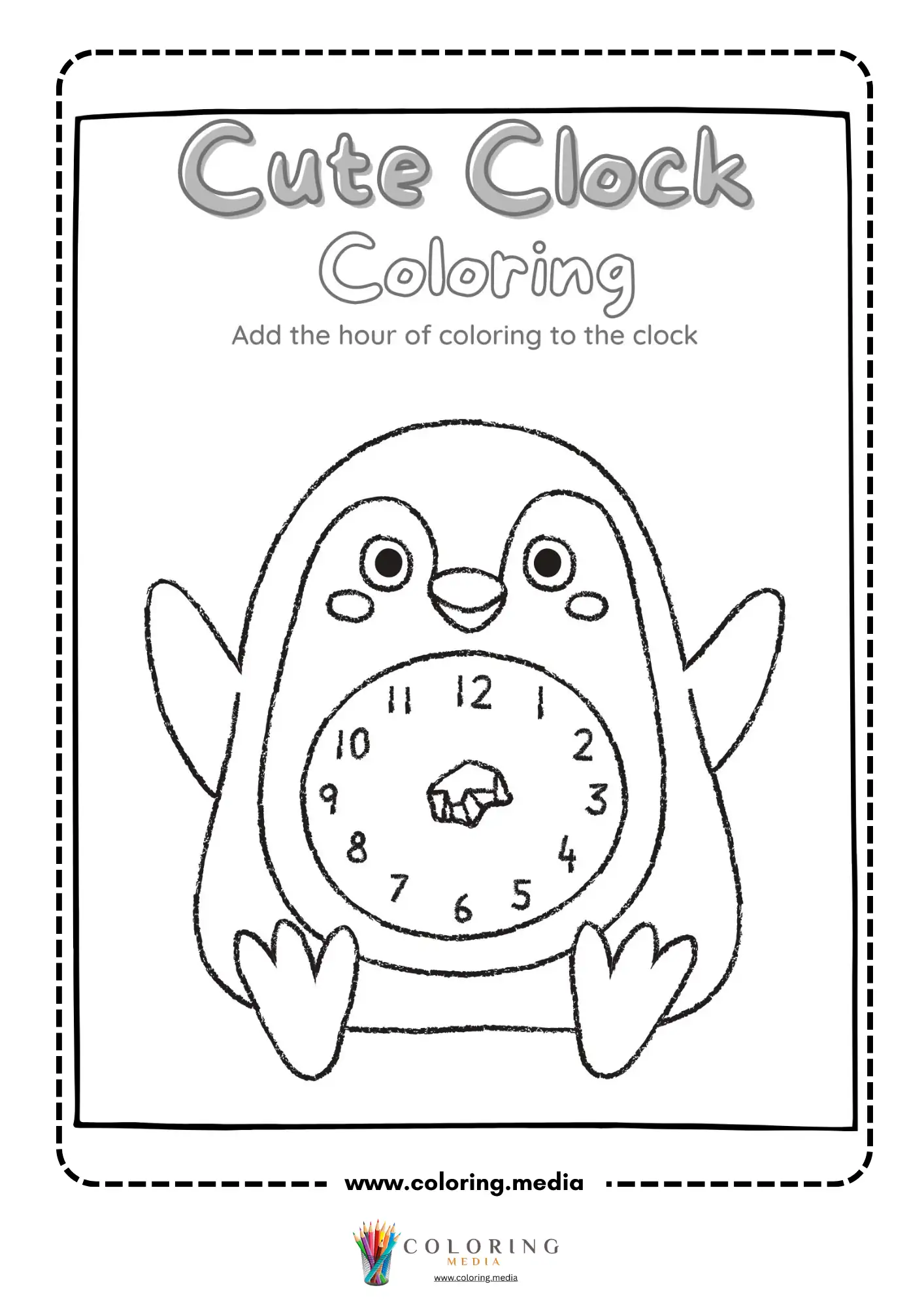
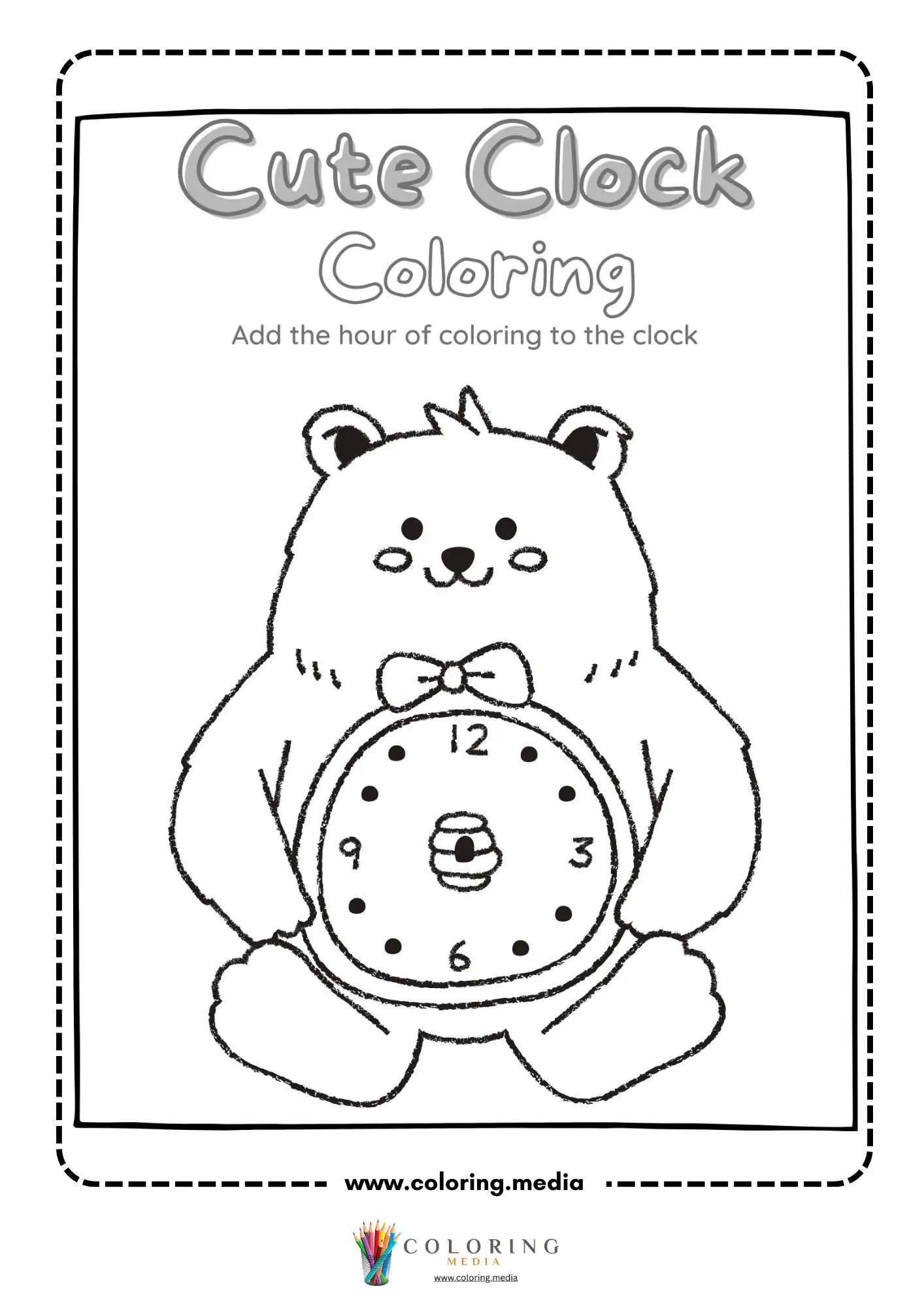
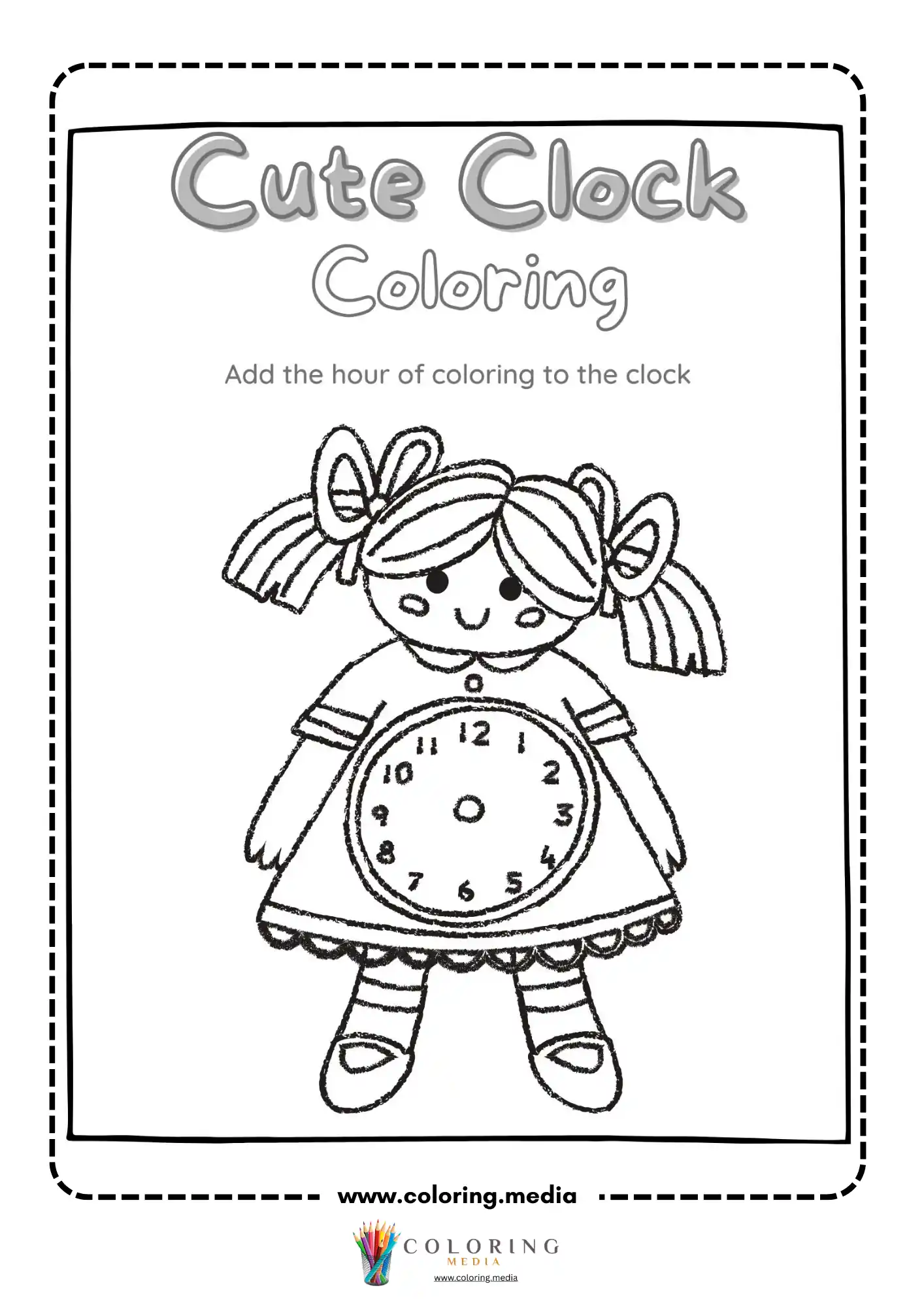
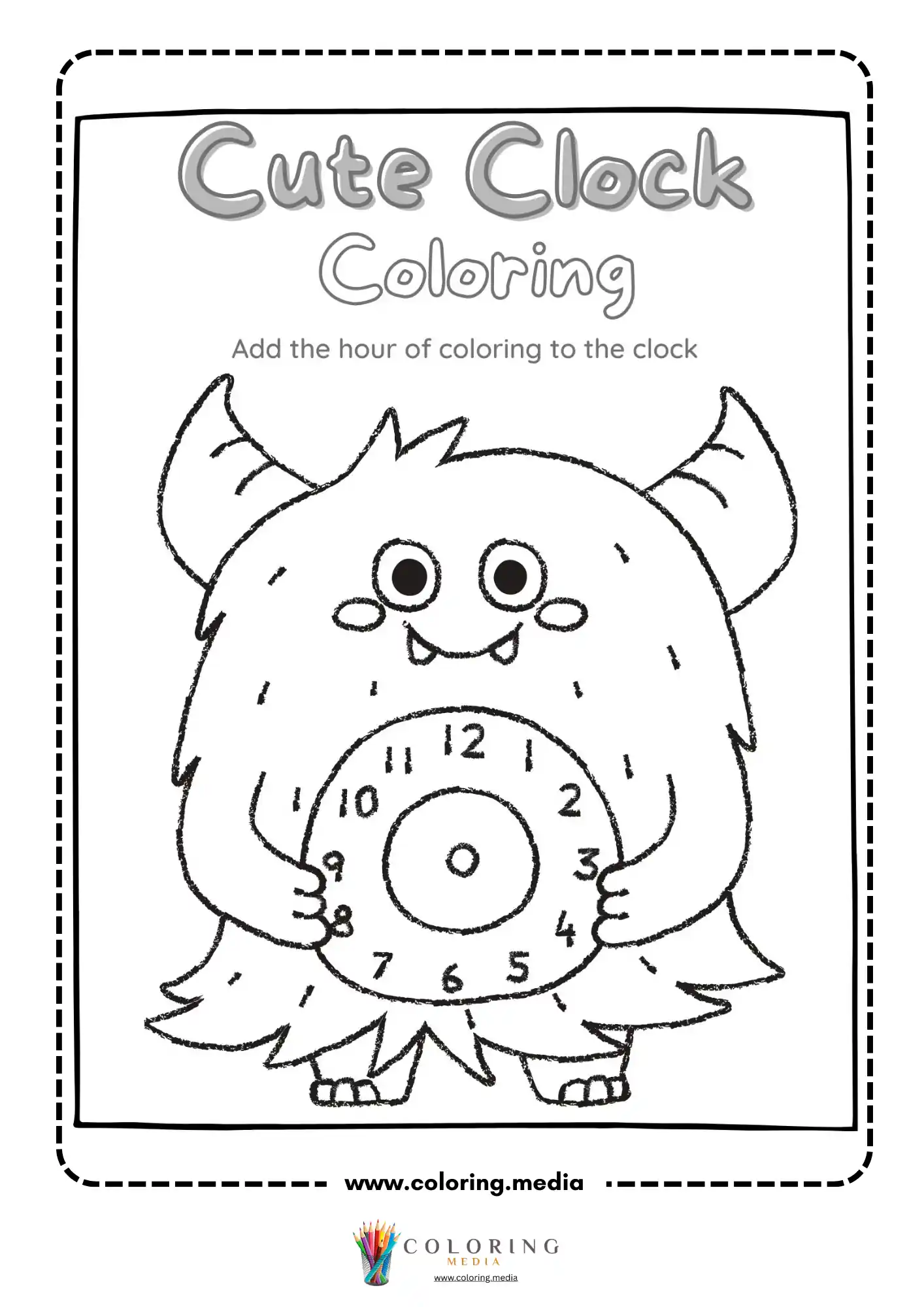
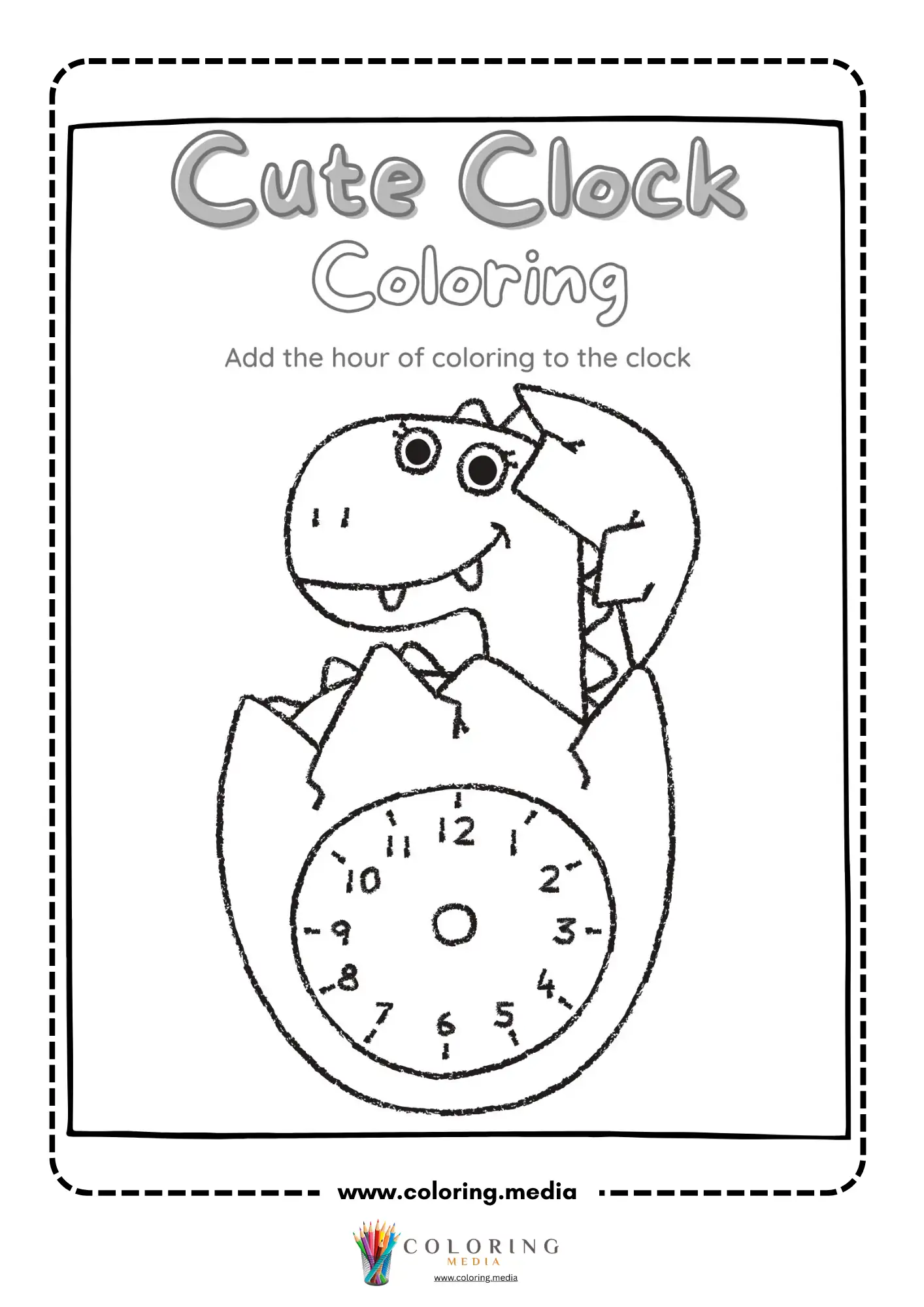
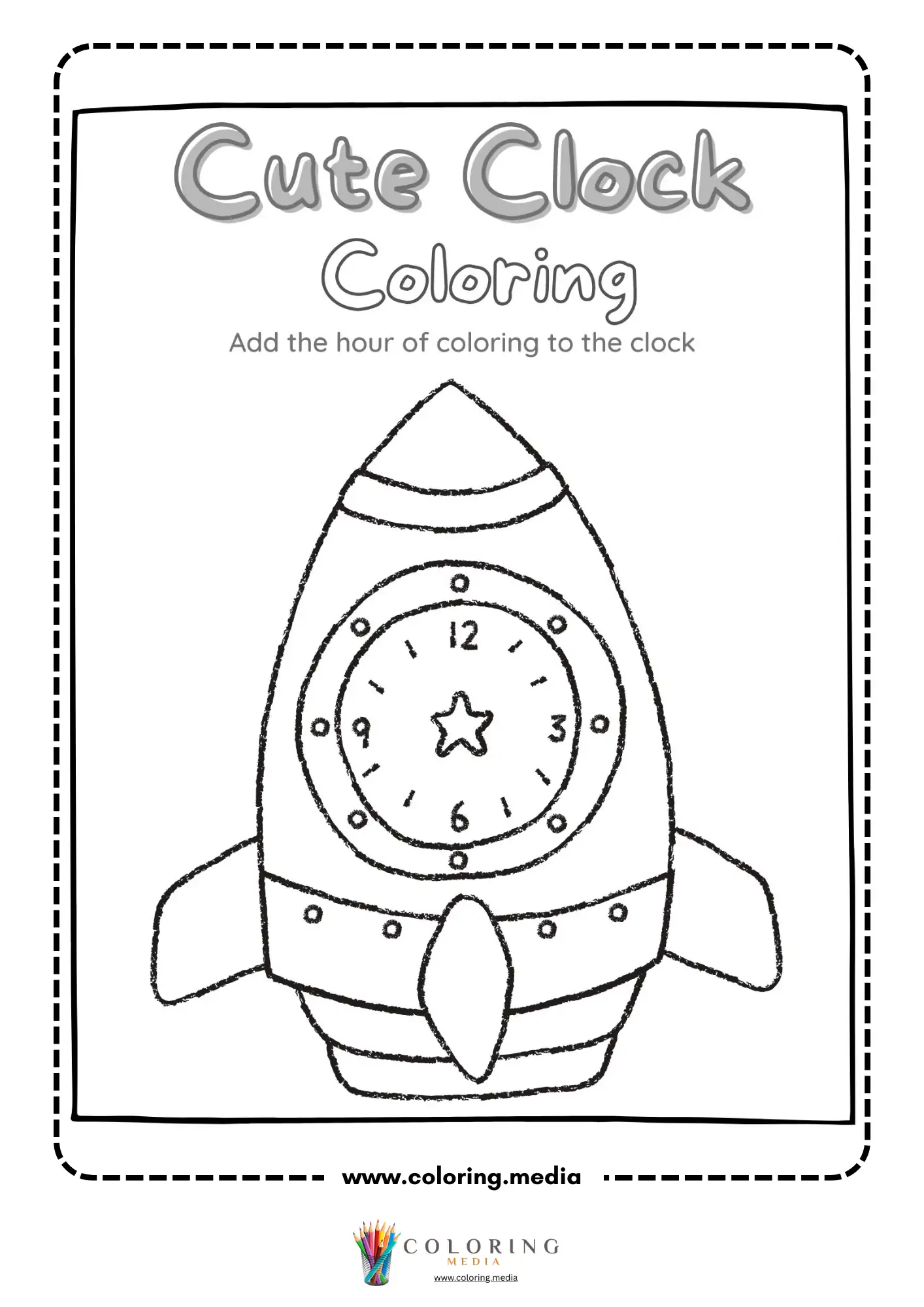
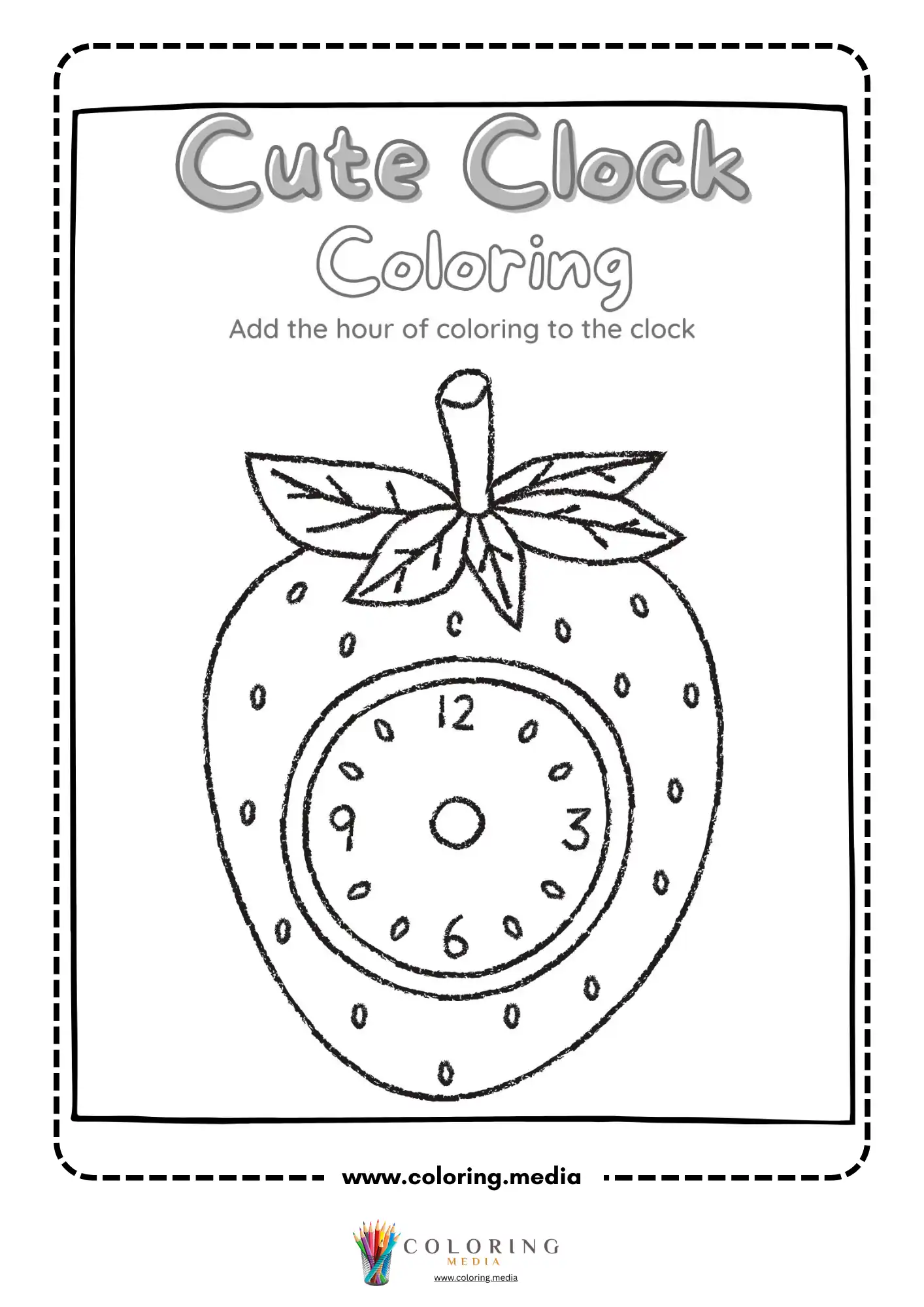
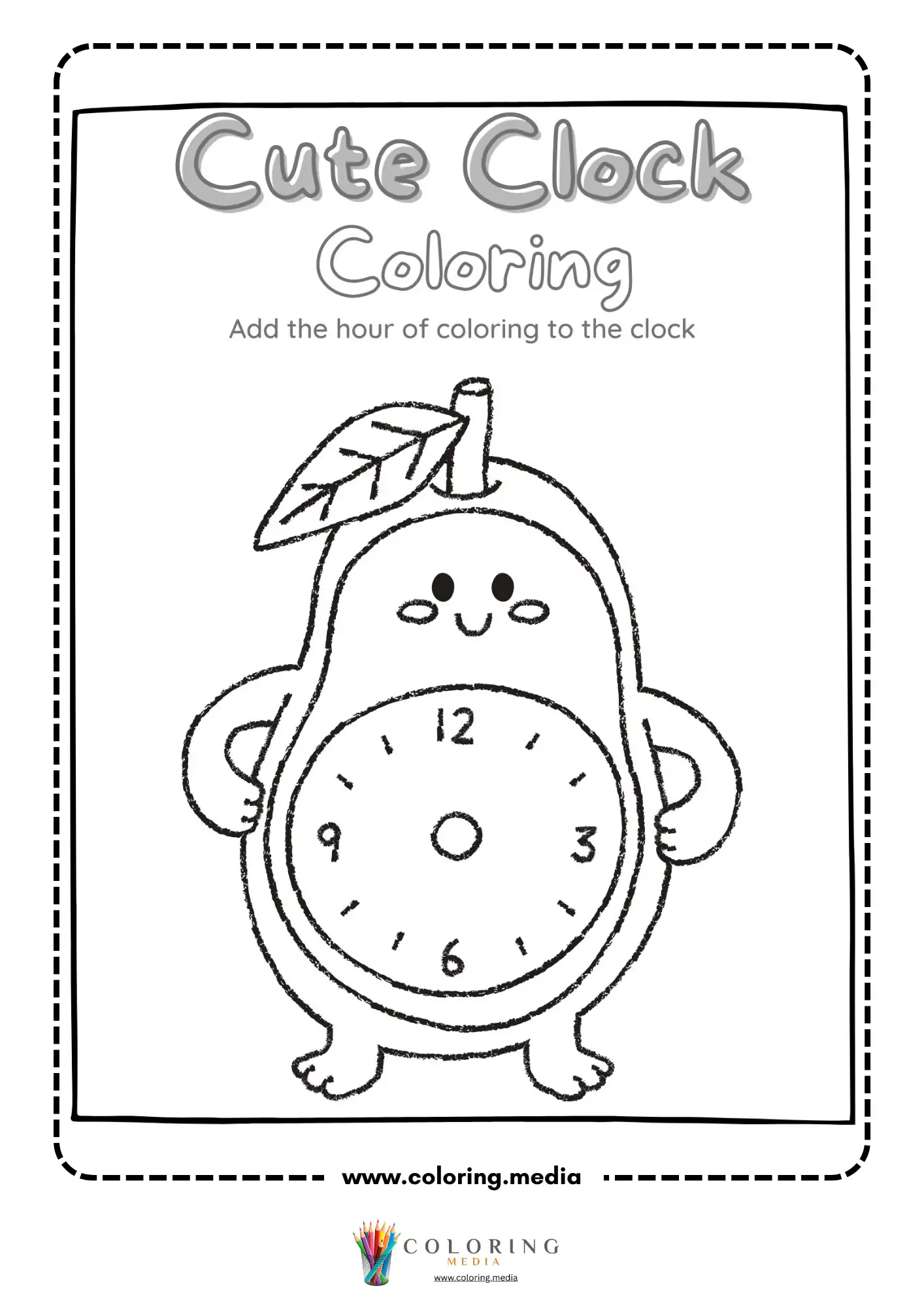
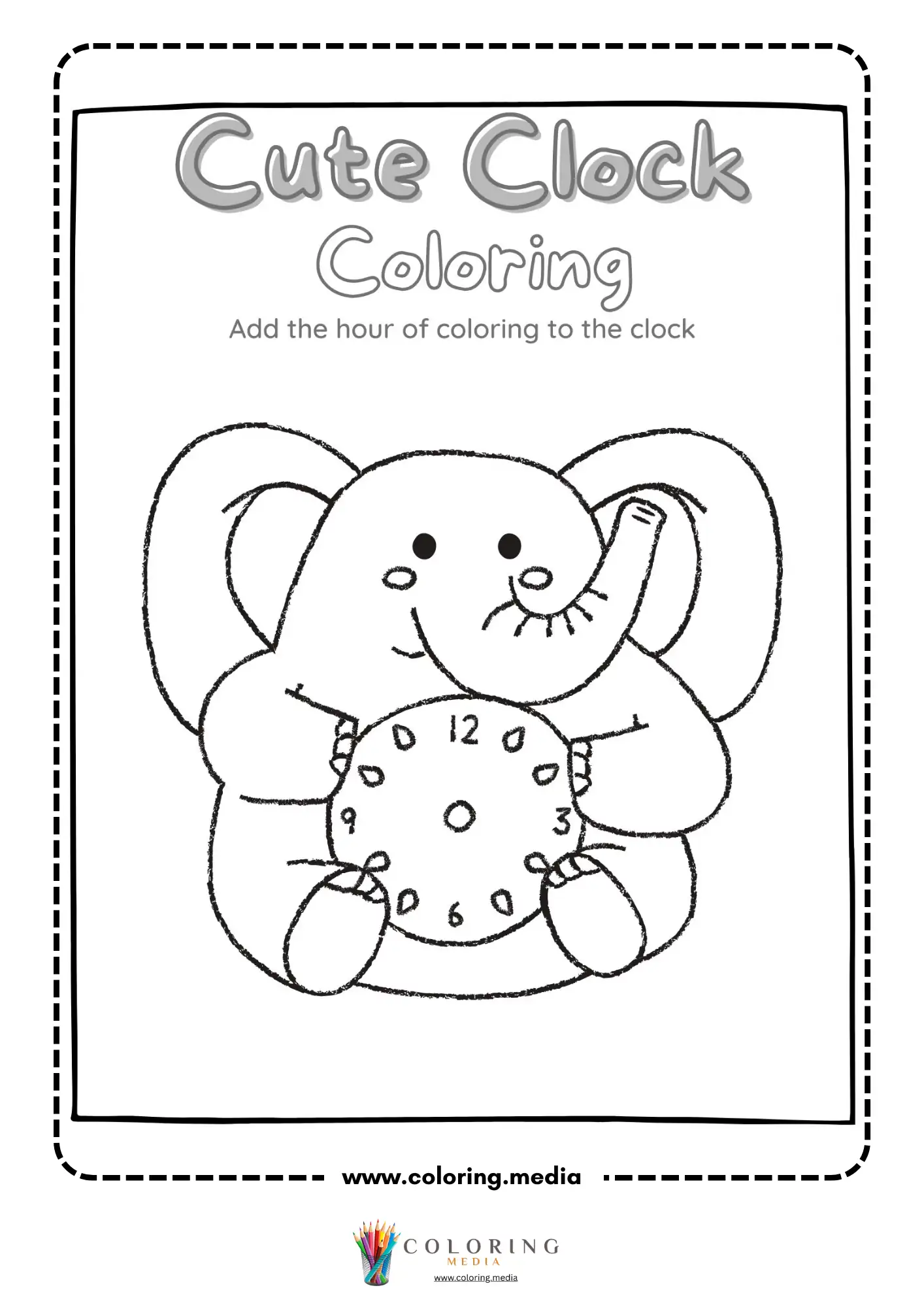
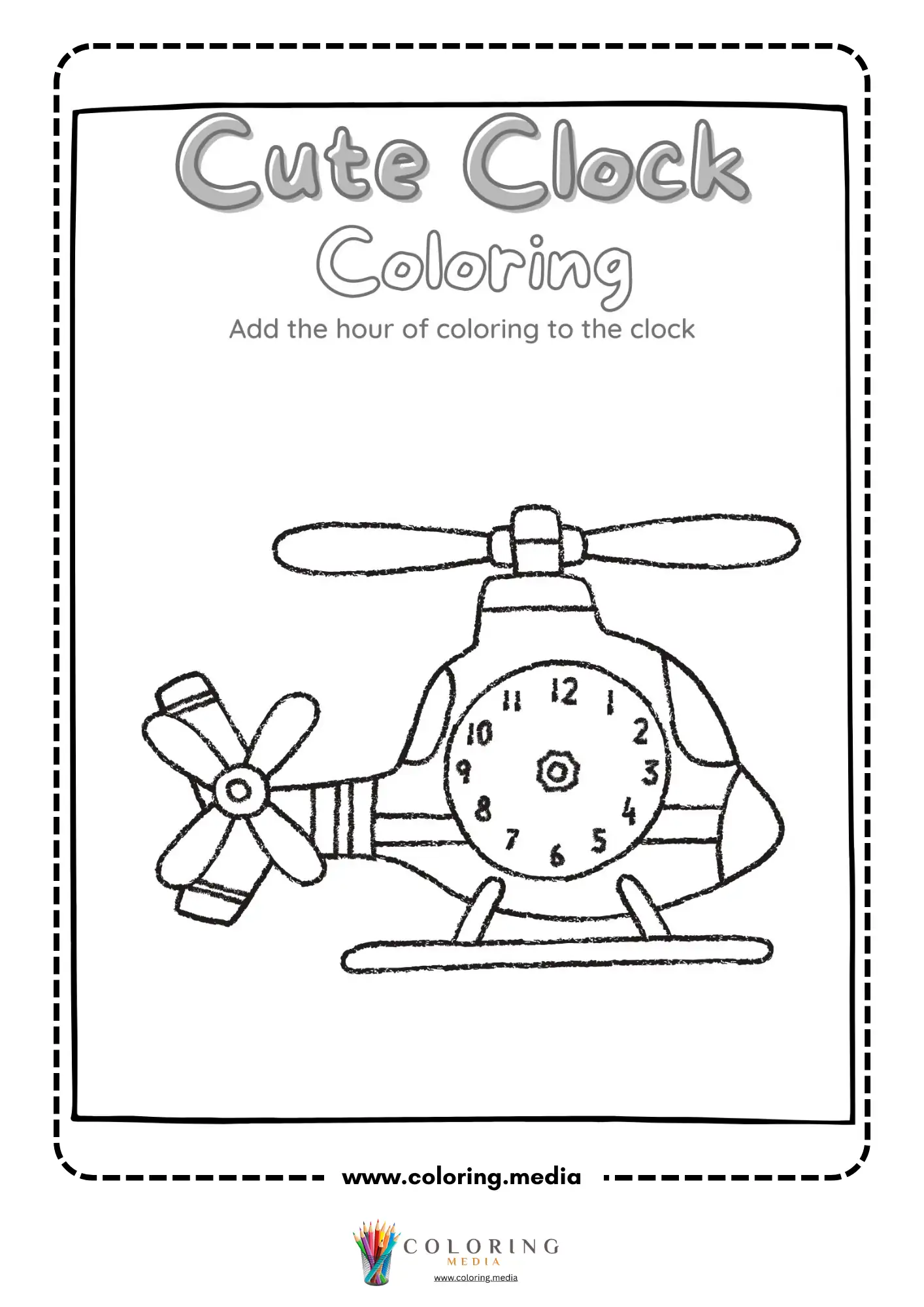
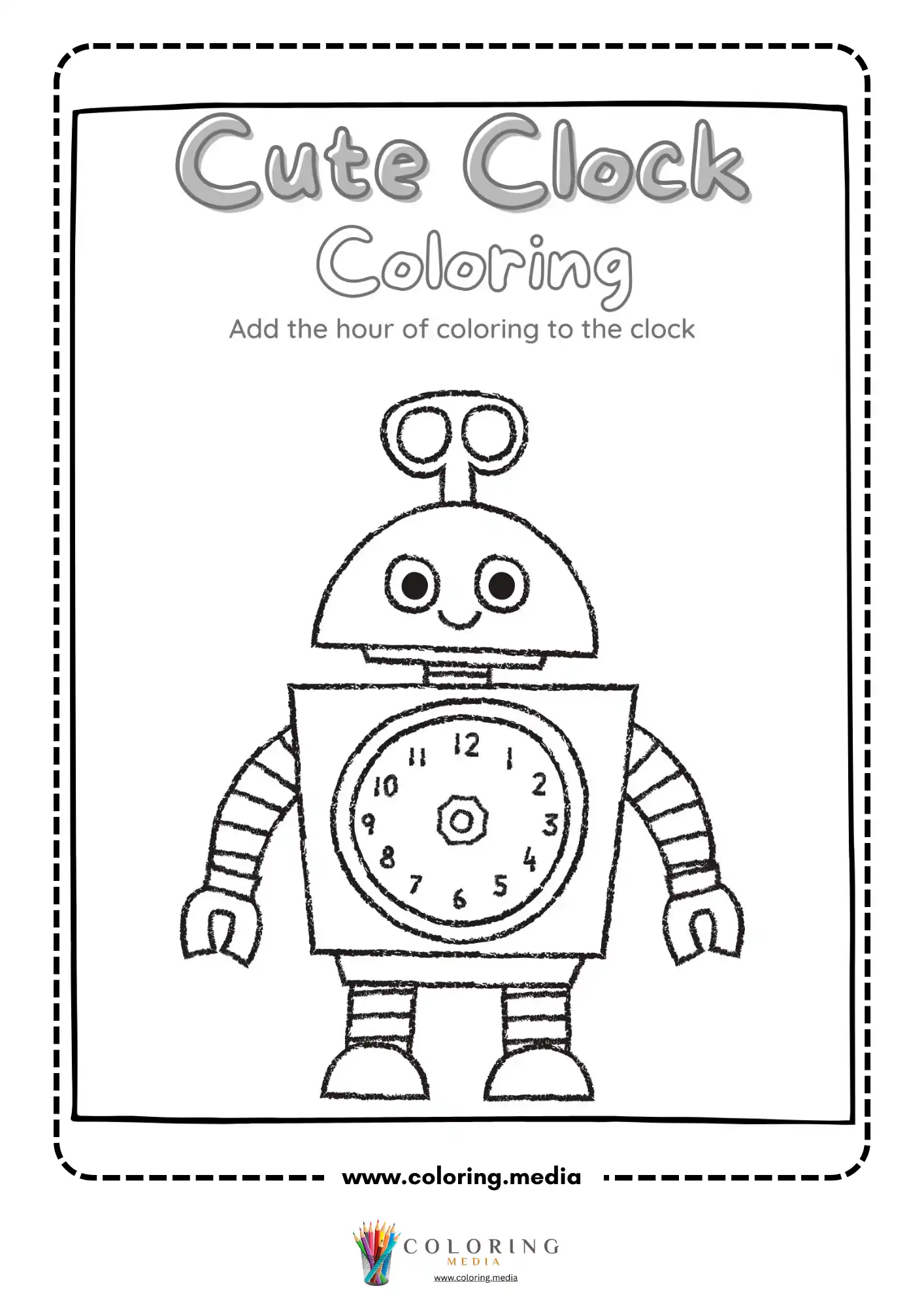
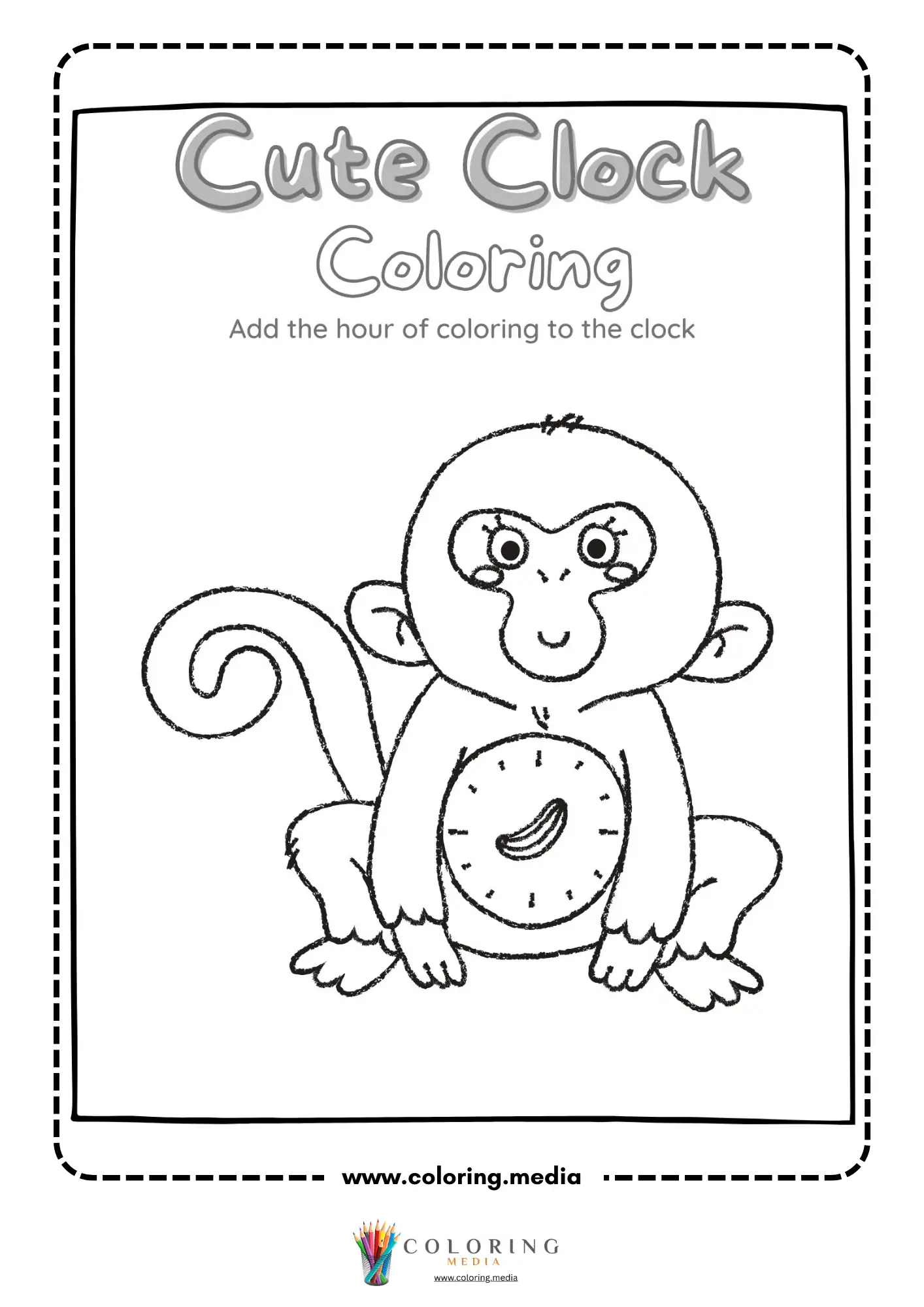
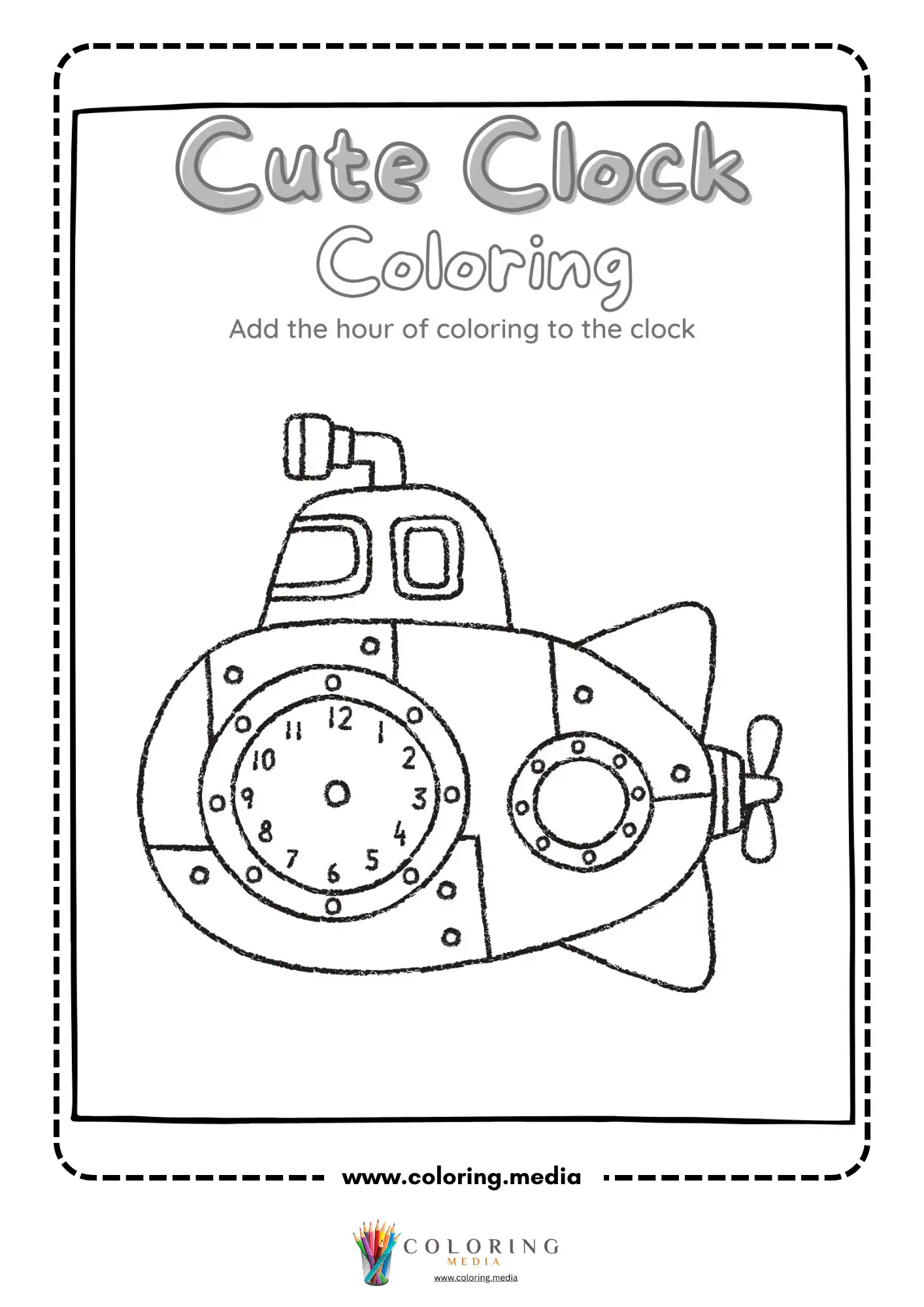
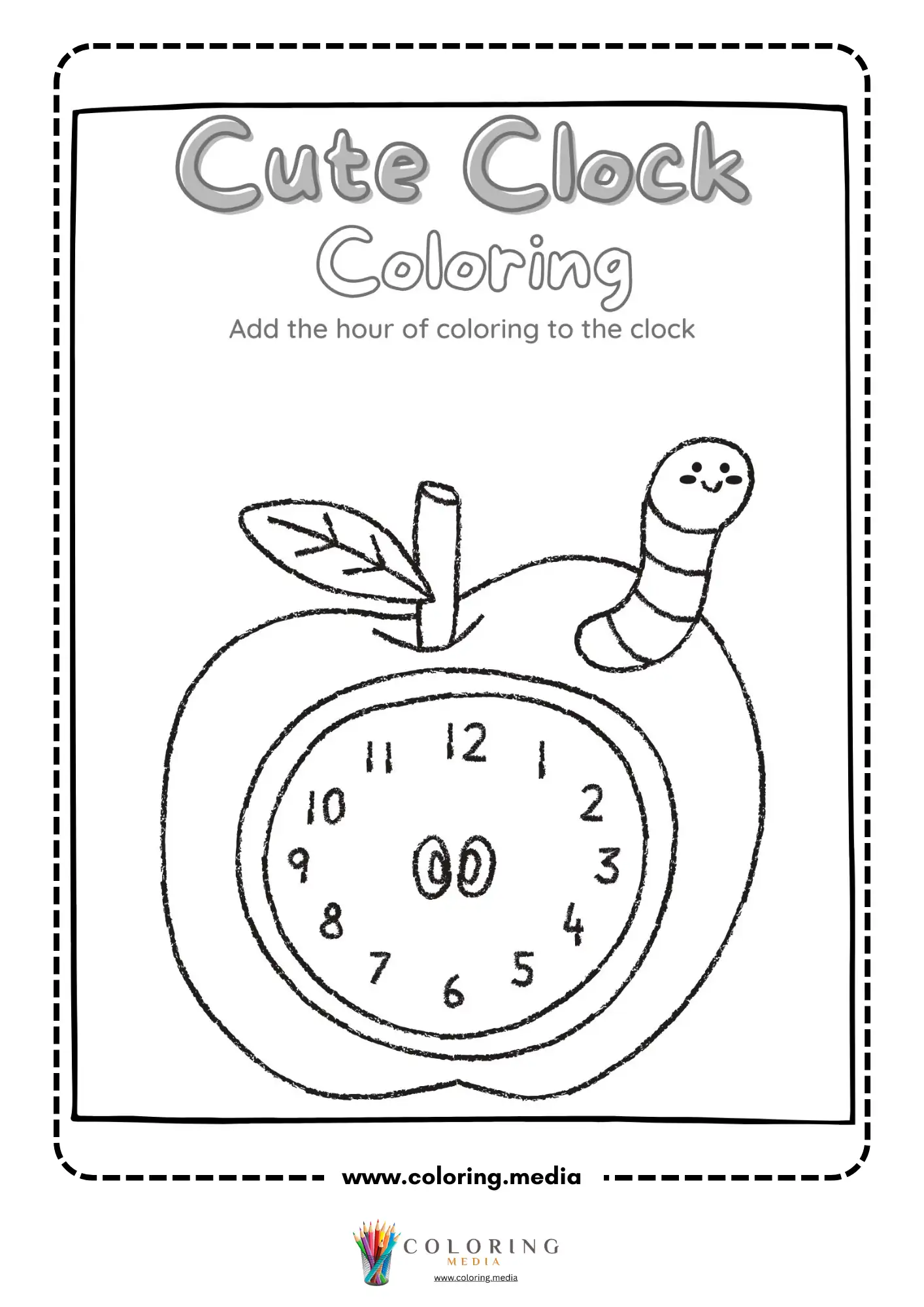
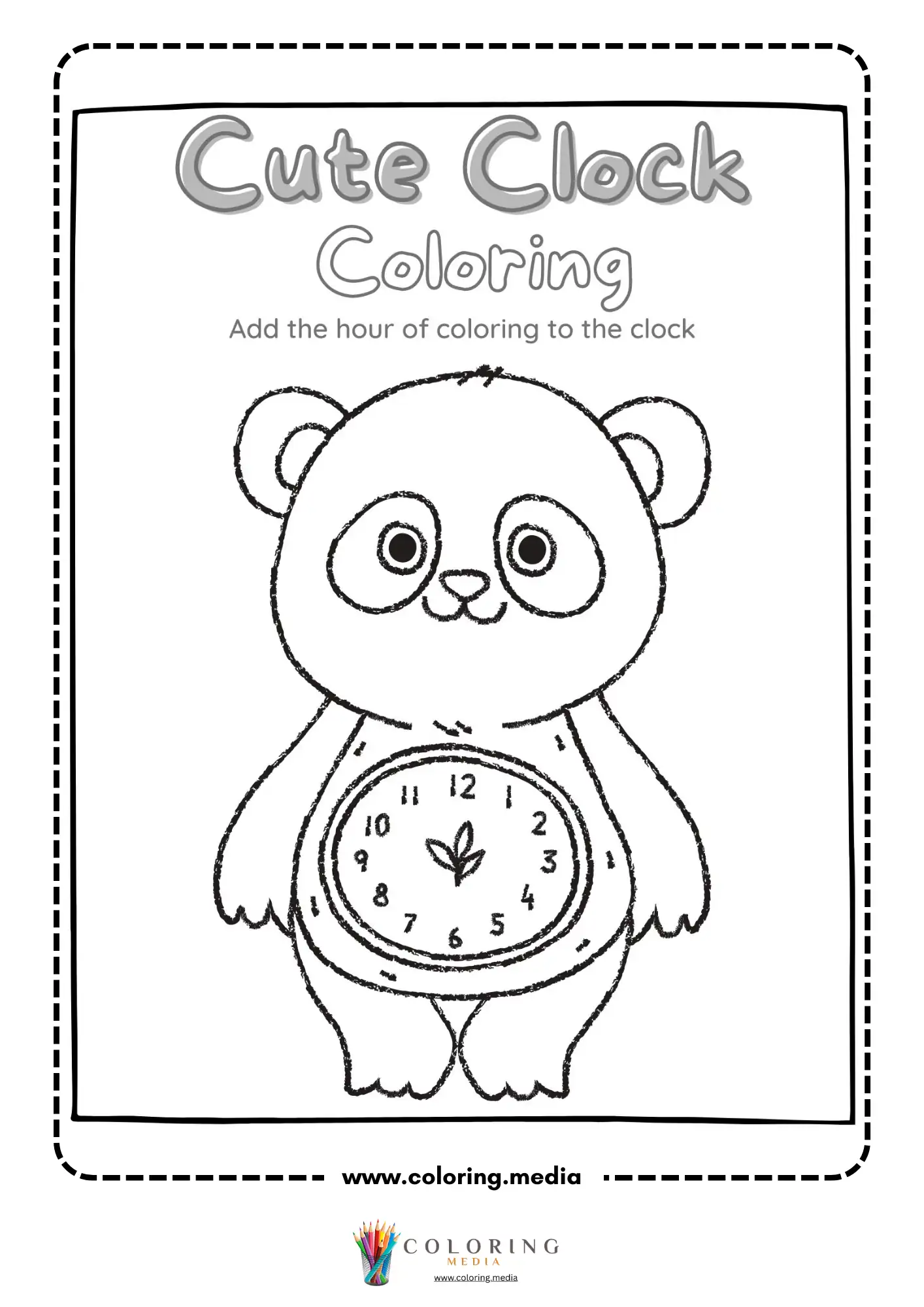
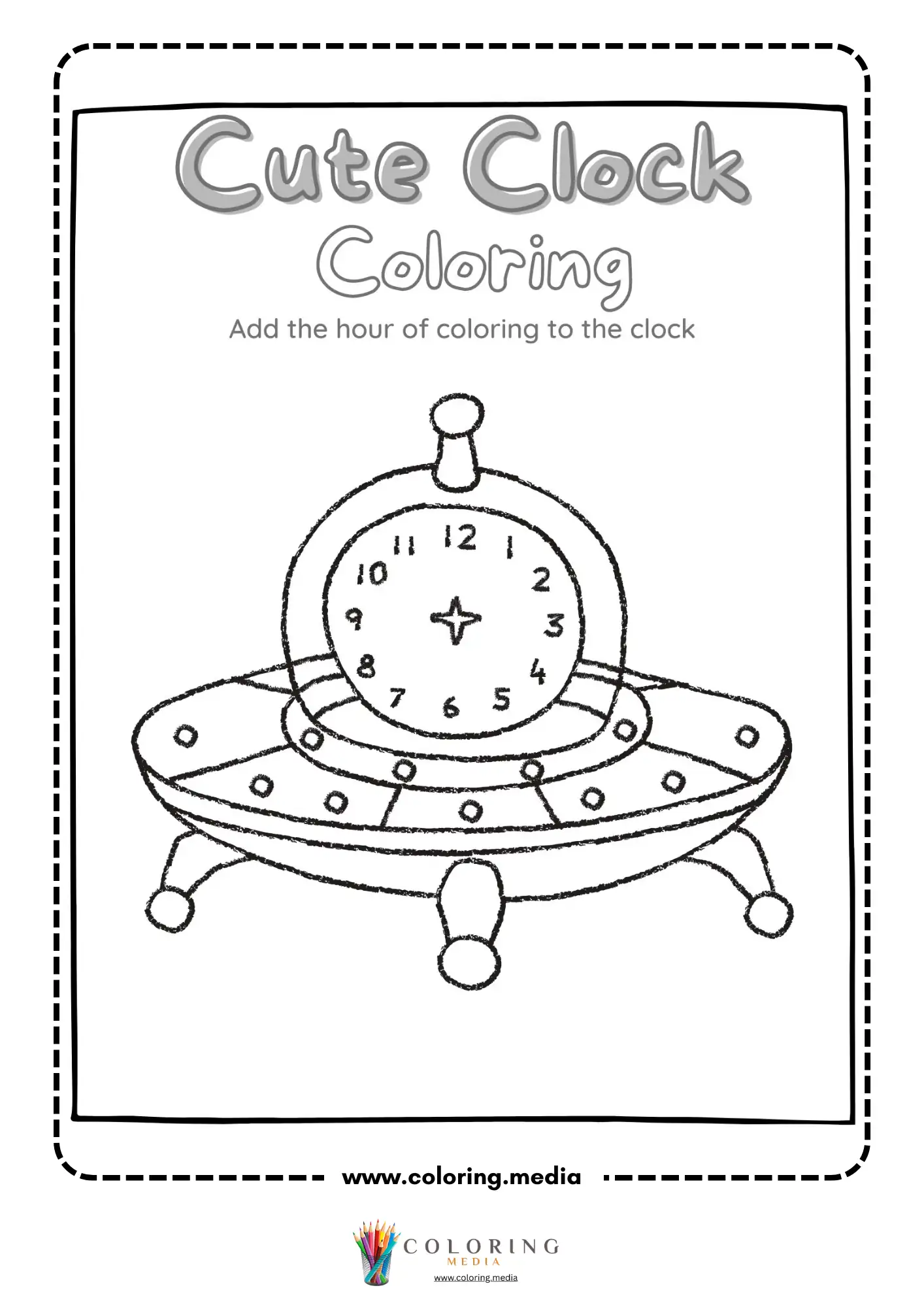
Every page in this “Cute Clock” series pairs a kawaii cartoon animal with a clock showing a specific time. There is a monkey, a bear, an elephant, a cat, a robot, a flamingo, an apple character, and more — each one holding or wearing a clock face as part of the illustration. The clock hands are clearly drawn, so the time can be read before or after coloring, making each sheet a two-in-one activity rather than just a worksheet with a picture stapled to it.
The thick outlines are friendly to young hands that are still learning to control a crayon, and the characters are appealing enough that kids will want to sit with these pages rather than rush through them. This is genuinely useful for the kindergarten or first-grade classroom where telling time is on the curriculum but practice materials tend to be dry. Everything here is free to download and easy to print.
Free Printable Clock Time Coloring Pages
This collection includes 20 printable clock time coloring pages featuring kawaii-style animal and character illustrations — including a monkey, bear, elephant, cat, robot, flamingo, and more — each centered around a clock face showing a specific time. The designs use thick, clean outlines with moderate interior detail, and each clock is large enough that the hour and minute hands are easy to read without squinting. Pages are formatted for standard US Letter or A4 paper and print clearly at 100% scale.
Who Are These Clock Time Coloring Pages Best For?
Kindergarteners who are just beginning to read analog clocks will get the most out of these pages. At this stage, kids are learning to identify the hour hand and minute hand and connect clock positions to times on the hour or half hour. The large, clearly drawn clock faces make it easy to see exactly where the hands are pointing without the confusion that often comes with smaller clock illustrations on busy worksheets. The kawaii animal characters give each page an identity — a child who loves bears or cats will gravitate toward a specific page, which is a small but genuine motivator.
First and second graders working on reading time to the quarter hour or five-minute intervals will also find these useful. The clock is detailed enough to show minute markings, so a teacher can direct students to write the time shown at the bottom of the page before coloring — adding a writing component to the activity at no extra cost. The thick outlines mean even kids who color roughly will produce something they feel proud of, which matters for engagement.
In a classroom setting these work well as a center activity during a unit on time, or as an early finisher task during math block. Homeschool parents can use them to break up a dry telling-time lesson with something hands-on and visually appealing.
Interesting Clock and Time Facts to Share While Coloring
Clocks were not always round. Early mechanical clocks from the 1300s were large tower devices that struck a bell on the hour — they had no face at all. The circular dial with numbers only became standard after clockmakers figured out how to make springs small enough to go inside a case.
The minute hand came second. For most of clock history, timepieces only had an hour hand. The minute hand was added in the late 1600s when pendulum clocks became precise enough that tracking minutes actually meant something. Before that, clocks were off by 15 minutes or more every day.
Not everyone in the world reads the same time. There are 24 time zones on Earth, one for roughly every 15 degrees of longitude. When it is noon in New York, it is already 6 in the evening in London and 1 in the morning the next day in Tokyo.
The numbers on a clock always add up to the same thing. The 12 numbers on a standard clock face add up to 78. Kids who enjoy patterns often find this satisfying to check for themselves.
Sundials are the oldest clocks we know of. Ancient Egyptians used them more than 3,500 years ago. They work by casting a shadow — when the sun moves, the shadow moves, and you read the time from where it falls. On a cloudy day, a sundial is useless, which is part of why mechanical clocks eventually replaced them.
Creative Clock Coloring and Craft Ideas
Write the Time First Before touching the crayons, have the child read the clock on the page and write the time in a small box at the bottom of the sheet. Then color as a reward for completing the task correctly.
Daily Schedule Match Pick five pages whose clocks show times from the child’s actual day — wake-up time, lunch, school start, dinner, bedtime — and color them in order as a personal schedule display.
Set a Real Clock Keep a plastic teaching clock nearby while coloring. After reading the time on the page, the child sets the teaching clock to match before picking up a crayon. The physical action reinforces the concept.
Animal Clock Book Staple all 20 finished pages together in order to make a personal “Cute Clock” coloring book. Write the time shown on the back of each page in the child’s own handwriting for a keepsake reference.
Before or After Game After coloring two pages, ask: which time shown is earlier in the day? Which comes later? This works the same concept from a different angle without any additional materials.
Digital vs. Analog Comparison Below each colored page, write the same time in digital format (e.g., 3:00). Seeing both representations side by side helps children bridge the gap between the analog clock in school and the digital clock on the microwave at home.
Elapsed Time Challenge For older students, pick two pages and ask: how much time passed between the first clock and the second? This turns a simple coloring activity into a mental math exercise without rewriting any part of the page.
How to Print These Clock Time Coloring Pages
Download any page as a PDF and print at 100% scale on US Letter or A4 paper — scaling down will make the clock face smaller and harder to read accurately. Standard copy paper works fine for crayons; if using markers, a 24 lb or cardstock paper will prevent bleed-through. The pages are black-and-white line art, so grayscale printing uses minimal ink without any loss of detail.
Explore More Math Coloring Pages
If you enjoyed these pages, you may also like:
Addition Math Coloring Pages
Subtraction Math Coloring Pages
Counting Fruits Coloring Pages
Math Activity Coloring Pages
Color by Number Easy Kindergarten Coloring Pages