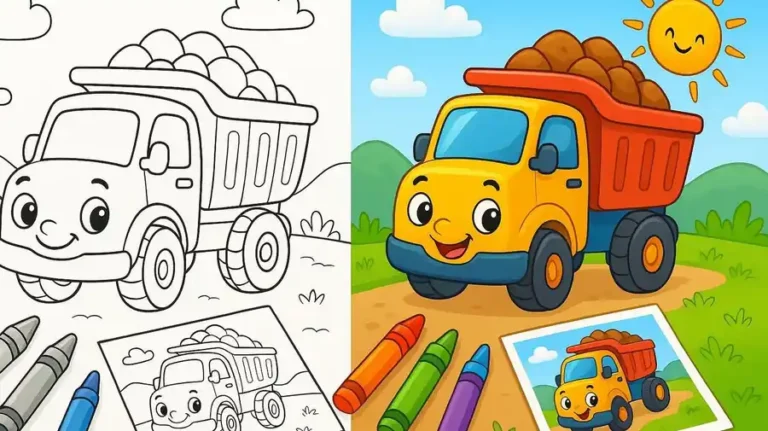

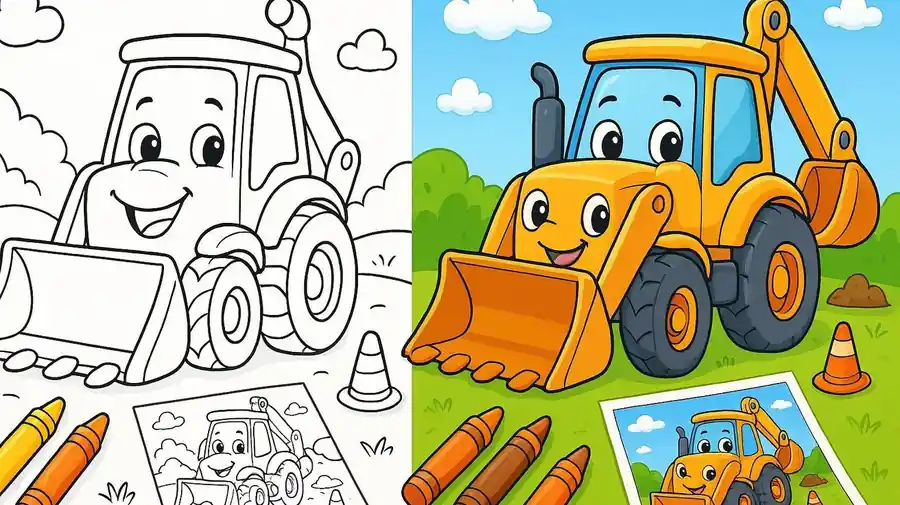
The twenty pages cover the core fleet of construction machinery that children typically encounter near building sites or in toy sets. Excavators appear in multiple pages from different angles — profile view, three-quarter view, bucket extended and bucket at rest. Bulldozers, wheel loaders, dump trucks, tower cranes, concrete mixers, and forklifts each get at least one dedicated page. The drawing style is primarily diagrammatic rather than cartoon — clean outlines showing the actual mechanical proportions of each machine, with detail lines indicating hydraulic arms, cab windows, tracks, and bucket teeth.
The absence of characters keeps the machines as the subject, which makes this set useful both as a vehicle reference and as a coloring activity for children who are specifically enthusiastic about construction equipment. Everything here is free to download and easy to print.
Free Printable Construction Vehicle Coloring Pages
This collection includes 20 printable construction vehicle coloring pages featuring tracked excavators with extended and resting boom-and-bucket configurations, bulldozers with blade and ripper detail, articulated wheel loaders, dump trucks shown from side and rear-three-quarter angles, a tower crane with trolley and hook visible, a rotating concrete mixer truck, a rough-terrain forklift, a skid steer loader, a compactor roller, and combination scenes showing multiple vehicles on a construction site together. The technical drawing style shows mechanical proportions accurately across all pages. All files print on A4 or US Letter paper.


Who Are These Construction Vehicle Coloring Pages Best For?
Kindergarteners who are obsessed with construction equipment — and there is no shortage of them — will be in their element with this set. The machines are drawn large enough and with outlines wide enough that a five-year-old can color the major areas with crayons and produce a recognizable result. The variety means a single sit-down coloring session can cover multiple machine types, each with its distinctive shape and function.
Early elementary students (grades 1–3) can engage with the mechanical detail: the layered hydraulic arm segments on an excavator, the track link patterns on a bulldozer, the drum rotation lines on a concrete mixer. These details give older children more to work with without the pages becoming overwhelming.
These pages pair naturally with nearby construction site observation, toy vehicle collections, and books about how buildings are made. A child who has watched real excavators at work will recognize the machines on the page and bring specific visual memories to the coloring session.
Interesting Construction Vehicle Facts to Share While Coloring
A large hydraulic excavator can move about 500 to 1,000 cubic meters of earth per day — the equivalent of filling dozens of dump truck loads per hour. The hydraulic pressure in the arm cylinders can reach 350 bar, more than 5,000 pounds per square inch, which is what generates the enormous force needed to bite into hard soil and rock.
The largest dump trucks in the world are used in open-pit mining, not construction sites. The Caterpillar 797F can carry 363 metric tonnes of material per load and stands 7.2 meters tall at the cab. Getting into the cab requires climbing a three-level staircase.
Tower cranes assemble themselves by using a climbing mechanism to insert new sections into their own mast from below, then lift each section into position. A tall tower crane can reach heights of over 80 meters and lift loads of 20 tonnes or more, but cannot move on their own — they stay fixed to a single location for the duration of a project.
Concrete mixers rotate the drum while driving to prevent the concrete from hardening. Once water is added to the concrete mix, a chemical reaction called hydration begins. If the drum stopped rotating, the concrete would set solid inside. The drum must reach the pour site and be emptied within about 90 minutes of water being added.
Caterpillar, JCB, and Komatsu are the three largest construction equipment manufacturers in the world. Each produces thousands of different machine variants. The distinctive yellow color that most construction equipment uses was standardized across the industry for visibility and safety — bright yellow stands out against soil, concrete, and shadow.
Creative Construction Vehicle Coloring and Craft Ideas
Construction Yellow Standard Research the specific shade of yellow used by Caterpillar (CAT Yellow) and try to match it using yellow and a very small amount of orange. Apply it consistently across all pages.
Dirt and Wear Effect For a realistic look, add streaks of grey and brown around the tracks, bucket teeth, and lower body of each machine to suggest actual use.
Machine Function Labels After coloring each page, write on the back: the machine’s name, its primary job on a construction site, and one specific feature that helps it do that job.
Construction Site Scene For the multi-vehicle pages, color each vehicle a different tone — some clean, some dirty — as if they have been working for different amounts of time.
Hydraulic Arm Color Code For excavator pages, use a consistent color for hydraulic cylinders across all pages — silver for the piston rod, grey for the cylinder body.
Scale Comparison Next to a colored excavator, draw a person at the correct scale. Research the actual height of a standard construction excavator cab to determine how small the person should be.
Build a Cardboard Excavator Using cardboard tubes, boxes, and tape, build a model of the excavator from the coloring page. Make the arm articulate if possible.
Site Plan Design Draw a simple construction site from above (bird’s eye view) showing where each machine from the coloring pages would be positioned and what task each would be doing.
How to Print These Construction Vehicle Coloring Pages
Each PDF is formatted for A4 and US Letter at 300 dpi. Print from Adobe Reader or a browser with ‘fit to page’ selected. Standard copy paper works for crayons and basic coloring. For the mechanical detail pages where track links, hydraulic lines, and cab window frames are all distinct zones, fine-tip colored pencils give the cleanest result. Select black-and-white print mode to save ink.
Explore More Vehicles Coloring Pages
If you enjoyed these pages, you may also like:
Trucks Coloring Pages
Vehicle Coloring Pages for Kids
Bicycle Coloring Pages
Airplane Coloring Pages
Vehicles & Transportation Coloring Pages