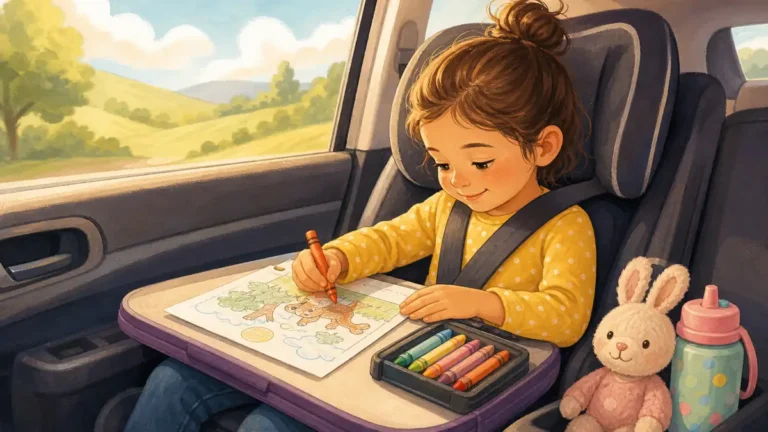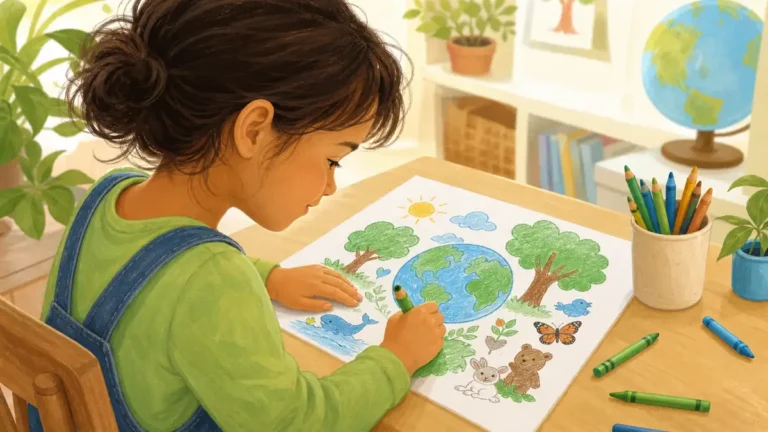

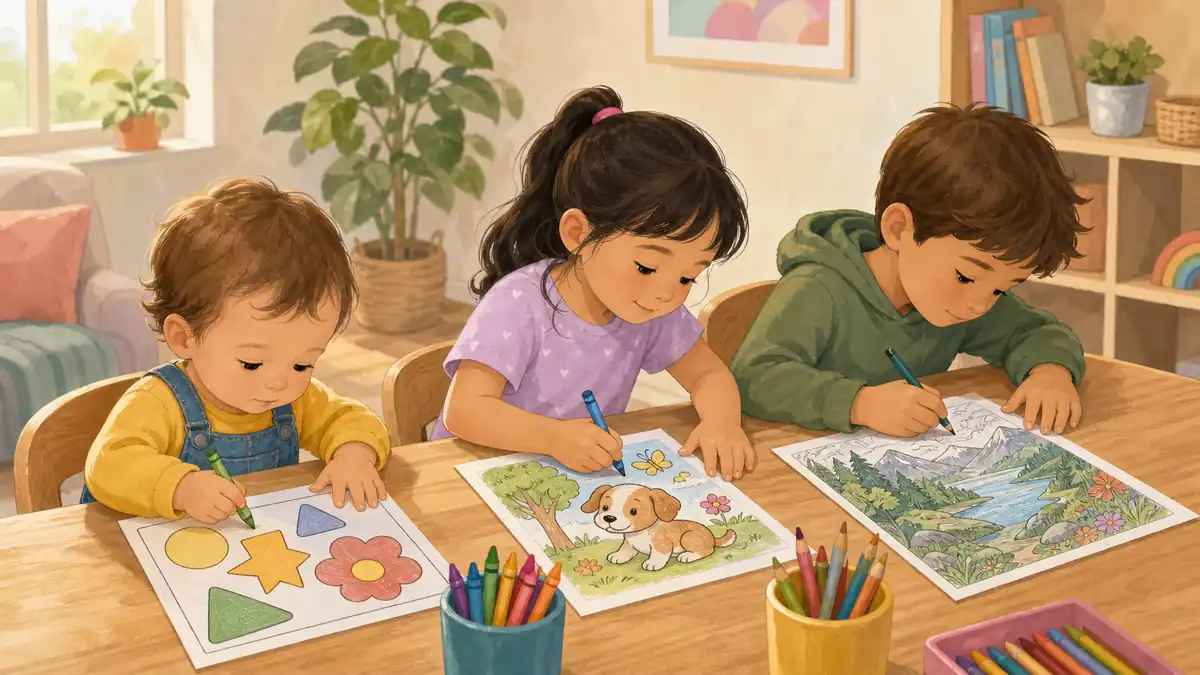

Choosing the right coloring pages for your child’s age makes the difference between a 30-minute absorbed session and a page abandoned in frustration after three minutes. The right page for a 2-year-old — large, bold shapes with minimal detail — will bore a 7-year-old within seconds. The right page for a 9-year-old — intricate patterns and detailed scenes — will overwhelm a preschooler before they finish the first section. This guide covers what to look for and what to avoid at every age from toddler through upper elementary, with specific recommendations for each developmental stage.
What Makes a Coloring Page Age-Appropriate
Age-appropriateness in coloring pages is determined by three factors, in order of importance:
- Fine motor demand: The size of the areas to be colored, the precision required to stay within outlines, and the complexity of the shapes all determine whether a child can physically execute the page successfully. A page that exceeds the child’s current fine motor capability produces frustration, not engagement.
- Cognitive complexity: The conceptual content of the page — how many things are depicted, how much visual information needs to be processed simultaneously — should match the child’s current cognitive processing capacity.
- Interest alignment: A page that perfectly matches developmental criteria but depicts nothing the child cares about will still fail to engage. Theme interest is the multiplier that makes developmentally appropriate pages genuinely effective.
Fine motor development is the binding constraint — it’s the factor most commonly misjudged by parents and teachers who choose pages based on content interest or cognitive level without accounting for the physical execution challenge.
Coloring Pages for Toddlers (Ages 1–2)
Developmental Profile
Children ages 1–2 are in the earliest stages of mark-making. Their grip is palmar (whole-fist) rather than pincer or tripod. They cannot control crayon direction or stay within any outline. Their attention spans for a single activity are typically 3–8 minutes. The goal of coloring at this age is entirely sensory and exploratory — the experience of making marks, the cause-and-effect of color appearing on paper, the sensory input of crayon on page.
What to Look For
- Large, open white space — the entire page, essentially — with one or two very bold, very large outlines
- Familiar, beloved subjects: faces, animals, simple vehicles
- Thick paper that holds up to enthusiastic pressure
What to Avoid
- Any page with sections smaller than a child’s fist
- Pages with thin outlines that break under pressure
- Pages with multiple detailed elements — visual overwhelm leads to immediate abandonment
Best Coloring Tools
Jumbo-grip crayons (Crayola My First, Prang Big Dipper) are designed specifically for palmar-grip toddlers. Do-A-Dot markers are another excellent option — the large round tip makes satisfying marks regardless of grip precision. Washable is non-negotiable at this age.
Coloring Pages for 2-Year-Olds
Developmental Profile
Two-year-olds are developing intentional mark-making — they’re beginning to fill areas rather than just scribble across the page. Grip is transitioning from palmar to adapted palmar. Attention spans are 5–10 minutes per self-chosen activity. Color naming is developing and children at this age find it engaging to name colors as they choose them.
What to Look For
- Bold outlines with very large coloring areas — the outline is a loose boundary suggestion, not a precision target
- Simple, recognizable subjects: large animals, big stars, simple food items
- Pages with 3–5 large distinct areas rather than many small sections
Our easy coloring pages are the most appropriate category for age 2 — large, bold, and immediately recognizable. Our animal coloring pages include simple animal designs appropriate for this age.
Engagement Tip
Name colors together as the child selects them. “You picked yellow! Yellow like the sun.” This simple narration builds vocabulary, reinforces color names, and makes the activity feel social and connected rather than solitary.
Coloring Pages for 3-Year-Olds
Developmental Profile
Three-year-olds are entering a period of rapid fine motor development. Grip is typically transitioning toward a tripod hold. Many 3-year-olds begin attempting to stay within outlines — not always successfully, but with intention. Attention spans are 8–15 minutes for chosen activities. Imagination is exploding, and 3-year-olds often narrate stories about what they’re coloring as they work.
What to Look For
- Bold outlines with clearly defined sections — the sections can be smaller than at age 2, but each should still be easily colorable with a standard crayon held in an imperfect grip
- Simple scenes with 2–4 characters or elements
- Subjects tied to current obsessions — whatever the child is most excited about right now
For screen-free activity planning with 3-year-olds, see our screen-free activities for toddlers guide.
Coloring Pages for 4-Year-Olds
Developmental Profile
Four-year-olds are in a developmental sweet spot for coloring — old enough to have strong personal preferences, developed enough for intentional within-outline coloring on most pages, young enough to find a fresh page of their favorite subject genuinely exciting. Grip is typically functional tripod or adapted tripod. Attention spans are 10–20 minutes for chosen activities. Color choices become deliberate rather than random.
What to Look For
- Clear outlines with medium-size coloring areas — slightly more detail than at age 3 is achievable and satisfying
- Subjects with strong personal meaning: favorite animals, food items, characters, seasonal themes
- Pages that invite imagination and storytelling alongside the coloring
See our complete guide to screen-free activities for 4-year-olds for how coloring fits into the 4-year-old daily routine.
Best Pages for 4-Year-Olds
Our animal pages, food pages, and seasonal pages are the highest-use categories for age 4. Our alphabet pages add early literacy value appropriate for this pre-reading age.
Coloring Pages for Preschoolers (Ages 3–5) — Overview
The Preschool Coloring Principles
Across the preschool range, the most important principle is choice: preschoolers who select their own pages from a curated set engage significantly more deeply than those handed a page. Offer 3–5 options and let the child choose. The act of selection itself builds investment in the chosen page.
Educational coloring content appropriate for preschoolers: alphabet pages (letter-sound introduction), simple number pages (counting and recognition), and simple science pages (animal names, plant parts, weather concepts).
For educational coloring page recommendations for this age, see our guide to coloring activities for preschool and early learning and our pillar guide on educational coloring activities for kids.
Coloring Pages for Kindergarteners (Age 5–6)
Developmental Profile
Kindergarteners are typically in the critical window for writing readiness — the fine motor development happening at age 5–6 directly underpins pencil grip, letter formation, and the sustained hand work that formal writing requires. Coloring pages at this age are simultaneously a creative activity and a writing-readiness intervention. Grip control, pencil pressure regulation, stroke direction — all develop through intentional coloring practice.
What to Look For
- Pages with clear sections of varying sizes — some large (achievable) and some medium (slightly challenging)
- Educational content aligned with kindergarten curriculum: alphabet letters, number concepts, simple science diagrams
- Seasonal and holiday themes that connect to the classroom calendar
Educational Value at This Age
Kindergarten is the peak year for alphabet coloring page value. A child who colors alphabet pages while the teacher reinforces the letter-name-sound-picture connection is building the phonics foundation that reading instruction builds on. Our alphabet coloring pages pair each letter with a picture cue designed for phonics integration.
For classroom-specific kindergarten applications, see our guide on coloring pages for morning work in kindergarten.
For a complete overview of kindergarten readiness through coloring, see our guide to best coloring pages for kindergarten.
Coloring Pages for First and Second Graders (Ages 6–8)
Developmental Profile
Children ages 6–8 are in an accelerating phase of fine motor skill refinement. Most have a functional pencil grip; the work is now about pressure control, precision, and endurance. Coloring sessions can extend to 30–45 minutes with a page they love. Color choices become intentional and referential — a child at this age will look up what color a real frog is rather than choosing arbitrarily.
What to Look For
- Pages with more detail and smaller sections — children at this age can successfully color areas the size of a thumb or smaller
- Educational science content: life cycles, ecosystems, plant anatomy — our life cycle pages and science and nature pages are highly appropriate
- Pages that reward careful, extended work — detailed animal portraits, nature scenes with many elements
Coloring Technique Introduction
Ages 6–8 is when technique introduction becomes appropriate and enjoyable: practicing pressure control (pressing lighter for paler shades, harder for darker), staying within lines deliberately, and considering color choices intentionally. These aren’t corrections — they’re invitations to a new dimension of the activity. See our guide to how to color neatly inside the lines for age-appropriate technique guidance.
Coloring Pages for Third Through Fifth Graders (Ages 8–12)
Developmental Profile
Upper elementary children have sophisticated fine motor control and can handle genuinely complex coloring pages — highly detailed illustrations, intricate patterns, small precise sections. They may also have opinions about coloring tools: many children at this age prefer colored pencils over crayons for the greater control and blendability they offer. Engagement at this age requires pages that feel genuinely challenging and worthy of their developed skill.
What to Look For
- Detailed illustrations with small sections and fine detail — anything that would have been frustrating at age 5 is now appropriate and satisfying
- Complex science content: detailed anatomy diagrams, food web illustrations, geographical maps
- Technique-appropriate pages: hatching areas, gradient-friendly zones, pattern repetition for blending practice
- Subject matter that respects their age — avoid pages designed for young children, which will feel condescending
Tool Transition
Ages 8–10 is the window when many children naturally transition from crayons to colored pencils as their primary coloring tool. Colored pencils offer finer control, blending capability, and a more “grown-up” feel that appeals to upper elementary children who want to take their work seriously. Our guide to colored pencils vs. crayons for kids covers the transition in detail.
Age-Based Coloring Page Recommendations at a Glance
| Age | Fine Motor Stage | Best Page Type | Best Tools | Session Length |
|---|---|---|---|---|
| 1–2 | Palmar grip, mark-making | Very bold, single large image | Jumbo crayons, Do-A-Dot markers | 3–8 minutes |
| 2–3 | Adapted palmar, exploring outlines | Bold outlines, large areas | Chunky washable crayons | 5–10 minutes |
| 3–4 | Transitional tripod | Bold outlines, simple scenes | Standard washable crayons | 8–15 minutes |
| 4–5 | Functional tripod emerging | Clear outlines, medium sections | Standard washable crayons | 10–20 minutes |
| 5–6 | Functional tripod, refining | Varied section sizes, educational content | Standard crayons, intro colored pencils | 15–25 minutes |
| 6–8 | Controlled, pressure-refining | Moderate detail, science diagrams | Crayons or colored pencils | 20–45 minutes |
| 8–12 | Sophisticated, technique-capable | Complex detail, fine sections | Colored pencils preferred | 30–60+ minutes |
Age-Specific Coloring Guides
For deeper age-specific guidance beyond this overview:
- Best coloring pages for toddlers — ages 1–3 in detail
- Best coloring pages for preschoolers — ages 3–5 in detail
- Best coloring pages for kindergarten — age 5–6 in detail
- How to choose coloring pages for your child’s age — decision framework for parents
Frequently Asked Questions
At what age should kids start coloring?
Children can begin coloring as soon as they can hold a crayon — typically around 12–18 months. At this stage, coloring is pure mark-making rather than purposeful image-filling, and the goal is entirely sensory and exploratory. Purposeful coloring (attempting to fill areas with specific colors) typically develops between ages 2 and 3. By age 4, most children can color intentionally within outlines on appropriately sized pages.
How do I know if a coloring page is too hard for my child?
A page is too hard if the coloring areas are smaller than the child can precisely target with their current grip, or if the complexity creates visual overwhelm before the child starts. The reliable test: watch the child’s first 2–3 minutes with the page. If they’re engaged and attempting the coloring, it’s appropriate or appropriately challenging. If they set it aside, scribble randomly across sections without engaging, or express frustration, the page is too complex for their current fine motor level.
Can younger children use the same coloring pages as older siblings?
Younger children can use the same pages but with different expectations — a 3-year-old who scribbles across a detailed page their 8-year-old sibling colored carefully is engaging with the page appropriately for their age. The problem arises when parents or children expect age-appropriate execution from an underdeveloped fine motor system. Provide age-appropriate pages as the primary option while making the older sibling’s pages available if the younger child wants them.
My child is 7 but seems to need toddler-level pages — is that a problem?
Fine motor development varies significantly among children of the same age — a 7-year-old needing bold, simple pages is not necessarily behind, but it may be worth noting in the context of their overall fine motor development (including handwriting). If the simplified coloring preference is accompanied by handwriting difficulties, occupational therapy assessment may be worth exploring with your pediatrician. Fine motor delays are common and very responsive to intervention when addressed early.
What age do kids stop enjoying coloring?
Enjoyment of coloring doesn’t have a natural expiration age — it has a presentation one. Children stop enjoying coloring when it feels too young for them, not when they’ve developmentally outgrown it. Many children who “outgrow” coloring at age 8 re-engage enthusiastically when presented with adult-level complex illustrations or manga/anime-style pages that feel appropriately sophisticated. Upper elementary and middle school children often find detailed coloring deeply satisfying — the activity just needs to be offered at the right complexity level.
How does fine motor development through coloring help with writing?
Coloring and handwriting use the same fine motor systems — grip control, pressure regulation, stroke direction, and the sustained hand work required to complete a task. Research consistently links regular coloring activity in preschool and kindergarten with stronger writing readiness indicators: pencil grip quality, letter formation control, and the ability to sustain hand work without fatigue. For a detailed look at this connection, see our guide to how coloring builds fine motor skills.
Matching your child to the right coloring pages is one of the simplest ways to maximize both their enjoyment and the developmental benefit of the activity. Browse our full library organized by theme at coloring.media — our easy pages for young children, animal pages for universal appeal, science and nature pages for educational depth, and life cycle pages for curriculum connection — and visit our Tips & Techniques hub for age-specific guides.