
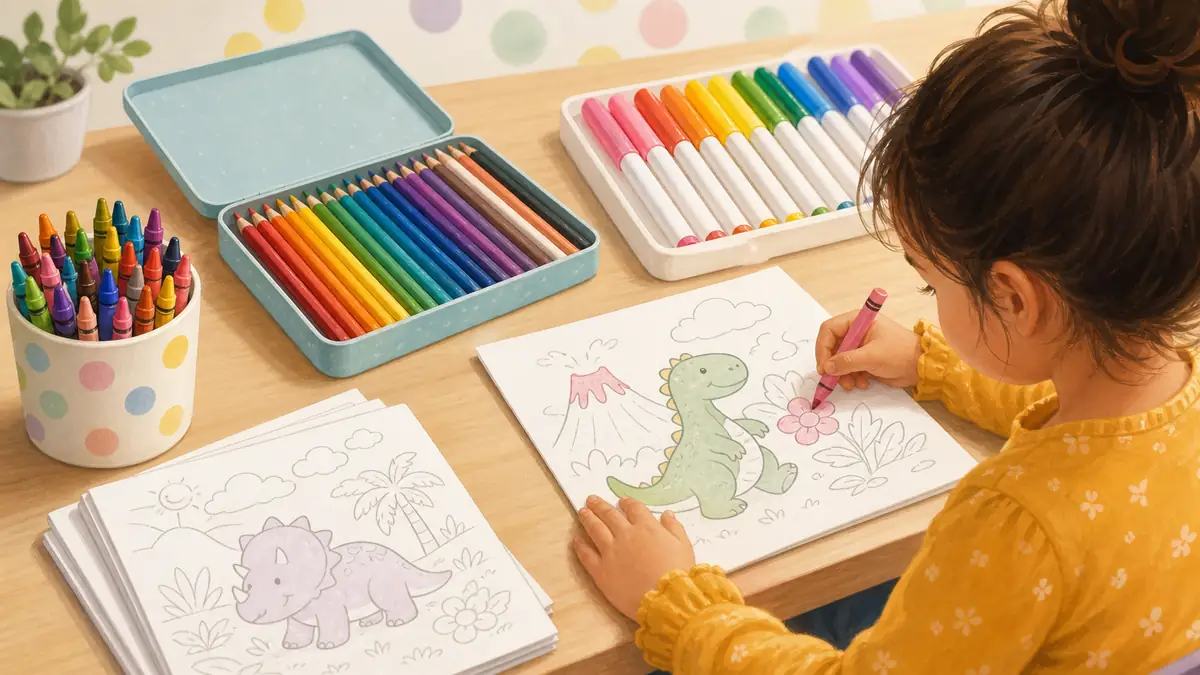

The right coloring supplies make a measurable difference in how long children stay engaged, how much they enjoy the activity, and how much fine motor development they get from it. A toddler handed adult-sized colored pencils will struggle with grip and quit within minutes; that same child given chunky washable crayons on bold paper may color happily for 20 minutes. This guide covers every category of coloring supply — crayons, colored pencils, markers, paper, and accessories — with specific recommendations at each age and skill level.
Crayons: The Foundation Supply
Crayons are the right starting point for almost every child — they’re forgiving of imprecise grip, durable enough to withstand enthusiastic use, and available in formulations specifically designed for each developmental stage. Understanding the differences between crayon types is the most important supply decision parents make.
Jumbo and Toddler Crayons (Ages 1–3)
Jumbo crayons — shorter, fatter, and designed for palmar or adapted palmar grip — are essential for children who haven’t developed a functional tripod grip. Standard-length crayons are too long and thin for young children to hold effectively; the awkward grip produces frustration and fatigue that ends coloring sessions prematurely.
Best toddler and jumbo crayon options:
- Crayola My First Crayons: Specifically designed for toddler grip, available in 8 and 16 count, washable, the most-recommended option for ages 1–3
- Prang Big Dipper: Extra-chunky, short body, excellent pigment quality
- Melissa & Doug Triangular Crayons: Triangular cross-section prevents rolling and naturally positions the fingers toward tripod grip — a useful transitional option for 2–3-year-olds
Washable is non-negotiable for ages 1–3. The alternative to washable crayons at this age is not washable crayons — it’s crayons on walls, furniture, and clothing.
Standard Crayons (Ages 3–8)
From around age 3, when grip is transitioning toward functional tripod, standard-size crayons become appropriate. The standard crayon market is dominated by Crayola, and for good reason — their pigment quality, durability, and color range are consistently superior to most alternatives at the same price point.
Best standard crayon options:
- Crayola Classic Crayons (24-count): The most-used children’s crayon in the world, washable, excellent color range, widely available — the default recommendation for ages 3–8
- Crayola Washable Crayons (16-count): For children who are still prone to coloring beyond the page — same quality with washable formula
- Crayola Triangular Crayons: Triangular body promotes tripod grip development — particularly useful for 3–5-year-olds whose grip is still developing
- Faber-Castell Grip Triangular Crayons: Premium option with excellent pigment and ergonomic design
The 24-count is the right starting point for most children — large enough for variety, small enough that the set isn’t overwhelming. Upgrade to 48 or 64-count when the child regularly reaches for the same colors and expresses frustration that specific shades aren’t available.
Premium Wax and Oil Pastels (Ages 6+)
Premium crayons — Crayola Portfolio Series, Sargent Art Premium, and similar adult-grade wax crayons — offer richer pigment, smoother application, and blending capability that standard children’s crayons don’t provide. These are appropriate for children aged 6+ who are taking their coloring seriously and would benefit from more sophisticated tool performance.
Oil pastels (Pentel Oil Pastels, Mungyo Gallery) are a related option that offers excellent blending and a different tactile experience. They’re messier than crayons and require clean hands after use, making them better suited to dedicated art sessions than casual everyday coloring.
For a detailed comparison of the two most common starting-point tools, see our guide to colored pencils vs. crayons for kids.
For age-specific crayon recommendations, see our guide to best crayons for toddlers and preschoolers.
Colored Pencils: The Upgrade Path
Colored pencils become the preferred tool for many children between ages 7 and 10 — the finer control, blending capability, and “grown-up” feel appeal to children who are taking their coloring seriously and find crayons limiting. The colored pencil market ranges from basic student sets to professional artist-grade pencils; choosing the right level matters.
Student-Grade Colored Pencils (Ages 6–10)
Student-grade colored pencils offer adequate pigment quality and durability for children’s use at an accessible price point. The primary considerations at this level are core thickness (thicker cores are more durable and more forgiving of imprecise sharpening) and color range.
Best student-grade options:
- Crayola Colored Pencils (24-count or 50-count): The most widely available student-grade option, adequate pigment, good durability — the default starting point for children making the crayon-to-pencil transition
- Faber-Castell Connector Pens (colored pencil version): Excellent quality for the price, European manufacturing, good color range
- Staedtler Noris Colour (24-count): Break-resistant core technology — particularly useful for children who press hard and snap pencil cores frequently
Mid-Grade Colored Pencils (Ages 9+)
Children aged 9 and up who are serious about coloring benefit from mid-grade pencils that offer genuine blending capability, richer pigment, and more nuanced color ranges. This is the level where coloring as an art practice begins rather than coloring as a developmental activity.
Best mid-grade options:
- Faber-Castell Polychromos (24-set starter): Oil-based, excellent lightfastness, professional-quality blending — more expensive but significantly better performance than student grade
- Prismacolor Scholar (24-count): Wax-based, soft core, excellent blending, the most popular mid-grade recommendation for young artists transitioning to serious coloring
- Derwent Academy Colored Pencils: Good mid-range option with a wide color range and reliable core quality
Colored Pencil Technique Basics
Children who transition to colored pencils benefit from guidance on a few technique basics that make a significant difference in results:
- Pressure control: Light pressure for pale shades and highlights; heavy pressure for saturated color and dark areas — practicing the full range of pressure on a test piece before working on a final page
- Directional strokes: Following the shape of the area being colored produces neater results than random back-and-forth
- Layering: Multiple light layers produce richer, more even color than one heavy layer
- Blending: Colors applied in adjacent layers can be blended by working one color over another with light circular strokes
For structured technique guidance, see our guides to how to color neatly inside the lines and low-mess coloring ideas for kids.
Markers: High-Engagement, High-Maintenance
Washable markers produce vibrant, satisfying results that crayons and colored pencils can’t match — children find them highly engaging precisely because the color is so immediate and intense. The trade-off is mess risk and bleed-through on thin paper. Managed correctly, markers are excellent coloring tools; managed carelessly, they create more frustration than joy.
Washable Markers for Younger Children (Ages 2–6)
Washable markers are the appropriate choice when vibrant color is a priority and mess is an acceptable variable. Key requirements:
- Washable formula: Crayola Washable Markers, Melissa & Doug Washable Markers — washable from skin, clothing, and most surfaces when treated promptly
- Thick paper: Standard copy paper is too thin for markers — use 65lb or heavier cardstock to prevent bleed-through (see paper section below)
- Cap discipline: Teach cap replacement immediately after each color — markers left uncapped dry out within hours
Fine-Tip Markers for Older Children (Ages 7+)
Fine-tip washable markers (Crayola Supertips, Stabilo Point 88) give older children the precision of colored pencils with the vibrancy of markers. These are excellent for detailed coloring pages and outperform both crayons and standard colored pencils for staying within small sections. The washable formula makes them appropriate for home use; non-washable fine-tips should be reserved for supervised art sessions.
Do-A-Dot markers deserve special mention for toddlers and preschoolers — the large round dauber tip makes satisfying circular marks regardless of grip precision, producing a sense of accomplishment and visible color coverage that is uniquely motivating for very young children.
Paper: The Overlooked Supply
Paper quality is the most commonly overlooked supply variable — and it makes a significant difference in the coloring experience. The wrong paper produces bleed-through with markers, tearing under heavy crayon pressure, and an unsatisfying surface that dulls the coloring experience for careful workers.
Standard Copy Paper (80gsm/20lb)
Standard copy paper works adequately for crayons and colored pencils but poorly for markers, which bleed through and onto whatever is underneath. It’s appropriate for everyday casual coloring and disposable daily practice but not for pages children care about completing carefully.
Cardstock (65–80lb, 176–216gsm)
Cardstock is the recommended paper for printing coloring pages intended for careful work, marker use, or display. It holds marker ink without bleed-through, withstands heavy crayon pressure without tearing, and produces a finished page substantial enough to display, laminate, or use as a card. 65lb cardstock is the practical sweet spot — heavier than copy paper, light enough to print on standard home inkjet printers.
Specialty Paper Options
- Watercolor paper: For children using water-based markers or experimenting with watercolor pencils — the texture adds visual interest and the weight handles moisture without warping
- Bristol board (smooth): A smooth, heavy surface that works beautifully with colored pencils and produces near-professional results for serious young artists
- Vellum surface cardstock: Slightly textured, produces excellent crayon and colored pencil results with a professional feel
For a complete guide to paper selection, see our article on best paper for printable coloring pages.
Accessories and Organization
Crayon and Pencil Storage
How supplies are stored significantly affects how consistently children use them. Accessible storage — crayons in an open cup on the coloring table, colored pencils in a pencil roll or flat case — produces more spontaneous coloring than supplies in a closed bin that requires adult retrieval. The coloring supplies that are visible are the ones that get used.
Best storage options by tool:
- Crayons: Divided caddy or open cups — crayons visible, accessible, and organized enough that children can find specific colors quickly
- Colored pencils: Roll-up pencil case or flat wooden case with individual slots — protects the points and allows children to see the full color range at a glance
- Markers: Vertical storage, tips down — prevents tip drying and makes caps easy to replace
Pencil Sharpeners
A good sharpener is essential once colored pencils enter the rotation. Manual sharpeners that are too aggressive break soft-core pencil cores frequently; electric sharpeners with variable settings are a worthwhile investment for children who use colored pencils regularly. Faber-Castell’s GRIP sharpener is specifically designed for their colored pencil cores and produces consistently clean points without breakage.
Clipboards and Lap Desks
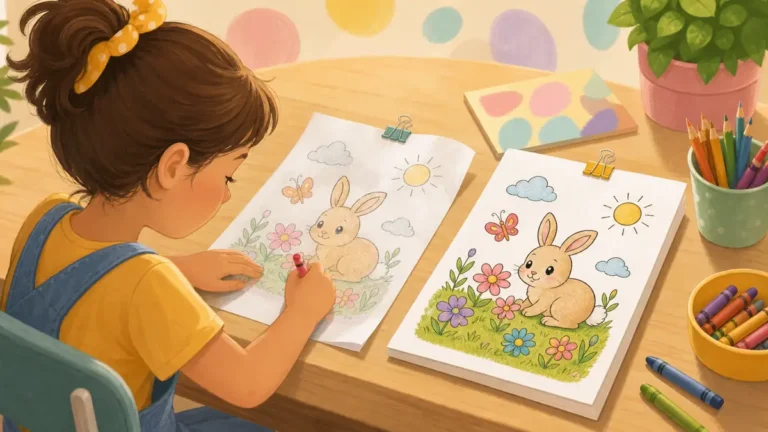
For children who color in locations without a flat table surface — in the car, on the sofa, in bed — a clipboard or lap desk provides the firm, flat support that makes quality coloring possible. A clipboard with a coloring page attached creates a portable coloring kit appropriate for travel, waiting rooms, and outdoor coloring sessions.
For travel-specific setup, see our guide to coloring pages for car rides and travel.
Low-Mess Coloring Setup
For parents concerned about coloring mess — particularly with younger children — a few setup choices eliminate most of the mess risk without limiting the activity:
- Use only washable crayons and washable markers for children under 6
- Print on cardstock to prevent marker bleed-through to the table surface
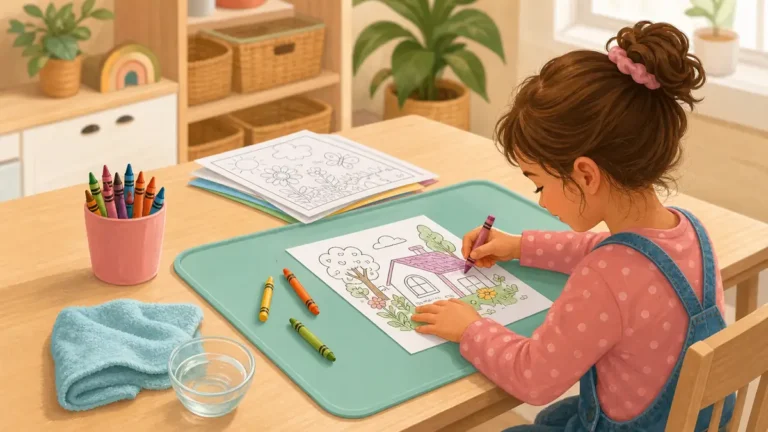
- Use a silicone placemat or art mat under the coloring page as a wipeable barrier
- Keep a damp cloth at the station for immediate hand cleaning between colors
- Designate a consistent coloring location — “we color at the coloring table” — rather than allowing coloring anywhere in the house
For a complete low-mess approach, see our guide to low-mess coloring ideas for kids.
Building a Starter Coloring Kit by Age
Toddler Starter Kit (Ages 1–3)
- Crayola My First Crayons (8 or 16 count)
- Do-A-Dot markers (washable)
- Bold, simple coloring pages printed on cardstock
- Silicone art mat
Preschool Starter Kit (Ages 3–5)
- Crayola Washable Crayons (24 count)
- Crayola Washable Markers (8 count broad tip)
- Mixed page collection: bold easy pages + animal pages + alphabet pages
- Crayon cup or caddy
Elementary Starter Kit (Ages 5–8)
- Crayola Classic Crayons (48 count)
- Crayola Colored Pencils (24 count)
- Crayola Supertips washable markers (20 count)
- 65lb cardstock for printing
- Mixed page collection: educational, seasonal, and interest-based
Upper Elementary Kit (Ages 8–12)
- Prismacolor Scholar or Faber-Castell Polychromos colored pencils (24-set)
- Quality sharpener
- Blending tools (colorless blending pencil, blending stump)
- Bristol board or vellum cardstock for printing
- Complex, detailed coloring pages appropriate for their skill level
Frequently Asked Questions
What are the best crayons for kids?
Crayola Classic Crayons (24-count, washable) are the best general-purpose choice for children ages 3–8 — consistent pigment quality, good durability, widely available, and proven in millions of children’s hands. For toddlers under 3, Crayola My First Crayons or similar jumbo-grip crayons are more appropriate because standard crayons are too thin for palmar-grip children to hold effectively. For children 8 and up who want more sophisticated performance, mid-grade colored pencils are typically a better investment than premium crayons.
When should kids switch from crayons to colored pencils?
The natural transition window is ages 7–9, when children have sufficient fine motor control to sharpen pencils, apply consistent pressure, and benefit from the greater precision colored pencils provide. The clearest signal that a child is ready is when they express frustration that their crayons won’t produce the fine detail or precise shading they’re attempting. There’s no requirement to switch — many children continue using crayons well into upper elementary. Offer colored pencils as an additional option rather than a replacement.
What paper should I use to print coloring pages at home?
65lb cardstock is the recommended choice for any coloring page the child cares about completing carefully. It handles markers without bleed-through, withstands crayon pressure without tearing, and produces a finished page worth displaying. Standard copy paper is adequate for casual practice and daily use but produces poor results with markers and under heavy pressure. Most home inkjet printers handle 65lb cardstock without issue — load it as you would regular paper, using the manual feed tray if available.
Are washable crayons and markers worth it?
Yes — for children under 6, washable formulas are worth the slightly higher cost because the alternative is permanent marks on unintended surfaces that produce stress and conflict. Washable formulas have improved significantly — Crayola Washable products wash from skin and clothing with water and from most surfaces when treated promptly. The peace of mind for parents and the freedom for children to color without fear of consequences more than justify the cost difference.
How many colors does a child need in their coloring set?
24 colors is the right starting point for most children — large enough for genuine color variety, small enough that the selection isn’t overwhelming. Children who are coloring seriously and regularly reaching for colors not in their set benefit from upgrading to 48 or 64 colors. More than 64 colors is rarely useful for children (the differences between similar shades become too subtle to matter) and the large set size creates organizational friction that slows the coloring process.
What’s the best way to store crayons so they last longer?
Keep crayons in a single layer in a flat or divided container rather than jumbled in a box — hunting through a jumbled box breaks tips and creates frustration that shortens coloring sessions. Store away from heat sources (crayons soften and deform above 100°F). Replace the paper label if it tears — unwrapped crayons are harder to grip and harder to identify. Peel the paper from broken crayon halves and store the halves upright in a cup — they color identically to full-length crayons and children often prefer the shorter length for better control.
The right coloring supplies make coloring more enjoyable, more productive, and more likely to become a lasting habit. Browse our full collection of printable coloring pages at coloring.media — from our easy pages for beginners to our science and nature pages for curriculum use — and visit our Tips & Techniques hub for supply guides, technique tutorials, and age-specific recommendations.