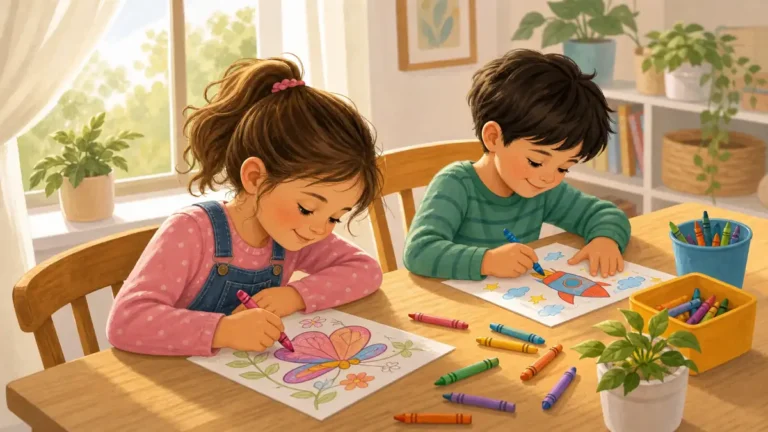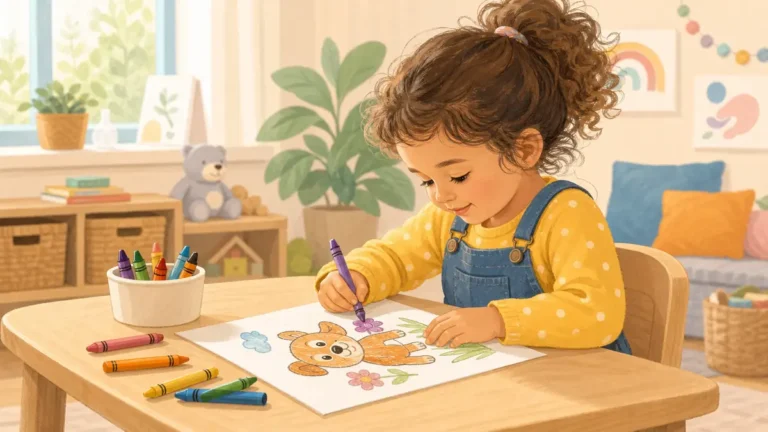


Quiet time activities with coloring pages solve one of the most persistent daily challenges for parents of young children: what does a child who no longer naps do for the 1–2 hours their parent needs for focused adult work, rest, or sibling care? Coloring is the answer most consistently recommended by parents who have successfully built a daily quiet time routine — it’s independently executable, genuinely absorbing, and calming enough to serve the restorative purpose that sleep once did.
Why Coloring Works for Quiet Time
Quiet time succeeds when the activity meets four criteria: it can be done independently without adult involvement, it’s engaging enough to hold attention for the full quiet time window, it’s calm enough not to escalate energy or noise, and it produces something — some sense of completion — that gives the child a reason to stay with it. Coloring is the rare activity that meets all four criteria simultaneously.
Unlike audiobooks (passive), puzzles (can frustrate and generate calls for help), or drawing on a blank page (requires creative initiation that many children find difficult in the first minutes), a coloring page provides structure, direction, and clear progress — the child can see their work accumulating with every section colored. That visible progress is what sustains quiet time engagement without adult reinforcement.
Setting Up a Quiet Time Coloring Station
The physical setup determines whether quiet time coloring actually happens. A coloring station that is ready and accessible produces consistent quiet time; supplies scattered across different rooms produce daily renegotiation.
What a quiet time coloring station needs:
- A consistent location: A designated table, desk, or corner that the child associates specifically with quiet time — not the general art area used for other activities
- Pre-printed pages: A folder or small box of pages ready to go — ideally 5–8 pages covering a few themes so the child has genuine choice without an overwhelming selection
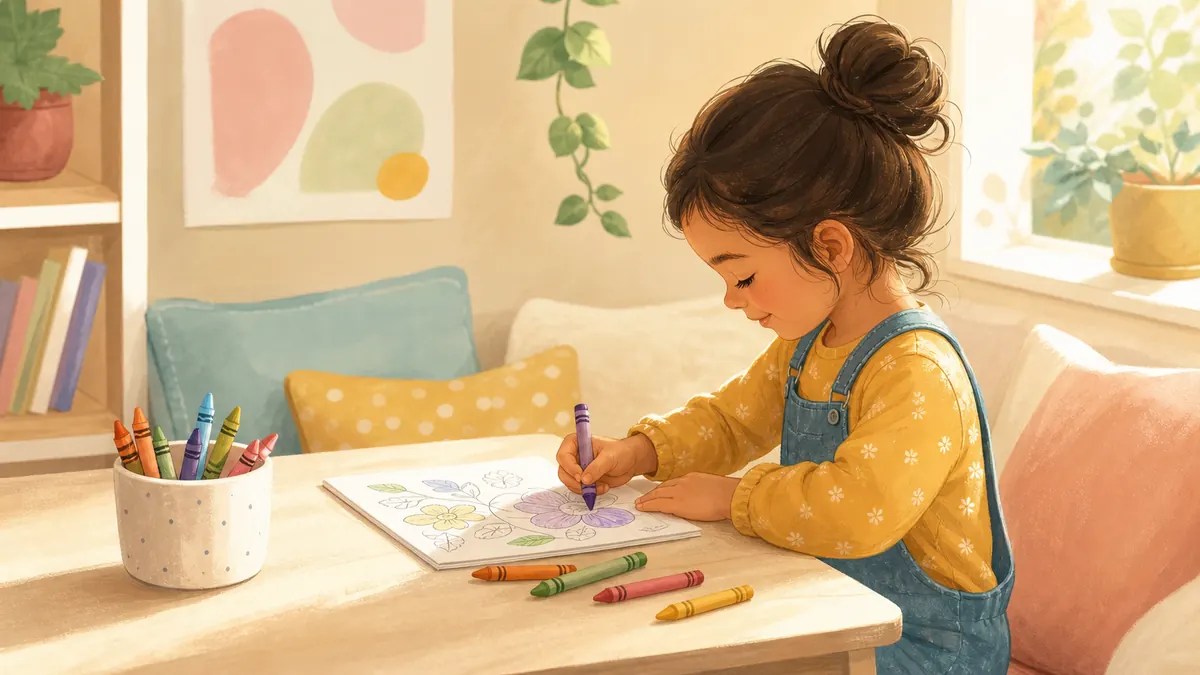
- Accessible coloring tools: Crayons in an open cup, not a closed box — the child can reach their preferred colors without searching
- Novelty rotation: Replace the available pages weekly to maintain the sense that quiet time brings something new
Quiet Time Coloring by Age
Ages 2.5–4: Transitional Quiet Time
For children recently transitioned out of napping, quiet time is often a 45–60 minute window rather than the full 2-hour block older children can sustain. Bold, simple pages — our easy coloring pages and animal pages — are most appropriate. Have 3–4 pages available so the child can switch without needing to ask for more. Expect some calling-out in the first weeks as the routine is established; this normalizes quickly when the expectation is consistent.
Ages 4–6: Established Quiet Time
Children in this range can sustain 60–90 minutes of independent quiet time with the right materials. This age group benefits from having a slightly larger page selection (8–10 pages) covering their current interests. Alphabet and number pages add educational value without requiring adult facilitation. Our alphabet pages and seasonal pages work well at this age — familiar enough to engage immediately, varied enough to sustain the full quiet time window.
Ages 6–9: Extended Quiet Time
School-age children who still do quiet time can sustain 90–120 minutes with more complex pages. Detailed animal scenes, science diagrams, and holiday-themed pages are all appropriate. This age group often produces their best, most careful coloring during quiet time because the absence of sibling competition and parent attention means they can take their time with precision work. Our science and nature pages and life cycle pages are particularly well-suited for this age during quiet time.
Extending Quiet Time with Coloring Additions
When children work through their available pages before quiet time ends, a few simple additions extend the activity without requiring adult involvement:
- Include a small blank notebook for drawing after the printed pages are done
- Add a “coloring challenge” card with simple prompts: “Color everything in your favorite color first. Use only three colors. Make the sky a color it’s never been.” Children who see these as creative games rather than restrictions find them highly engaging
- Allow the child to cut out completed pages for a collage or display — the purposeful extension gives additional meaning to the coloring work
Quiet Time as a Screen-Free Anchor
For families working to reduce screen time, quiet time is one of the most important daily screen-free anchors to protect. A quiet time that consistently involves coloring rather than a screen builds the neural habit of reaching for creative tools during downtime — a habit that compounds over years. Children who learn to color independently during quiet time at age 3 are more likely to reach for creative activities at age 7 and 10 than children whose quiet time was consistently screen-based.
For a complete approach to screen-free family time, see our guides on screen-free activities for kids at home and digital detox with kids.
Frequently Asked Questions
How long should quiet time with coloring pages last?
Start with a duration the child can succeed at — 30–45 minutes for children under 4, 60–90 minutes for ages 4–6, up to 2 hours for school-age children. Building up gradually from a successful shorter window produces more durable quiet time habits than starting at the full duration and struggling through resistance. The goal is a child who enters quiet time willingly because it’s associated with pleasant, absorbing activities rather than enforced isolation.
What if my child calls out or leaves their quiet time area?
Expect this in the first 1–2 weeks, especially with children under 4. Gently return the child to their quiet time space without extended conversation or negotiation — the consistency of the return is what establishes the routine. Ensure the coloring station is genuinely appealing: fresh pages, accessible tools, and a comfortable space. A child who keeps leaving quiet time is often telling you the materials aren’t engaging enough rather than that quiet time can’t work.
Can quiet time replace nap time?
Quiet time is the standard recommendation for children who have transitioned out of napping — typically between ages 2.5 and 4 — as a way to preserve the restorative mid-day break for both child and parent. While it doesn’t provide the sleep benefits of a nap, well-structured quiet time with absorbing activities like coloring does provide genuine rest and nervous system regulation. Many children who begin quiet time immediately post-nap transition fall asleep during quiet time initially; this is normal and resolves as the child’s sleep needs adjust.
Quiet time with coloring pages is one of the most reliably sustainable independent activities in the parent toolkit — low effort to set up, high benefit to sustain, and genuinely enjoyable for the children who develop the habit. Browse our easy pages, animal pages, and seasonal pages at coloring.media to build your quiet time coloring collection, and visit our Tips & Techniques hub for more activity guides.