

Easter coloring activities for kids are among the most creatively open of any holiday — the Easter egg page, unlike a Christmas ornament or Halloween pumpkin, has no “correct” color scheme, which makes it one of the few holiday coloring subjects where children have total creative latitude. Add to that the rich spring imagery of chicks, bunnies, flowers, and nests, and Easter produces some of the most enthusiastic and carefully executed coloring of the year.
Easter Coloring Activity Ideas
Easter Egg Design Pages
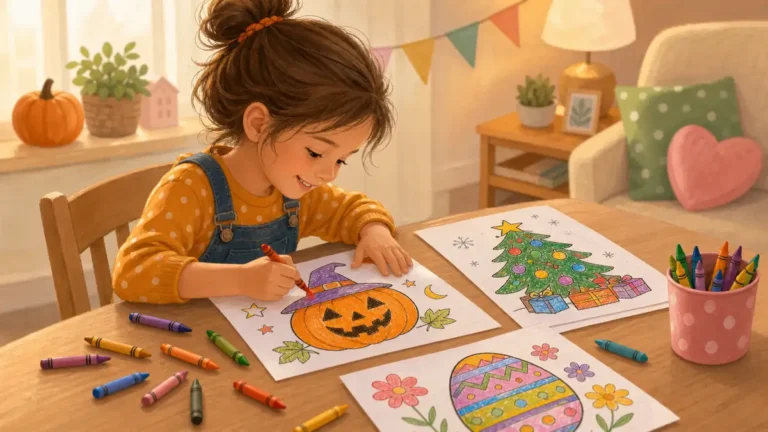
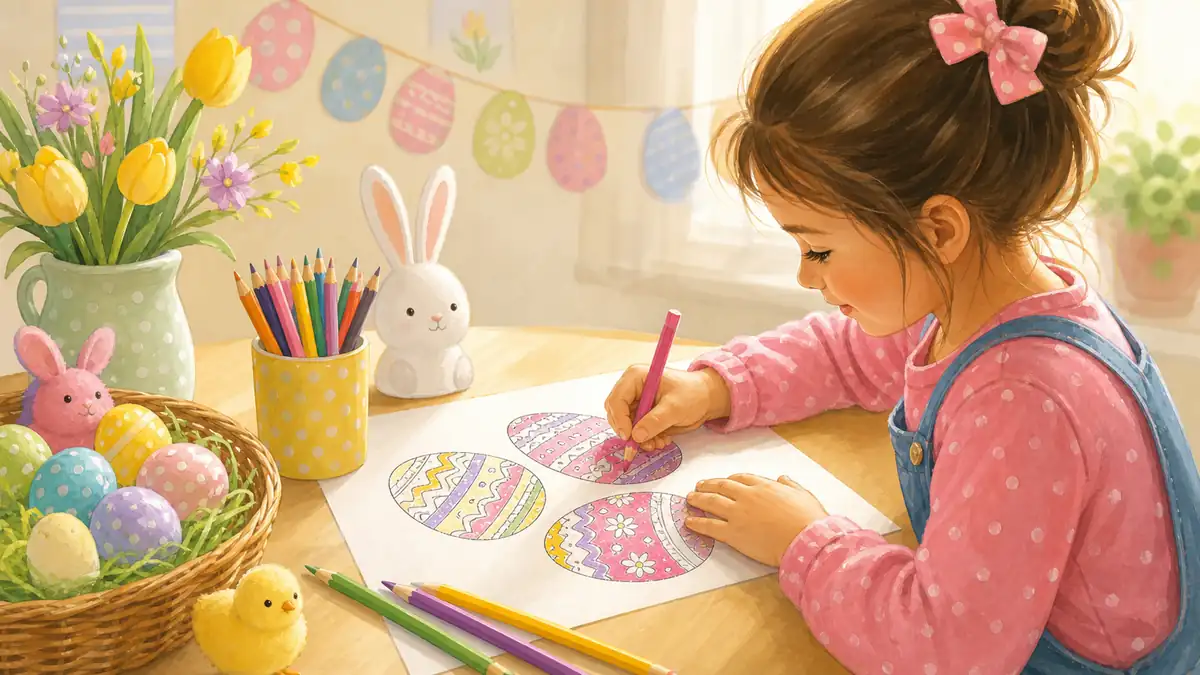
Easter egg coloring pages are uniquely motivating because the blank egg outline is an explicit invitation to be as creative as possible — no “right” colors, no reference images to match, just pure creative expression within a familiar shape. Children who are normally tentative about color choices become boldly experimental with Easter eggs. Ideas to enhance the activity:
- Easter egg design challenge: Each family member or classmate colors the same egg outline with entirely different designs — display them together and celebrate how different each one is
- Pattern exploration: Encourage children to try stripes, dots, zigzags, and flowers rather than solid color fills
- Color theory introduction: “Can you make a warm egg (reds, oranges, yellows) and a cool egg (blues, greens, purples)?” — a natural entry point for color theory vocabulary
Spring Animals: Chicks, Bunnies, and Lambs
Easter’s animal imagery — baby chicks, bunnies, lambs, and ducklings — connects holiday celebration to spring nature science. Children who color a chick page after discussing how birds hatch from eggs, or a bunny page during a mammals unit, are connecting holiday content to genuine science vocabulary. Our animal coloring pages include spring animals appropriate for Easter activities.
Educational extension: pair each spring animal coloring page with one fact about the animal (“Baby chicks stay in their eggshell for 21 days before hatching. What do you think it feels like to hatch?”).
Spring Flowers and Nature
Easter’s spring timing makes it a natural window for spring nature coloring — flowers blooming, trees leafing out, insects emerging. Our flowers and plants pages and nature pages provide spring nature content that complements Easter without being specifically holiday-themed — useful for classrooms with diverse student populations.
Life Cycle Connection
Easter is a natural entry point for life cycle science — the egg, the chick, the adult bird. A butterfly life cycle page used during Easter week connects the holiday’s egg-and-new-life theme to the most-studied elementary life cycle. Our life cycle pages provide curriculum-connected science content appropriate for this seasonal window.
Easter Coloring by Setting
Easter Coloring at Home
The most effective home Easter coloring approach involves purpose-driven projects. Finished Easter egg pages make charming:
- Place cards at the Easter dinner table — cut out, write a family member’s name, fold and stand
- Easter basket additions — a small Easter-themed coloring activity is a zero-sugar basket addition that children actually use
- Window decorations — taped to windows, colored egg pages create a cheerful spring display
- Easter card inserts — a colored page folded with a written message makes a personal handmade card
Easter Coloring in the Classroom
For classroom use, spring nature and flower pages are more broadly inclusive than specifically Easter egg or religious content. An Easter week classroom coloring activity that connects to spring science — spring animals, flowers, life cycles — serves all students regardless of holiday observance. If Easter-specific pages are appropriate for the school community, egg design pages are the safest choice — they’re celebratory without religious or cultural specificity.
Easter Coloring in Homeschool
Homeschool families can build a multi-day Easter and spring unit using coloring as the visual anchor: day one, color spring flowers and discuss what makes spring different from winter; day two, color a baby animal page and discuss life cycles; day three, color Easter eggs as a creative celebration activity. The coloring pages create a visual record of the spring study that becomes a nature journal section.
For a complete holiday coloring framework throughout the year, see our pillar guide on holiday coloring activities for kids.
Frequently Asked Questions
What Easter coloring activities work best for toddlers and preschoolers?
Large, bold Easter egg pages with simple sections, big bunny or chick pages, and simple flower pages are most appropriate for young children. Keep the activity light and celebratory — naming the colors as the child chooses them, talking about what Easter means in your family. Our easy pages provide the bold outlines appropriate for ages 2–4.
How can I use Easter coloring as an educational activity?
Connect each page to a simple fact or question: spring animals to life cycle science, flowers to plant biology, egg designs to pattern and color theory. The educational extension takes 30 seconds — one question before or after coloring — and converts the activity from purely celebratory to genuinely multi-dimensional. “How do you think that egg got its pattern?” or “What do you know about how chicks hatch?” are enough.
What are the best non-religious Easter coloring alternatives for diverse classrooms?
Spring nature pages — flowers, spring animals, outdoor scenes, and new-growth plant pages — celebrate the spring season without specifically Easter content. These are universally appropriate and connect naturally to the spring science curriculum most schools cover in April. Our flowers and plants pages, nature pages, and animal pages provide abundant spring-appropriate content.
Easter coloring activities combine the unstructured creative freedom of egg design with the rich spring imagery of animals, flowers, and new growth — making them some of the most enthusiastically executed holiday coloring of the year. Browse our animal, flowers and plants, nature, and life cycle pages at coloring.media to build your Easter collection, and visit our Tips & Techniques hub for seasonal activity guides.