
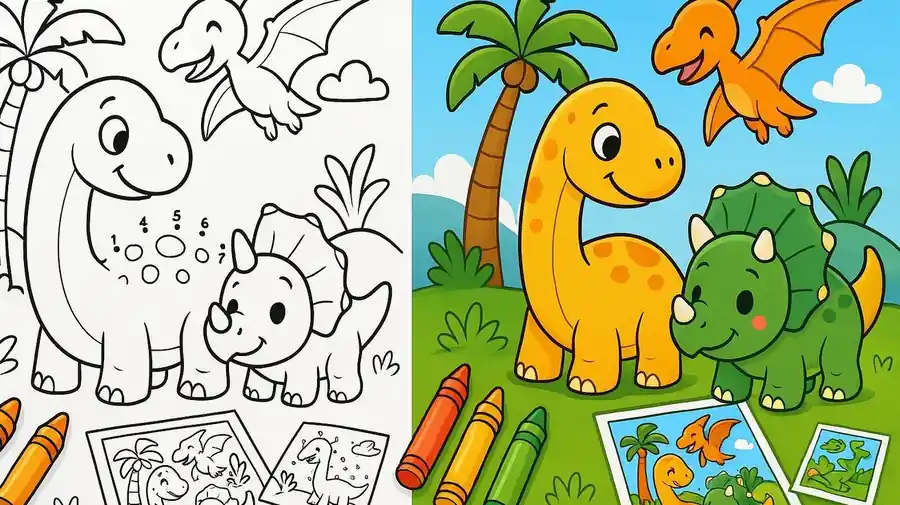
Seven dinosaurs are waiting inside these dot-to-dot pages — each one a field of numbered dots from 1 to 20 that, once connected in order, resolves into a recognizable dinosaur outline. A T-Rex rearing up on hind legs, a Triceratops with its distinctive three-horn frill, a long-necked Brachiosaurus, a spiny Stegosaurus, and a few other Cretaceous-era shapes appear across the collection. The dot count is deliberately low — 20 dots per page — and the instruction at the top of each sheet is printed clearly: “Connect the Dots with Numbers 1 to 20. Color the picture brightly.” The whole process from blank page to colored dinosaur takes most kindergarteners about 10 to 15 minutes.
The appeal of dot-to-dot for dinosaur fans specifically is the reveal. Kids who are already obsessed with dinosaurs have strong opinions about what a T-Rex looks like, and watching the shape emerge from the numbered dots engages that existing knowledge in a way that a pre-drawn coloring page doesn’t. The 1-to-20 number range keeps the activity accessible to children who are still working on number recognition, while the coloring stage afterward gives the session a satisfying finish. Everything here is free to download and easy to print.
Free Printable Dinosaur Dot to Dot Coloring Pages
This collection includes 7 printable dinosaur dot-to-dot coloring pages featuring a T-Rex, Triceratops, Raptor, Brachiosaurus, Stegosaurus, Carnotaurus, and a spiny horned dinosaur — each drawn in a clear cartoon outline style with 20 numbered dots to connect. Each page has a name field at the top for classroom use. After connecting the dots and revealing the dinosaur, the outline is sized well for coloring with crayons or colored pencils. All pages download as print-ready PDFs formatted for A4 or US Letter paper.


Who Are These Dinosaur Dot to Dot Pages Best For?
With only 20 dots per page, these sheets are calibrated for preschool and kindergarten children (ages 4–6) who are learning number recognition and sequence. The number range 1–20 is a core goal for pre-K and kindergarten curricula, and following the dots gives kids purposeful practice that doesn’t feel like a worksheet. Because the dinosaur theme is strongly motivating for this age group, even children who find number activities frustrating are more likely to persist to the finish.
The resulting dinosaur outlines are large enough for fat crayons — the lines are simple curves with generous open areas inside. Four-year-olds who know their numbers to 20 can complete these pages, though a parent sitting nearby helps at that age to keep the sequence on track. Five and six-year-olds with solid number recognition can work independently. The pages also include a name field at the top, which makes them easy to use in a classroom context without any modification.
In a homeschool or preschool setting, these pages work naturally alongside a dinosaur unit. Print the full set of 7 and do one per day across a week, naming the dinosaur together before connecting the dots — it’s a low-key way to introduce dinosaur vocabulary like “Triceratops” and “Brachiosaurus” to a very young child.
Interesting Dinosaur Facts to Share While Coloring
Dinosaurs lived during a period called the Mesozoic Era, which lasted from about 252 to 66 million years ago. That’s so long ago that the continents looked completely different — North America and Europe were connected, and there was a shallow sea running down the middle of what is now the United States.
The T-Rex had the most powerful bite of any land animal ever measured — estimated at around 8,000 pounds of force. That’s enough to crush the bones of its prey and access the nutritious marrow inside. Despite the enormous jaws, T-Rex had relatively small arms, which scientists still debate the purpose of.
Triceratops gets its name from the Greek words for “three-horned face.” The large bony frill behind its head wasn’t just decoration — paleontologists believe it may have been used for temperature regulation, display, or protection. The frill was likely brightly colored in living Triceratops, which means there’s no wrong color choice when coloring one.
Birds are actually living dinosaurs. The evolutionary line from small feathered theropod dinosaurs to modern birds is now well established in the fossil record. When you watch a chicken walk or a crow problem-solve, you’re watching a dinosaur descendant behave in ways their ancient relatives likely did too.
Creative Dinosaur Dot to Dot and Coloring Ideas
Name That Dino Before connecting any dots, look at the dot pattern and guess which dinosaur it will be. Check the guess after finishing the connection.
Realistic vs. Silly Colors Print two copies of the same dinosaur — color one with realistic earthy tones (green, brown, grey) and the other with completely invented colors (purple with orange spots). Compare the results.
Dinosaur Habitat Background After coloring, add a Cretaceous background — palm trees, volcanoes in the distance, a river, a herd of other dinosaurs — to turn each sheet into a diorama-style scene.
All 7 in a Row Complete all 7 sheets over a week and line them up to make a dinosaur parade display along the edge of a desk or across a wall.
Dot-to-Dot Teach-Back After a child completes a page, have them “teach” a younger sibling or stuffed animal how dot-to-dot works using the finished sheet as a demonstration. Explaining a process reinforces it.
How to Print These Dinosaur Dot to Dot Pages
Each page downloads as a PDF formatted for A4 or US Letter paper. Print on standard 80gsm copy paper — the numbered dots and instructions are sized to print clearly without any scaling. Use a pencil to connect the dots so mistakes in the sequence can be erased and corrected. Once the dinosaur outline is complete, colored pencils or chunky crayons both work well for the coloring stage.
Explore More Dot to Dot and Dinosaur Pages
If you enjoyed these pages, you may also like:
Cute Animals Dot to Dot Coloring Pages
Dot to Dot Animal Coloring Pages
Dinosaur Coloring Pages
T-Rex Dinosaur Coloring Pages
All Connect the Dot Activity Pages