
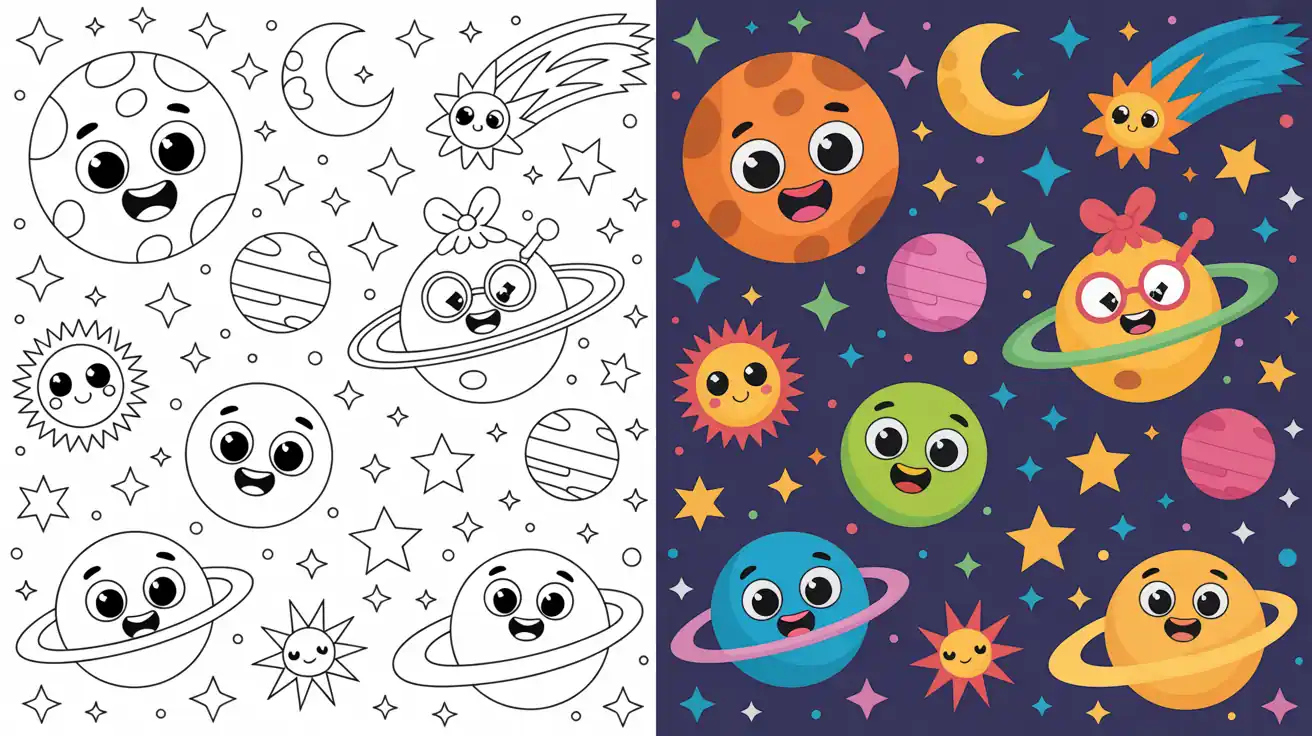
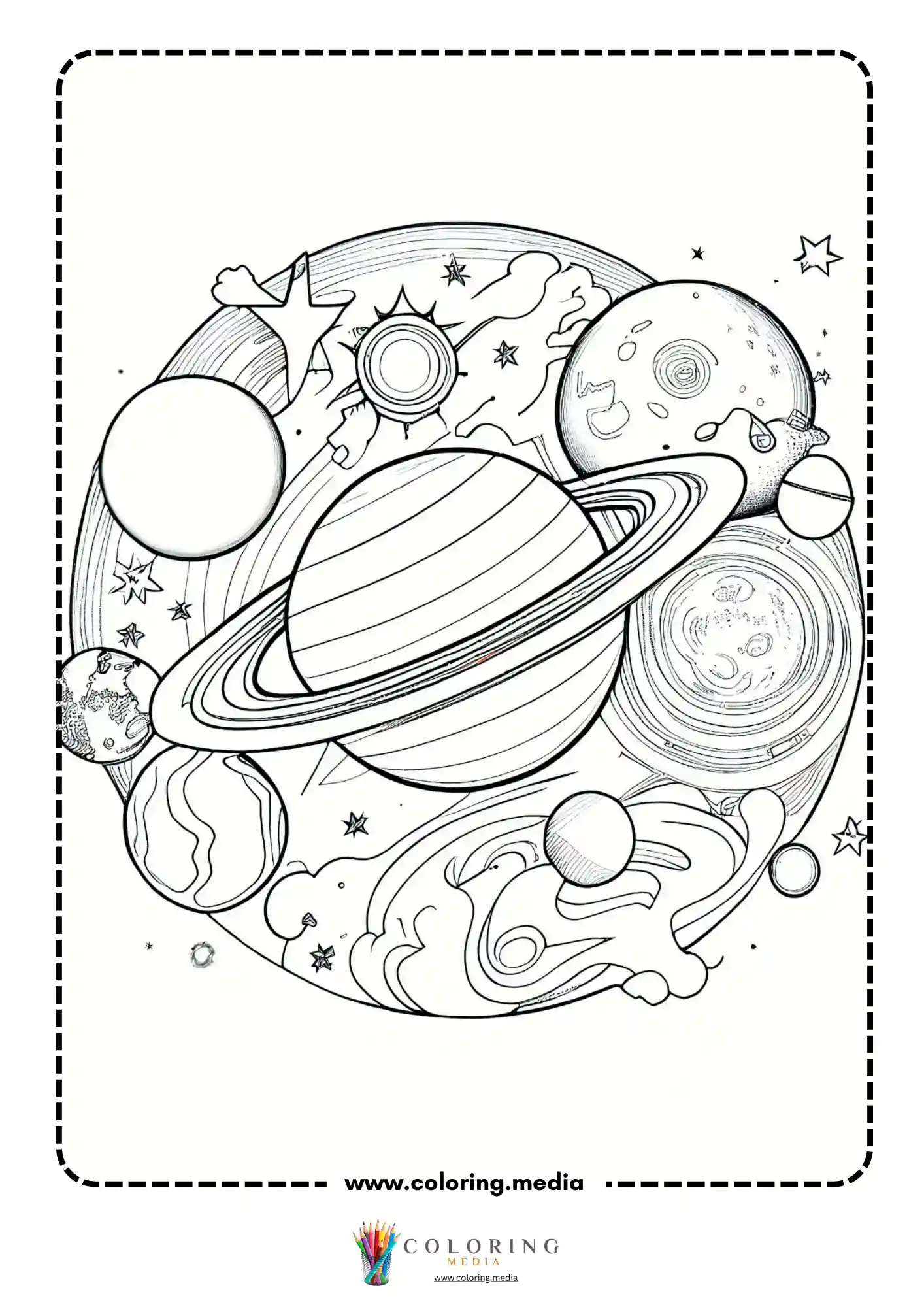
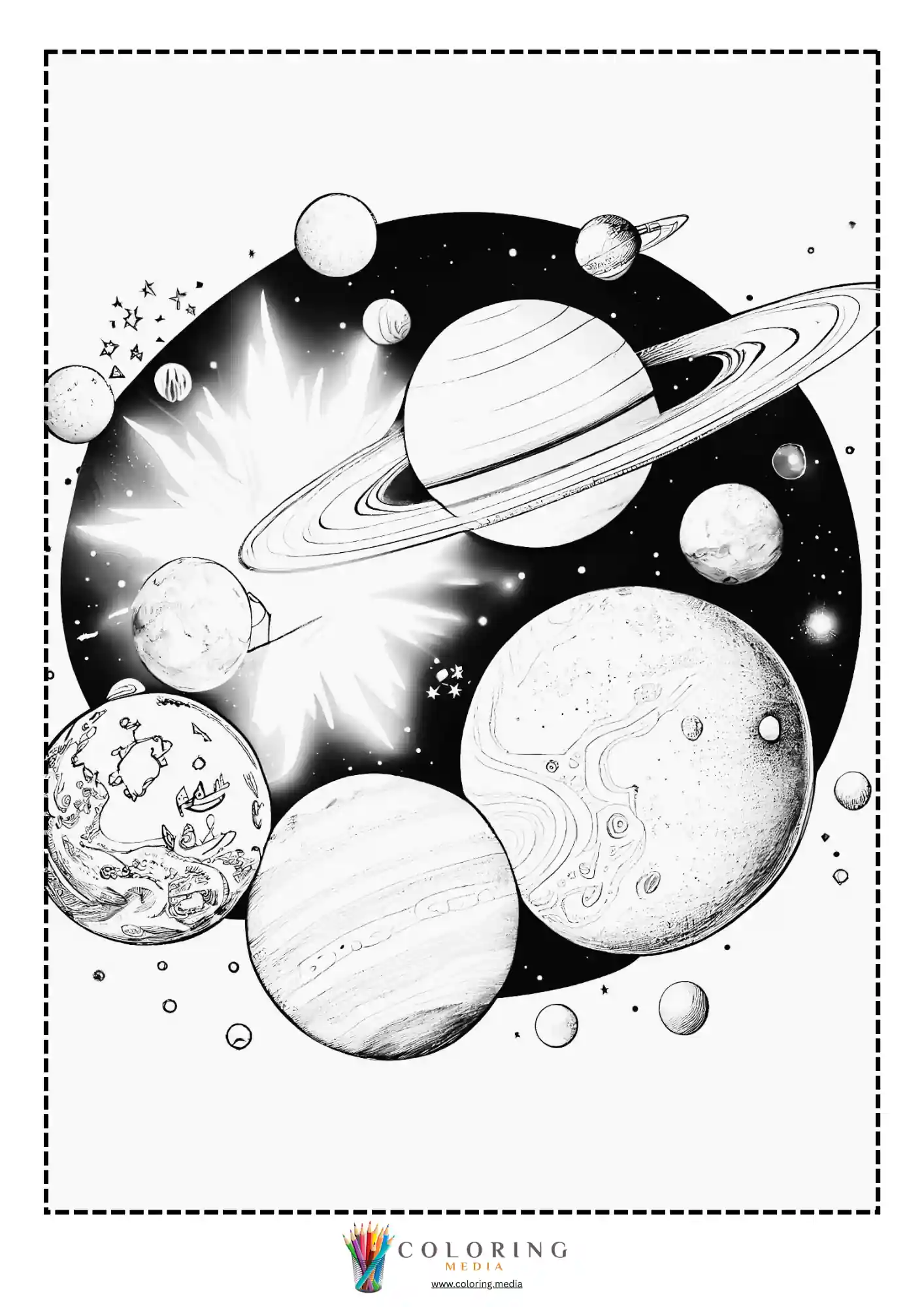
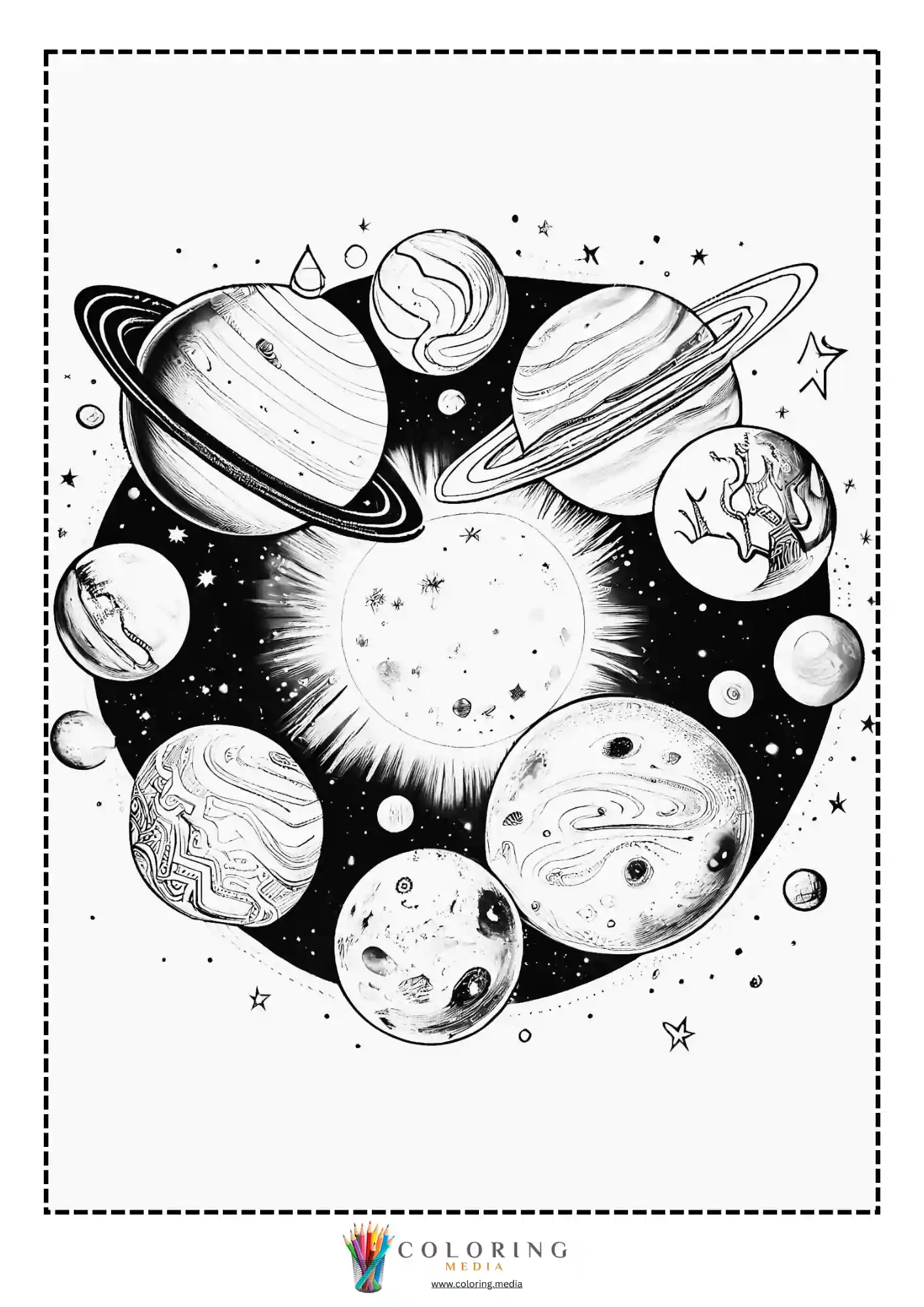
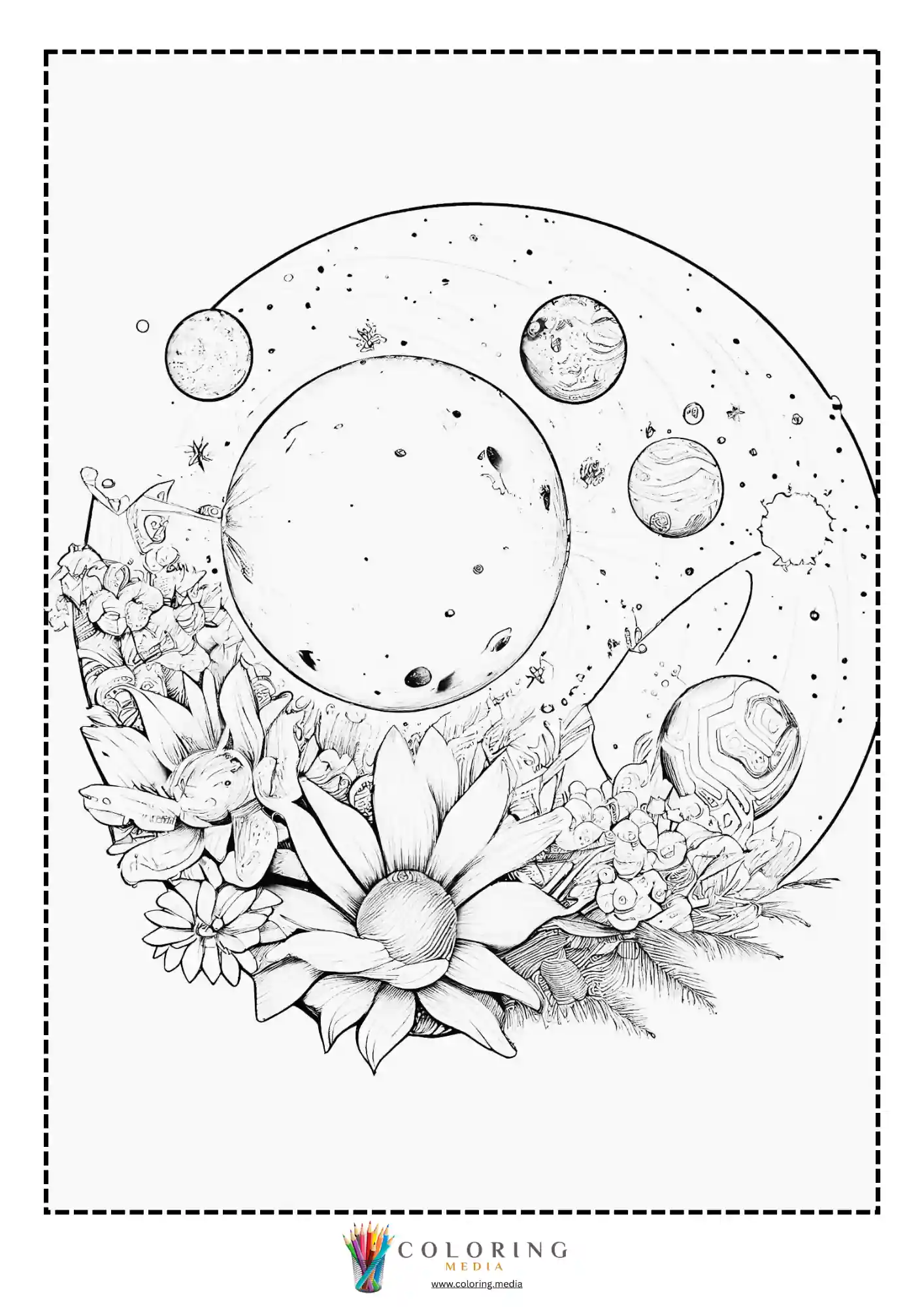
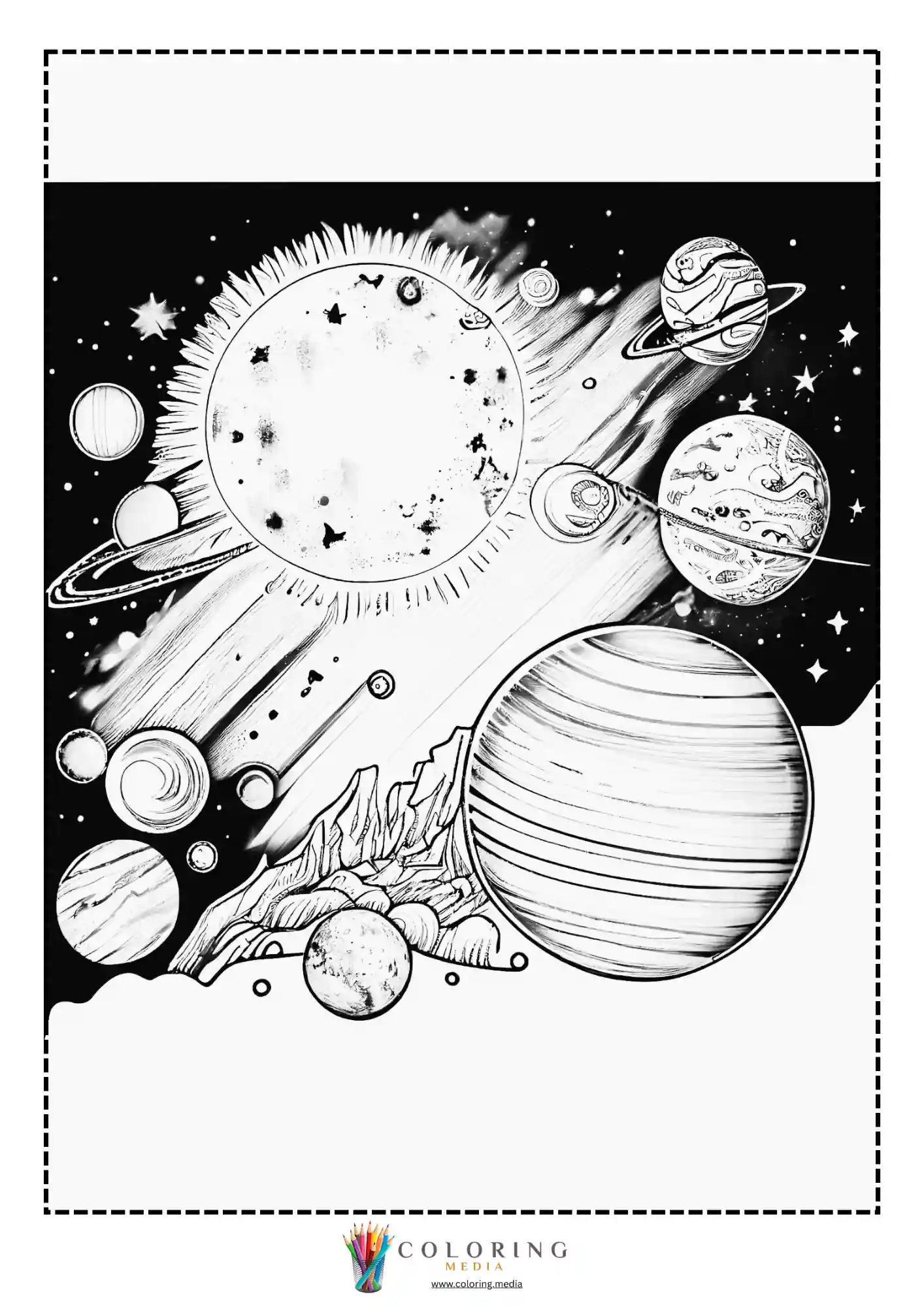
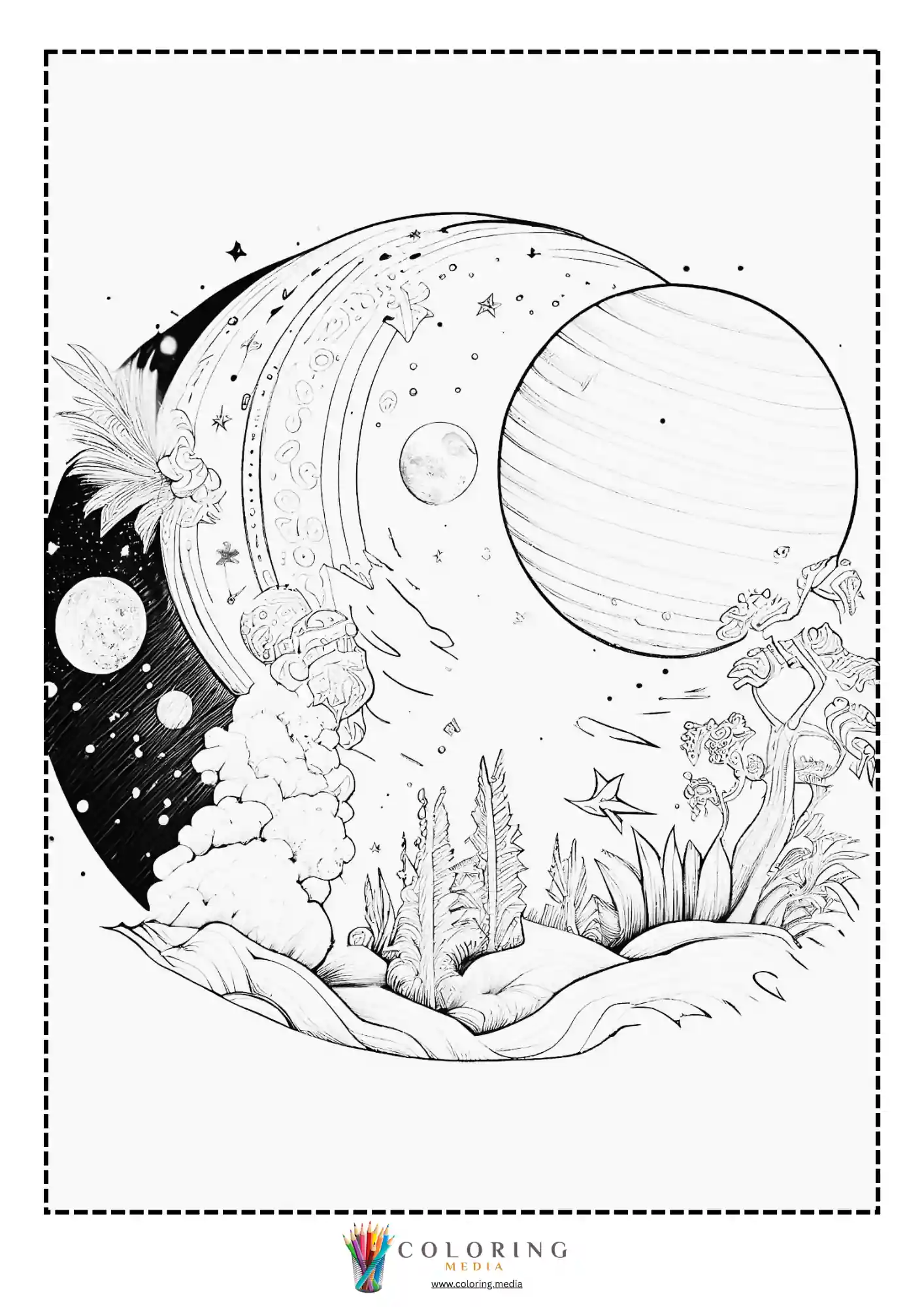
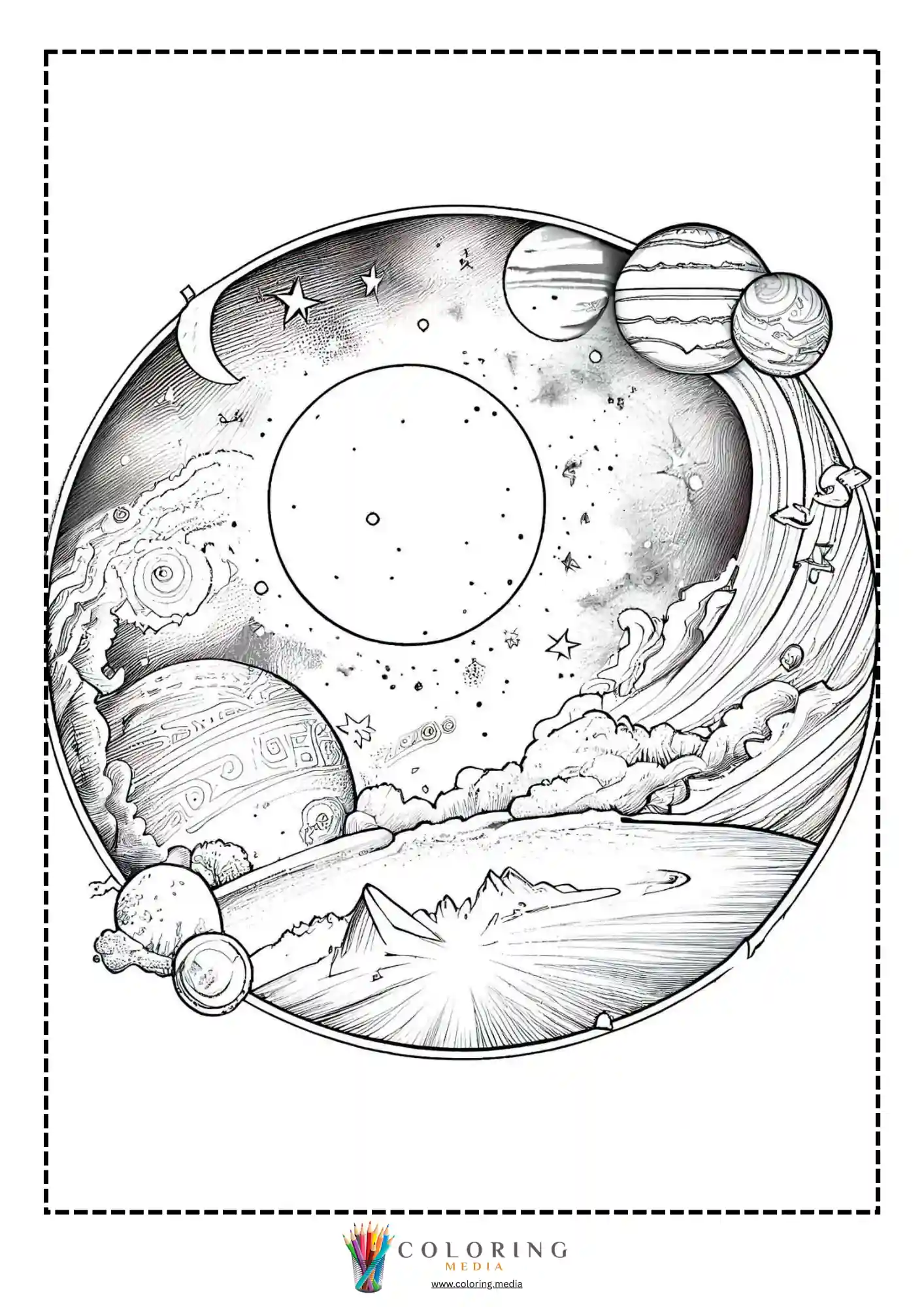
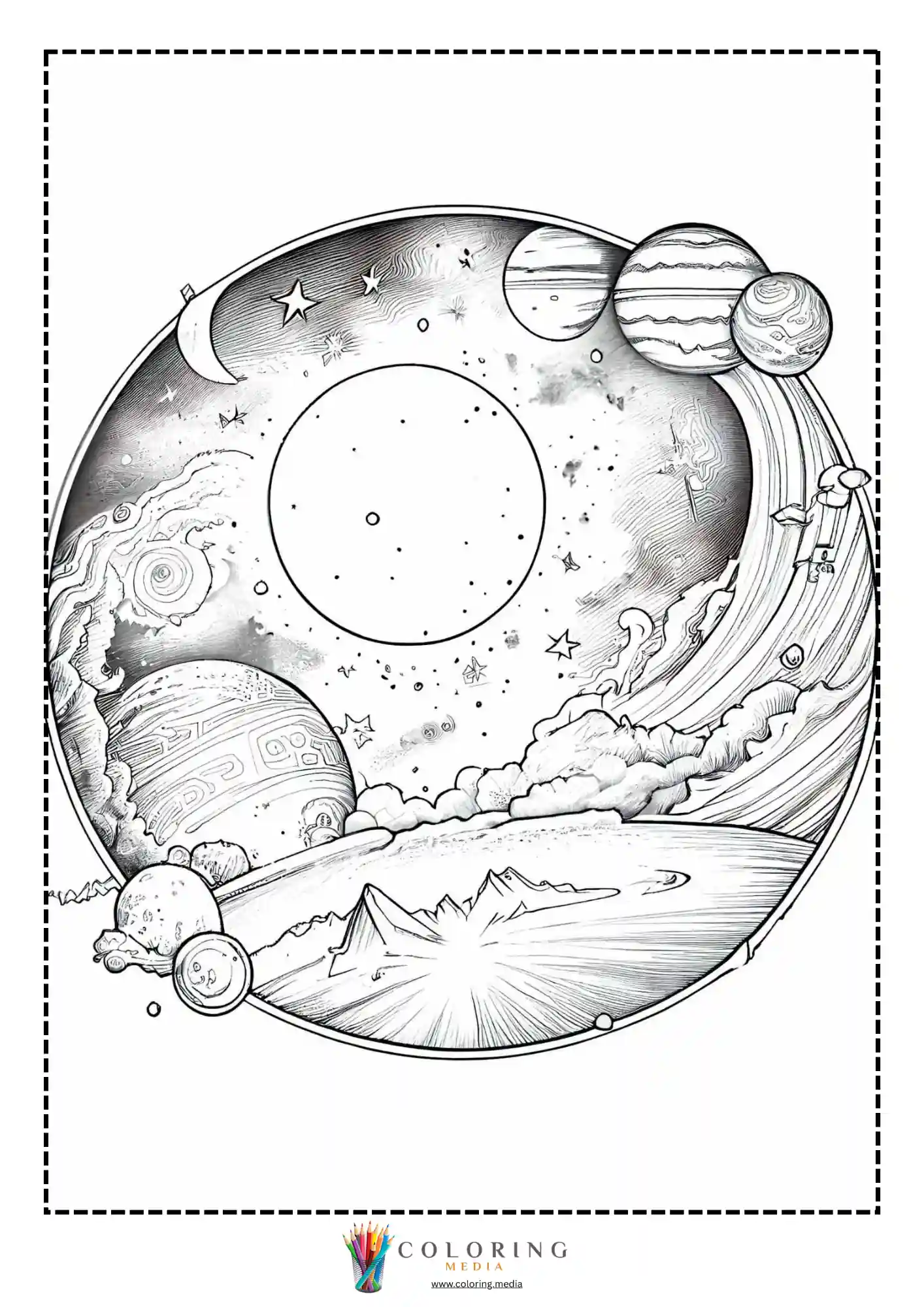
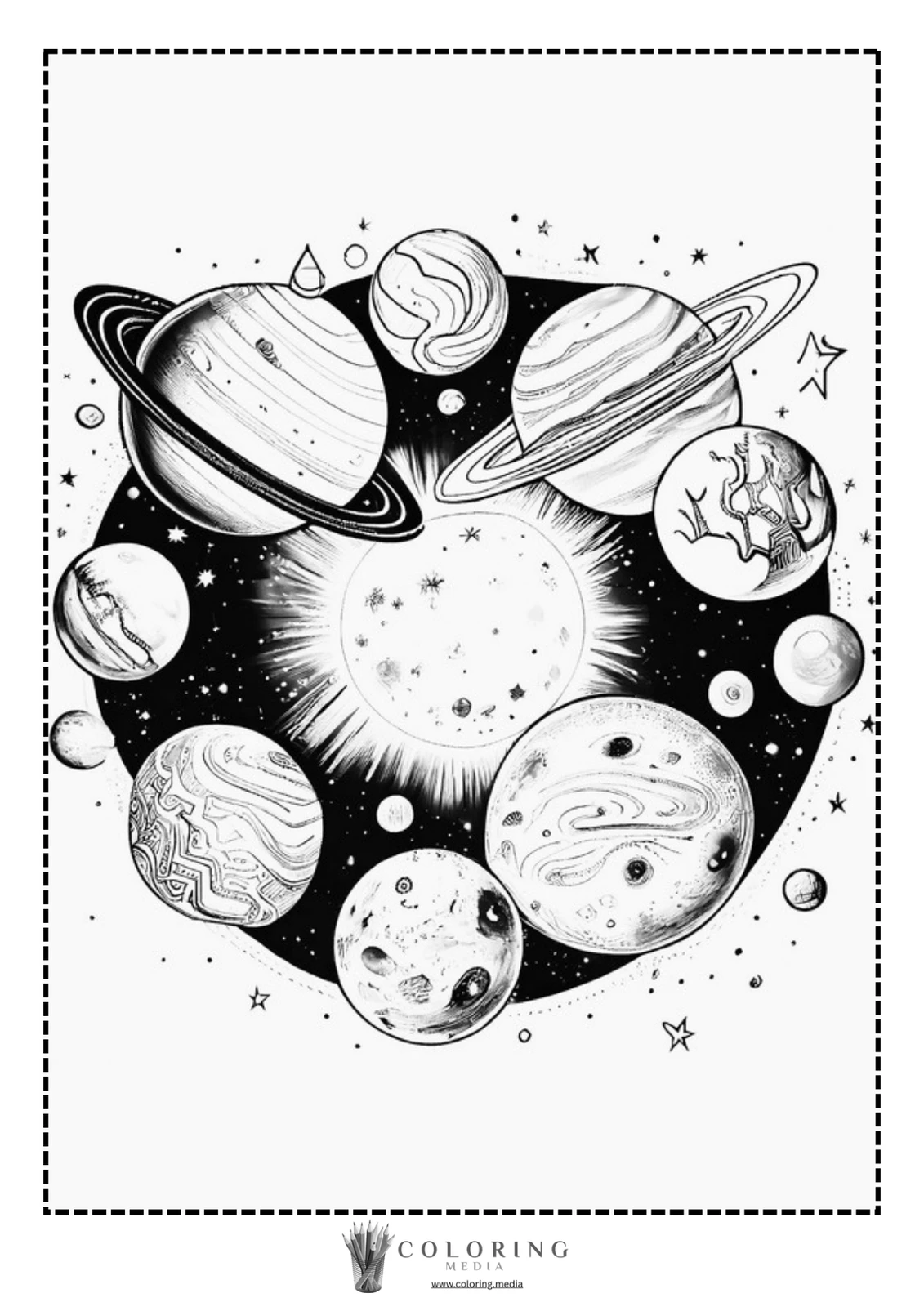
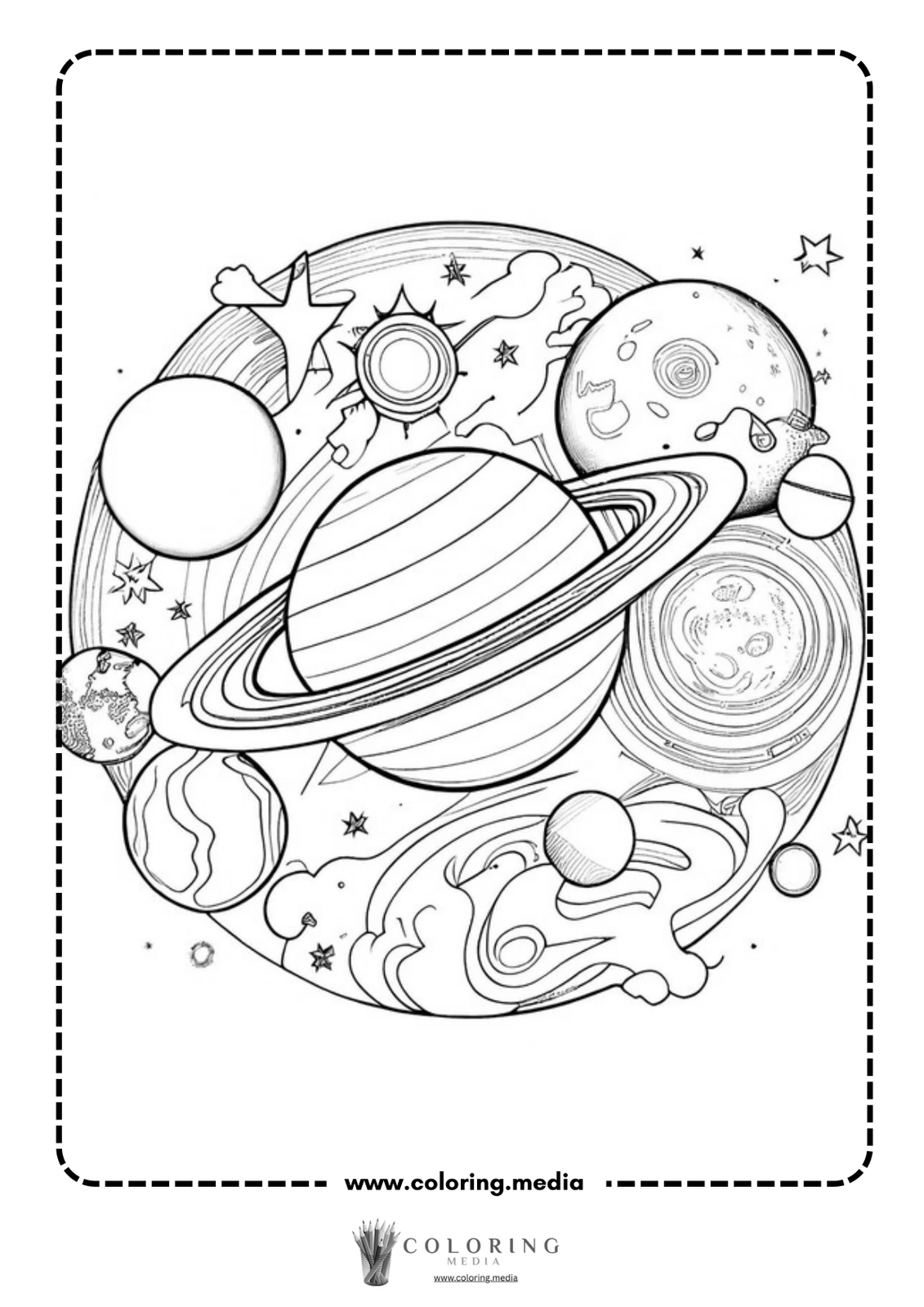
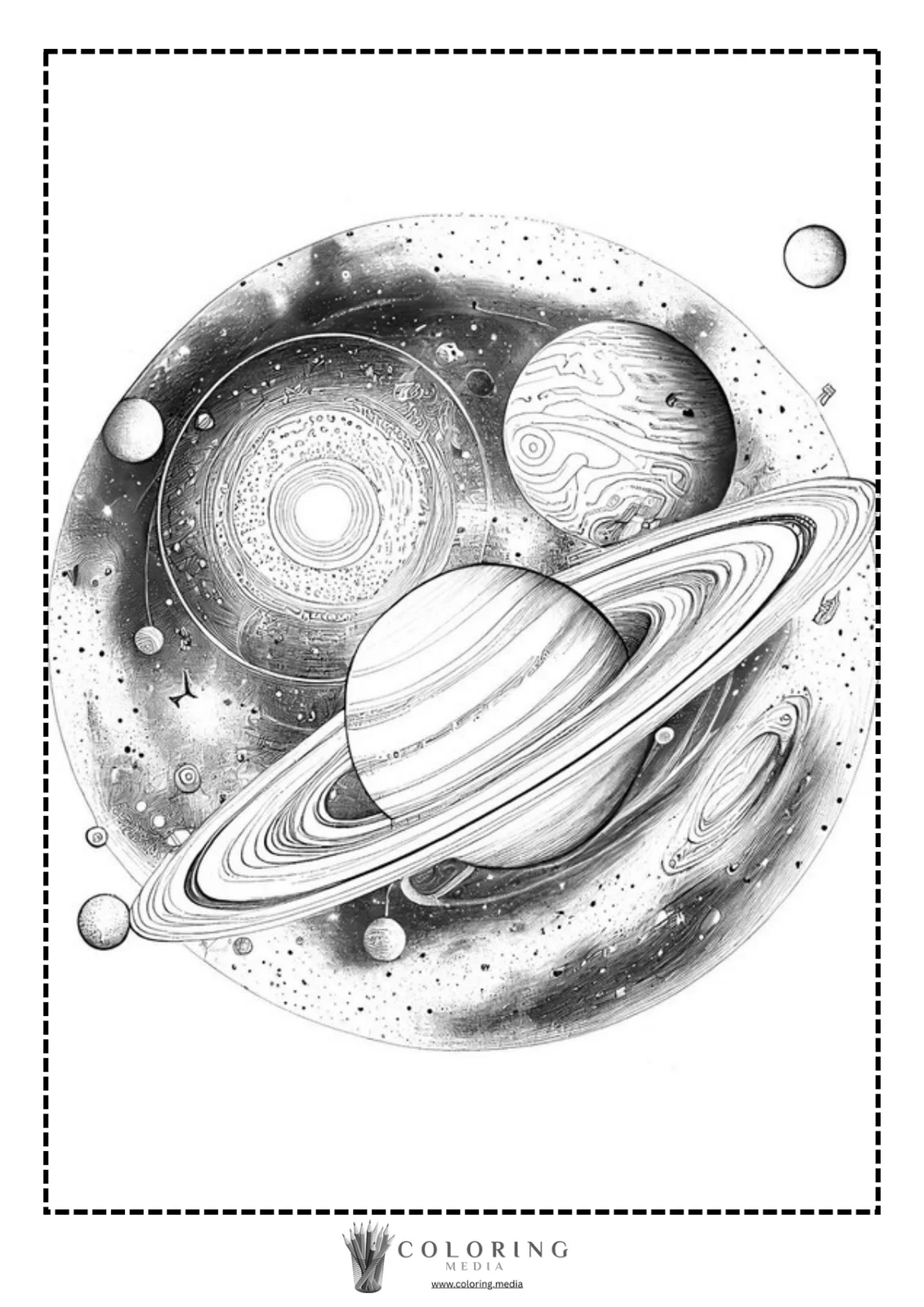
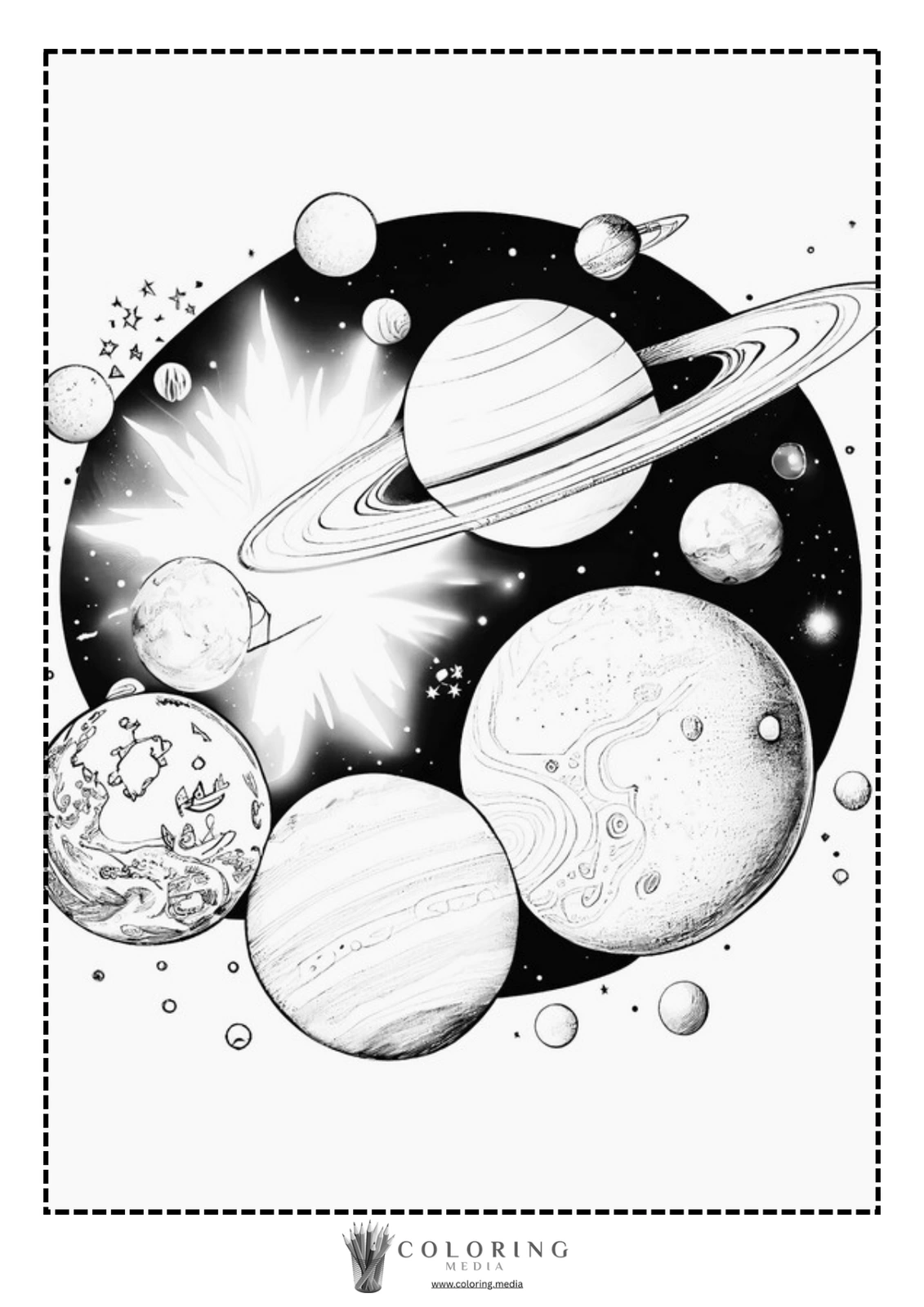
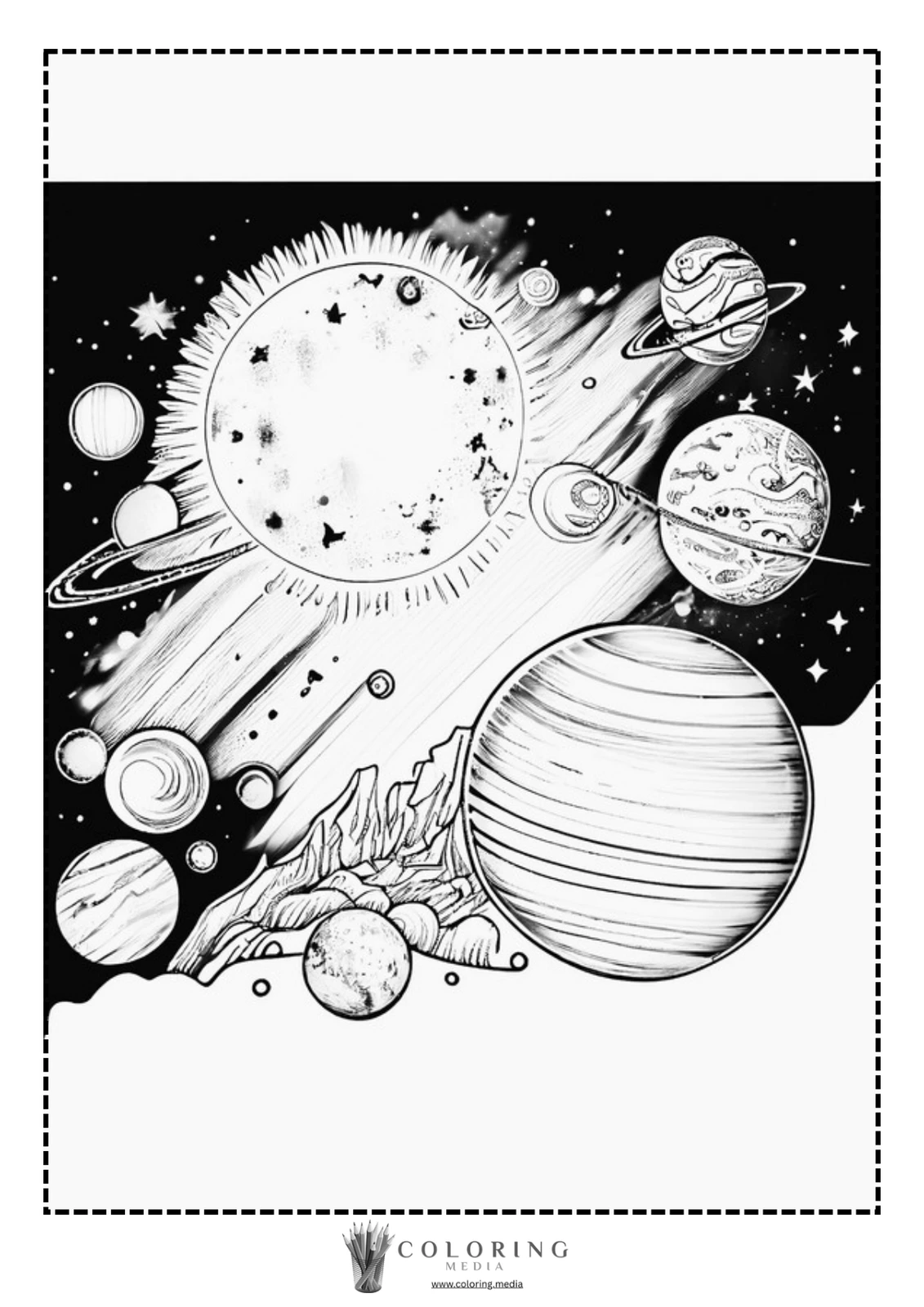
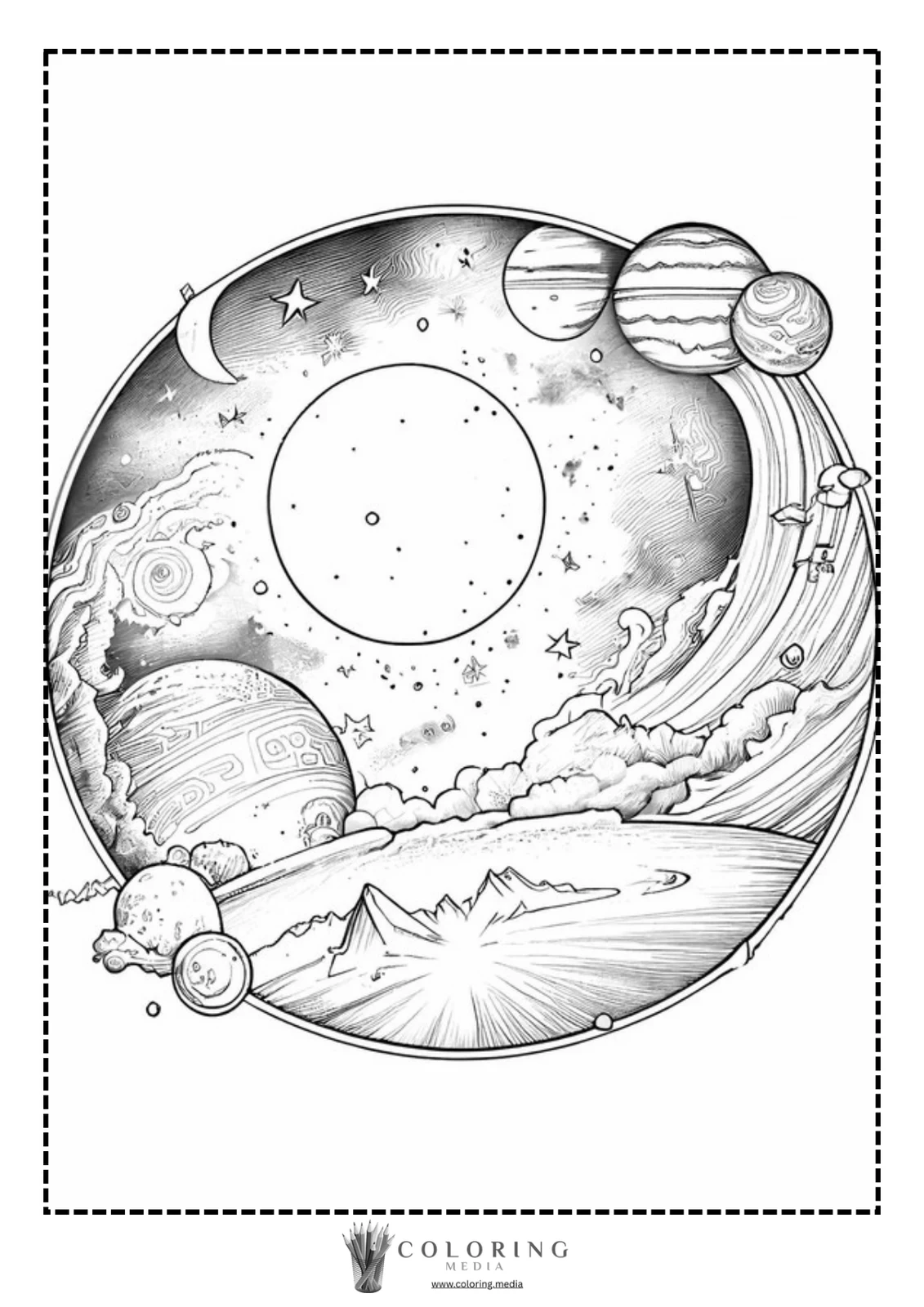
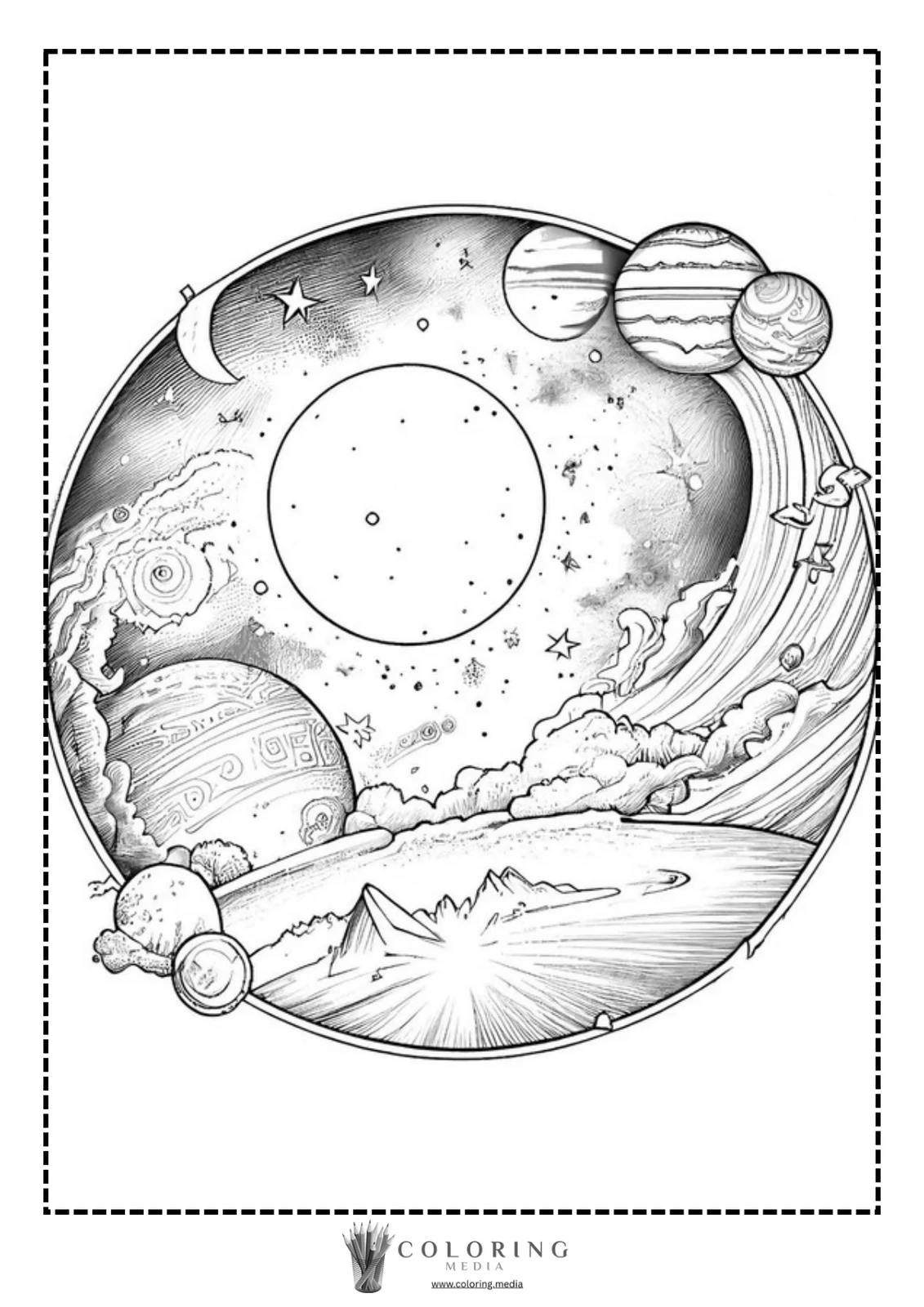
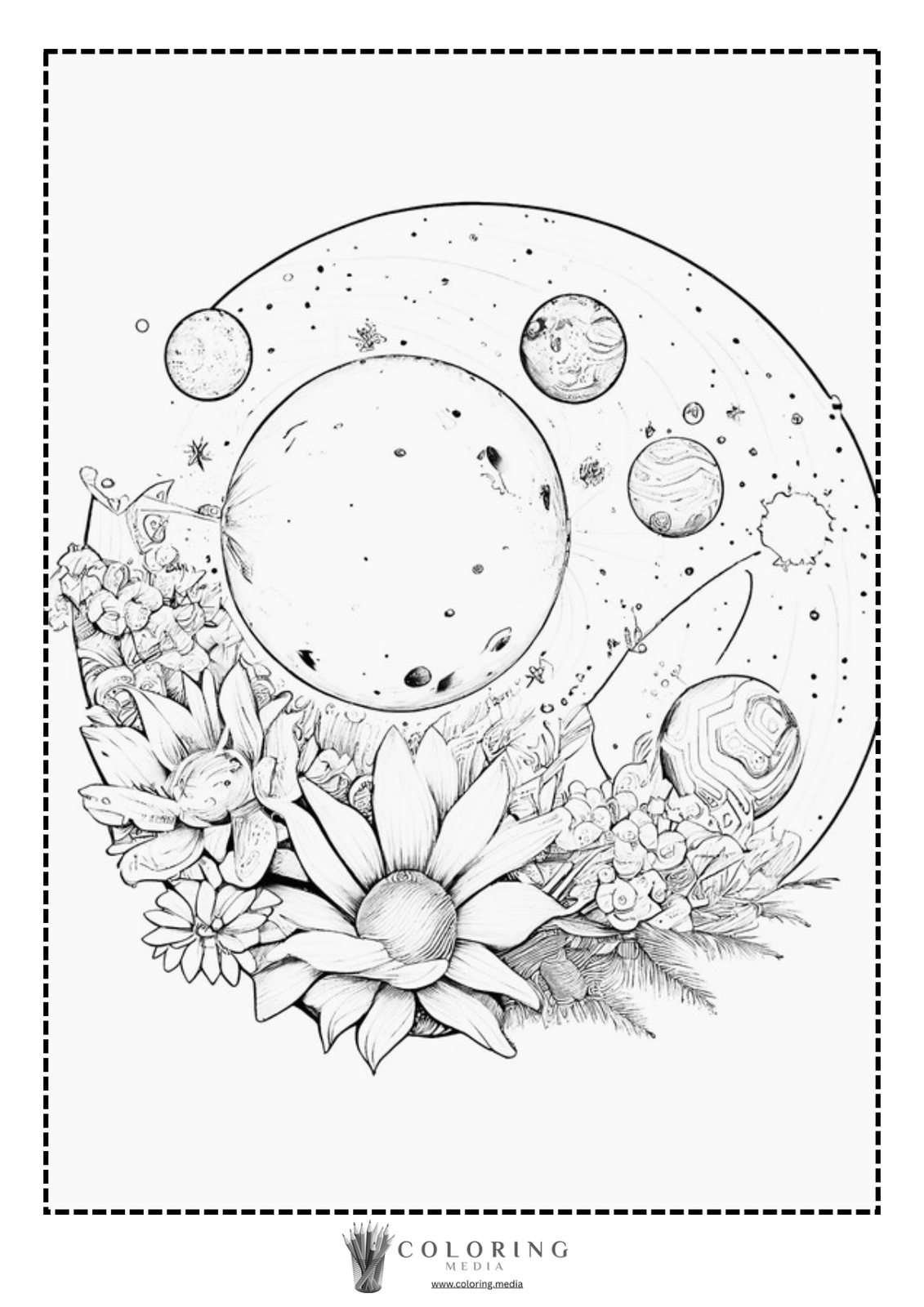
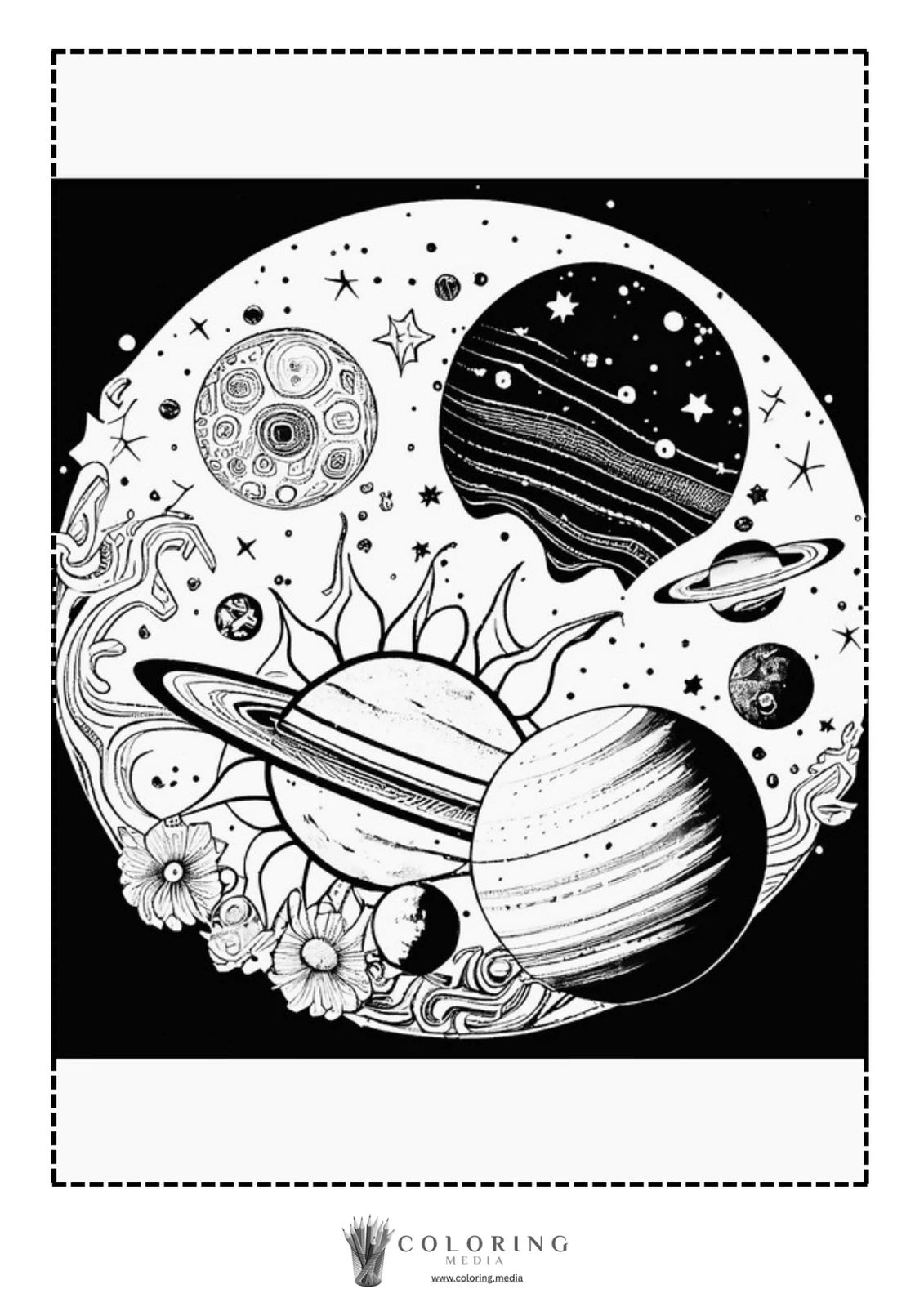
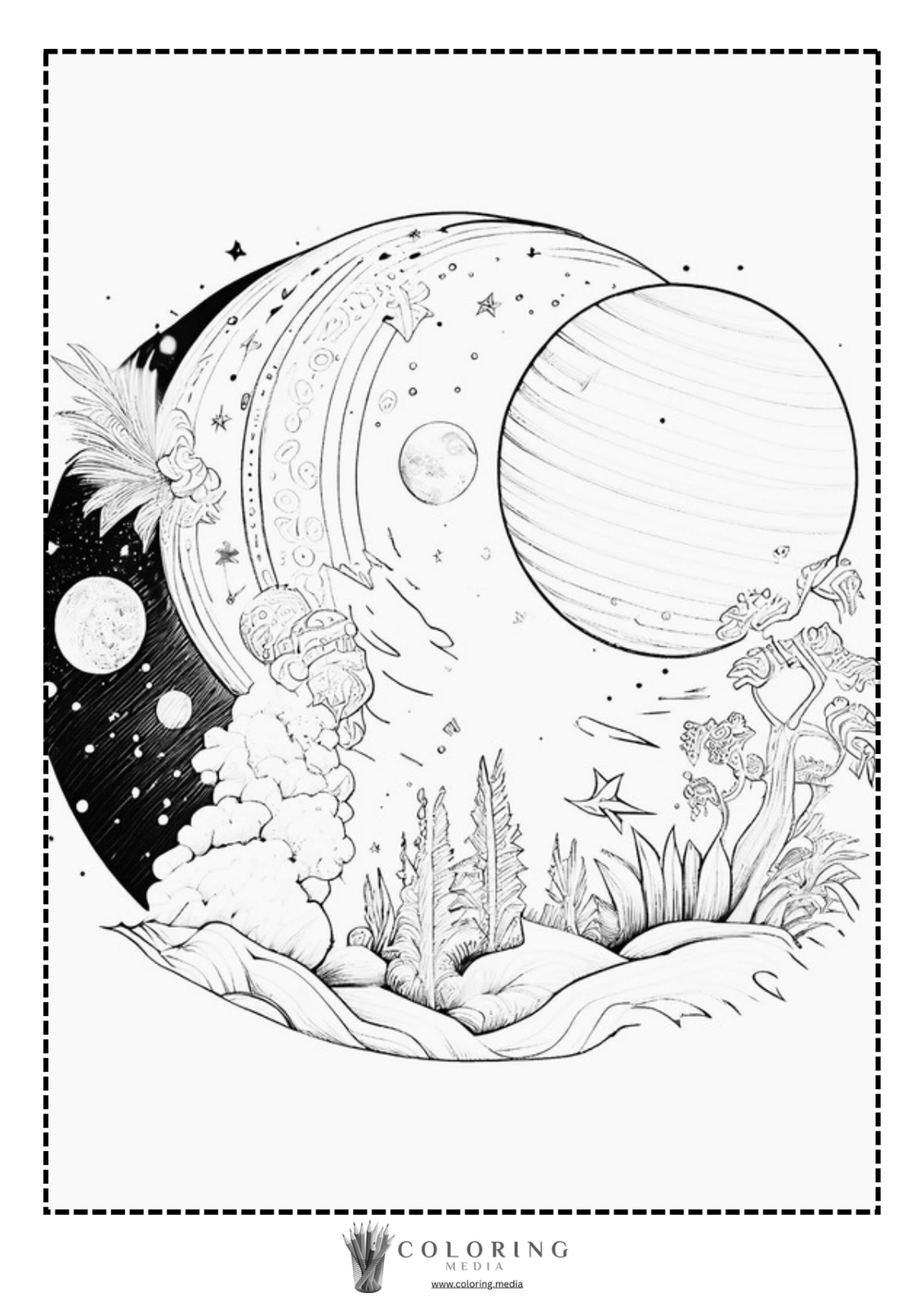
These 10 pages each present a circular cosmic composition — planets of different sizes, ring systems, moons, and nebula cloud swirls arranged within a globe-shaped frame. Some pages are relatively spare, with a few large planetary bodies and clean star fields. Others are densely packed with planets overlapping and cosmic gas clouds filling the background. The linework ranges from semi-realistic crosshatched shading to more open, decorative cosmic designs.
The circular framing gives each page a contained, almost mandala-like quality — the cosmos compressed into a single coloring area. Choosing how to color a ringed planet, a swirling nebula, or a distant star cluster is fundamentally an exercise in color decision-making with a scientific reference point. Everything here is free to download and easy to print.
Free Printable Galaxy and Planet Coloring Pages
This collection includes 10 printable galaxy and planet coloring pages featuring circular cosmic compositions with planets, ring systems, moons, star clusters, and nebula cloud formations arranged in globe-shaped frames. Styles range from semi-realistic with detail shading to more open decorative designs. Print on US Letter or A4 paper.


Who Are These Galaxy and Planet Coloring Pages Best For?
Early-elementary children (ages 6-9) who are into space will find the circular planetary compositions immediately engaging — they are visually dramatic and the circular frame gives clear structure to the coloring area. Children who have been studying the solar system can apply what they know about real planet colors (Mars red, Neptune blue, Saturn’s golden rings) even if the compositions are not strictly accurate scientifically.
Older children and teens interested in astronomy or astrophotography will find these pages a creative complement to what they know. The nebula cloud sections in particular reward layered color work — blending blues, purples, and pinks in the same area mimics the actual appearance of real nebulae photographed by space telescopes.
These pages also work as an introduction to galaxy and nebula concepts for children who have not yet encountered them in school. Coloring a cosmic cloud formation and asking ‘what do you think this is made of’ opens a conversation about gas, dust, and star formation without requiring any prior knowledge.
Interesting Galaxy and Planet Facts to Share While Coloring
There are more stars in the observable universe than grains of sand on all of Earth’s beaches. The observable universe contains an estimated 2 trillion galaxies, each with hundreds of billions of stars. The number is so large it is genuinely impossible to visualize — and yet the universe may extend far beyond what we can observe.
Saturn’s rings are surprisingly thin relative to their width. The rings span about 282,000 kilometers in diameter — wider than the distance between Earth and the Moon — but are only about 10 meters thick on average. If you scaled Saturn to the size of a basketball, the rings would be thinner than a sheet of paper.
Nebulae are the birthplaces and graveyards of stars. When stars die, they eject their outer layers into space, forming colorful emission nebulae. Gravity slowly pulls the dispersed gas and dust back together over millions of years until it collapses into new stars — a cycle that has been running since the first stars formed nearly 13 billion years ago.
Creative Galaxy and Planet Coloring and Craft Ideas
Scientifically Accurate Colors Research real planet colors before coloring: Jupiter’s orange and white cloud bands, Venus’s pale yellow-white, Uranus’s pale blue-green from methane, Neptune’s deeper blue. Apply them to whichever planets appear in the composition.
Nebula Technique Blend purple, pink, teal, and blue in layered watercolor washes for nebula cloud areas — the actual appearance of nebulae in Hubble Space Telescope images uses exactly those color families.
Glow Effect Color the star points yellow or white, then use a diluted blue or purple marker to create a soft glow radiating outward from each star.
Space Art Comparison Look up one real Hubble or James Webb Space Telescope image and identify which colors the coloring page’s design shares with the real photograph.
Black Space Background For a dramatic effect, use black oil pastel or black crayon to fill all background space areas, then color the planets and nebulae in bright contrast.
Constellation Add-On Connect several stars in the composition with light pencil lines to form a real constellation and label it.
Scale Comparison Draw Earth, the Moon, and the Sun at correct relative sizes on another sheet of paper — Earth is about 4 times the size of the Moon, and the Sun is about 109 times the size of Earth.
Space Poetry Write a four-line poem inspired by the finished colored page — what does the galaxy feel like, what would it sound like if you were standing inside it?
How to Print These Galaxy and Planet Coloring Pages
Each page downloads as a PDF formatted for US Letter and A4 paper. For the best visual result with nebula color work, print on smooth white cardstock (65 lb or heavier) and use colored pencils that blend well. Grayscale printing works fine for crayon use. The circular composition prints centered on the page with white margin space around it.
Explore More Science & Nature Coloring Pages
If you enjoyed these pages, you may also like:
Astronaut Coloring Pages
Solar System Coloring Pages
Outer Space Coloring Pages
Space Coloring Pages
Science & Nature Coloring Pages