

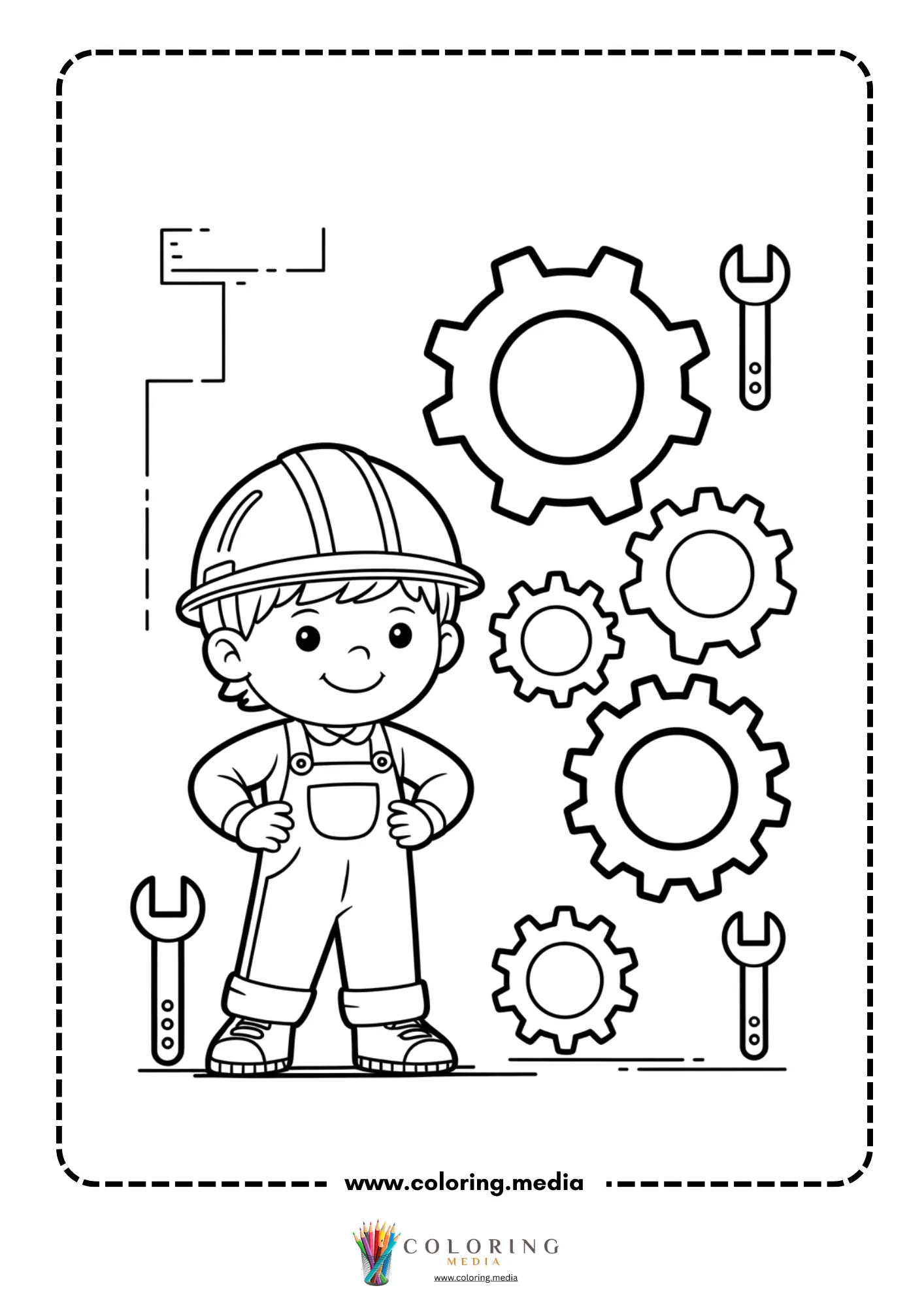
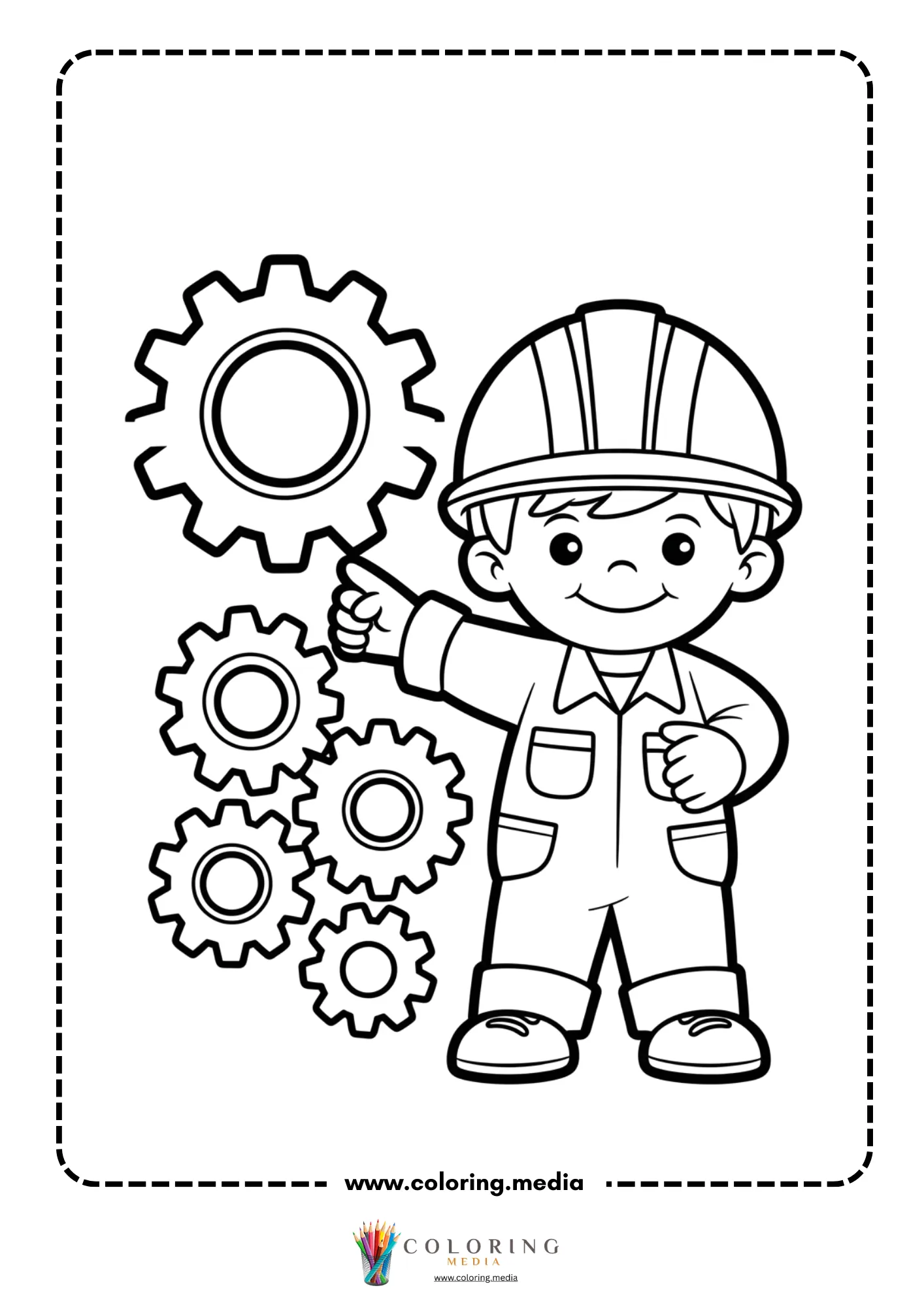
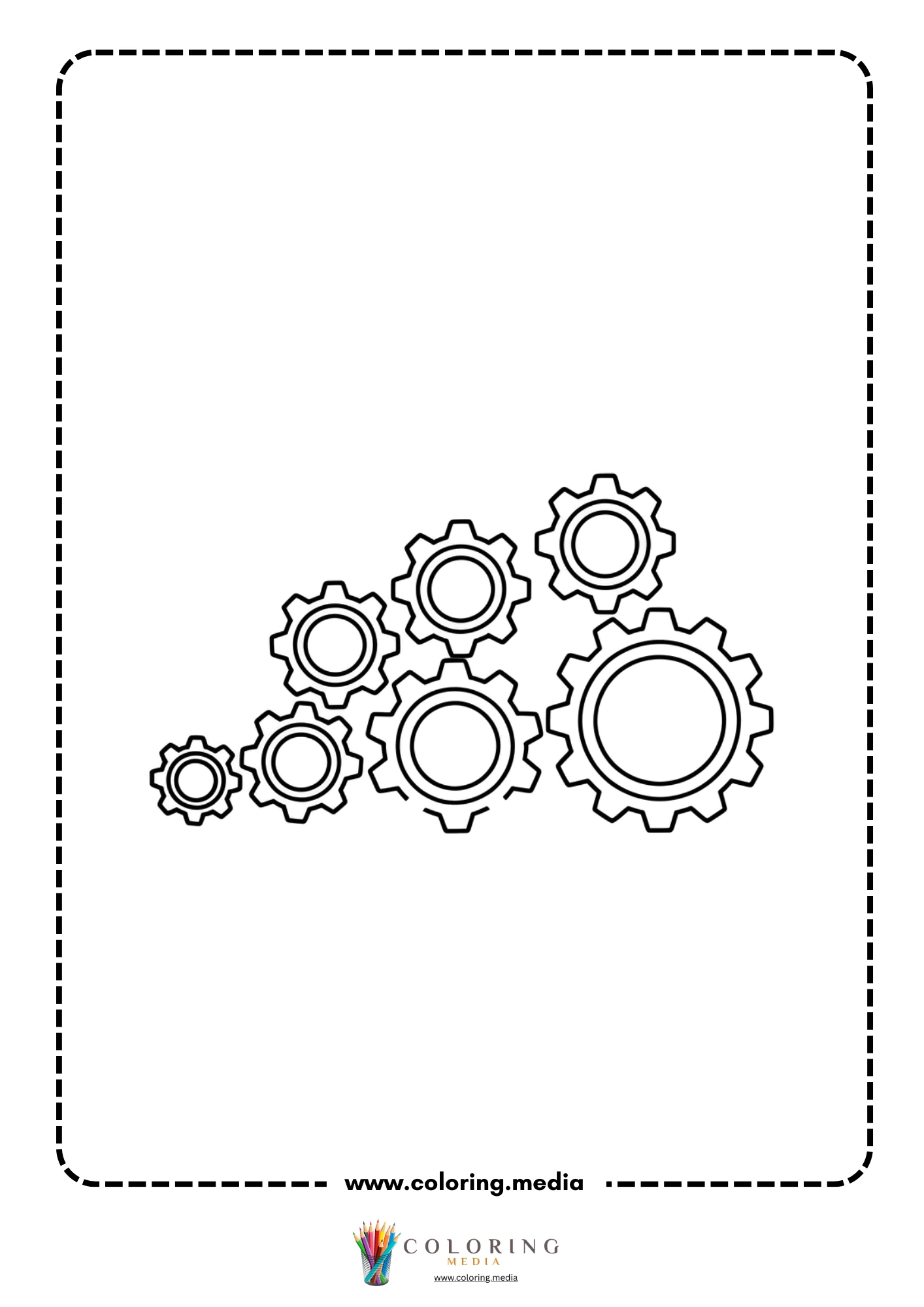
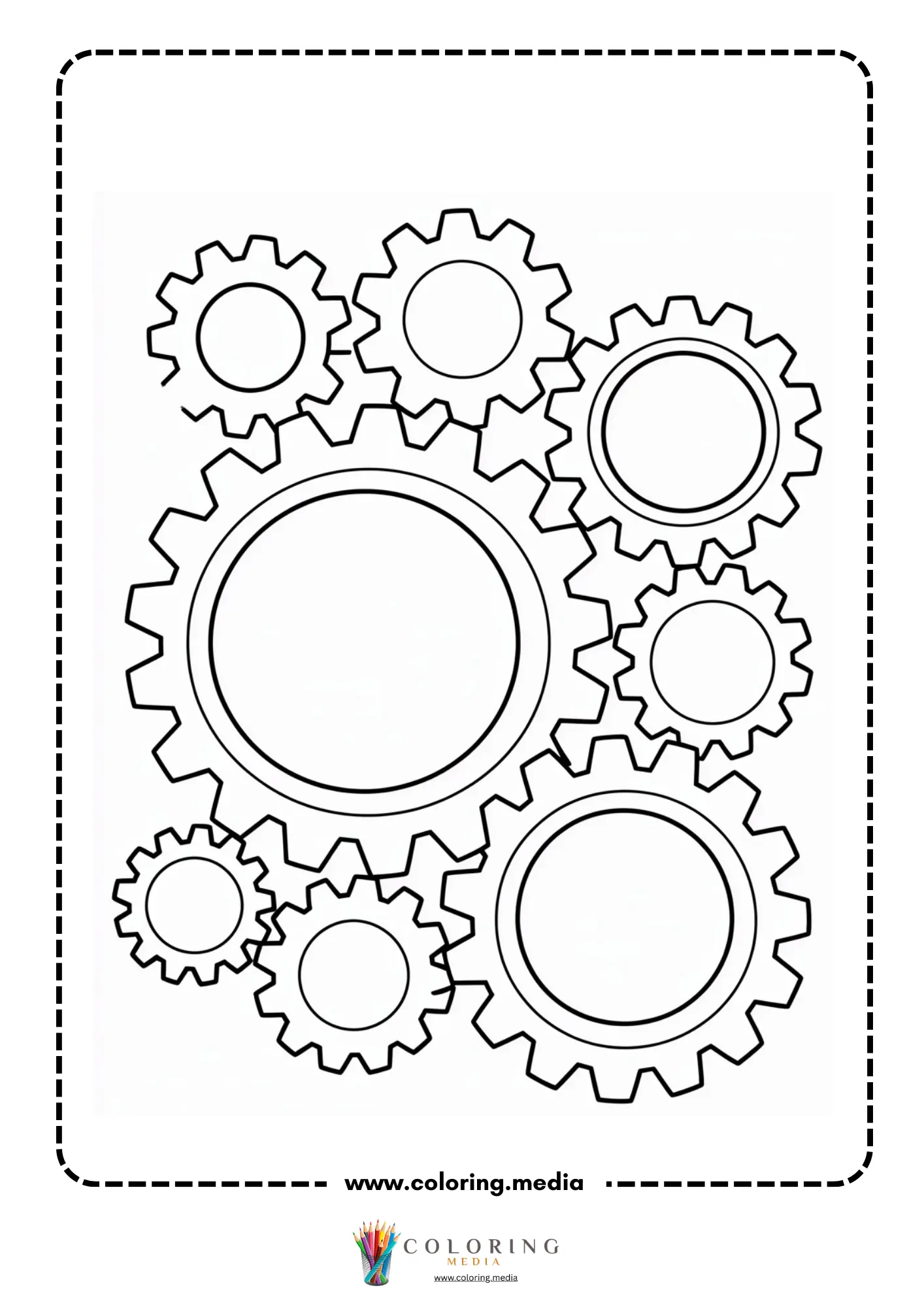
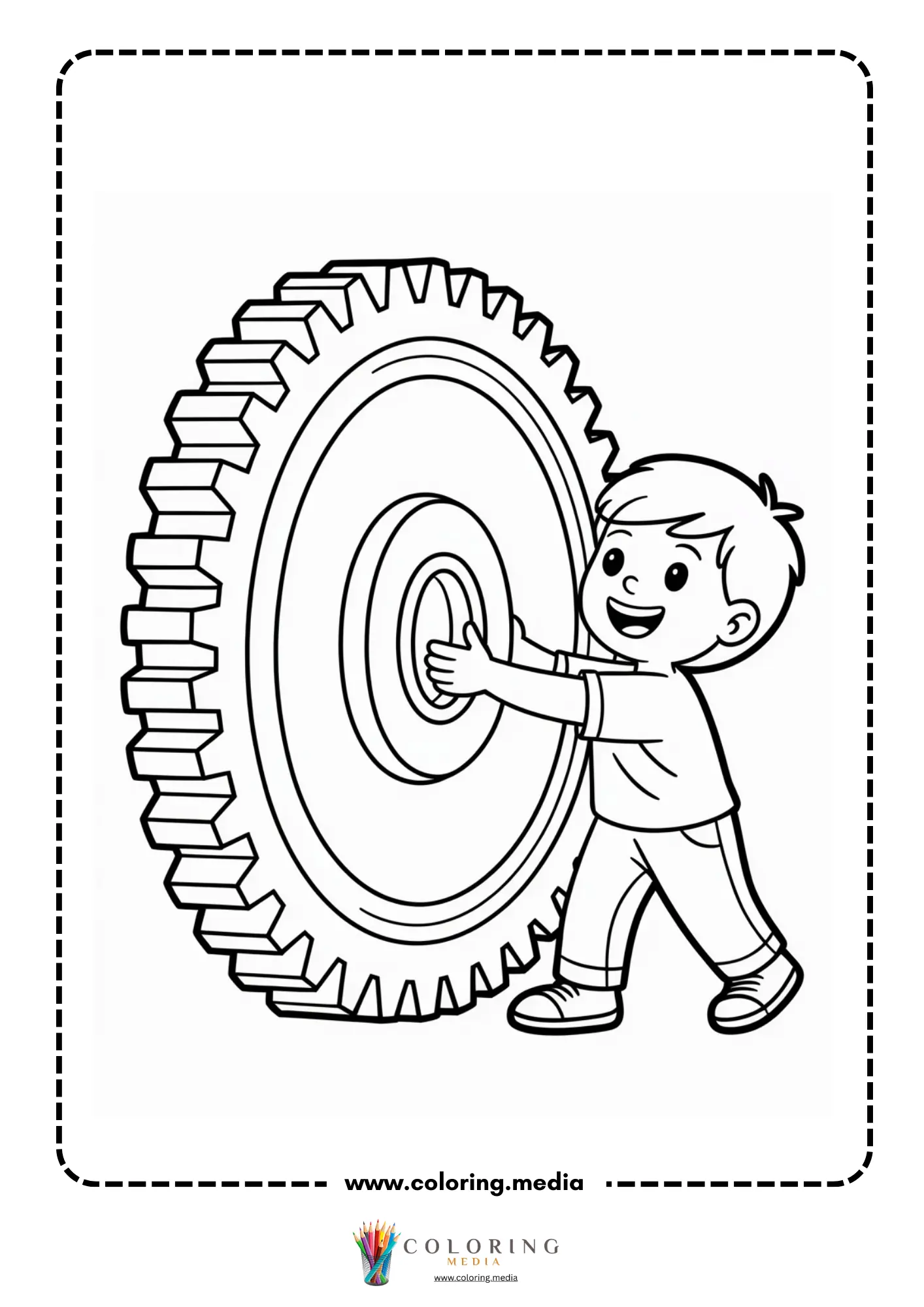
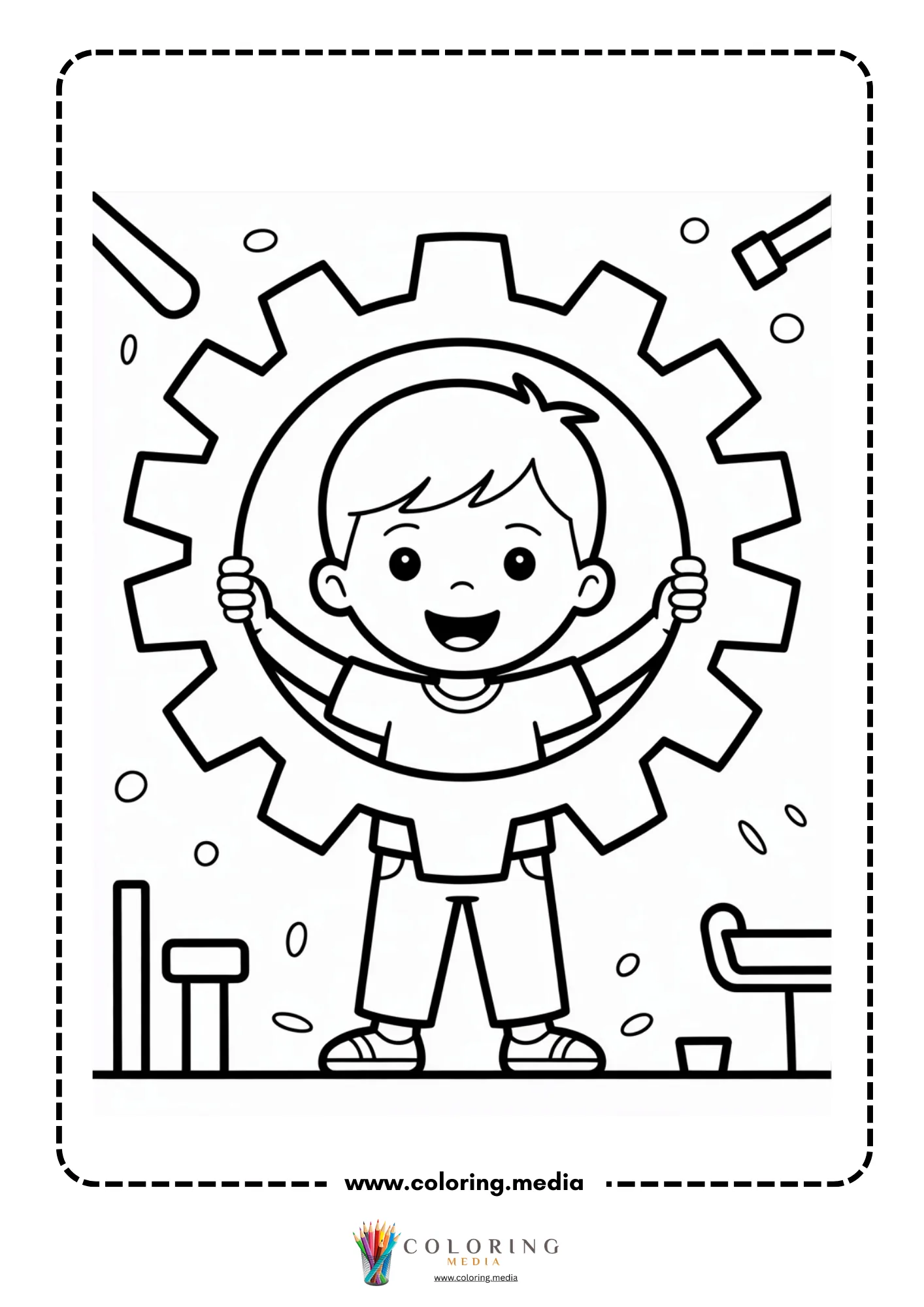
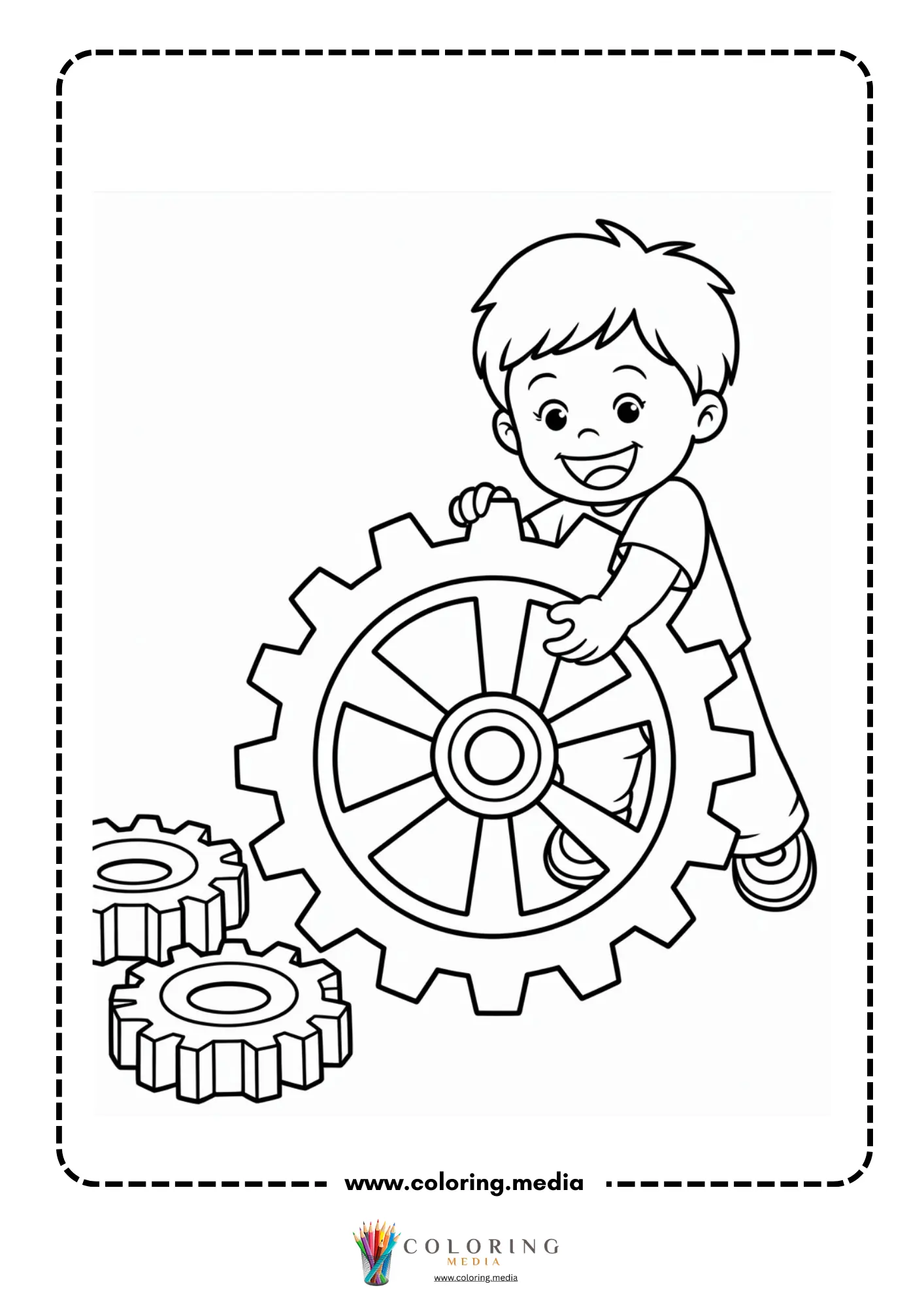
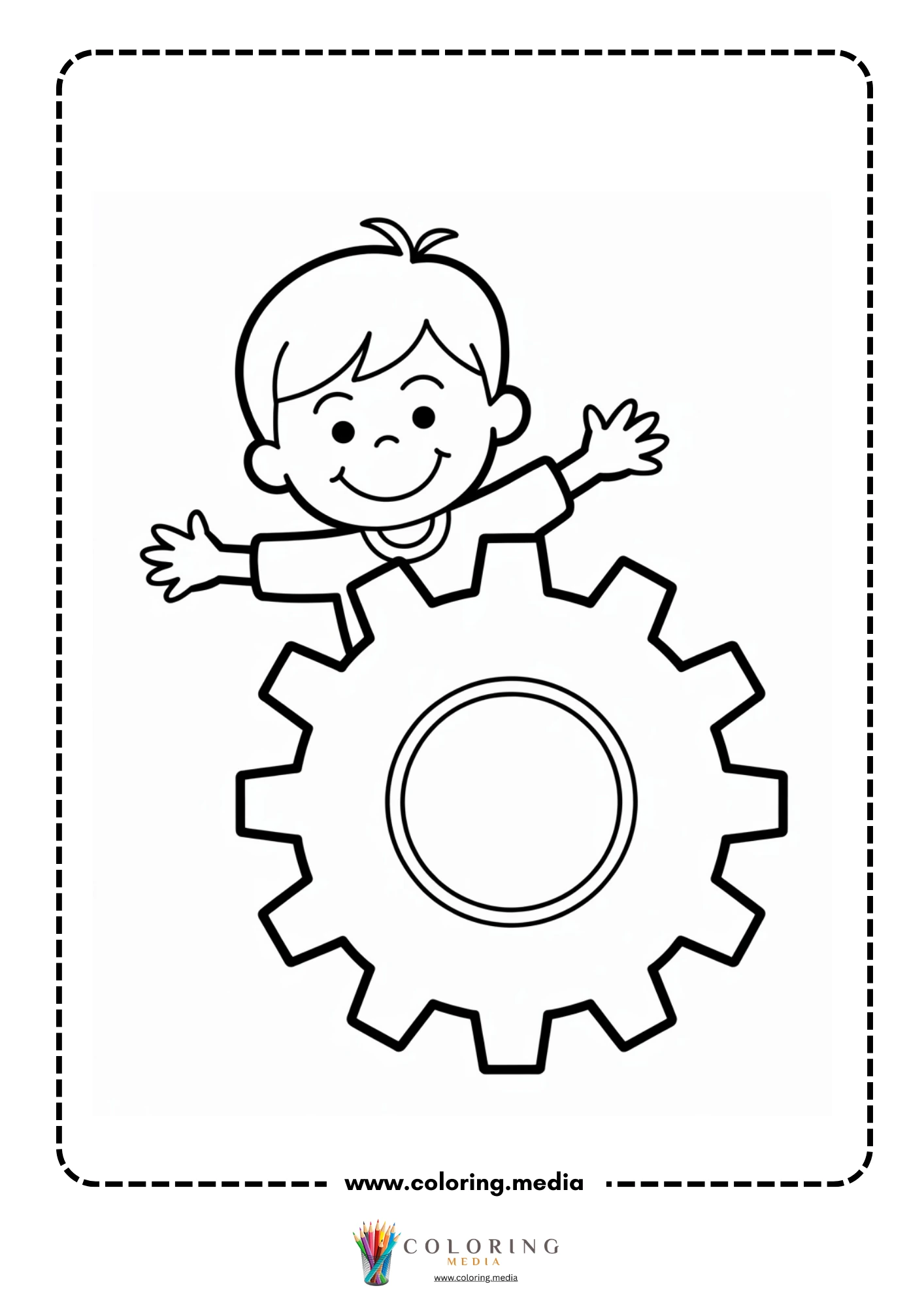
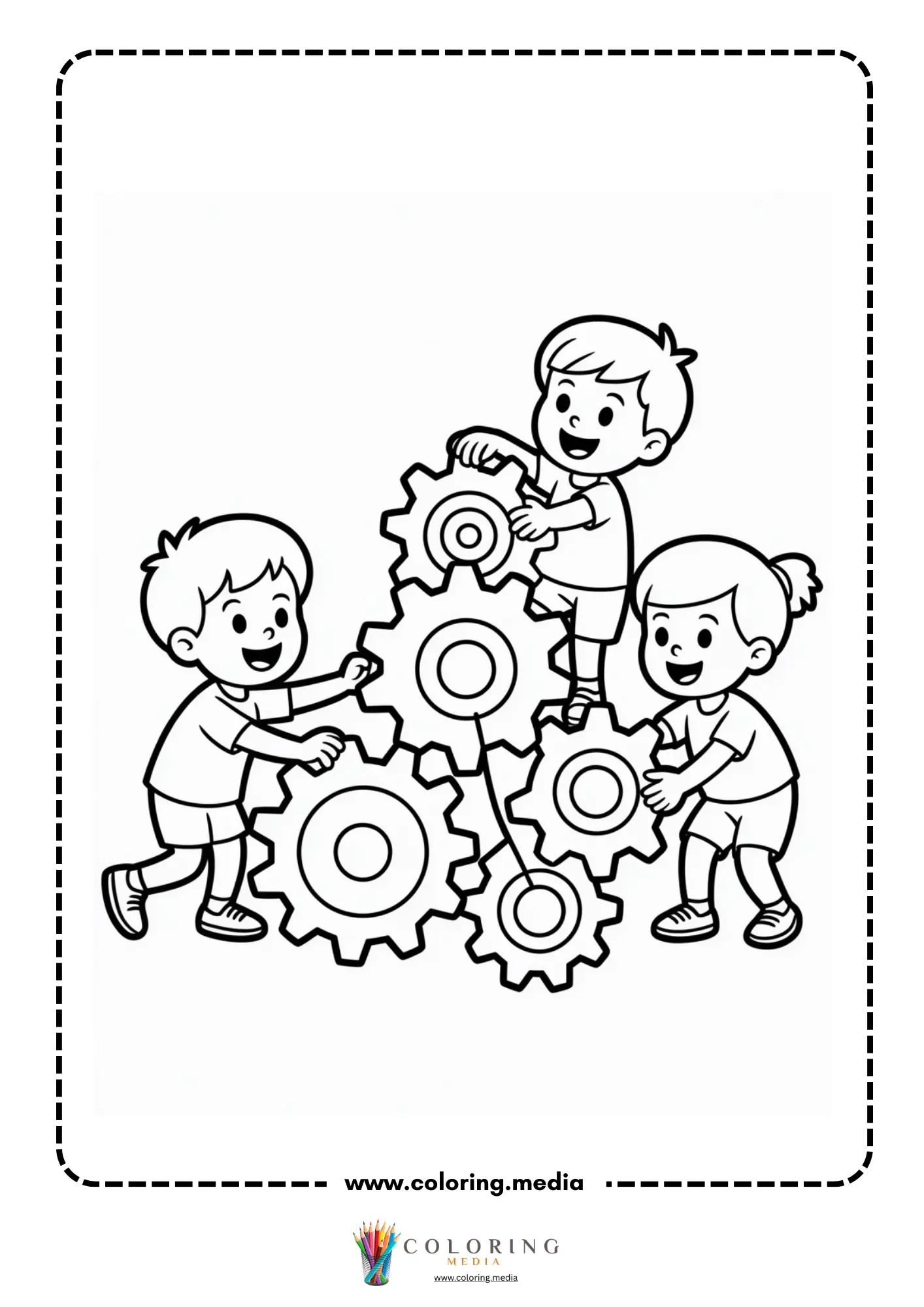
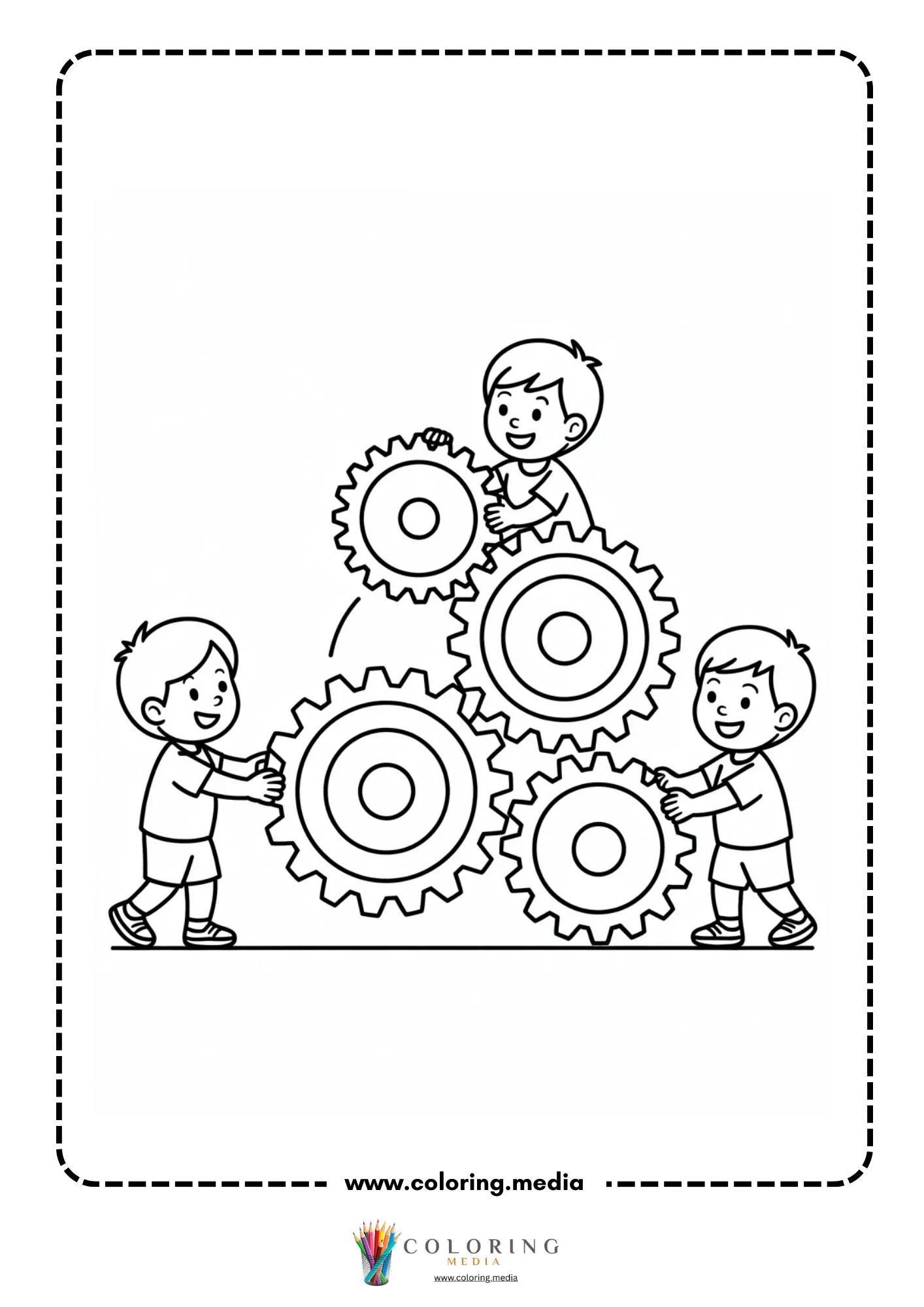
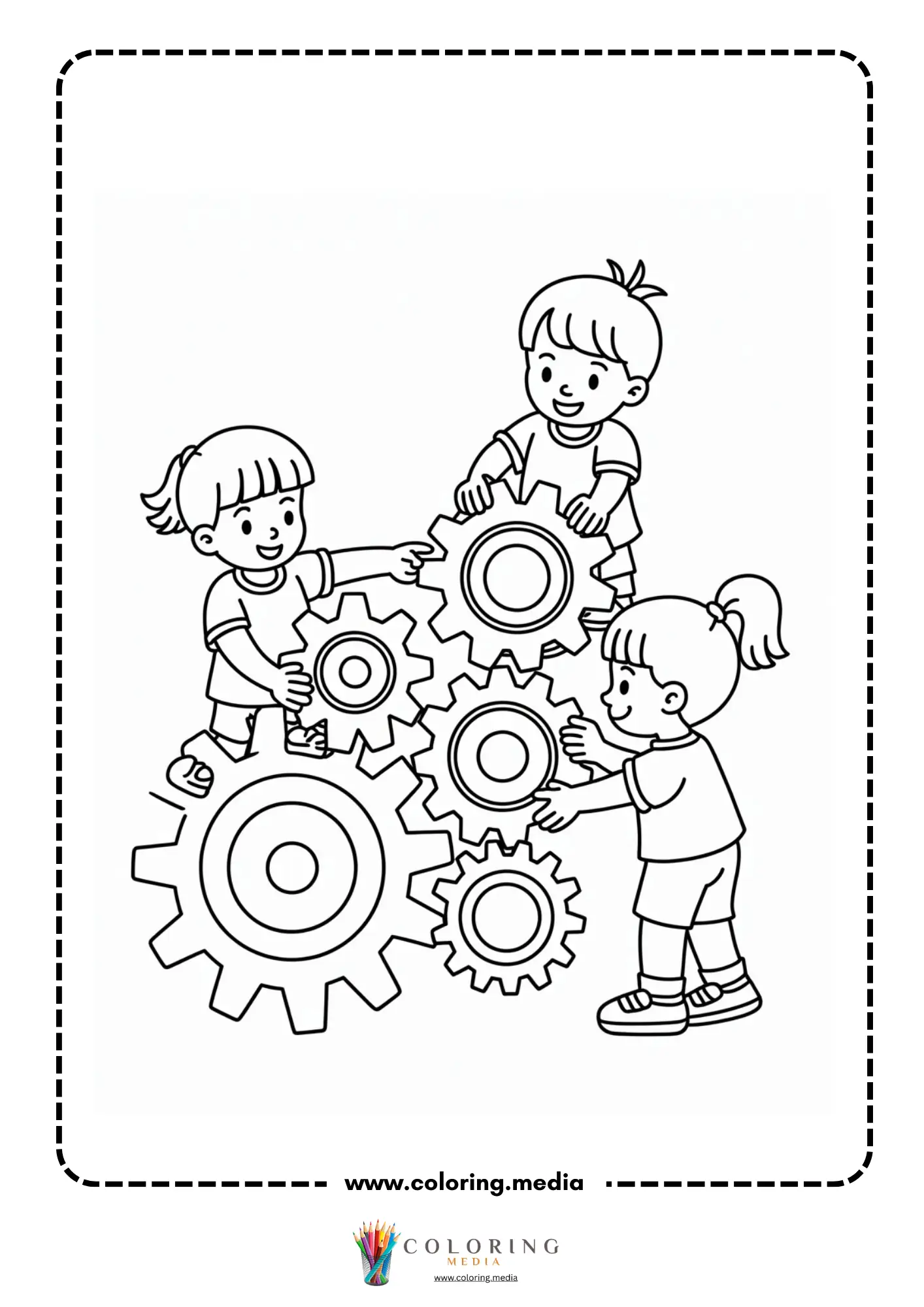
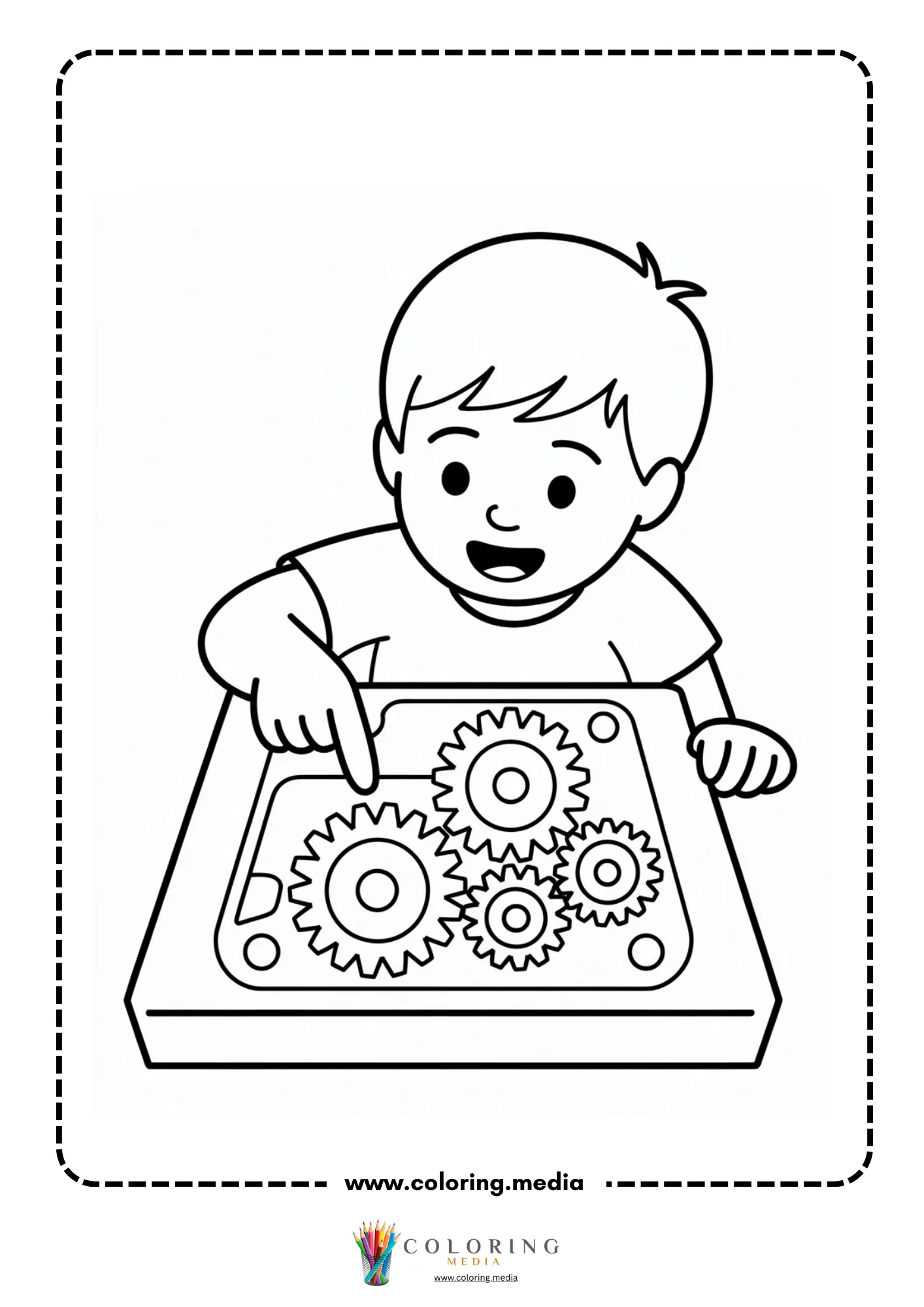
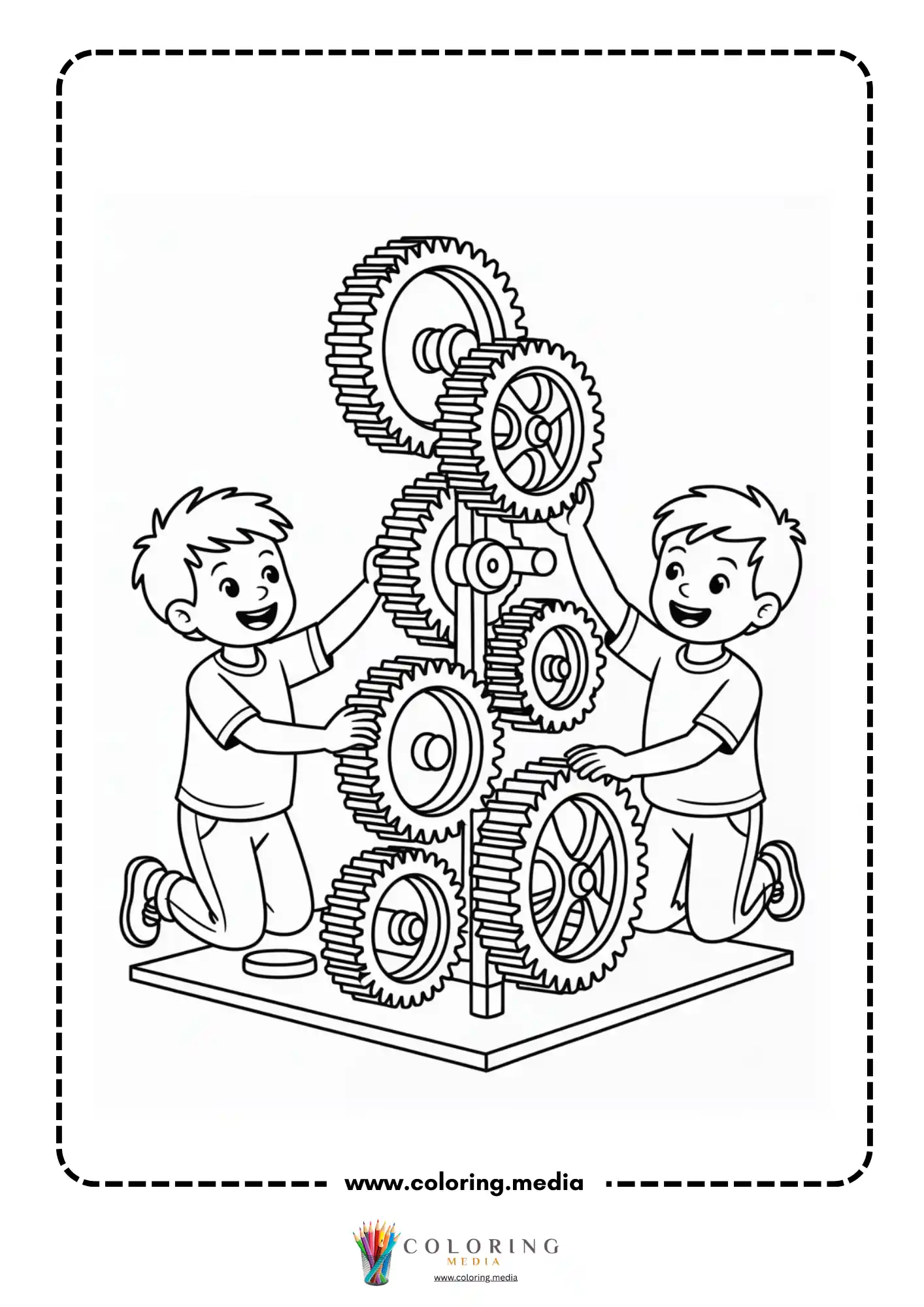
Roughly half the pages here are abstract gear compositions — a single large cog filling most of the page, a cluster of interlocking gears in a tight mechanical arrangement, a pattern of small cogs scattered across a field. The other half introduces human figures: a child peering into a gear assembly, a cartoon engineer surrounded by spinning cogs, a character holding an oversized gear like a prop. Both modes are visually interesting, but the character pages give younger colorers something to anchor to while the abstract ones suit older children who can appreciate pattern and structure for their own sake.
The detail level varies significantly — some pages have very few interior lines and are appropriate for crayons, while others have dense interlocking teeth and inner hub details that call for fine-tip colored pencils. Everything here is free to download and easy to print.
Free Printable Gear Coloring Pages
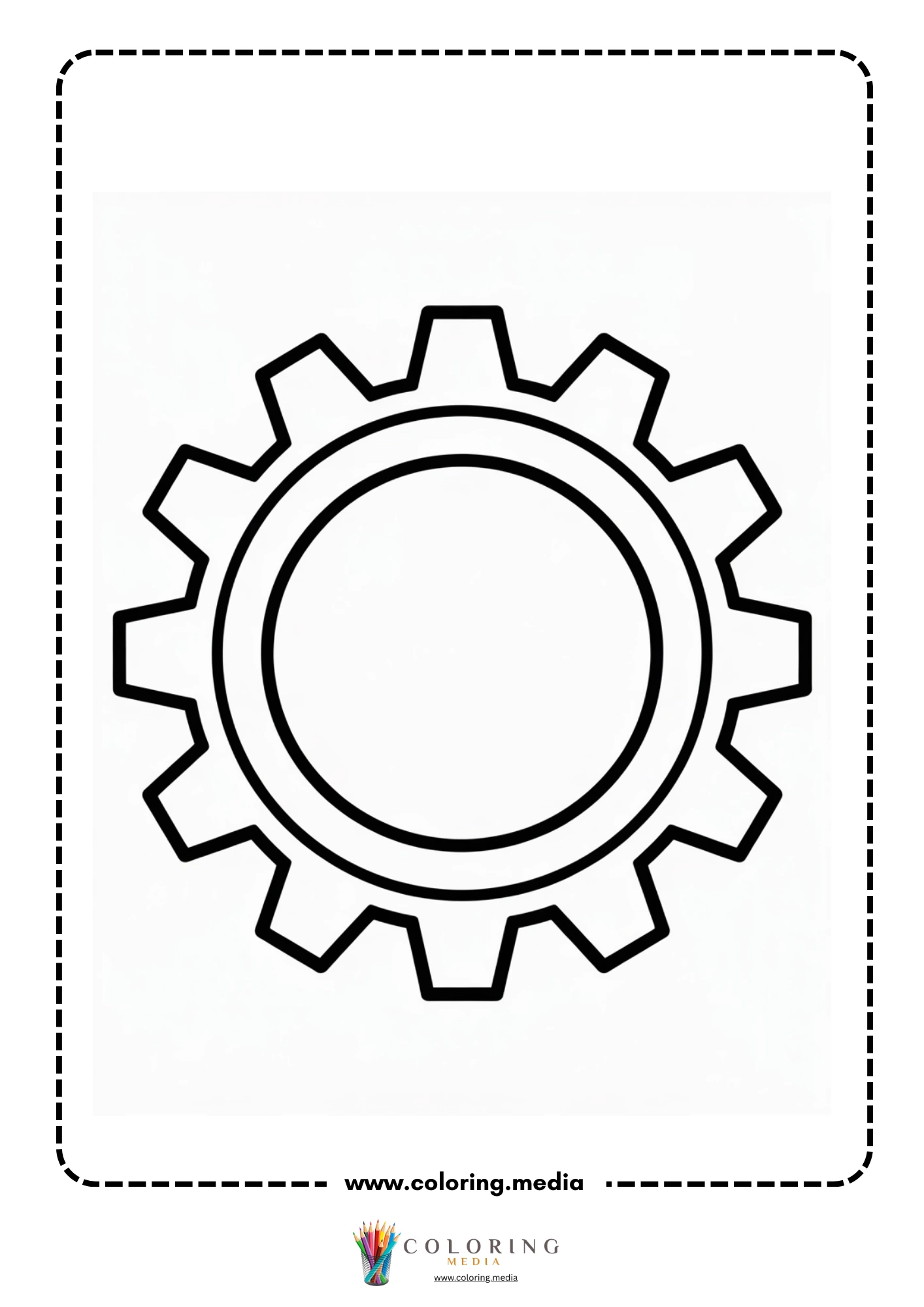
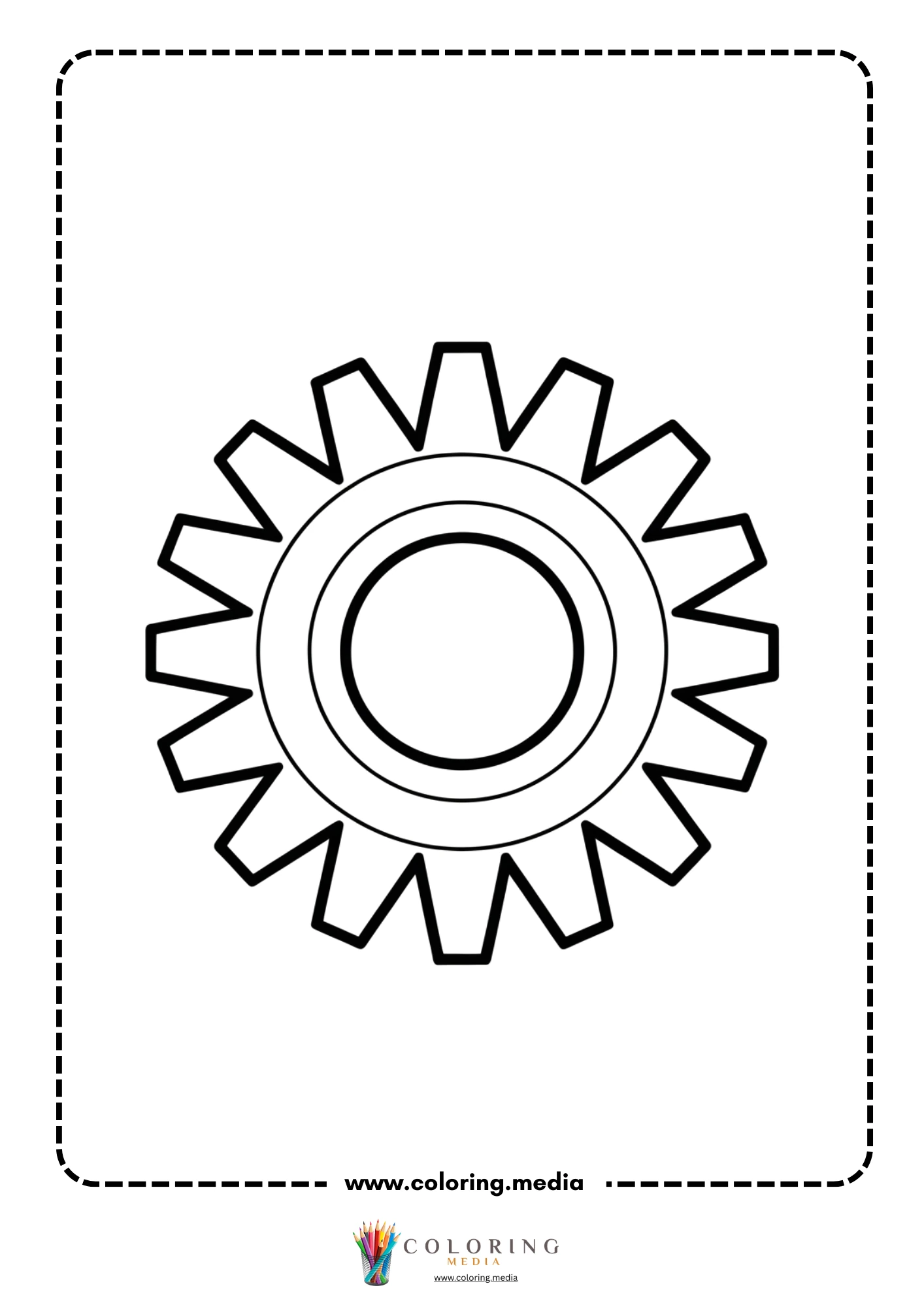
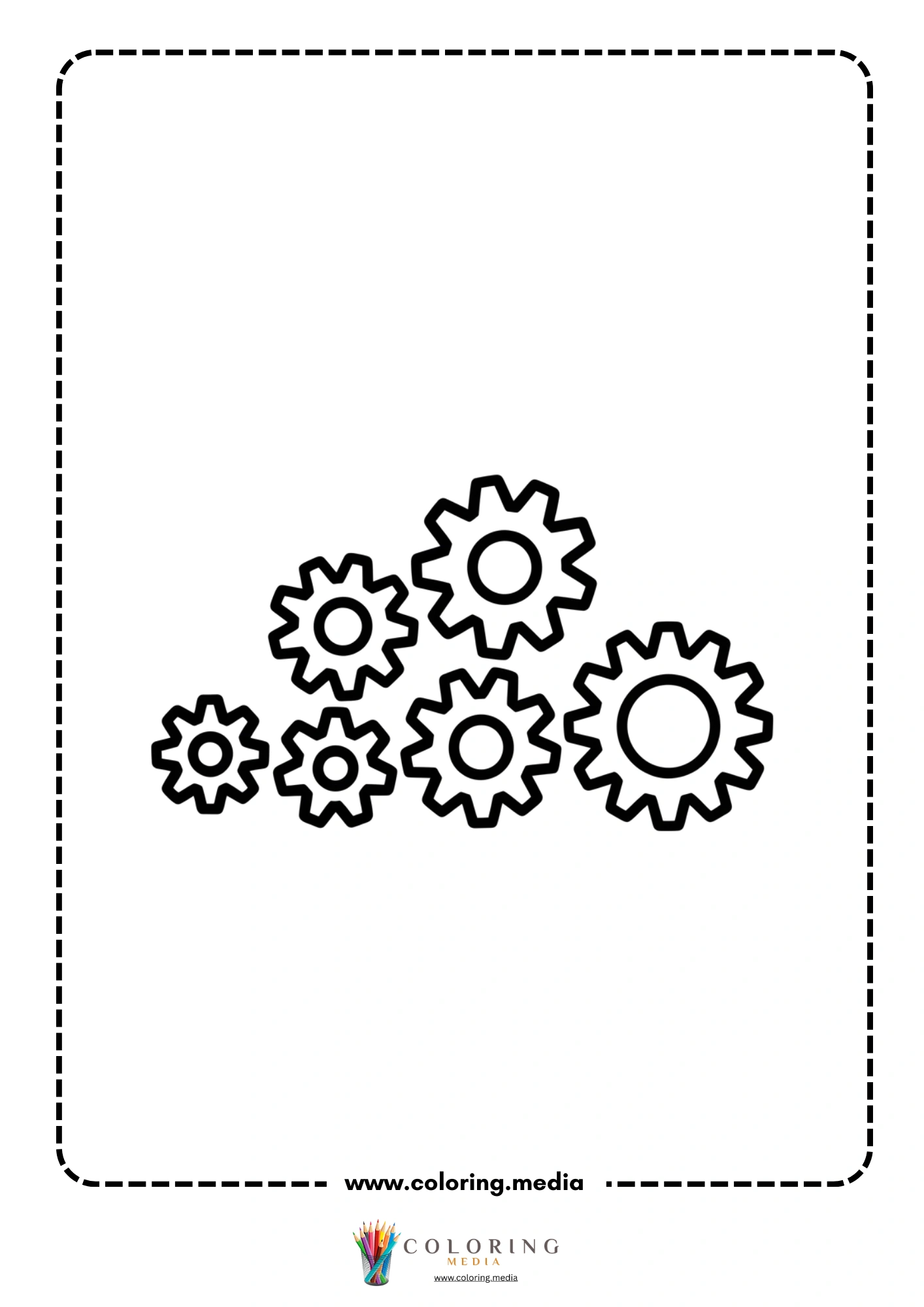
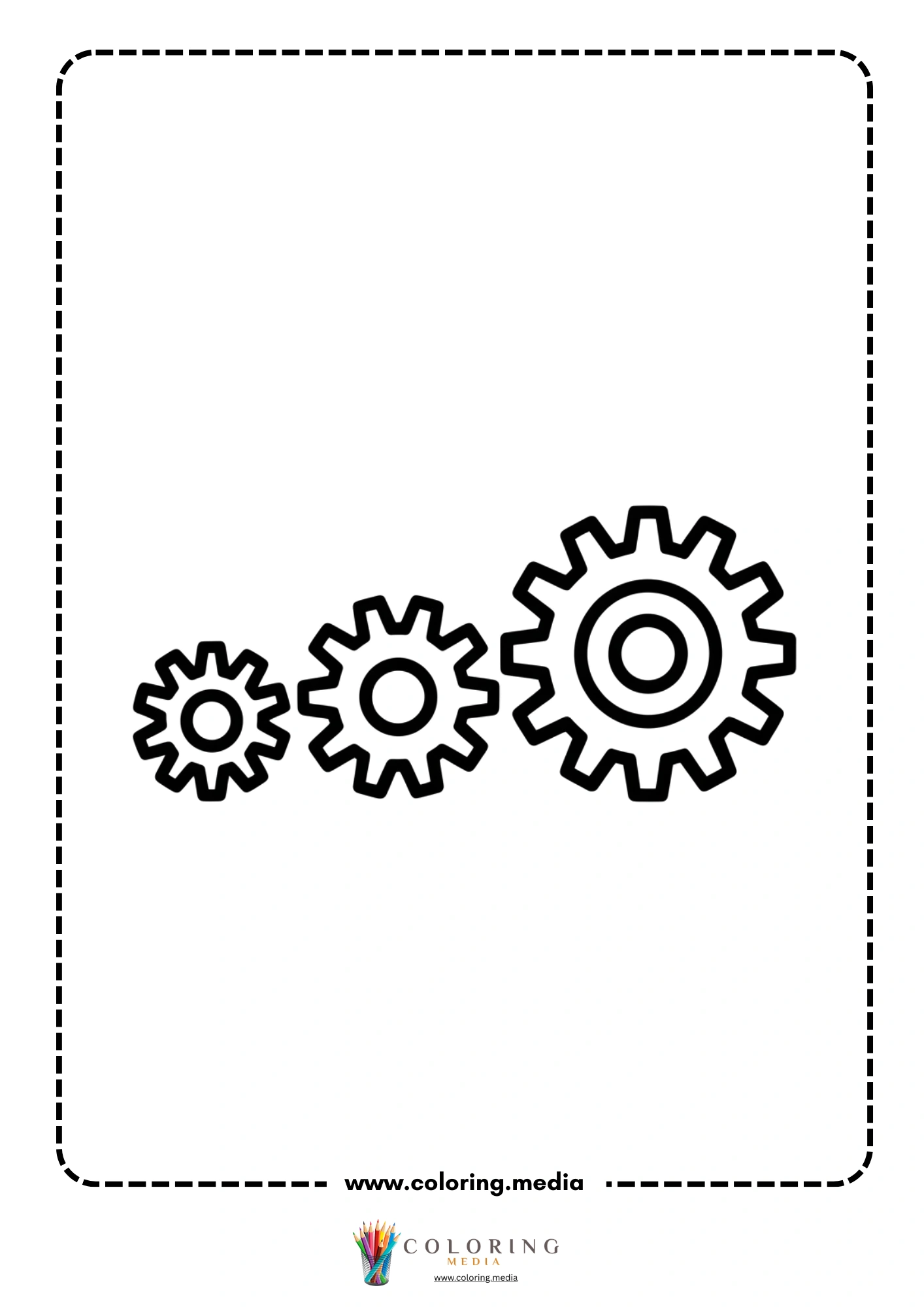
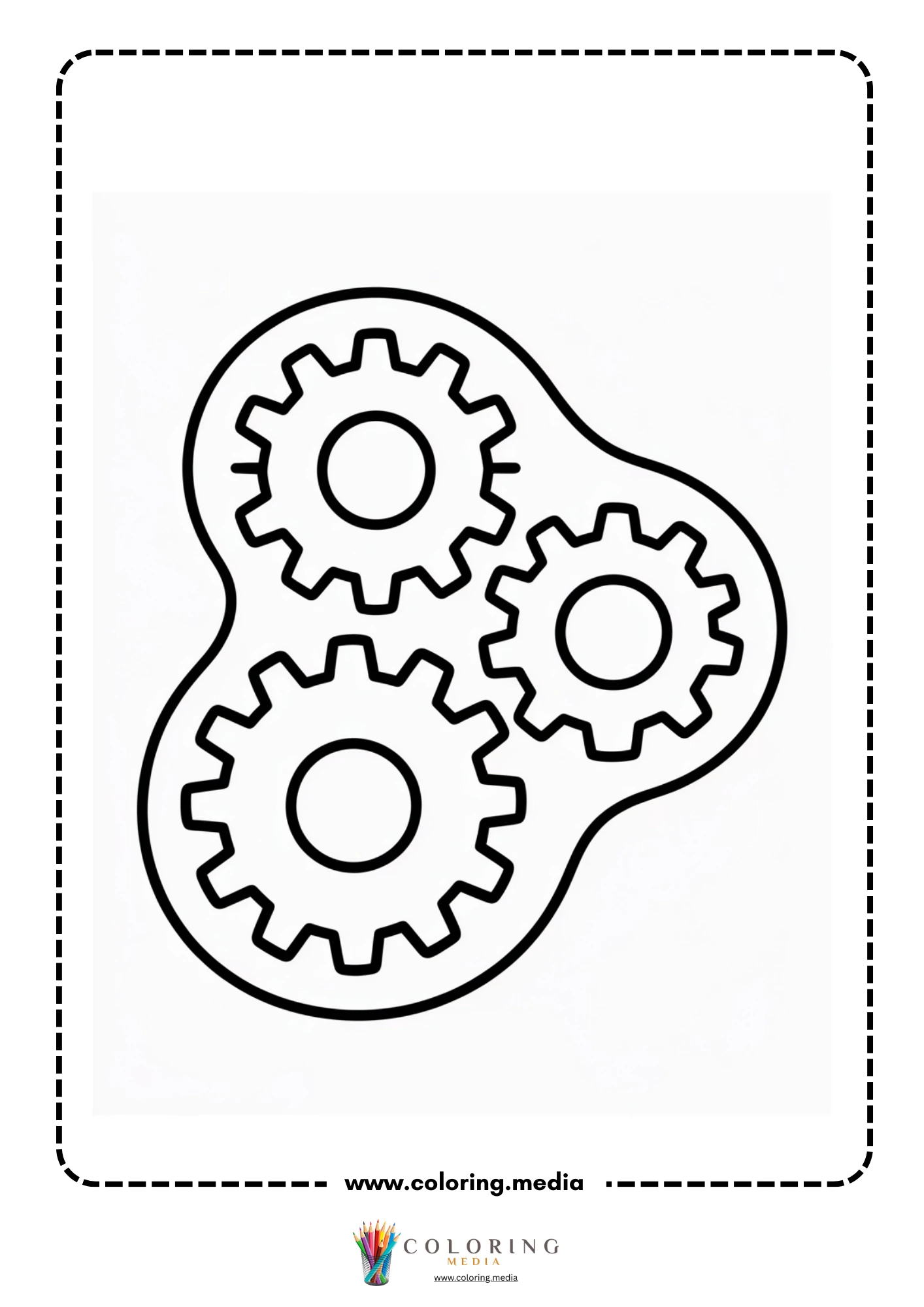
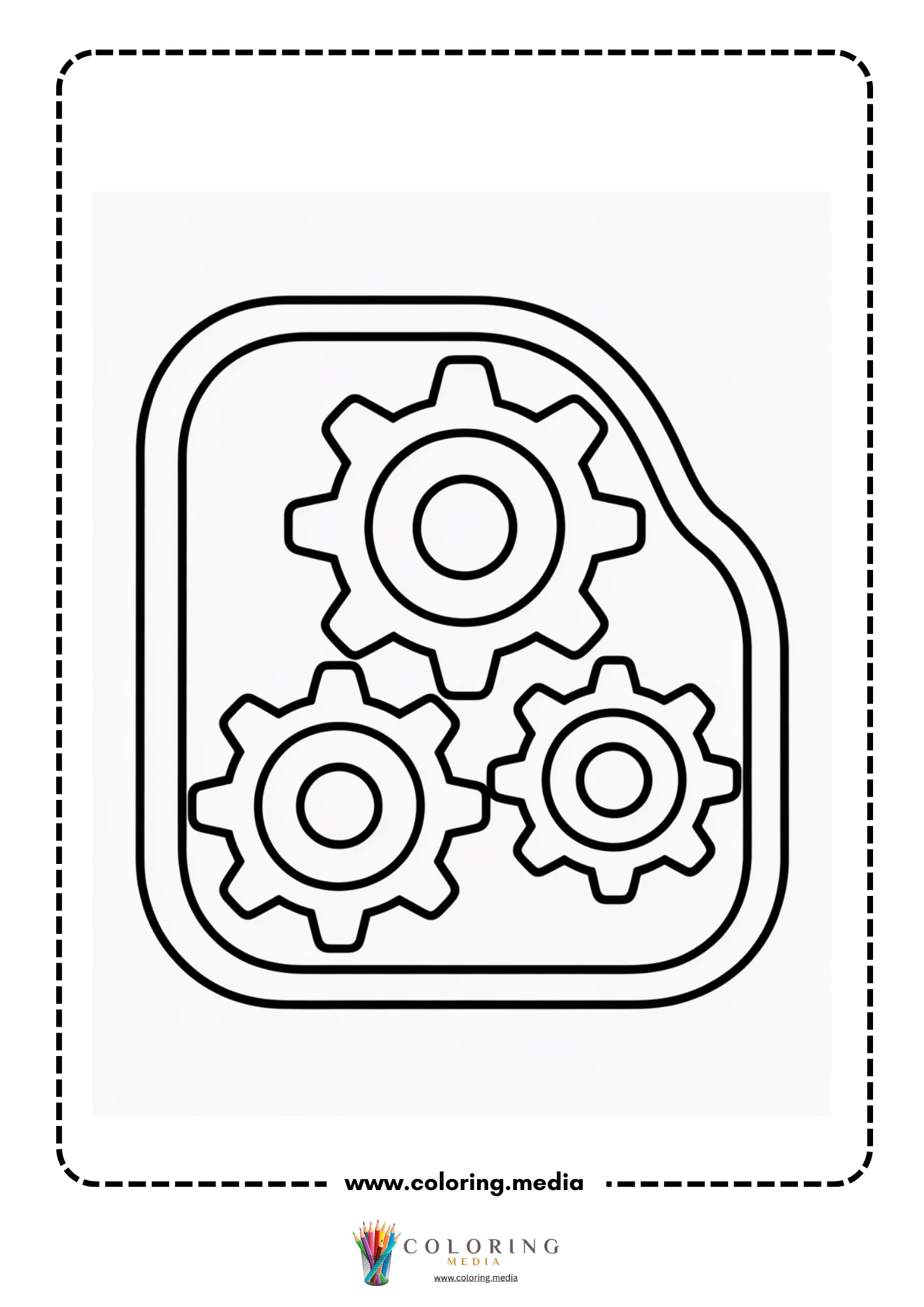
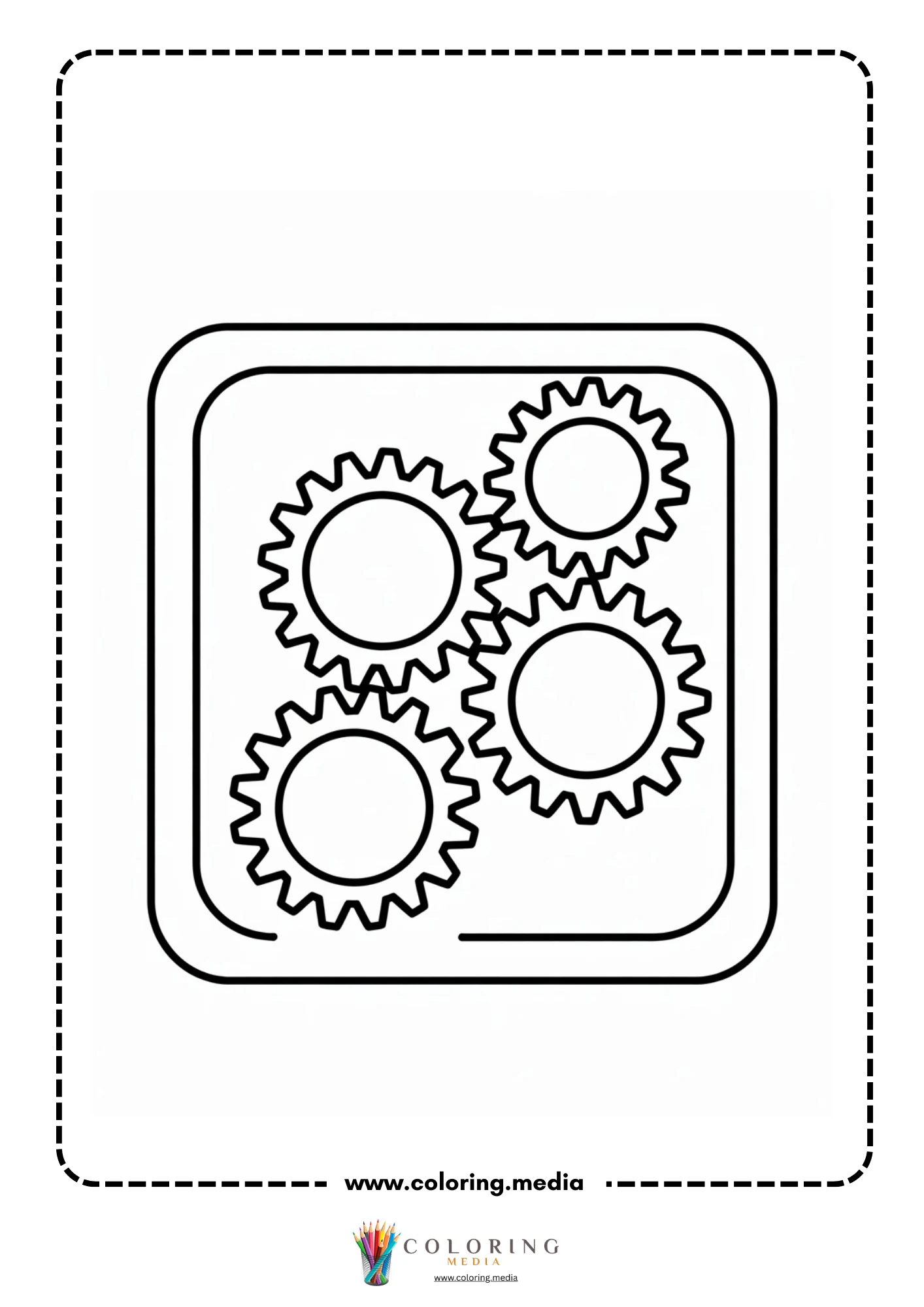
This collection includes 26 printable gear coloring pages featuring single large gear illustrations with detailed teeth and hub holes, multi-gear interlocking systems showing how cogs mesh together, abstract gear pattern compositions, child and engineer characters interacting with gear assemblies, whimsical gear-powered machine scenes, and decorative gear arrangements. The range from simple single-cog to complex interlocking system makes this set useful across a wide age range and works equally well as a STEM activity or a pattern-focused art exercise. All pages print on A4 or US Letter paper.






Who Are These Gear Coloring Pages Best For?
Kindergarteners can work with the single-gear pages and the character scenes. The large isolated cog designs have outlines thick enough for crayon coloring, and the character pages give a recognizable human face to the mechanical subject. A child who has played with interconnecting toy gears will recognize the shapes immediately and bring that prior experience to the coloring.
Early elementary students (grades 1–3) will find the multi-gear interlocking pages most engaging from both a visual and a conceptual standpoint. Coloring adjacent gears in different colors makes the mesh points visible and prompts questions about how turning one gear affects the next. This is an ideal hands-on entry point for a unit on simple machines or mechanical engineering.
The abstract pattern pages work well for older students or any age in an art context — the geometric repetition and radial symmetry of gear shapes respond beautifully to systematic color schemes like alternating colors or gradient progressions around the circumference.
Interesting Gear Facts to Share While Coloring
Gears can change both the speed and the force of a rotation. A small gear driving a large gear slows the rotation down but increases the turning force — this is why bicycle riders shift to a lower gear on a hill. A large gear driving a small one does the opposite: faster rotation, less force.
The Antikythera mechanism, discovered in a Greek shipwreck and dated to around 100 BC, is the oldest known gear-based device. It used at least 30 bronze gears to calculate astronomical positions, predict eclipses, and track the timing of Olympic Games. Nothing of similar complexity was made in Europe for another 1,400 years.
Clocks were the devices that drove the development of precise gear-cutting. Early clockmakers had to file each gear tooth by hand. The invention of gear-cutting machines in the 18th century was a critical step toward the Industrial Revolution, enabling all the other precision machinery that followed.
In a gear train, every other gear spins in the opposite direction to its neighbor. If you color gear 1 spinning clockwise, gear 2 turns counterclockwise, gear 3 clockwise again. This alternating pattern continues through any chain of meshing gears.
The largest gears in everyday use are in wind turbines. The gearbox inside a modern wind turbine takes the slow rotation of the blades — typically 5 to 15 revolutions per minute — and steps it up to around 1,500 RPM, fast enough to drive an electrical generator efficiently.
Creative Gear Coloring and Craft Ideas
Alternating Color Rule For interlocking gear pages, color each gear a different color from its neighbor so the mesh points stand out as transition zones.
Direction Arrows After coloring a multi-gear page, draw curved arrows on each gear showing which direction it would spin if the leftmost gear turned clockwise.
Gradient Circumference For a single large gear, color the teeth in a gradient from yellow near the top to orange to red near the bottom, as if the gear is glowing with heat.
Gear Stamp Art Cut a gear shape from a potato or sponge, dip in paint, and stamp overlapping impressions on blank paper to create a repeat pattern.
Machine Inventor On the back of a character-and-gears page, invent a machine that the gears power. Draw and label its function.
Size and Speed Discussion For a page showing different-sized gears meshing together, predict which would spin faster and which would have more turning force. Then look up how to verify the answer.
Pattern Coloring For abstract gear pattern pages, apply a strict rule — every gear with more than 8 teeth gets one color, every gear with 8 or fewer gets another — and see how the rule distributes color across the page.
Build a Gear System Use a gear construction kit or online gear simulator to build the same arrangement shown in one of the multi-gear pages, then observe what happens when you turn one gear.
How to Print These Gear Coloring Pages
Each PDF is formatted for A4 and US Letter at 300 dpi. Download by clicking any thumbnail, then print from Adobe Reader or a browser with ‘fit to page’ enabled. Standard copy paper works fine for crayons. For the intricate multi-gear pages, fine-tip colored pencils or pens give much cleaner results inside the narrow tooth gaps. Select black-and-white print mode to save ink.
Explore More STEM Coloring Pages
If you enjoyed these pages, you may also like:
Simple Machines Coloring Pages
Levers Coloring Pages
Pulley Coloring Pages
Circuit Coloring Pages
STEM & Technology Coloring Pages