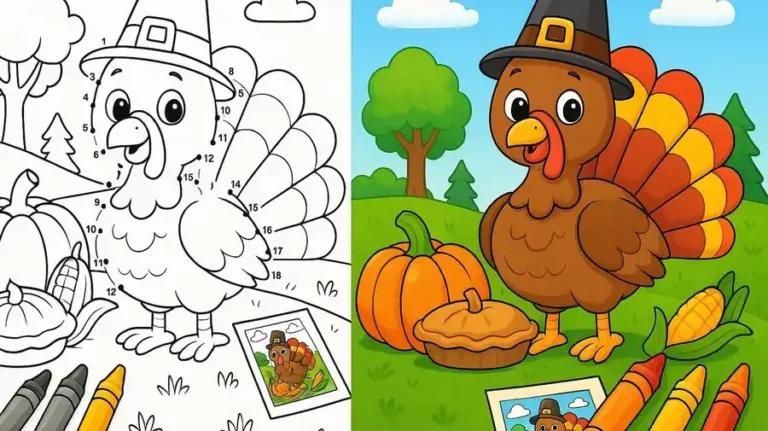

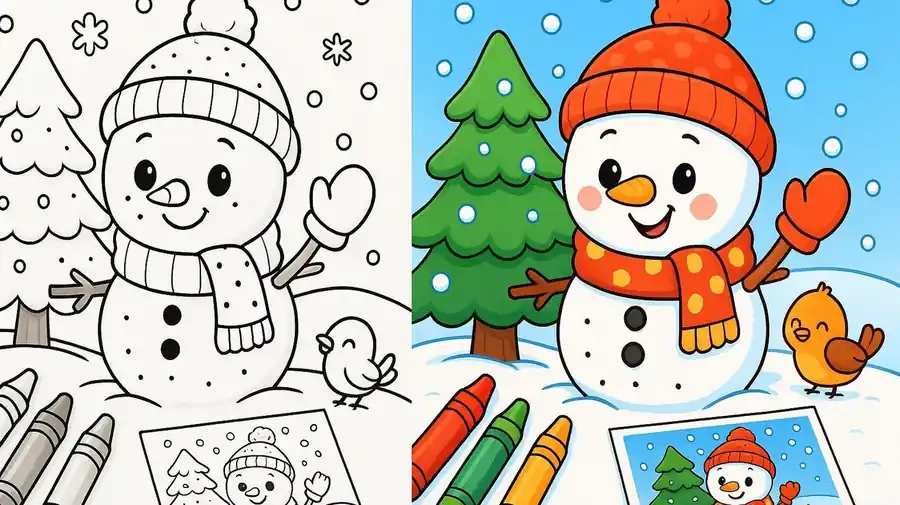
These winter dot-to-dot pages lean heavily into woodland animals in the cold season — owls perched wide-eyed, foxes bundled in scarves, deer and reindeer mid-stride, a hedgehog, bears, and even a penguin mixed in among the snowflakes and snowmen. The art style shifts between cleaner kawaii shapes with round faces and rounder dots, and more naturalistic outlines with longer point sequences that ask a bit more of the child completing them. Both types show up across the 40 pages, which means this set spans a wider ability range than most single-theme dot-to-dot collections.
The snow-and-woodland pairing gives kids something to talk about while they draw — why owls stay active in winter, how deer grow thicker coats, what foxes actually eat when the ground is frozen. That conversational layer makes these pages useful for more than fine motor practice. Everything here is free to download and easy to print.
Free Printable Dot to Dot Winter Coloring Pages
This collection includes 40 printable dot-to-dot winter coloring pages featuring snowmen with numbered dot sequences, symmetrical snowflakes, a wide cast of winter woodland animals including foxes, owls, deer, reindeer, bears, and a hedgehog, plus winter-themed items like gift boxes, garlands, and snow scenes. Dot counts range from roughly 20 on the simpler pages to well over 50 on the more complex ones, giving the set real range. Each page downloads as a crisp PDF sized for standard A4 or US Letter paper.


Who Are These Winter Dot to Dot Coloring Pages Best For?
The simpler pages in this set — the ones featuring large snowflake shapes, round-bodied snowmen, and kawaii-style animals with dot counts under 30 — are a good fit for kindergartners who can recognize numerals up to that range and hold a pencil with enough control to draw a straight line between dots. The shapes are forgiving enough that small wobbles don’t ruin the picture, which matters at that age. A child who can count reliably to 20 will get a lot of satisfaction from completing the owl or the round bear faces.
The more detailed pages — running deer, the hedgehog, foxes shown in full-body poses, and the longer snowflake constructions — are better matched to early elementary kids, roughly grades 1 and 2. These require tracking a sequence of 40 or more numbered dots while maintaining a consistent pencil direction, which is genuinely harder than it looks. The reward is a more complex and detailed finished image that older kids find more satisfying to color afterward.
In a classroom or homeschool setting, the mixed difficulty level in this pack is actually an asset. Kindergartners and first graders can work side by side on the same winter theme, each at the right challenge level. The animal pages also pair naturally with a unit on winter habitats or seasonal animal behavior.
Interesting Winter Animal Facts to Share While Coloring
Foxes don’t hibernate — they stay active all winter. A red fox in January is still hunting every day, listening for mice under the snow and pouncing through the surface to catch them. Their thick winter coat has two layers: a soft underfur for warmth and coarser guard hairs that shed moisture.
Owls can hear a mouse moving under a foot of snow. The disc-shaped feathers around an owl’s face act like a satellite dish, funneling sound toward their ears. Great horned owls, one of the owls that winters in cold climates, can hear frequencies far below what humans detect — which is how they locate prey they can’t even see.
Deer grow a completely different coat each winter. Their summer coat is reddish and sparse. By October, deer have shed it and grown a thick grayish-brown winter coat made up of hollow hairs that trap air and insulate like a down jacket. That’s why deer seen in snow always look darker and bulkier than their summer selves.
Snowflakes really do have six sides, always. The six-sided symmetry comes from the molecular structure of ice — water molecules bond in a hexagonal lattice as they freeze. No two snowflakes follow the exact same path through the atmosphere, so no two develop the exact same branching pattern, but all of them have that six-fold structure at the core.
Bears in winter are not actually fully hibernating. True hibernators like ground squirrels drop their body temperature to near freezing. Bears go into a lighter sleep called torpor — their temperature stays relatively warm, they can wake up if disturbed, and females even give birth to cubs mid-winter without fully waking. They lose up to 30% of their body weight while in torpor, surviving entirely on stored fat.
Creative Winter Coloring and Craft Ideas
Watercolor wash after connecting Once the dots are connected and the picture is revealed, fill it in with a light watercolor wash — pale blues and whites work especially well for snow scenes and ice crystal designs.
Pencil crayon layering for fur textures Use short strokes in the direction of the animal’s fur rather than filling in solid blocks of color — this works particularly well on the fox, bear, and hedgehog pages to give them a more realistic texture.
Winter scene background After completing an animal page, cut it out and glue it onto a larger sheet of blue or gray paper. Add cotton ball snow at the bottom and a pencil-drawn tree line in the background for a full winter scene display.
Numbered dot practice sheet Before a younger child attempts a page, write numbers 1–30 on a separate sheet and have them trace connecting lines between them first. This builds the tracking habit so the dot-to-dot itself goes more smoothly.
Mix and match winter animal book Print several of the woodland animal pages, complete and color them, then staple them together as a homemade winter animal book. Have the child dictate or write one fact about each animal to add underneath the picture.
Snowflake symmetry comparison Print two or three of the snowflake dot-to-dot pages and compare the finished shapes. Talk about which parts of each design are symmetrical and where the lines of symmetry are — a low-key introduction to geometry that fits naturally with the theme.
Color-code the dot sequence Give the child two colors of pencil and ask them to draw every other line segment in an alternating color. This adds a visual logic game on top of the sequencing task and produces a striped, geometric look in the final image.
Holiday card versions The snowman, gift box, and garland pages are compact enough to print at reduced size (70–75%) and use as the inside art for a homemade holiday card. Connect the dots, color it in, fold, and send.
How to Print These Winter Dot to Dot Coloring Pages
Each page downloads as a PDF that prints cleanly on standard A4 or US Letter paper. Regular 20lb copy paper works for pencil and crayon coloring; if you plan to use markers or watercolors after connecting the dots, 65lb cardstock will prevent bleed-through and keep the pages flat. If your printer tends to use heavy ink, print a test page in grayscale draft mode first — lighter dot numbers and connecting lines are easier for young children to see and follow.
Explore More Connect the Dot Coloring Pages
If you enjoyed these pages, you may also like:
Dot to Dot Animal Coloring Pages
Dot to Dot Autumn Coloring Pages
Dinosaurs Dot to Dot Coloring Pages
Dot to Dot Christmas Coloring Pages
All Connect the Dot Coloring Pages