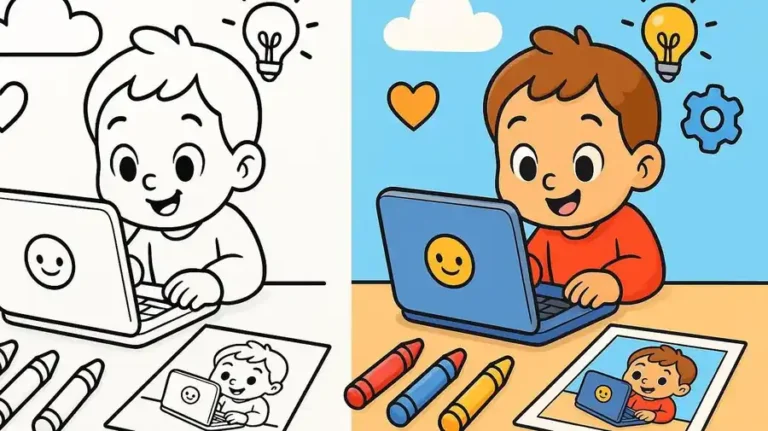

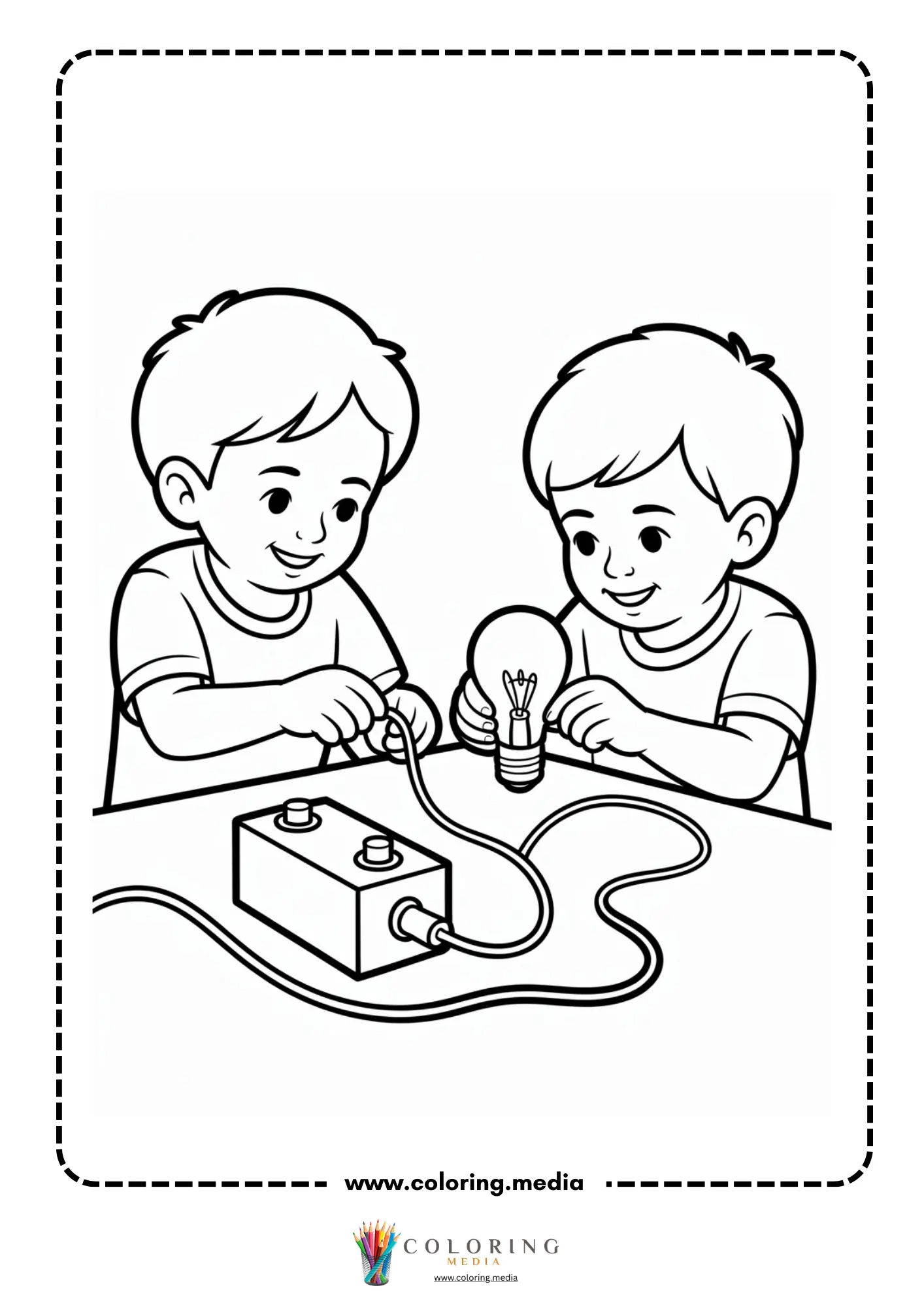
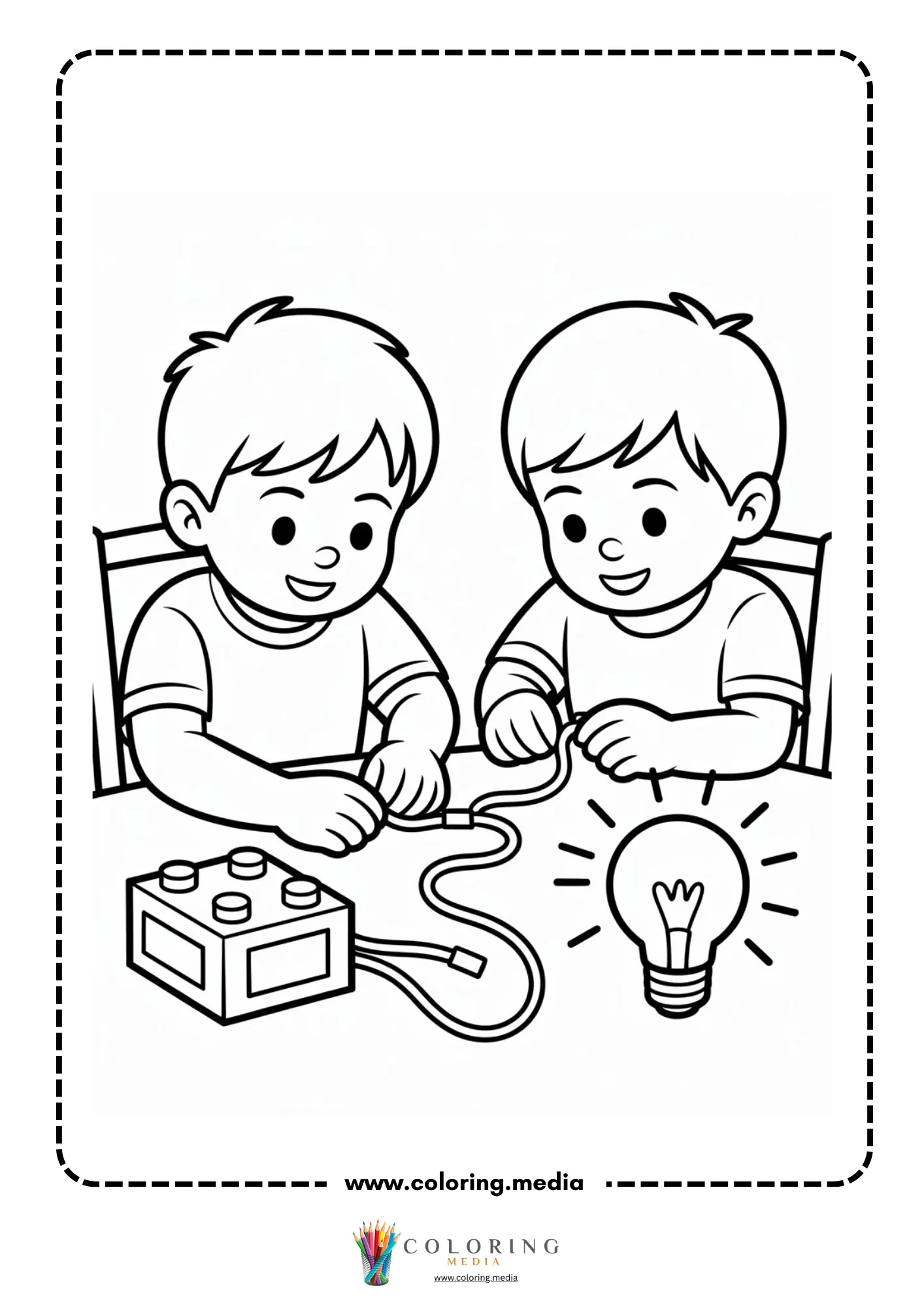
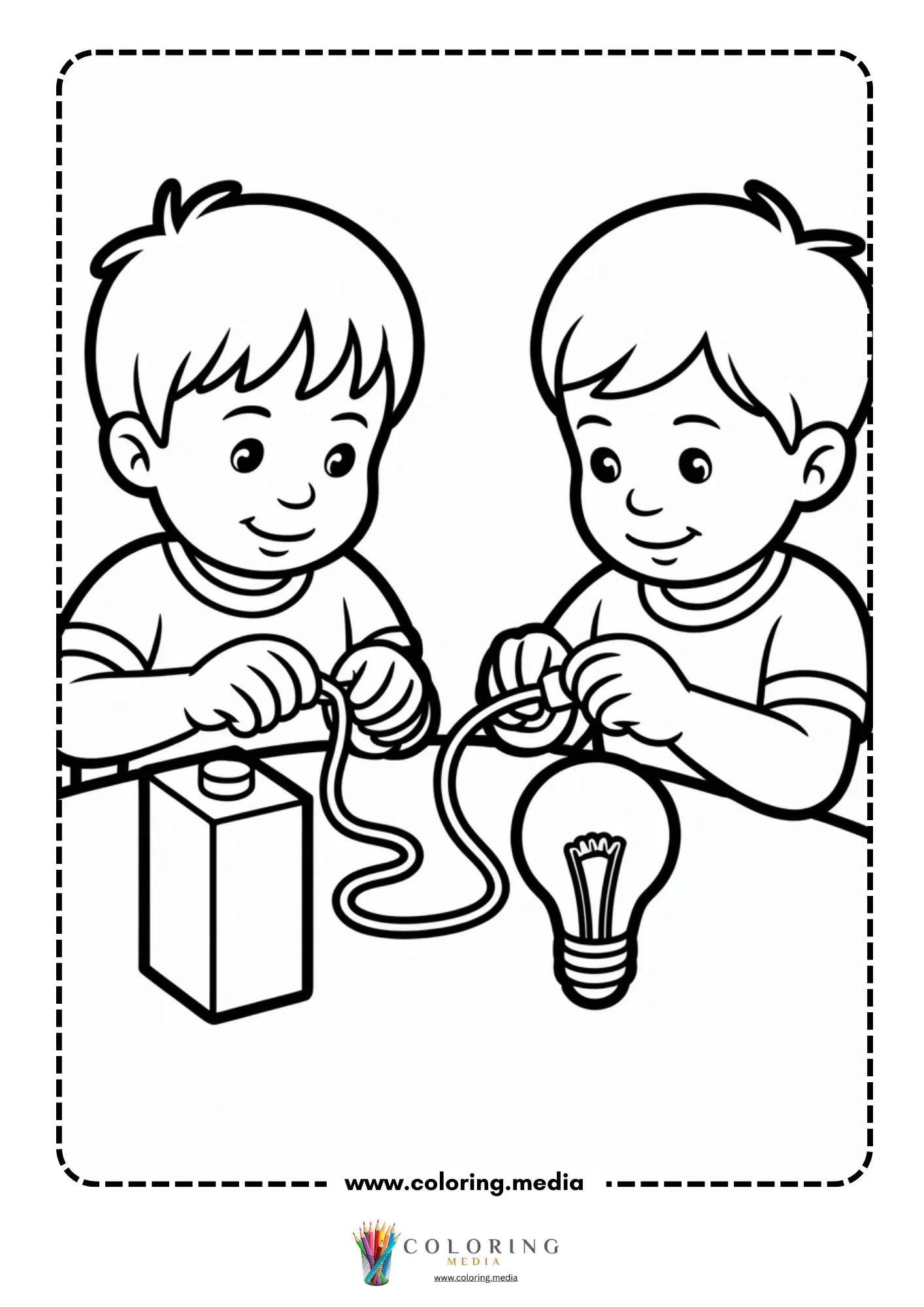
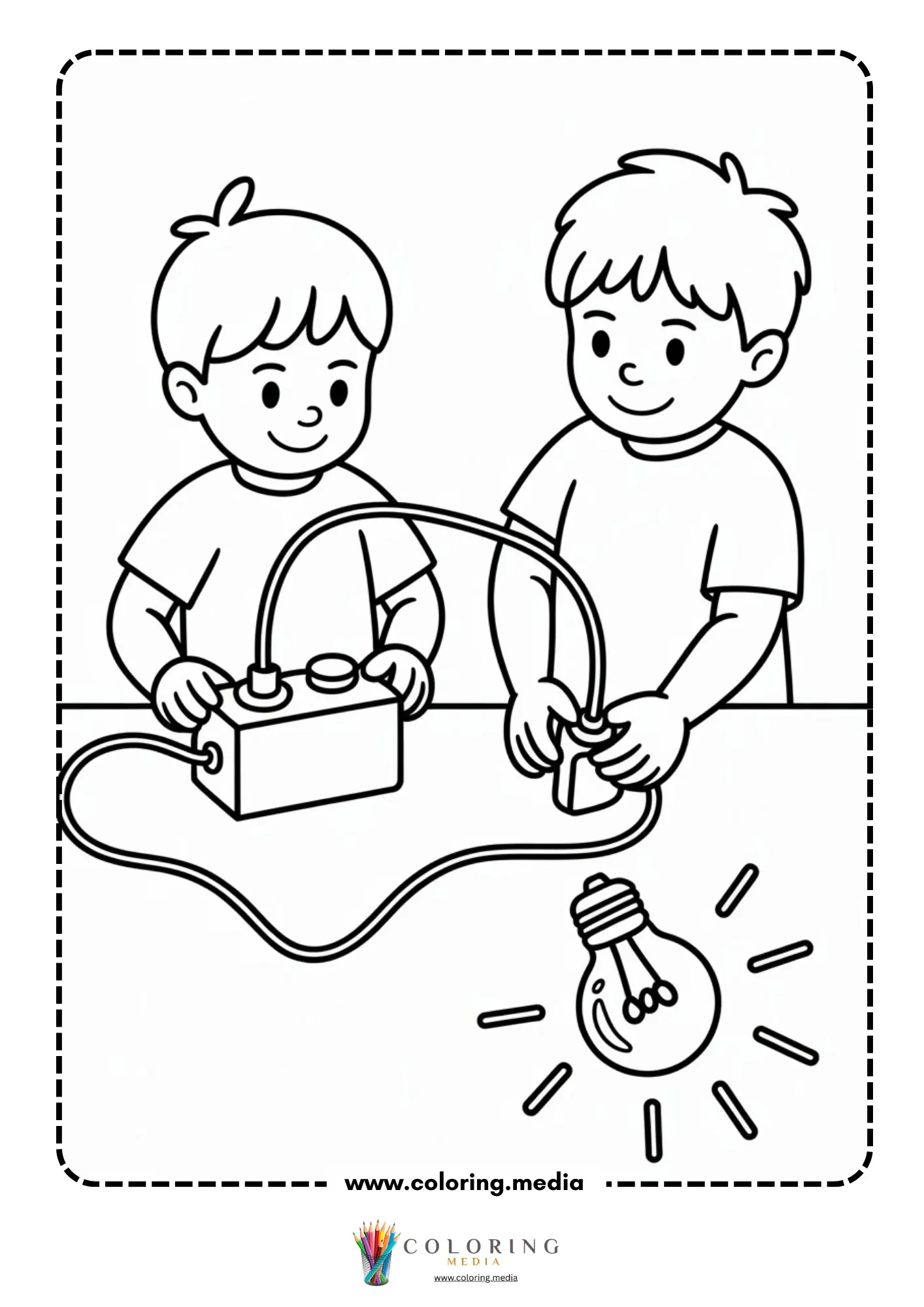
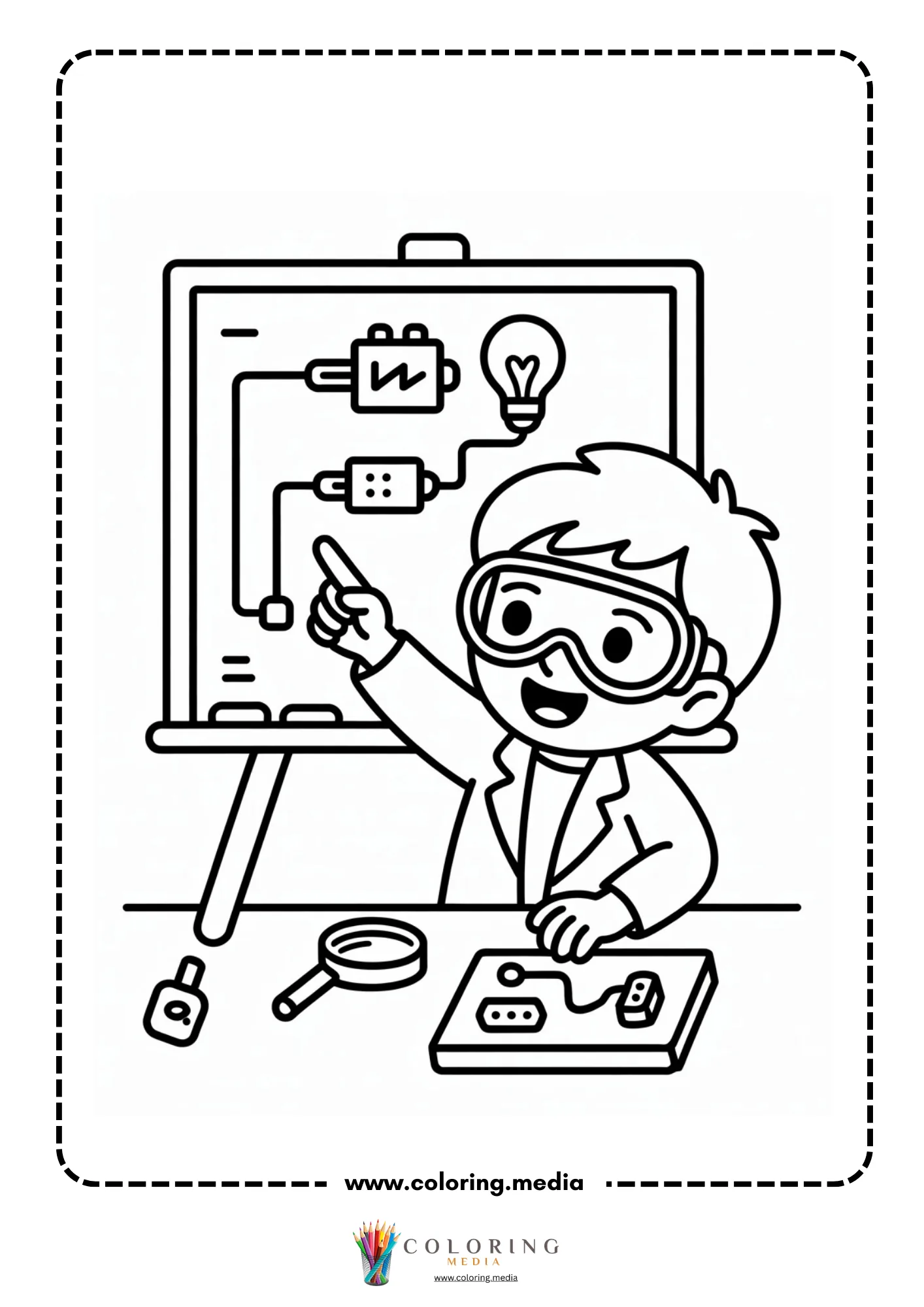
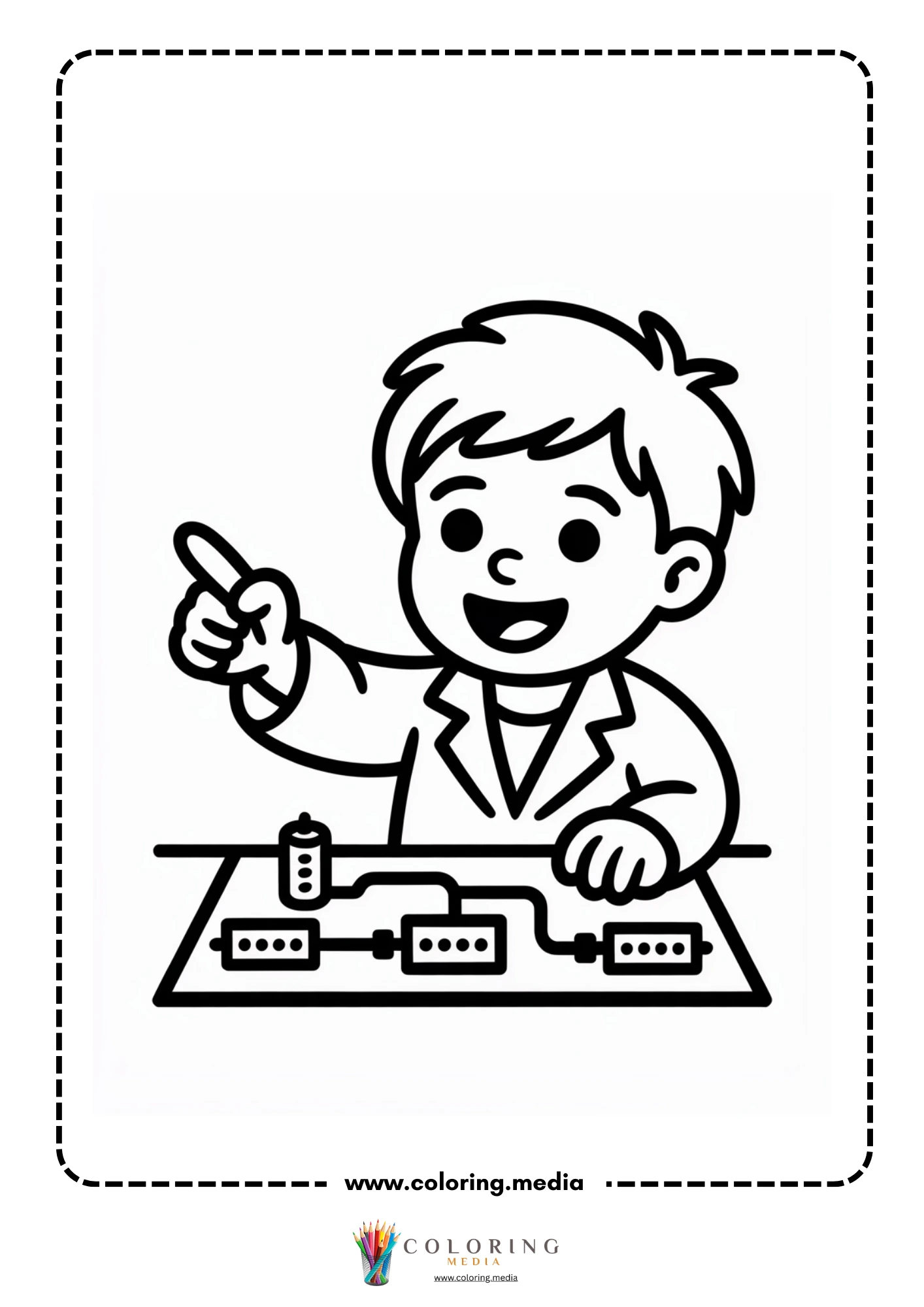
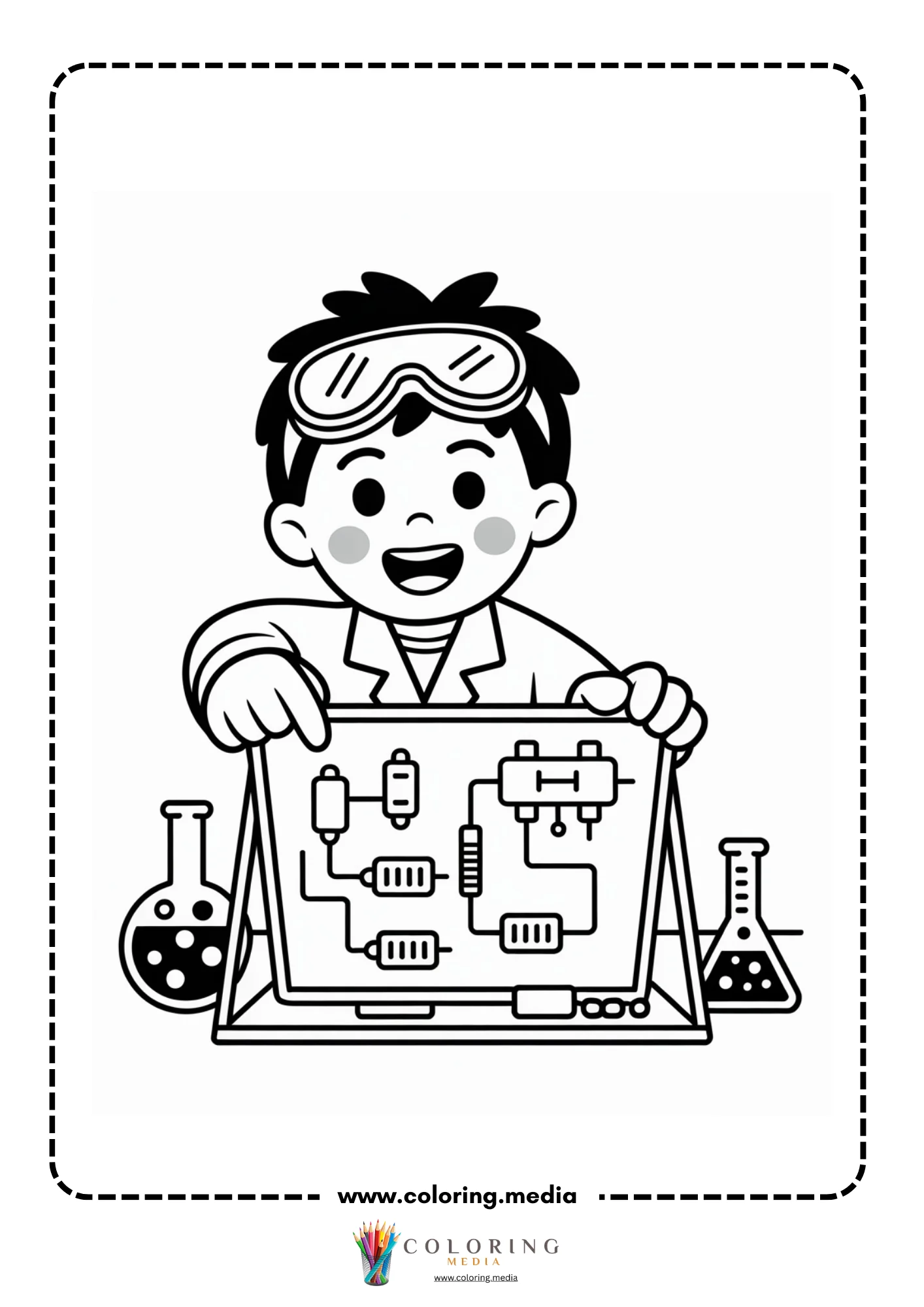
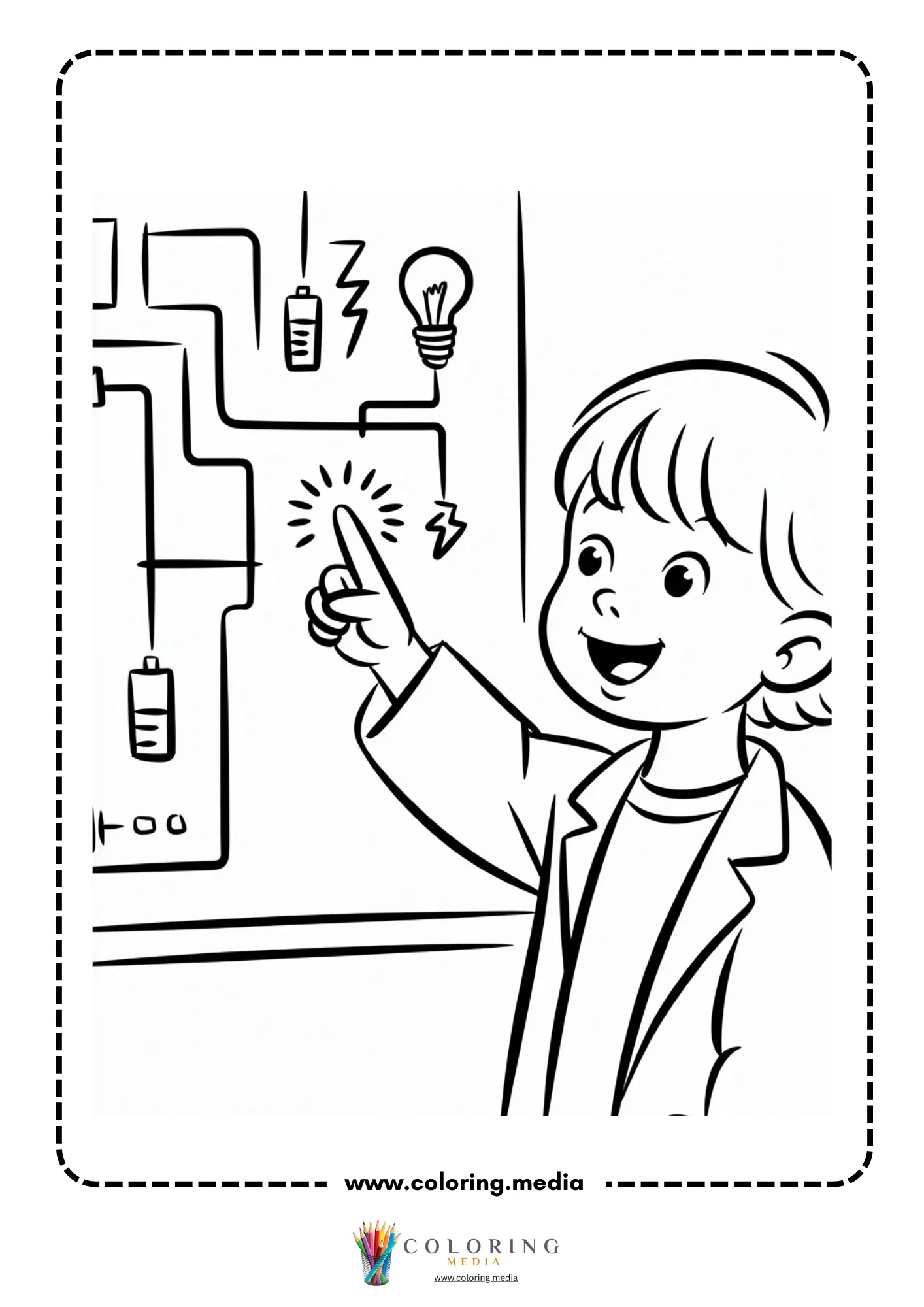
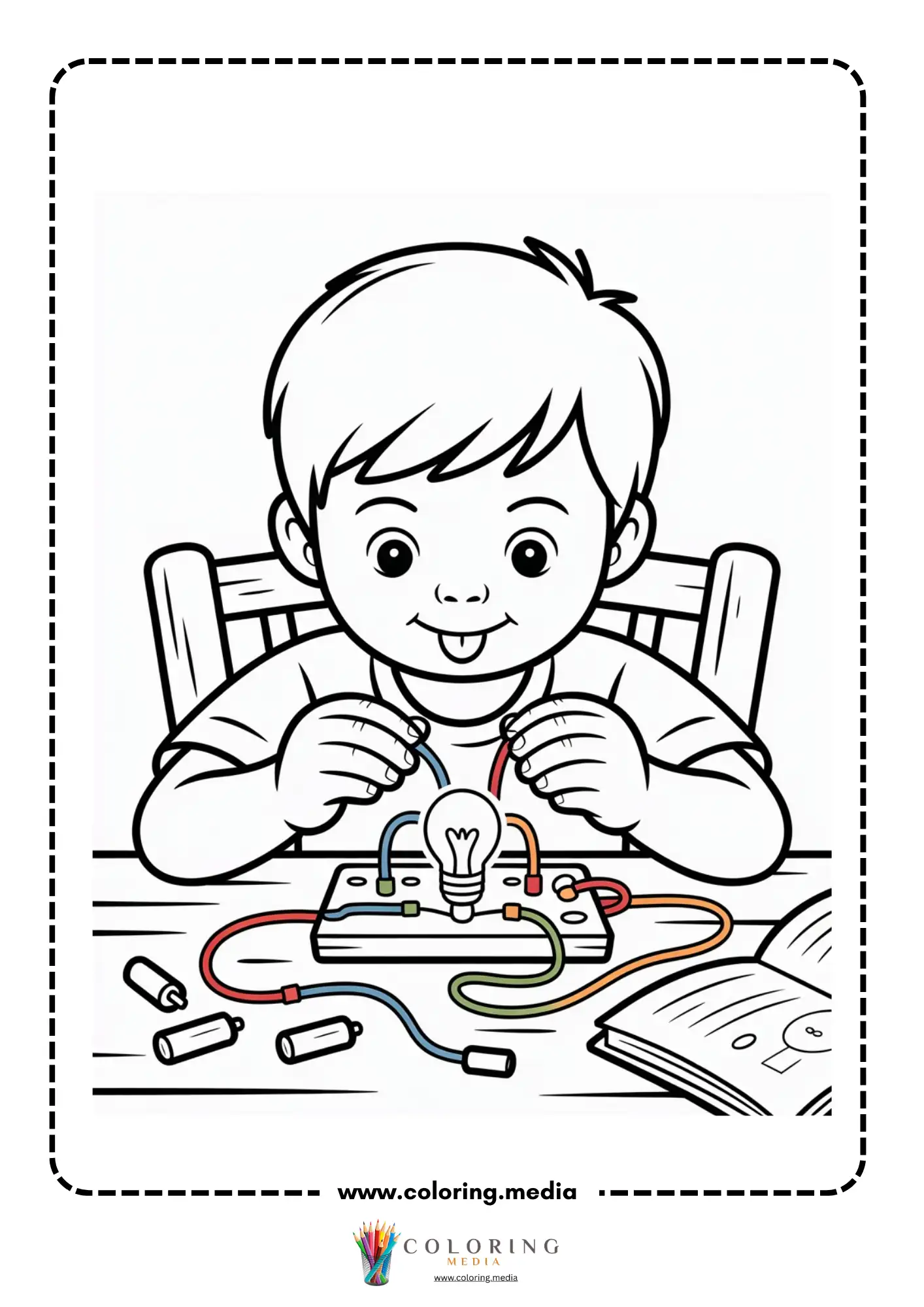
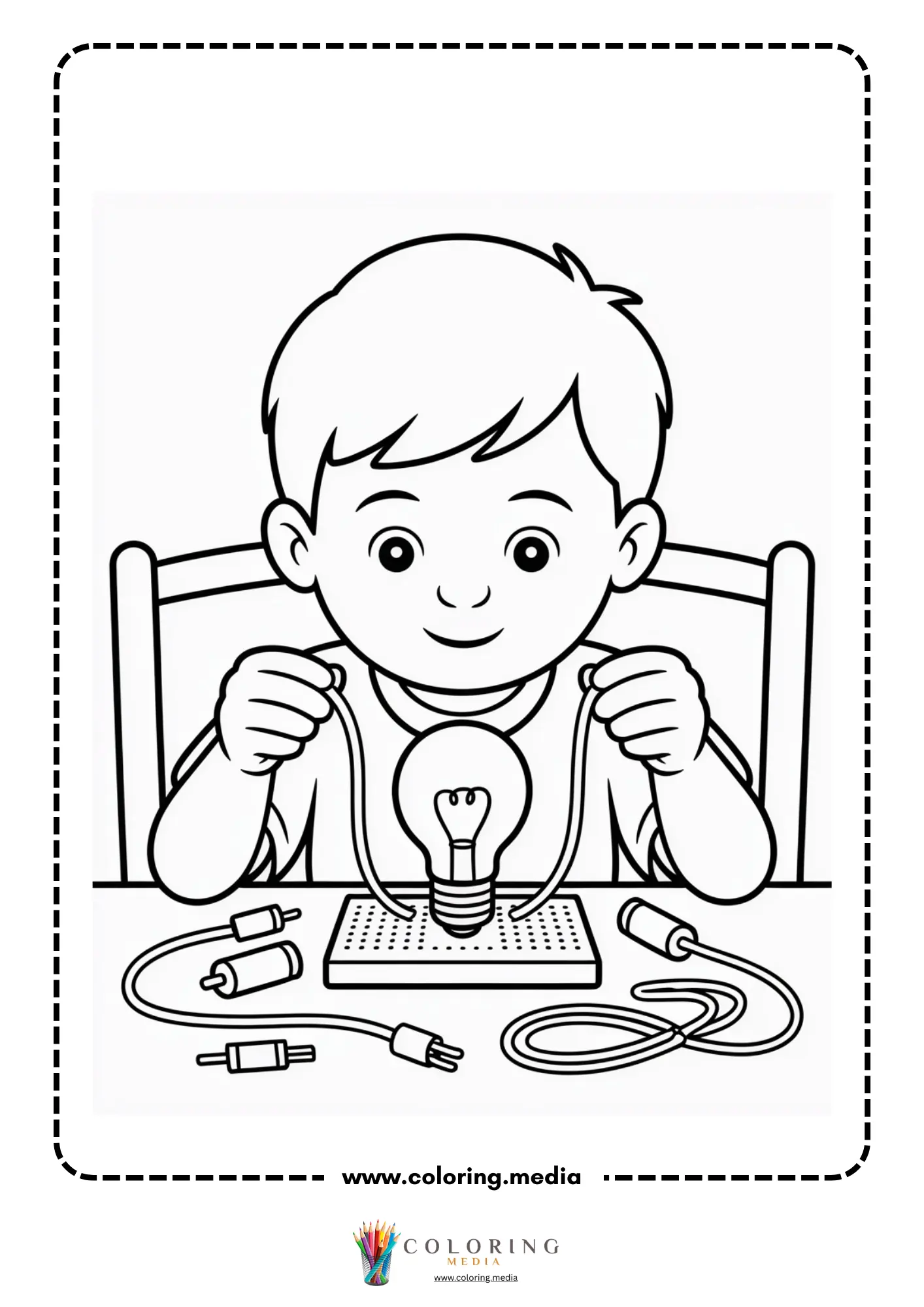
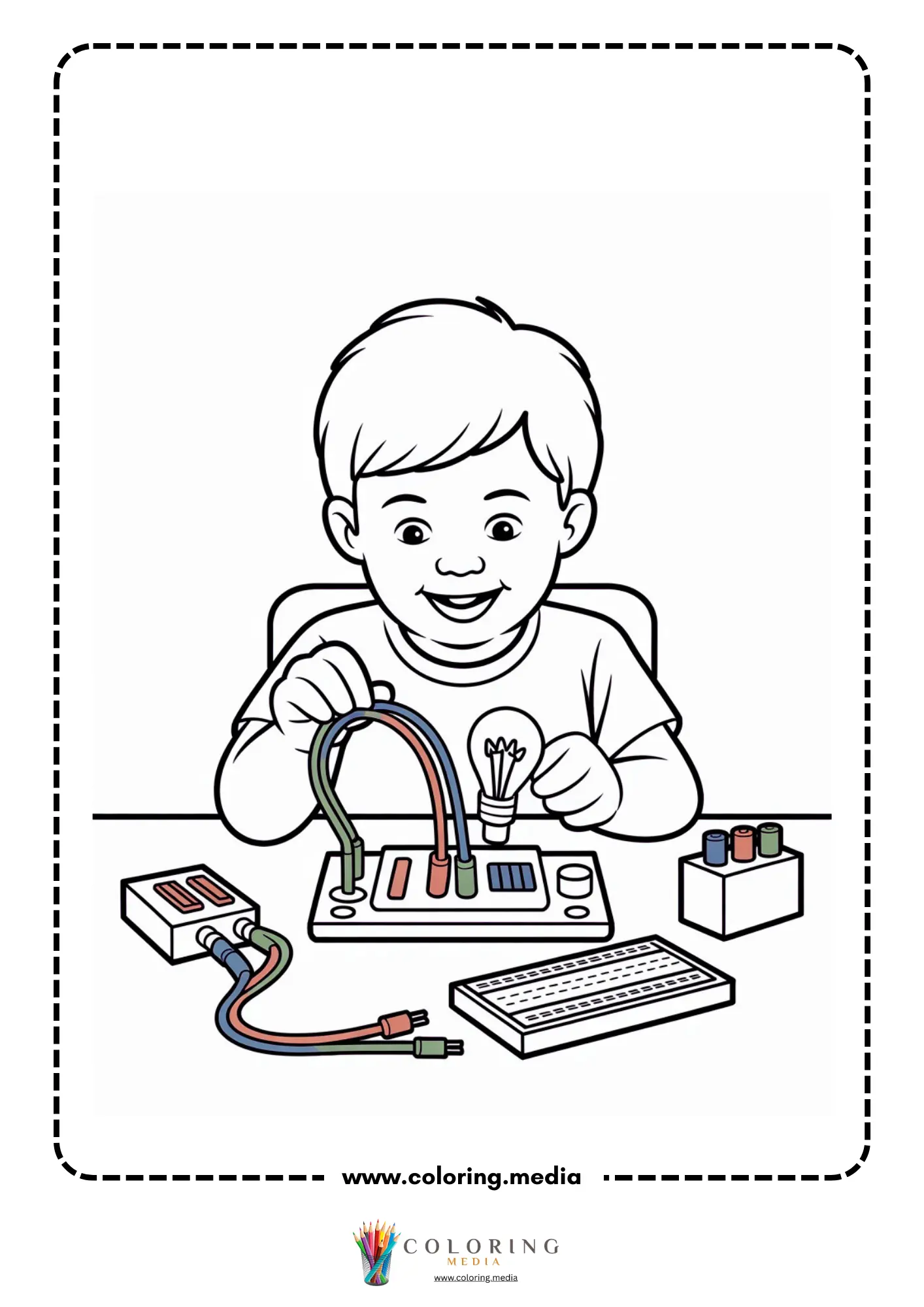
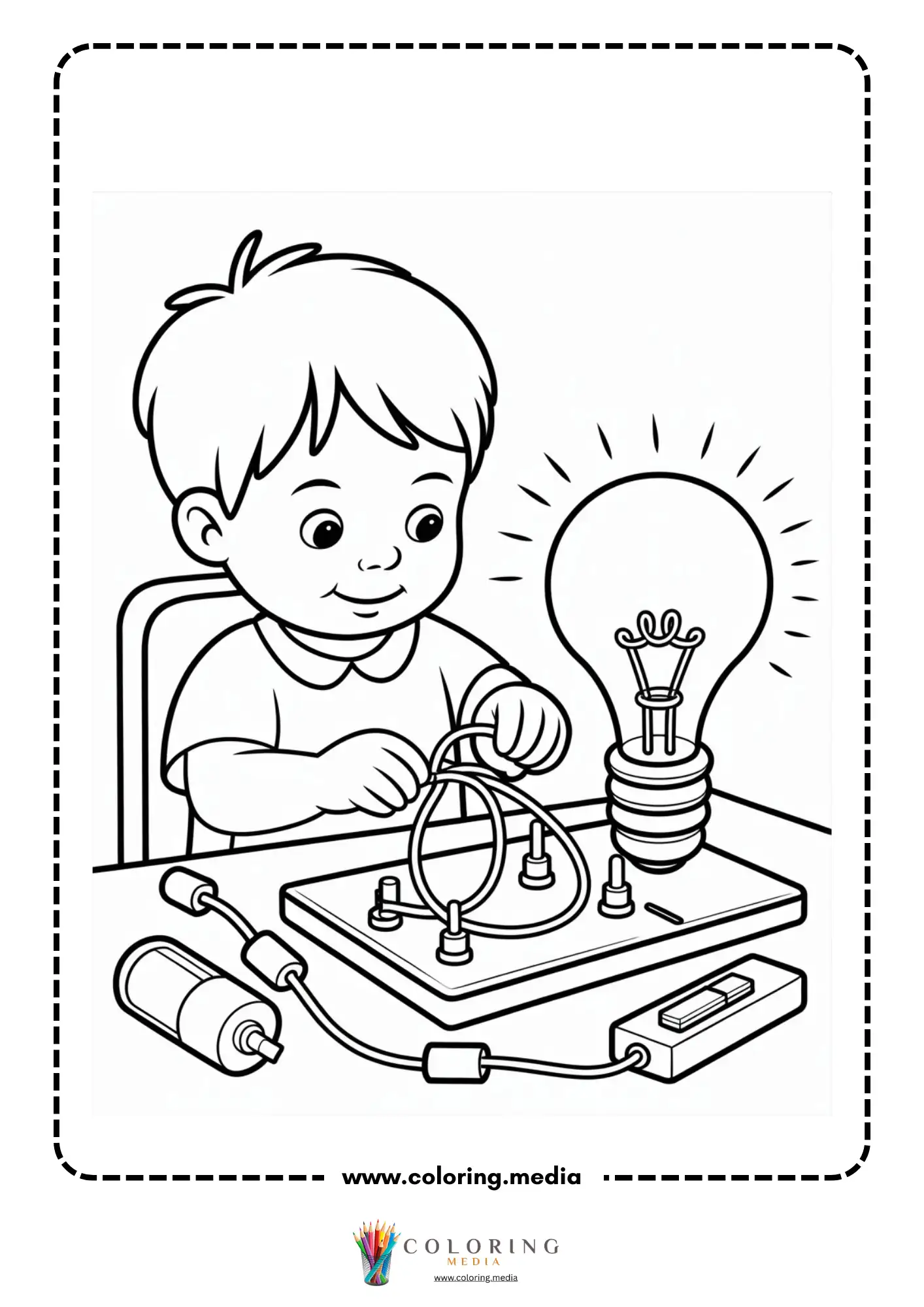
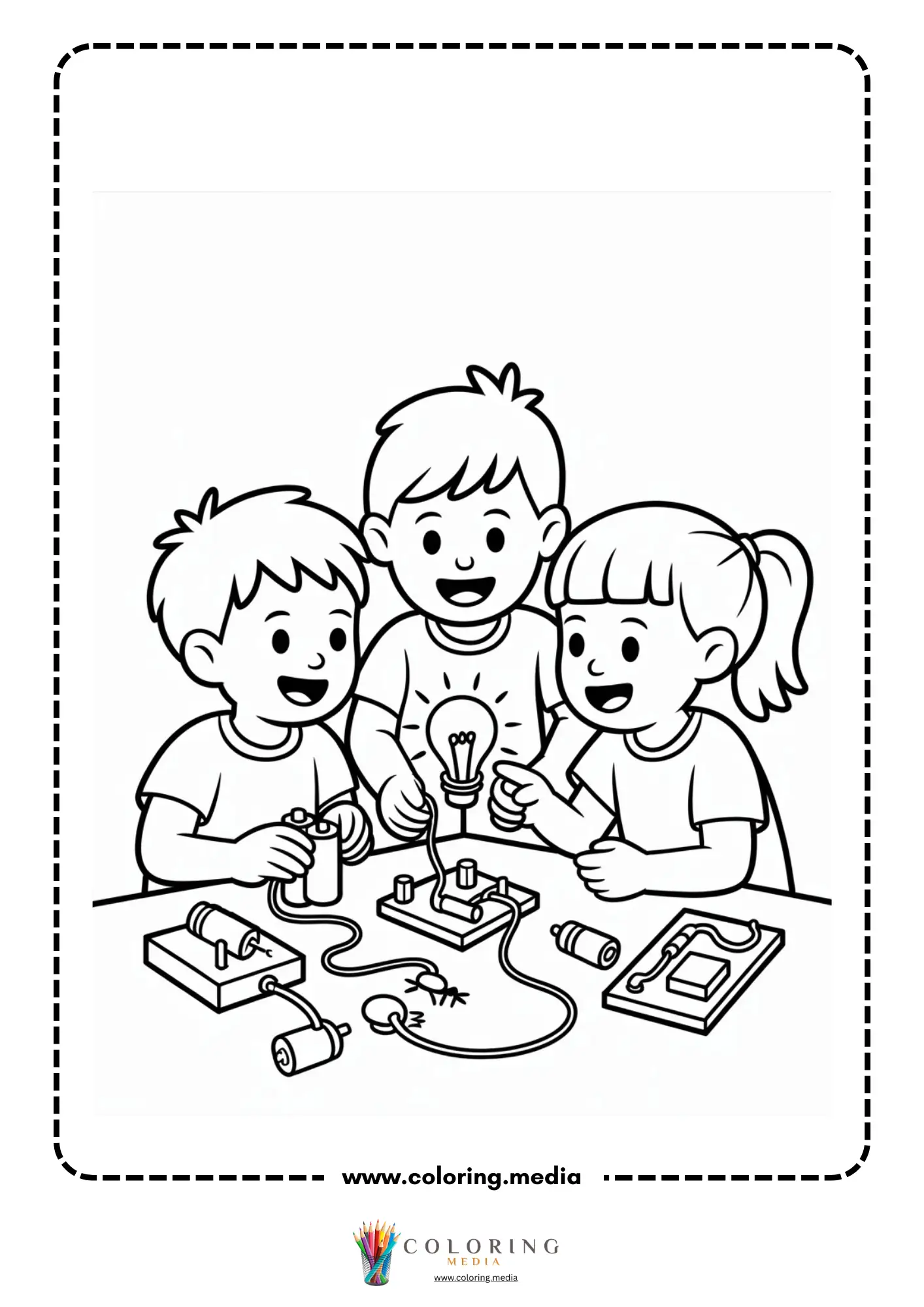
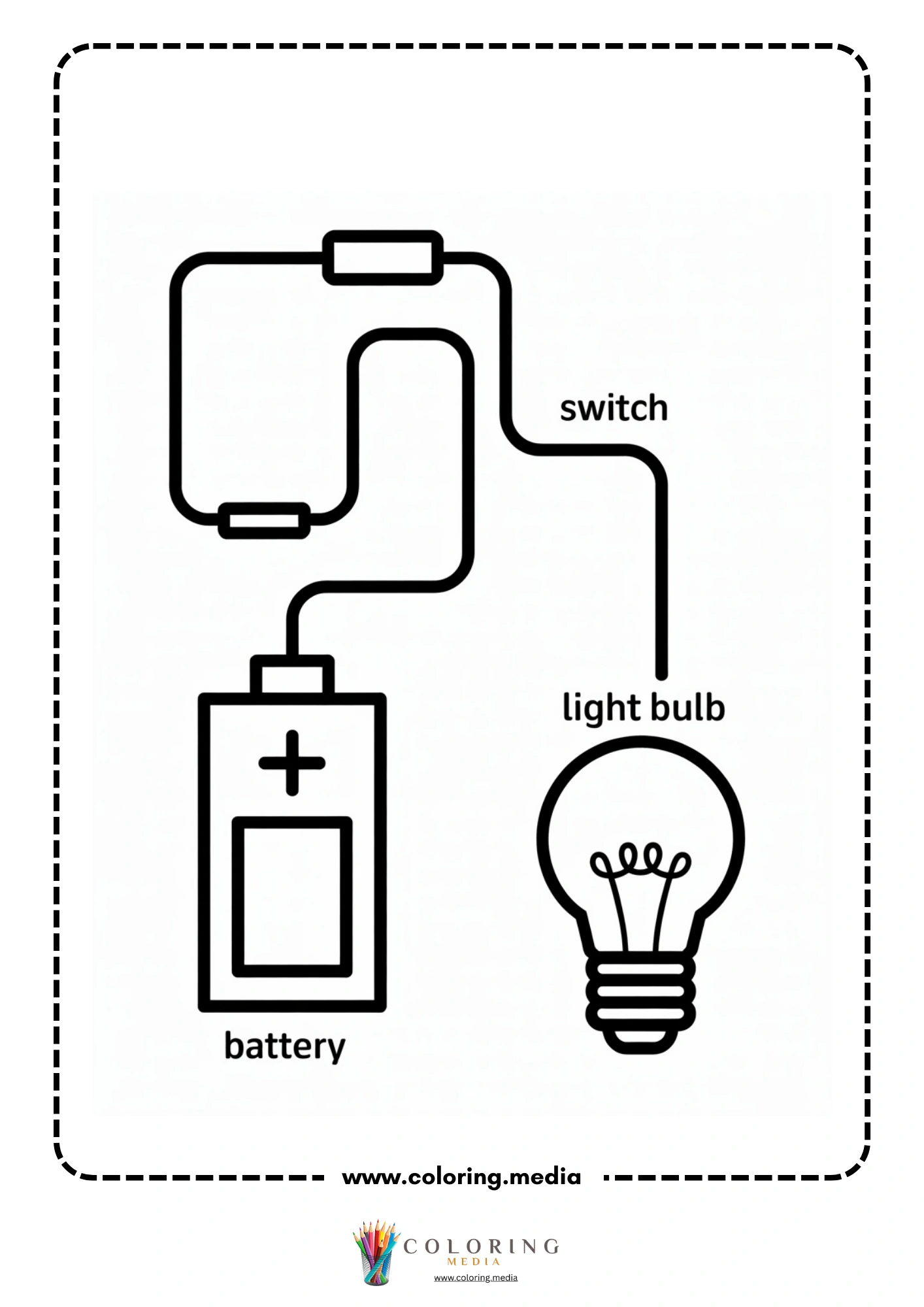
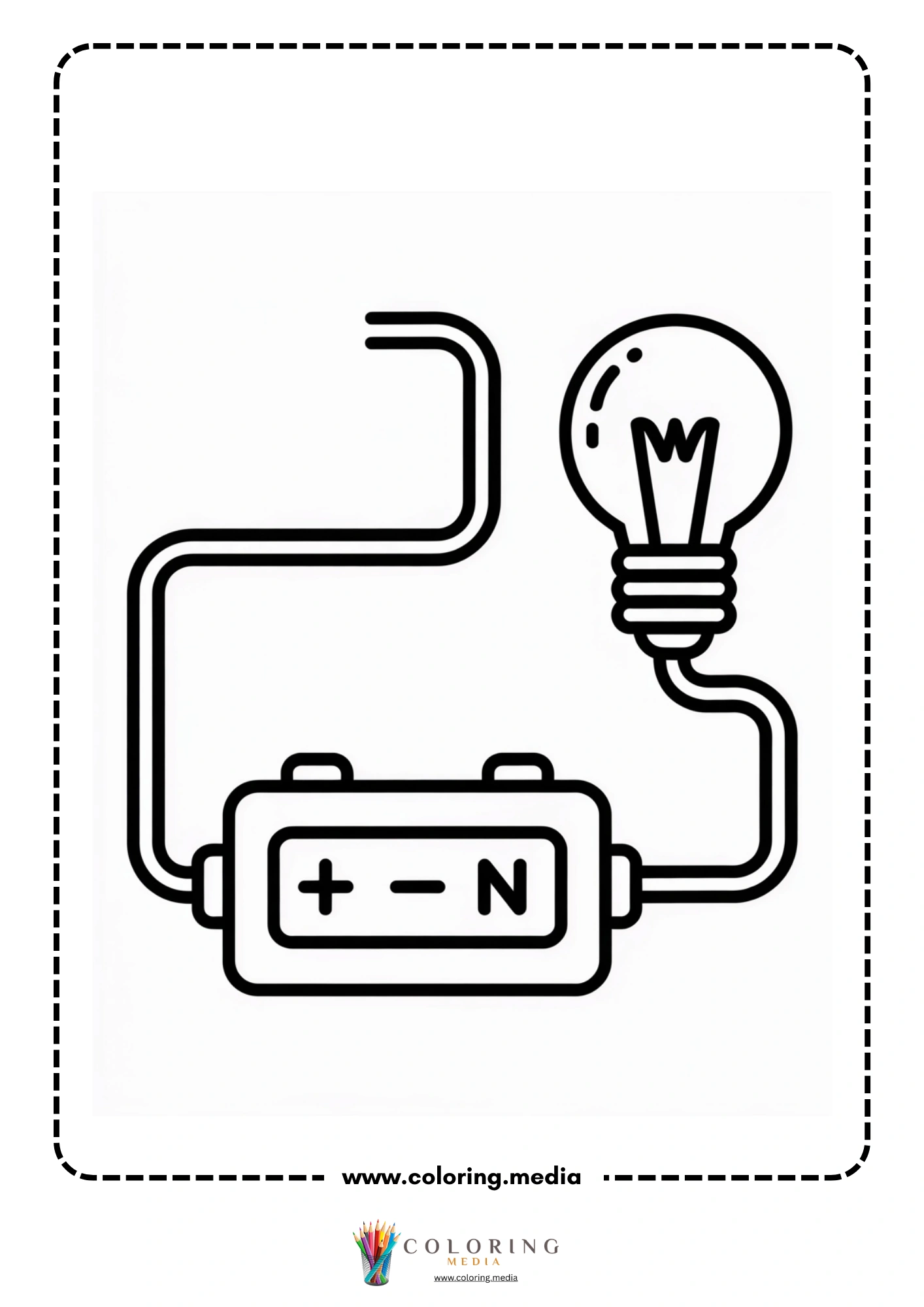
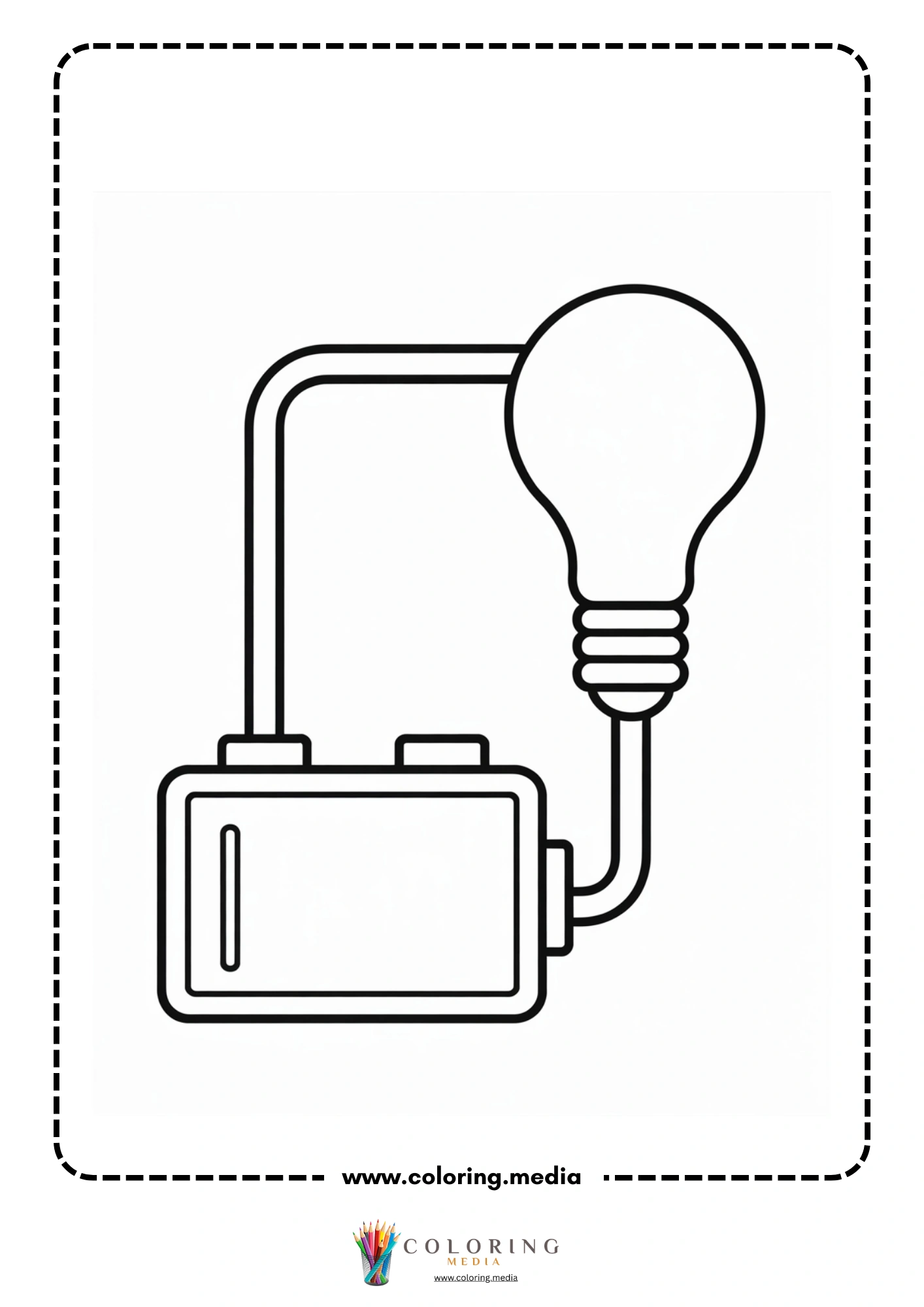
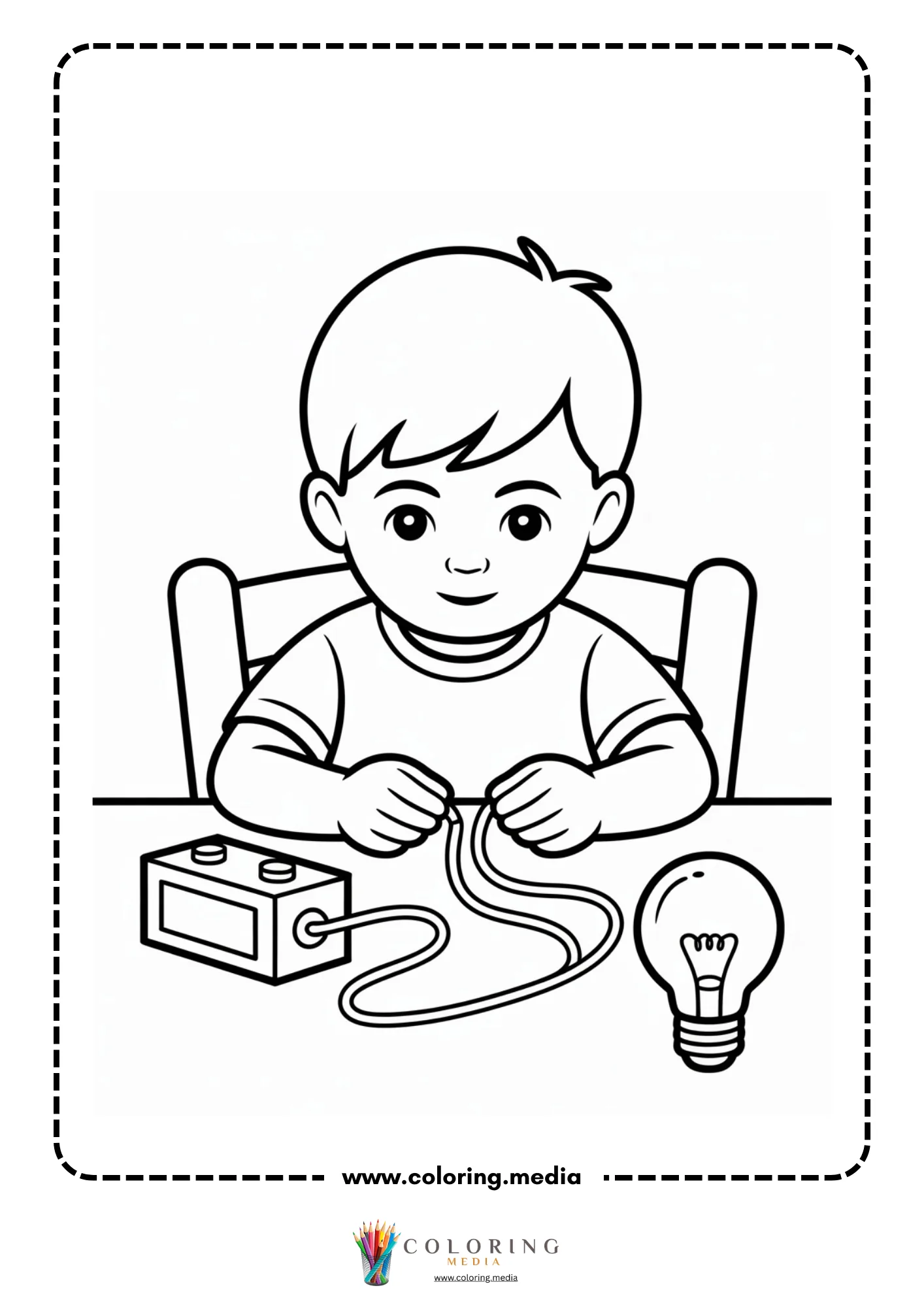
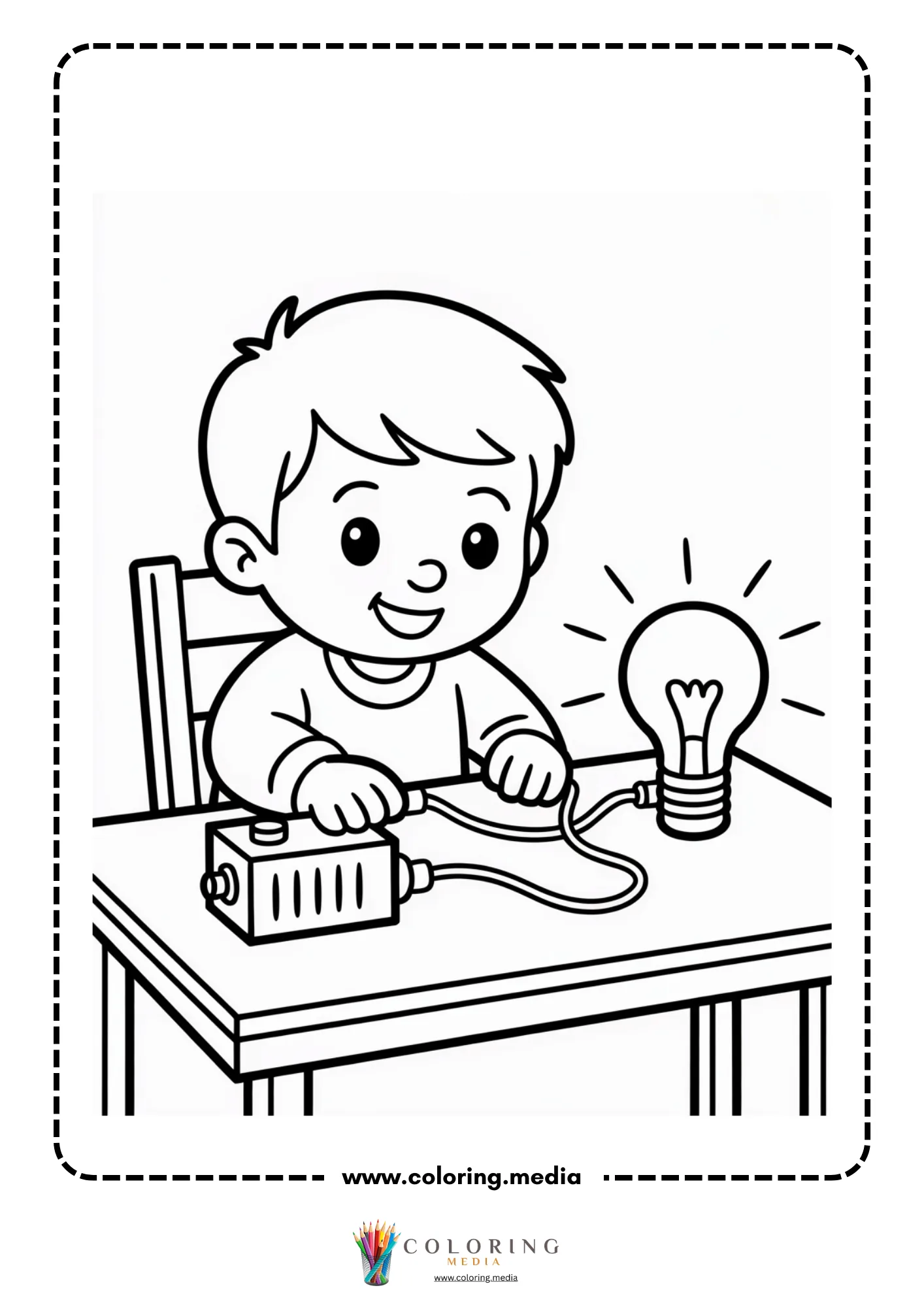
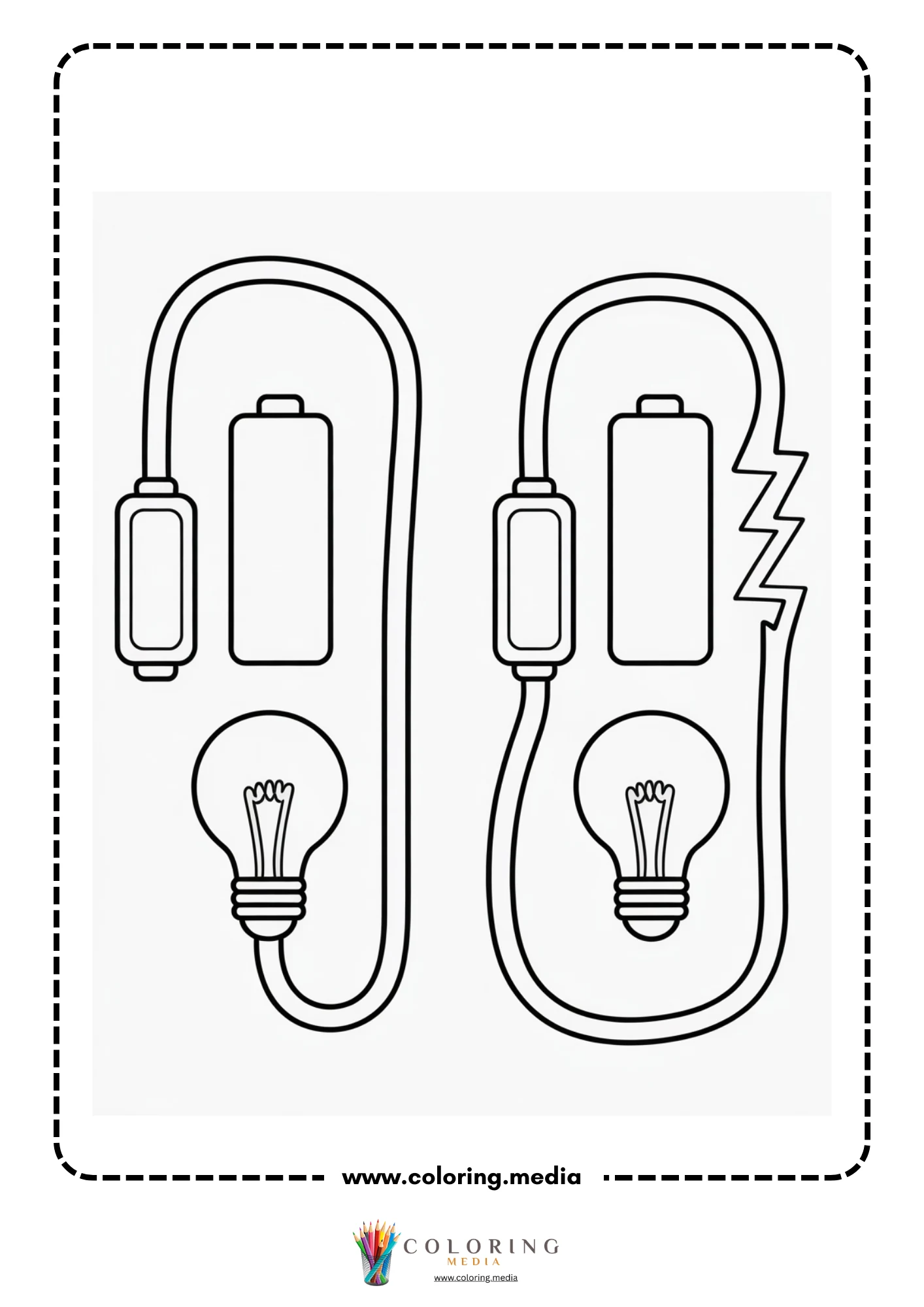
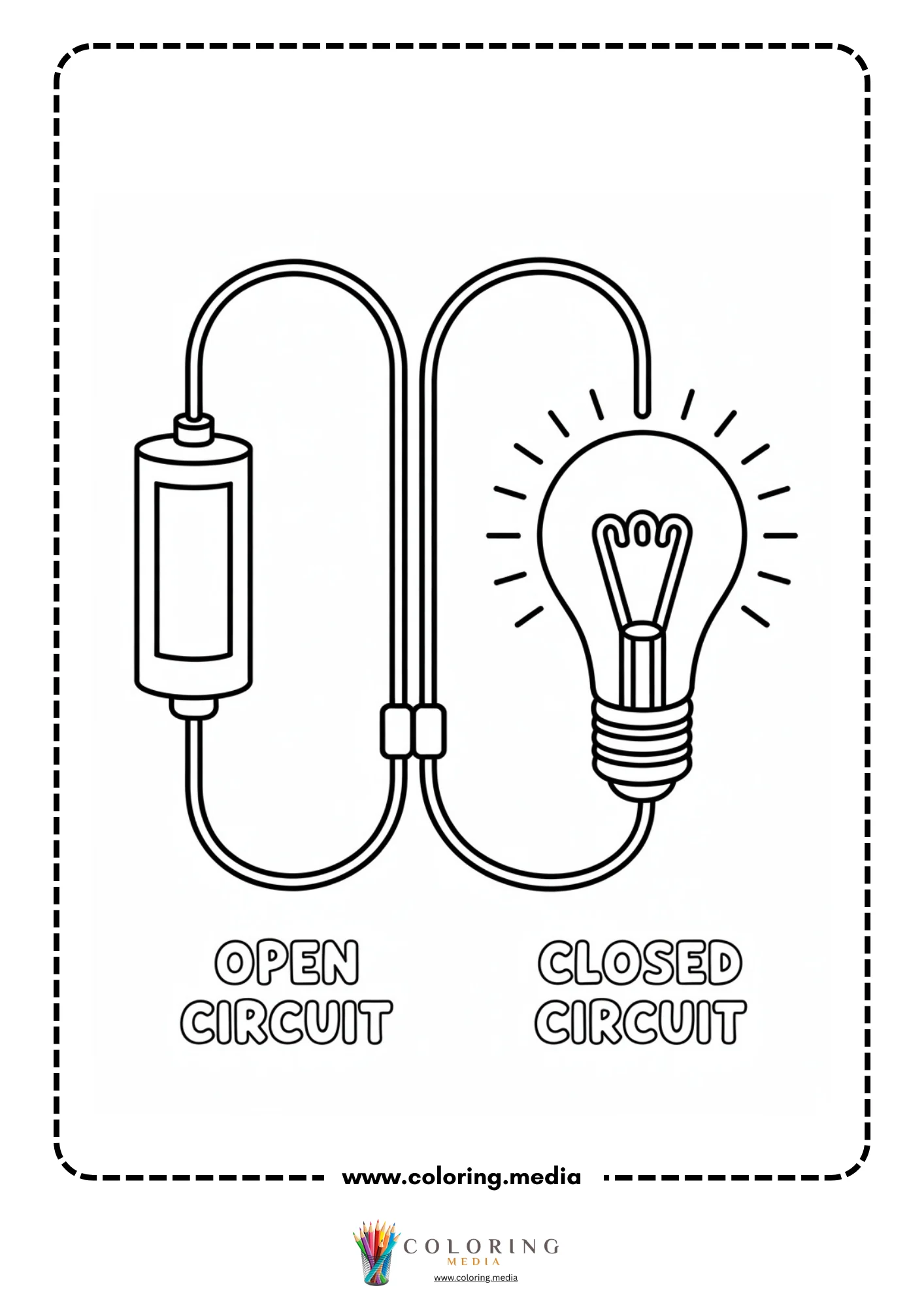
Two visual modes run through this collection. The majority of pages show child characters doing hands-on electronics work — a boy soldering at a workbench, two children connecting a battery to a bulb, a group huddled around a circuit board. These scenes are cartoon-style with 2–3mm outlines and emphasize the human curiosity side of electronics. The remaining pages step back from narrative into diagram territory: clean schematic-style drawings of circuits showing battery, wire, switch, and bulb in the simplified symbols used in beginner science textbooks.
Both modes are educationally useful and visually different enough that mixing them keeps a coloring session from feeling repetitive. Everything here is free to download and easy to print.
Free Printable Circuit Coloring Pages
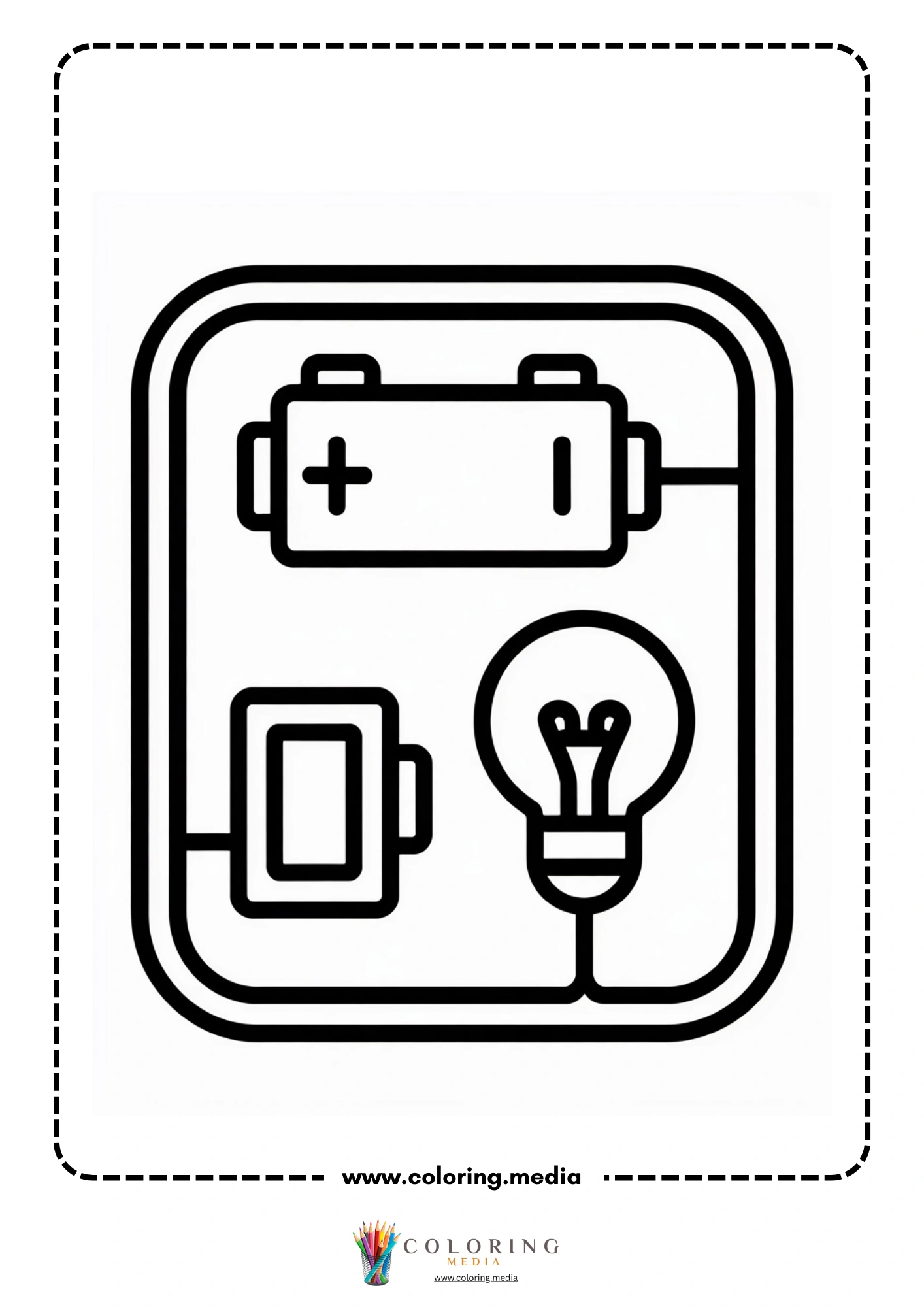
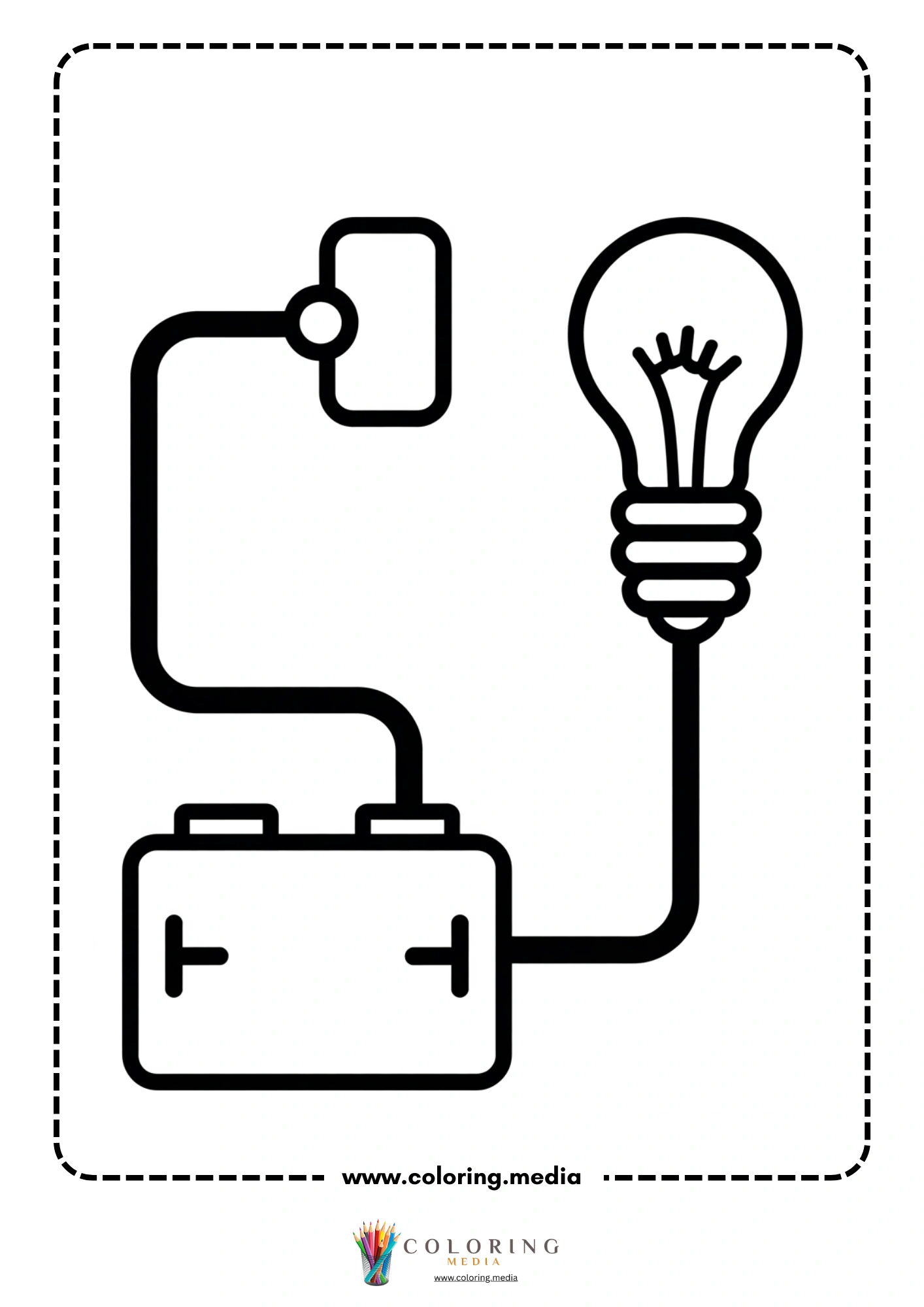
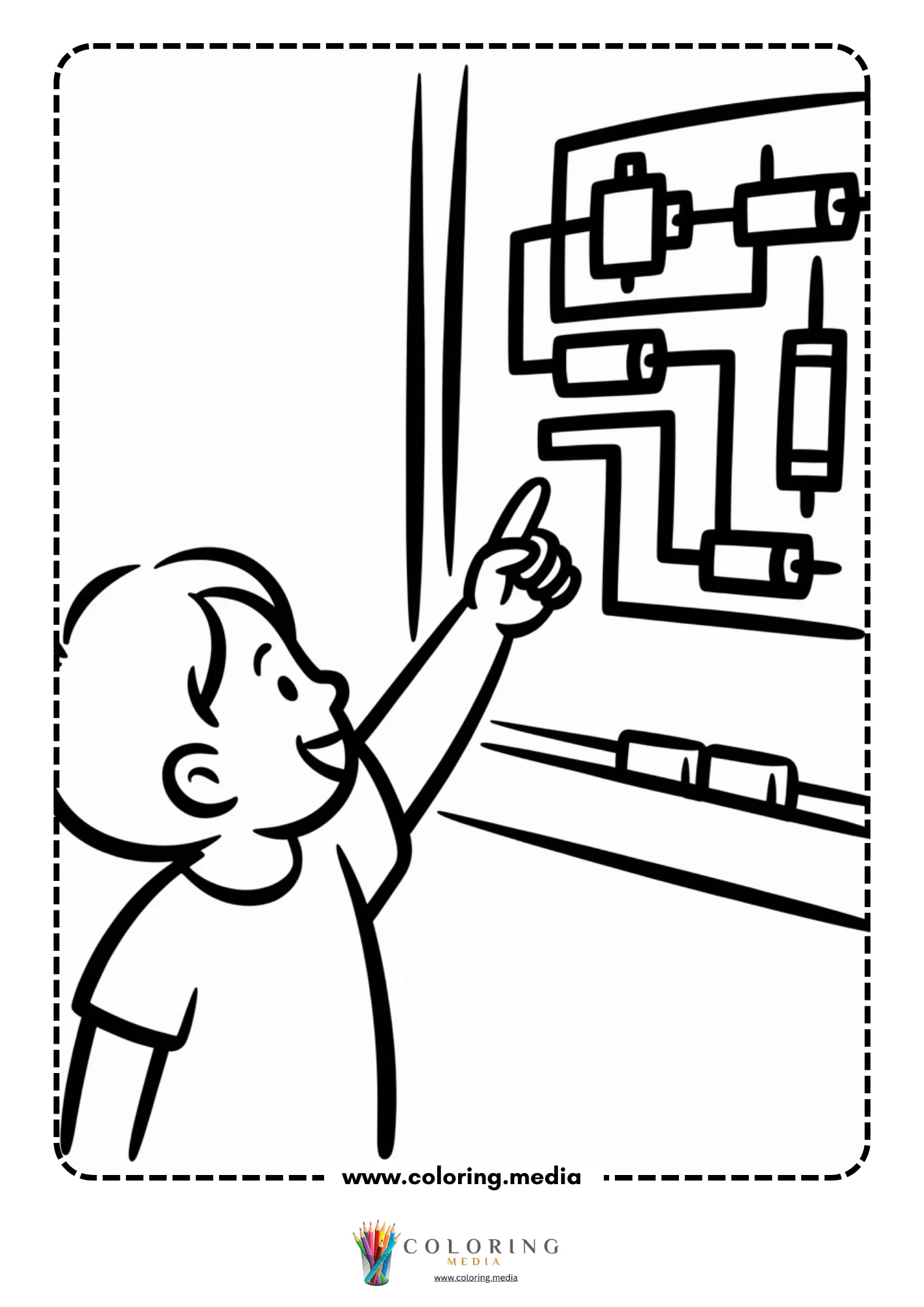
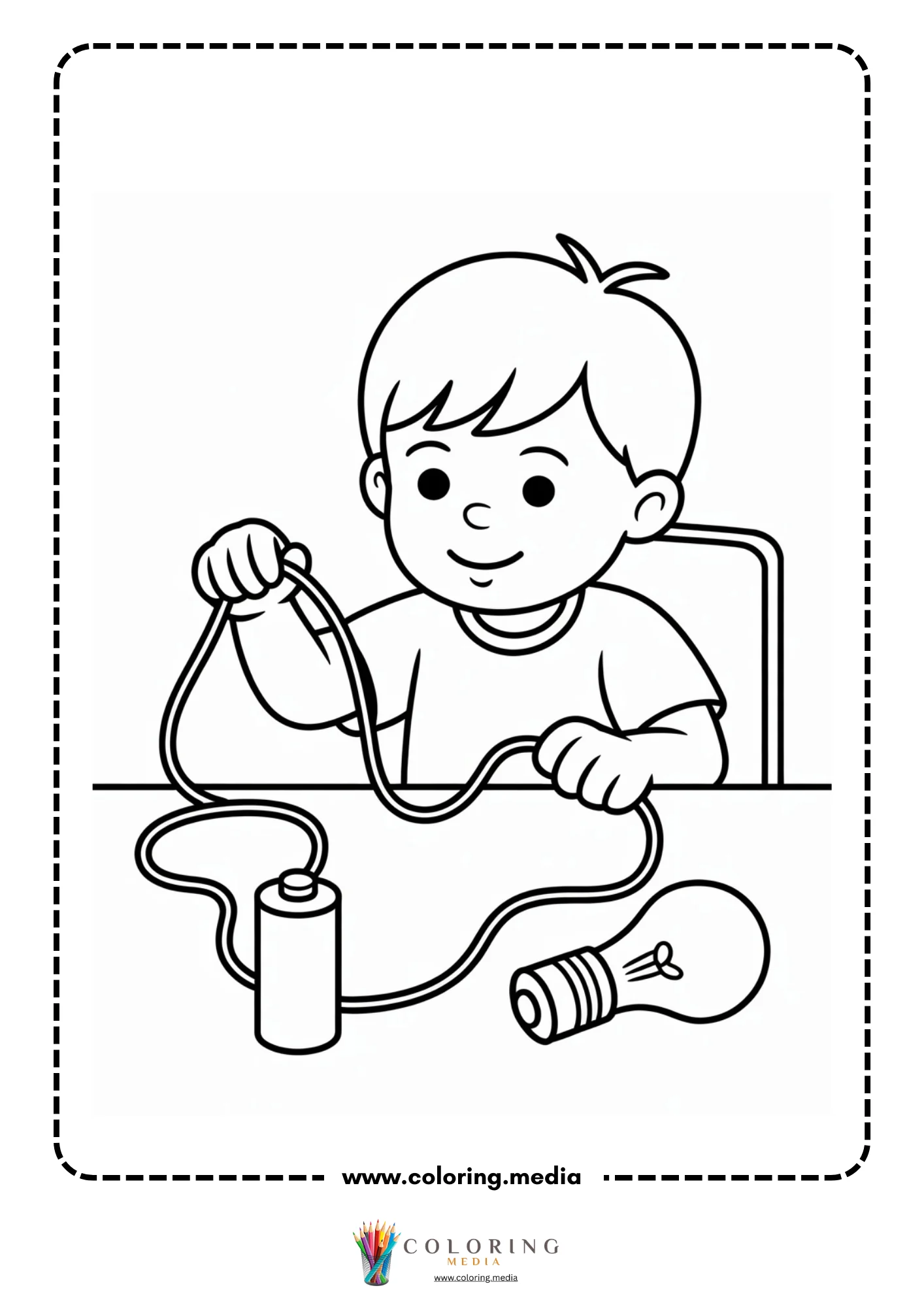
This collection includes 24 printable circuit coloring pages featuring children experimenting with simple circuits at desks and workbenches, battery-and-bulb diagrams with connecting wires, groups of children collaborating on electronics projects, a child pointing to a circuit board on a screen, simple switch diagrams, and multiple light bulb illustrations showing both lit and unlit states. The mix of hands-on scene pages and clean diagram pages makes this set useful for both creative coloring and introductory electronics lessons. All pages print on A4 or US Letter paper.
Who Are These Circuit Coloring Pages Best For?
Early elementary students in grades 1–3 are the primary audience. The character pages have enough visual storytelling — you can see what the child is doing, what the components are, and what the expected result is — to spark questions and conversation without requiring prior knowledge of electronics. The coloring activity itself can run alongside a basic circuits lesson using real batteries and bulbs.
Kindergarteners can engage with the simpler character scenes, particularly the ones showing two children holding wires near a bulb — the outlines are wide enough and the scene is clear enough that younger children can participate. The abstract diagram pages are better suited to grade 1 and above, where kids have some familiarity with the idea of electrical flow.
Science clubs, homeschool STEM days, and classroom electricity units are natural contexts for this set. Coloring a circuit diagram before building one with real components gives children a mental model to work from, and coloring it afterward gives them a record to keep.
Interesting Circuit Facts to Share While Coloring
Electricity flows in a circuit only when the path is unbroken. If you remove any one piece — the battery, a wire, the bulb — the circuit opens and the current stops. This is why a single burned-out bulb in an old-style string of Christmas lights causes the whole string to go dark.
The first practical light bulb was developed by Thomas Edison in 1879, but he was not the only inventor working on the problem. Warren de la Rue had demonstrated an enclosed platinum bulb 40 years earlier, and Joseph Swan patented a similar design almost simultaneously with Edison. Edison’s main contribution was the entire system — the generator, the wires, the sockets, and the switch.
Batteries do not store electricity — they store chemical energy that gets converted to electrical energy when the circuit is closed. When the chemicals are used up, the battery is dead. Rechargeable batteries reverse the chemical reaction by pushing electricity back in.
The human body conducts electricity because it contains water and dissolved salts. Even a relatively small voltage — around 50 volts AC — can push enough current through the body to be dangerous. This is why electricians use insulated tools and rubber gloves.
LEDs (light-emitting diodes) are fundamentally different from traditional bulbs. A traditional bulb heats a wire filament until it glows; an LED produces light through a quantum process in a semiconductor, which is why it produces almost no heat and uses about 75% less energy.
Creative Circuit Coloring and Craft Ideas
Color-Code the Components Before coloring, decide on a consistent scheme: all batteries red, all wires yellow, all bulbs white/light blue. Apply it across every diagram page for a unified system.
Build It After Coloring After coloring a simple battery-bulb diagram, gather a 9V battery, two wires with alligator clips, and a small bulb. Build the exact circuit shown and see it light up.
Lit vs. Unlit Bulbs For bulb illustration pages, color half the bulbs showing a lit state (bright yellow glow with radiating lines) and half showing an unlit state (clear white glass).
Circuit Story For the character pages, write a paragraph about what experiment the child is running, what they expect to happen, and what would make them excited or frustrated.
Switch Diagram Annotation On the switch diagram pages, draw arrows showing which direction electricity flows when the switch is open vs. closed.
Inventor Profile On the back of a colored bulb page, write a three-sentence biography of Thomas Edison or Nikola Tesla as if it were a trading card.
Series vs. Parallel Discussion For older students: after coloring two bulb-and-battery pages, discuss what would happen if the bulbs were wired in series (one dies, all go dark) vs. parallel (one dies, others stay lit).
Electronics Vocabulary Wall Label each component visible in the coloring pages (battery, bulb, wire, switch, resistor) and create a mini vocabulary card for the classroom wall.
How to Print These Circuit Coloring Pages
Each file downloads as a single PDF at 300 dpi, formatted for A4 and US Letter. Print from Adobe Reader or your browser with ‘fit to page’ enabled. Standard copy paper is suitable for crayons and colored pencils. For the diagram pages where fine line color-coding is intended, a fine-tip colored pen or 0.5mm colored pencil gives the cleanest result. Use black-and-white print mode to save ink.
Explore More STEM Coloring Pages
If you enjoyed these pages, you may also like:
Electronic Coloring Pages
Coding Coloring Pages
Computer Coloring Pages
Technology Coloring Pages
STEM & Technology Coloring Pages