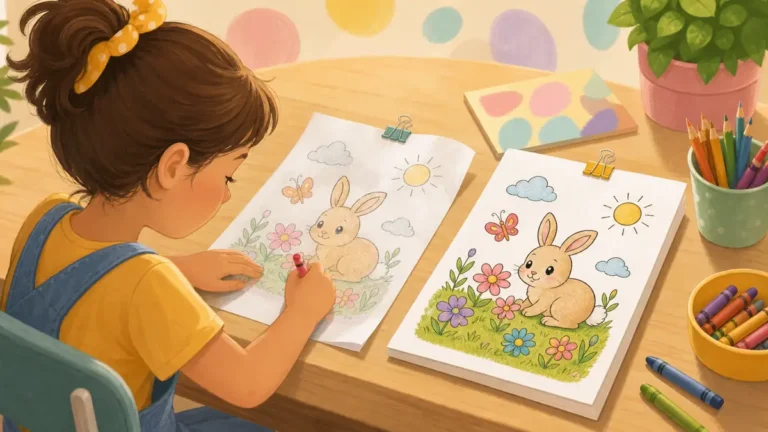

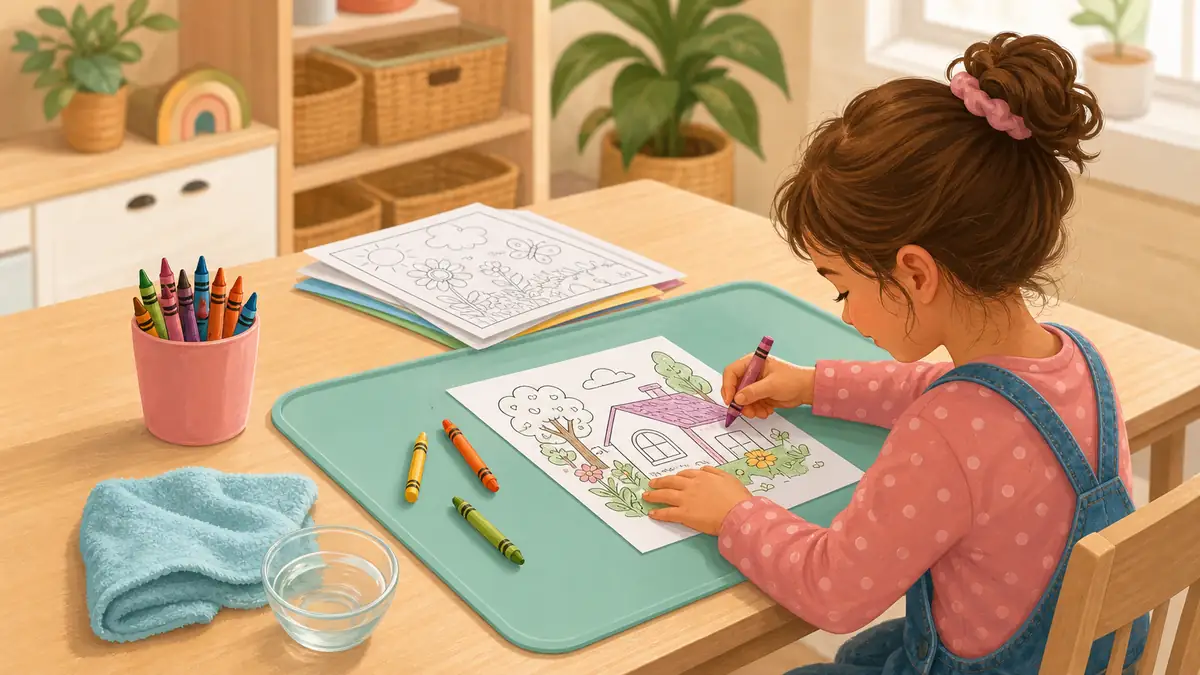

Low-mess coloring for kids is entirely achievable — the key is making three specific decisions before the coloring session starts rather than trying to manage mess after it happens. The right tools (washable formulas), the right surface setup (a barrier between page and table), and the right location (a consistent coloring station away from fabric and carpet) eliminate 95% of the mess risk without restricting what children can create. This guide covers the complete low-mess coloring setup.
The Three Low-Mess Decisions
Decision 1: Tool Selection
Washable formulas are the single most effective mess-reduction decision. “Washable” from reputable brands (Crayola Washable, Melissa & Doug Washable) means removable from skin and clothing with water and soap, and from most hard surfaces when treated promptly. This doesn’t mean “can go anywhere without consequence” — it means that the inevitable contact with non-page surfaces is recoverable.
Tool rankings by mess risk (lowest to highest):
- Washable crayons: Lowest mess risk overall — minimal transfer to skin, clothing, or surfaces; washable from most materials
- Colored pencils: Very low mess — negligible skin transfer, no liquid content, erasable from most surfaces
- Washable markers (broad tip): Moderate mess risk — vivid ink transfers readily to skin and clothing; washable formulas reduce consequence but require prompt treatment
- Washable markers (fine tip): Moderate-high mess risk — fine tips produce more precise but also more easily transferred marks; high engagement for older children worth the trade-off with proper setup
- Non-washable markers and ink: Highest mess risk — reserve for supervised art sessions with children old enough for careful handling
Decision 2: Surface Protection
A barrier between the coloring page and the table surface catches any tool contact that goes beyond the page. Three effective options:
- Silicone art mat or placemat: Washable, wipeable, provides a consistent “this is the coloring area” visual boundary. The most recommended option — costs $8–15, lasts years, wipes clean in seconds. Bright colors make it visually appealing for children.
- Thick scrap paper stack: 4–5 sheets of copy paper beneath the coloring page absorb marker bleed-through and protect the table. Free; replaced when saturated. Less effective than silicone for crayon marks and general cleanup.
- Plastic table protector or vinyl tablecloth: Covers the entire table surface; best for younger toddlers whose coloring regularly extends well beyond the page. Wipes clean easily.
Decision 3: Location and Boundaries
Designating a consistent coloring location — “we color at the coloring table” — is one of the most effective low-mess strategies because it removes the open-ended mess risk of coloring anywhere in the house. A hard-surface table in a location away from carpet, upholstered furniture, and fabric curtains means any mess is on wipeable surfaces.
The “coloring table” concept also builds the habit of going to a specific place for coloring rather than carrying supplies around the house — the supplies stay at the station, and the mess stays at the station.
Low-Mess Setup for Specific Ages
Toddlers (Ages 1–3): Maximum Mess Risk, Minimum Restriction
Toddler coloring produces the most mess because the activity is inherently exploratory — crayons go everywhere, hands touch the crayon and then everything else, and the page is a loose suggestion rather than a firm boundary. Low-mess toddler coloring setup:
- Washable jumbo crayons only — no markers until age 3 at minimum, and even then only washable broad-tip
- Silicone art mat covering the entire table surface within reach
- Child in clothing that can get marked — a designated “coloring shirt” removes the anxiety of clothing contact
- Damp cloth within arm’s reach for immediate hand cleaning
- Hard floor beneath the chair — not carpet
Preschoolers (Ages 3–5): Manageable Mess with Simple Boundaries
Preschoolers are more intentional colorers with better fine motor control — most of the coloring happens on the page, and the mess is primarily from hands touching crayons and then other surfaces. Low-mess preschool setup:
- Washable crayons and (from age 4) washable broad-tip markers
- Silicone mat beneath the page
- 65lb cardstock for any marker coloring — eliminates bleed-through to the mat and table
- Establish the “put the cap back” habit for markers from the first session — open markers are both a drying risk and a transfer risk
Elementary Age (Ages 5+): Tool Expansion with Maintained Boundaries
School-age children are capable of handling a wider range of coloring tools with appropriate expectations. The low-mess setup evolves rather than relaxes:
- Colored pencils replace or supplement crayons — very low mess profile
- Washable fine-tip markers for detail work — the mess risk is the cap habit; establish it firmly
- Maintain the surface barrier habit — silicone mat or scrap paper stack beneath the page
- A dedicated small cup or pencil holder at the station — keeps tools contained and reduces the scattering that produces markers-under-the-couch problems
Quick-Clean Mess Response
Even the best low-mess setup produces occasional contact with unintended surfaces. Response speed is the most important factor — most washable coloring marks become permanent if allowed to set:
- Skin: Soap and water immediately — washable formulas remove easily within minutes
- Clothing: Cold water rinse immediately, then launder normally — heat sets washable crayon and marker stains; never put a marked item in the dryer before treating
- Hard surfaces: Damp cloth immediately — most washable marks wipe from non-porous hard surfaces in seconds
- Carpet or upholstery: Blot with cold water immediately — don’t rub, which spreads the mark. For stubborn washable marker stains, a small amount of dish soap on a damp cloth followed by cold water rinse removes most residue
Travel and On-the-Go Low-Mess Coloring
Travel coloring has unique low-mess requirements — no fixed station, limited surface control, potential for car seat contact. Low-mess travel coloring kit:
- Washable crayons only — no markers in the car (caps come off, ink transfers to car surfaces)
- Clipboard as both hard writing surface and surface barrier
- Zip-lock bag or small pencil case to contain crayons when not in use
- 6–8 pre-printed pages — enough for a long trip without excess
For complete travel coloring guidance, see our guide to coloring pages for car rides and travel.
For the complete supplies picture, see our guide to coloring supplies guide for kids.
Frequently Asked Questions
What are the least messy coloring tools for young children?
Washable crayons are the least messy coloring tool for children under 5 — minimal transfer to skin and clothing, no liquid content, and washable from most surfaces. Colored pencils are similarly low-mess for children with sufficient grip development (ages 5+). Markers produce the most mess and require washable formulas and a surface barrier to manage effectively. Do-A-Dot markers (large dauber tip) are a controlled-mess option for toddlers — the dauber contains the ink more effectively than standard marker tips.
How do I get crayon off a table or wall?
For hard surfaces (table, painted walls): a Mr. Clean Magic Eraser or similar melamine foam cleaner removes most crayon marks without damaging the surface. For non-washable crayon, a small amount of WD-40 applied and wiped with a cloth removes even stubborn wax buildup. For washable crayon, a damp cloth with mild dish soap is usually sufficient. Prevention is more effective than removal — surface barriers and location designation eliminate most crayon-on-surface incidents before they happen.
Are washable markers actually washable from clothing?
Washable marker formulas (Crayola Washable, Crayola Super Tips) remove from most fabrics with cold water and laundering when treated promptly. The key word is “promptly” — washable markers that are allowed to dry and set become significantly harder to remove and may leave a faint stain. Treat immediately: cold water rinse, light soap, machine wash cold. Avoid heat until the stain is confirmed gone — heat permanently sets the dye.
Low-mess coloring is a setup problem, not a monitoring problem — the right tools, surface, and location eliminate most mess without requiring constant adult supervision. Browse our full coloring page library at coloring.media and visit our Tips & Techniques hub for setup guides, supply recommendations, and age-specific coloring resources.