
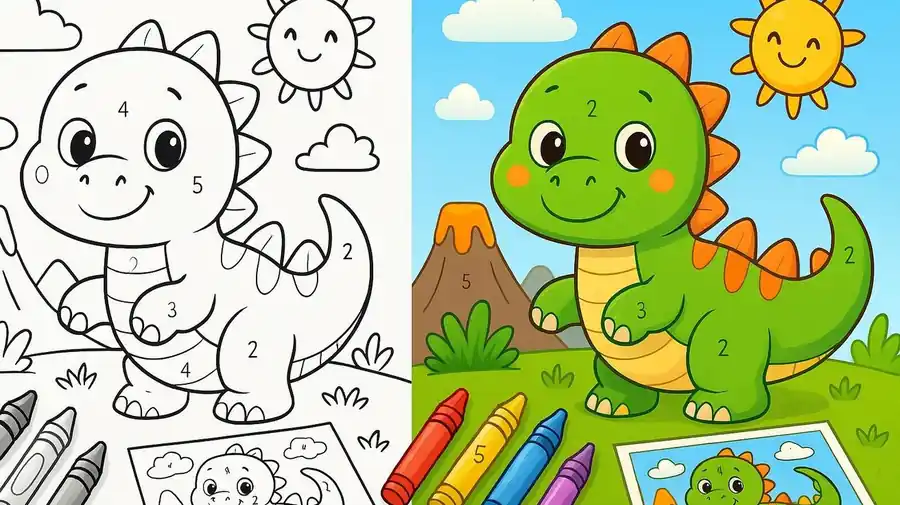
These pages lean into the cartoon and kawaii end of dinosaur illustration — big-eyed T-rexes, chubby brachiosaurs peeking through jungle foliage, pterodactyls soaring over prehistoric coastlines, and small theropods surrounded by ferns and flowers. Each page divides those scenes into numbered regions with a color key running 6 to 8 colors, which is a meaningful step up from the 4-color beginner format. The lines are still clearly drawn, but the regions are smaller and more varied than a simple shape-fill page, making the matching task genuinely engaging rather than mechanical.
Dinosaurs hold attention in a way few subjects can, which matters for a format that requires patience and sustained focus. A child who would normally rush through a coloring page tends to slow down and be more deliberate when the picture is something they actually want to look at when it’s finished. Everything here is free to download and easy to print.
Free Printable Dinosaur Color by Number Coloring Pages
This collection includes 24 printable dinosaur color by number coloring pages featuring T-rexes, brachiosaurs, pterodactyls, stegosaurs, and various small theropods set in lush prehistoric scenes with plants, water, rocks, and sky. The art style blends cartoon proportions with enough scene detail to reward careful coloring — backgrounds include jungle undergrowth, shallow prehistoric seas, and open skies with dramatic clouds. Color keys use 6 to 8 numbered colors per page, and all pages print cleanly on standard 8.5×11 Letter or A4 paper.


Who Are These Dinosaur Color by Number Pages Best For?
The 6-to-8-color keys and moderately detailed scenes make these a solid fit for kindergartners and early elementary kids, roughly ages 5 to 8. The key size matters: a page with eight numbered colors requires that the child hold more information in working memory while scanning the image, which is measurably harder than a four-color key. Kids in early elementary who have done simpler color-by-number pages before will find this set appropriately challenging without being frustrating.
Younger children who are strong for their age — a preschooler who can confidently recognize numerals 1 through 8 and has good crayon control — can manage the simpler pages in this set with light adult support. The pages vary somewhat in density, so it’s worth flipping through to find a good starting match rather than going in order.
For classroom use these work especially well during a dinosaurs or prehistoric life unit. A teacher can assign different pages to different kids and then assemble the finished pages as a prehistoric mural — the variety of species and scenes across the 24 pages makes them look coherent as a group.
Interesting Dinosaur Facts to Share While Coloring
No one knows exactly what color dinosaurs were. Because we only have fossils — bones and teeth, not skin — scientists can’t be certain. Some feathered dinosaurs preserved melanosomes, tiny structures that indicate color, suggesting at least some were iridescent or had banded patterns. The green and brown we see in movies is mostly educated guessing. These pages give kids full permission to choose any colors they like.
T-rex had arms that were too short to reach its own mouth. Tyrannosaurus rex arms measured only about 3 feet long on a body that could be 40 feet from nose to tail. Scientists still debate what those tiny arms were actually used for — current theories include gripping prey while biting, or pushing the animal upright after resting.
Brachiosaurus had nostrils on the top of its head, not the end of its snout. For a long time scientists thought this meant they lived mostly in water, breathing like a snorkel. More recent research suggests they were fully land animals, and the high nostril placement may have been related to vocalizing or heat regulation.
Pterodactyls were not actually dinosaurs. Pterodactyls — and pterosaurs generally — were flying reptiles that lived at the same time as dinosaurs, but they’re a separate group. True dinosaurs are defined by a specific hip structure; pterosaurs don’t have it. That said, pterosaurs appear in plenty of dinosaur coloring pages, including this set, because they belong to the same prehistoric era.
Birds are technically living dinosaurs. Modern birds are the direct descendants of a group of two-legged theropod dinosaurs. When scientists say the dinosaurs went extinct 66 million years ago, they mean the non-avian dinosaurs. The birds outside your window are the dinosaurs that survived.
Creative Dinosaur Coloring and Craft Ideas
Realistic vs. Fantasy Pair
Color one page with naturalistic earthy tones — brown, olive green, grey — then color a second identical page (or similar scene) with completely imaginary colors. Display them side by side to compare.
Species Label Cards
After coloring, look up the dinosaur on the page and write its name and one fact on a small card attached to the bottom. Turns the finished page into a mini science display.
Prehistoric Landscape Strip
Tape several finished pages together horizontally to create a panoramic prehistoric scene. Adding hand-drawn volcanoes, rivers, and trees in the margins extends the world beyond each individual page.
Color-by-Habitat
Instead of following the number key, assign colors by habitat zone: everything on the ground one color, sky another color, water a third, and foliage a fourth. It reinforces the idea of ecosystems while still producing a coherent finished image.
Size Comparison Chart
After coloring a large dinosaur like a brachiosaurus, draw a small human figure next to it at scale using a ruler. Discussing how tall the dinosaur actually was makes the image feel tangible rather than abstract.
Texture Rubbings
Place a finished page under a fresh sheet of paper and rub a crayon sideways across it to pick up the impression of the outlines. The resulting texture print looks interesting mounted next to the original colored version.
Dino Sound Guesses
While coloring, have kids invent what sound each dinosaur on the page might have made. Scientists actually don’t know — large sauropods may have made low rumbling sounds below human hearing range. Any guess is as valid as any other.
How to Print These Dinosaur Coloring Pages
Each page downloads as a PDF that prints on standard 8.5×11 Letter or A4 paper. For the denser pages with smaller numbered regions, printing at full size on white 24lb paper gives the clearest lines — scaling down to 80% can make small numbers hard to read. Grayscale printing works fine; the number key and all region labels remain fully legible without color ink.
Explore More Color by Number Coloring Pages
If you enjoyed these pages, you may also like:
Color by Number Dragon Coloring Pages
Color by Number Halloween Coloring Pages
Color by Number Easy Kindergarten Coloring Pages
Color by Number Thanksgiving Coloring Pages
Color by Number Pages