
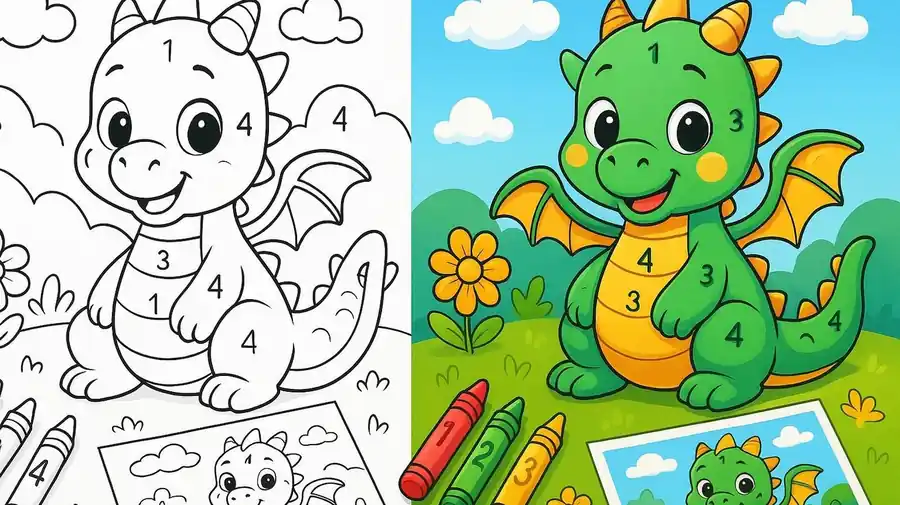
Dragon color-by-number hits a specific sweet spot: the subject is inherently appealing to kids who might otherwise dismiss coloring as too babyish, but the format structures the activity enough that even a child who freezes up in front of a blank page has a clear place to start. These ten pages lean into cartoon and kawaii dragon designs rather than intimidating medieval beasts — rounded bodies, expressive faces, wings that look more whimsical than threatening. One page features a small dragon curled inside a cracked egg. Another shows a flying dragon mid-swoop. Several have chunky silhouettes that color up quickly and satisfyingly.
The number keys use six to nine colors per page, which is enough to make the finished images look vibrant without requiring a child to juggle an unmanageable number of crayons at once. The numbered regions vary from page to page — some have large open sections that a kindergartener can fill confidently, others have smaller segmented areas along the wings and tail details that ask for a bit more precision. There’s enough range across the ten pages that siblings at different skill levels can each find a page that suits them. Everything here is free to download and easy to print.
Free Printable Color by Number Dragon Coloring Pages
This collection includes 10 printable color by number dragon coloring pages featuring kawaii and cartoon-style dragon characters in a range of poses and settings. Pages include a small dragon hatching from an egg, a flying dragon mid-swoop, a dragon with horns and spread wings in a standing pose, a cute chibi dragon with a round body, a dragon emerging from a cracked shell, a winged dragon silhouette, and several additional character compositions. Each page includes a numbered color key at the bottom. All pages are formatted for standard US Letter paper and print clearly in black and white.


Who Are These Dragon Color by Number Pages Best For?
Kindergarteners do well with the rounder, simpler designs — the hatching egg dragon and the chibi-style characters that fill most of the page with large, easy-to-reach regions. A five- or six-year-old who can match single-digit numbers to colors confidently won’t be slowed down by the outlines, and finishing one of these pages in a single sitting is realistic without rushing.
Early elementary kids will find more to chew on in the pages featuring detailed wing patterns, tail sections divided into smaller regions, and background elements. Those pages have more total sections and a higher color count, which stretches the activity out and rewards kids who have built enough stamina to work through something that takes real concentration. A first or second grader who loves fantasy creatures will happily spend thirty minutes on one of the more intricate pages.
In classroom or homeschool settings, dragon themes cross the line between art time and storytelling naturally — kids who finish early often want to name their dragon and describe its powers, which makes this a good lead-in to creative writing exercises.
Interesting Dragon Facts to Share While Coloring
Dragons appear in the mythologies of cultures that had no contact with each other. European dragons, Chinese dragons, Mesopotamian serpent creatures, and Mesoamerican feathered serpents all share enough similarities to suggest they arose independently rather than spreading from one source. Many researchers think early humans finding large fossilized bones — dinosaur skulls, mammoth remains — sparked these creatures across multiple traditions.
Chinese dragons are associated with good fortune, not destruction. In Chinese mythology, dragons are water deities connected to rain, rivers, and fertility rather than fire-breathing monsters. Imperial Chinese dragons have five claws on each foot — the number of claws was a marker of status, with fewer claws representing lesser rank.
The Komodo dragon is a real animal and it’s enormous. Native to a few Indonesian islands, Komodo dragons can grow up to 10 feet long and weigh over 150 pounds. They hunt deer and pigs and have been observed taking down prey much larger than themselves. Their saliva carries dangerous bacteria, and recent research suggests they also have venom glands.
The word “dragon” comes from the Greek “drakon,” meaning large serpent. Early dragon legends in Europe described them as giant snakes rather than the winged, four-legged fire-breathers depicted in medieval art. The wing-and-leg combination became standard in European illustration gradually over several centuries.
Creative Dragon Coloring and Craft Ideas
Dragon Name and Power Card
After finishing a page, write the dragon’s name, elemental power (fire, ice, lightning, poison), and one special ability on an index card and attach it to the back.
Eastern vs. Western Color Scheme
Color one dragon page using traditional Western dragon colors (red, black, dark green) and another using traditional Eastern dragon colors (gold, jade green, imperial yellow) — then compare how mood changes with palette.
Dragon Scale Pattern Practice
On a plain sheet, practice drawing repeating scale patterns in different colors, then cut out the scales and collage them onto a finished dragon page to add texture.
Egg to Dragon Story Strip
Use the hatching egg page as a starting point, then draw three additional scenes on a folded strip of paper showing the dragon growing up — hatchling, juvenile, adult.
Elemental Color Challenge
Assign an element to each page — fire dragon uses only reds and oranges, water dragon uses only blues and teals — and color accordingly rather than following the printed key.
Dragon’s Lair Backdrop
After coloring a dragon character page, draw a cave, mountain, or castle background on a separate sheet and place the cut-out dragon in front of it as a layered scene.
Mini Dragon Bestiary
Color all ten pages and staple them together with handwritten names and descriptions on the back of each, creating a personal dragon encyclopedia.
How to Print These Dragon Color by Number Pages
Each page downloads as a PDF formatted for standard US Letter (8.5 × 11 inches) and also prints on A4 without cropping. Standard 20 lb copy paper works for crayons and colored pencil; 24 lb or cardstock holds marker without bleed-through. Print in grayscale — the numbered regions and key at the bottom remain fully legible in black and white on any printer.
Explore More Color by Number Coloring Pages
If you enjoyed these pages, you may also like:
Dinosaur Color by Number Coloring Pages
Color by Number Halloween Coloring Pages
Color by Number Christmas Coloring Pages
Easy Kindergarten Color by Number Pages
All Color by Number Coloring Pages