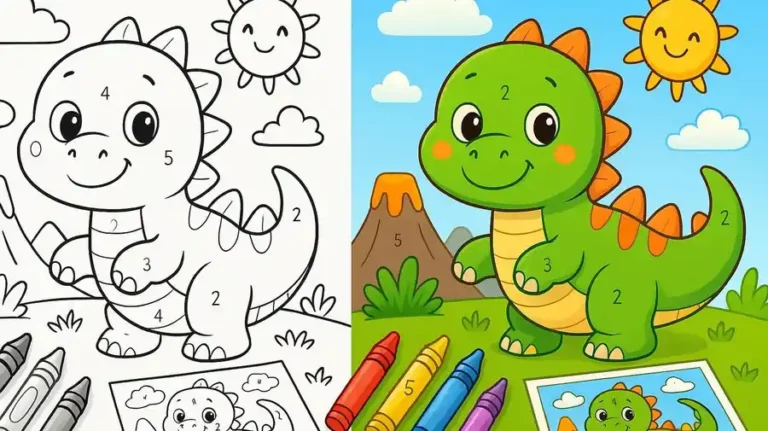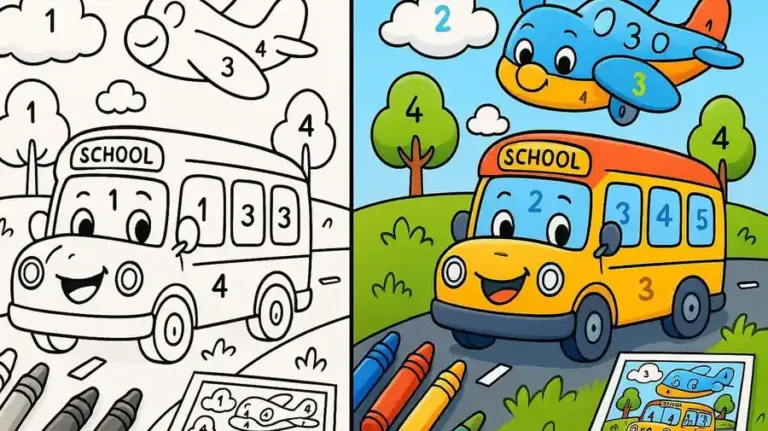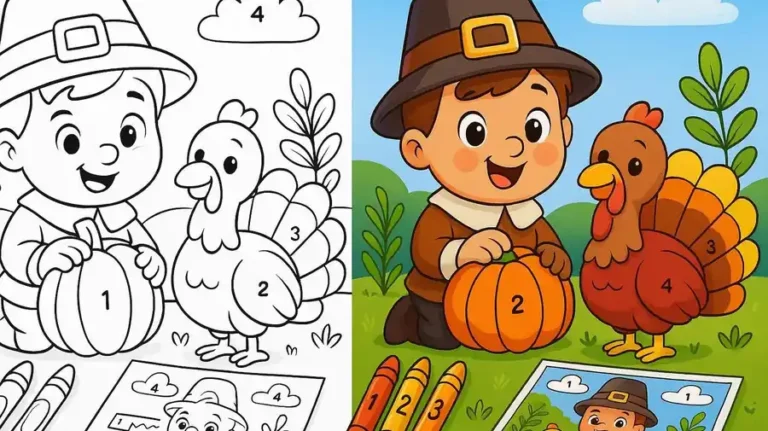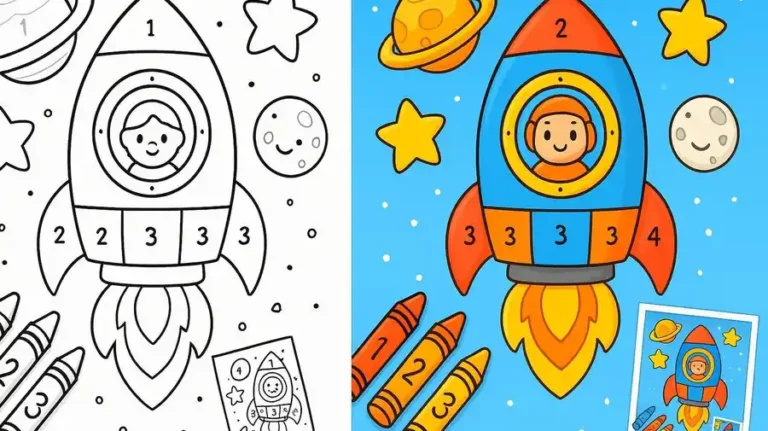

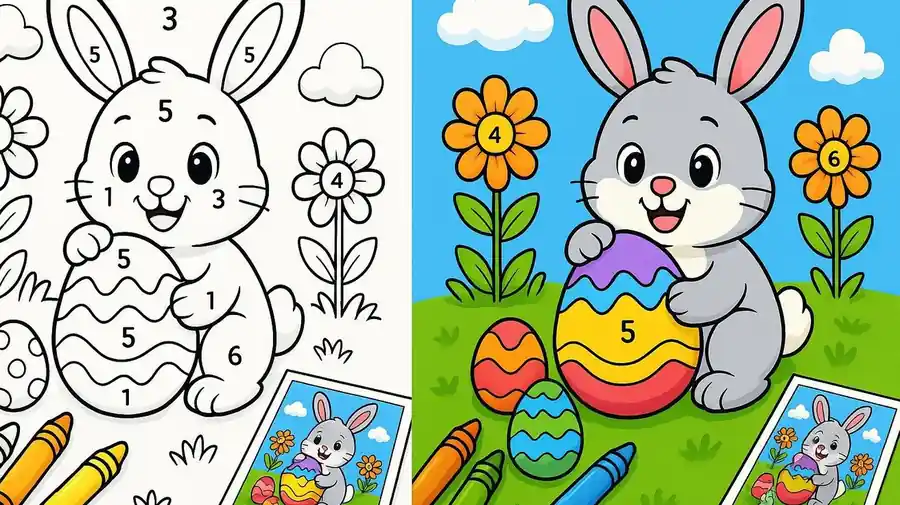
Easter bunnies in twenty variations — sitting, waving, peeking out of decorated eggs, carrying baskets, surrounded by tulips and chicks. The drawings use a soft kawaii style throughout: round bodies, oversized eyes, short limbs, expressions that land somewhere between cheerful and gently surprised. Each page pairs one of these characters or scenes with a color-by-number key printed at the bottom, using a set of colored dots as the reference rather than written color names, which makes the activity accessible to kids who are still working on reading.
The pages vary meaningfully in density. Some of the simplest ones — a single bunny in profile with five large regions — can be finished by a four-year-old in about ten minutes. Others, featuring bunnies alongside egg clusters, tulip arrangements, and background fill patterns, have enough sections to keep a seven-year-old busy for half an hour. The 20-page count also means you can hand out a different page each day through the two weeks before Easter without repeating yourself. Everything here is free to download and easy to print.
Free Printable Color by Number Easter Coloring Pages
This collection includes 20 printable color by number Easter coloring pages featuring kawaii-style Easter bunnies and seasonal scenes across a range of compositions. Pages include a bunny waving hello, a bunny seated in a cracked Easter egg, a rabbit carrying a basket of eggs, a bunny surrounded by tulips and flowers, a chick hatching from an egg, bunnies in pairs with Easter baskets, bunnies holding decorated Easter eggs, and several additional character and scene compositions. Each page includes a color-dot reference key at the bottom. All pages are formatted for standard US Letter paper.


Who Are These Easter Color by Number Pages Best For?
The simplest pages — a single bunny silhouette with five or six large regions and a five-color key — are genuinely preschool-appropriate. A four-year-old who can match a dot to a crayon and color inside a large outline can complete them. The dot key rather than number key removes the reading requirement entirely, which is what makes these accessible to kids who aren’t yet reading numerals confidently.
Kindergarteners will find most of the single-character pages comfortable and the paired-bunny pages a mild stretch. The flower and basket pages add enough additional sections to make the activity last a full quiet-time session without being overwhelming. At this level, kids often want to compare their finished pages with siblings or classmates, which the Easter theme — shared by almost every family in the target age group — makes easy.
Early elementary kids in grades one and two can work through the denser pages with background fills and multiple character elements. Those pages have ten or more distinct regions across the image, which calls for tracking the key carefully rather than guessing. In classroom settings, Easter color-by-number works well in the week before spring break when maintaining focused instruction is harder — the activity is structured enough to feel productive without requiring teacher facilitation.
Interesting Easter Facts to Share While Coloring
Rabbits became associated with Easter because they reproduce so rapidly in spring. The connection is ancient — spring festivals across Europe celebrated fertility and new life, and rabbits were visible symbols of that abundance as they emerged and multiplied in the warming months. The specific Easter Bunny character as a gift-giver arrived in America with German immigrants in the 1700s.
Dyeing Easter eggs is one of the oldest Easter traditions still practiced. Decorated eggs have been found in archaeological sites from pre-Christian cultures across Europe and the Middle East. Early Christians adopted the egg as a symbol of the resurrection — the egg looks dead but contains new life. Red was the most traditional dye color in Eastern European and Orthodox Christian traditions.
Baby rabbits are called kittens, not bunnies. A group of rabbits is called a colony or herd. Rabbits are not rodents — they belong to the order Lagomorpha, which also includes pikas and hares. Hares and rabbits are different animals: hares are larger, born with fur and open eyes, and don’t burrow.
The date of Easter changes every year. Easter is calculated as the first Sunday after the first full moon after the spring equinox — which means it can fall anywhere between March 22 and April 25. The calculation combines the solar calendar and the lunar calendar, which is why it shifts by up to five weeks from year to year.
Creative Easter Coloring and Craft Ideas
Daily Countdown Activity
Print one page per day for the two weeks before Easter and let kids work through the collection as a countdown calendar — similar to an Advent calendar but for spring.
Easter Basket Liner
Color the largest, most detailed page and use it as lining paper at the bottom of an Easter basket before filling it with eggs and treats.
Pastel Only Challenge
Color the page using only pastel versions of each required color — light pink instead of red, sky blue instead of navy — practicing how value shifts change the overall feel of a composition.
Bunny Name Story
After finishing a page, give the bunny a name and write a three-sentence story on the back: where they live, what’s in their basket, and where they’re going on Easter morning.
Egg Pattern Design
On a plain sheet of paper, draw three large oval egg shapes and decorate each one with original patterns using the same color palette as the finished color-by-number page.
Greeting Card
Color one of the simpler single-bunny pages, trim it to fit inside a folded piece of cardstock, and attach it as the front panel of a handmade Easter card.
Spring Color Palette Study
After finishing a page, list the colors used on the back and identify which ones feel like “spring colors.” Then try to find those same colors in real objects outside — flowers, leaves, sky — during a short walk.
How to Print These Easter Color by Number Pages
Each page downloads as a PDF formatted for standard US Letter (8.5 × 11 inches) and also prints on A4. Plain 20 lb copy paper is sufficient for crayons and colored pencils. The colored dot key at the bottom remains clear when printed in grayscale — each dot prints as a distinct shade of grey, which is readable for number-matching purposes though less convenient than printing in color. If your printer has a color draft mode, that saves ink while keeping the key legible.
Explore More Color by Number Coloring Pages
If you enjoyed these pages, you may also like:
Color by Number Christmas Coloring Pages
Color by Number Thanksgiving Coloring Pages
Color by Number Halloween Coloring Pages
Easy Kindergarten Color by Number Pages
All Color by Number Coloring Pages