
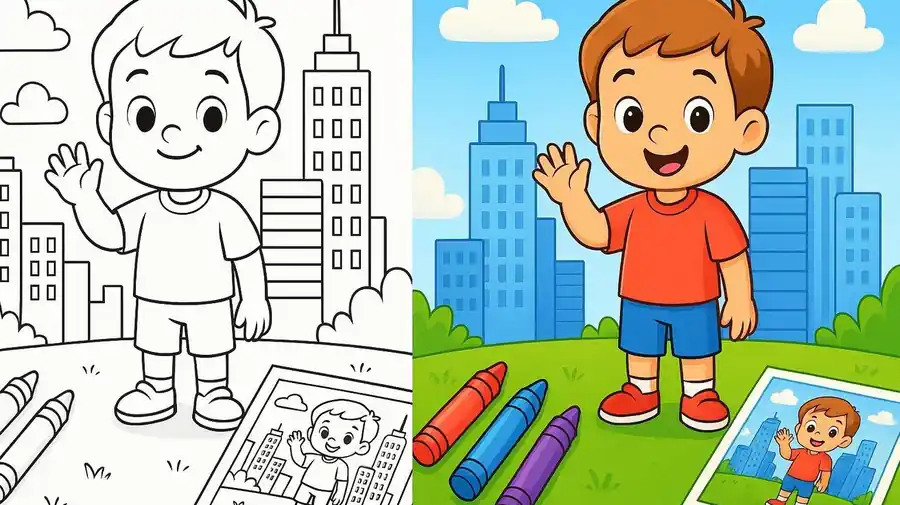
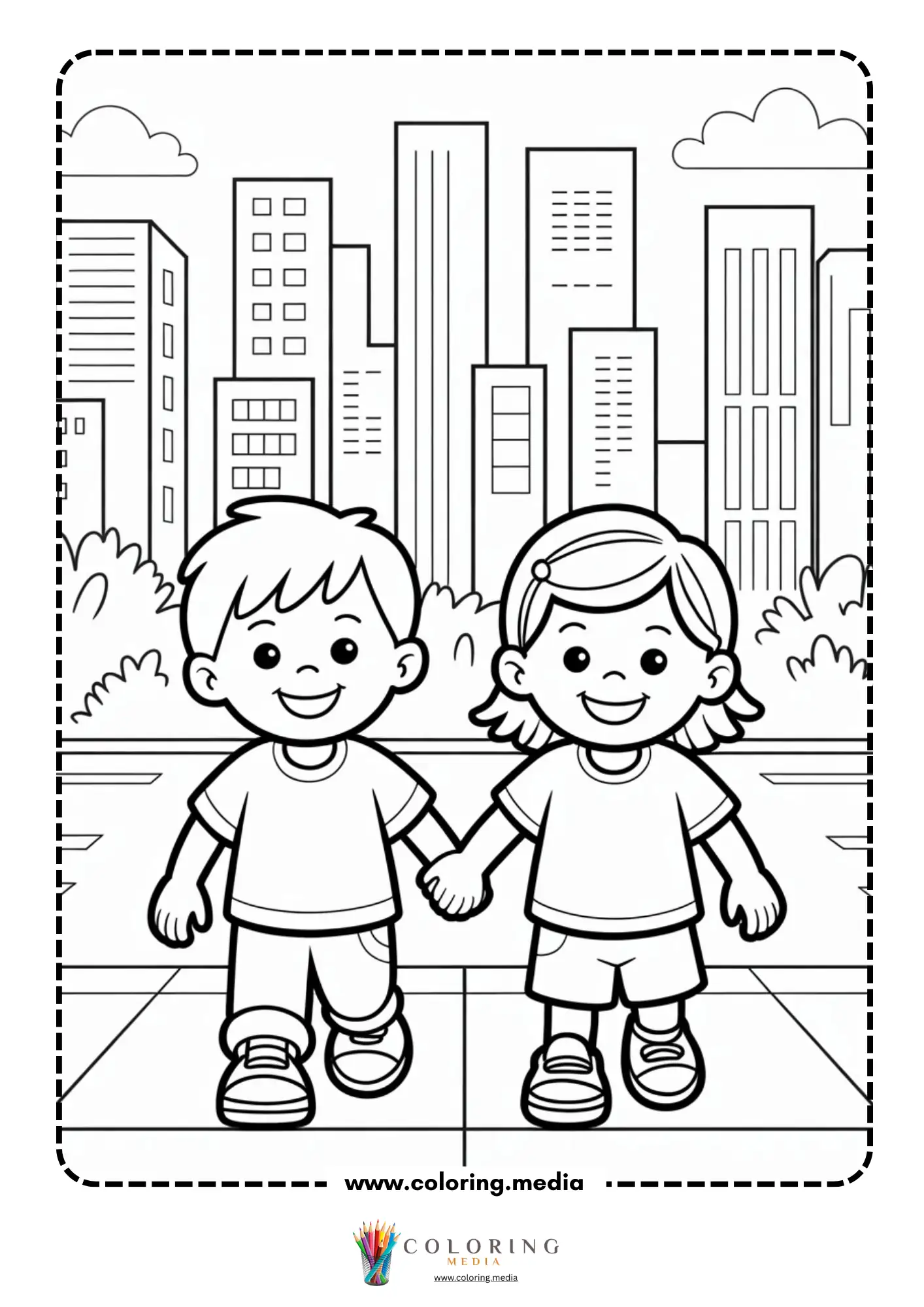
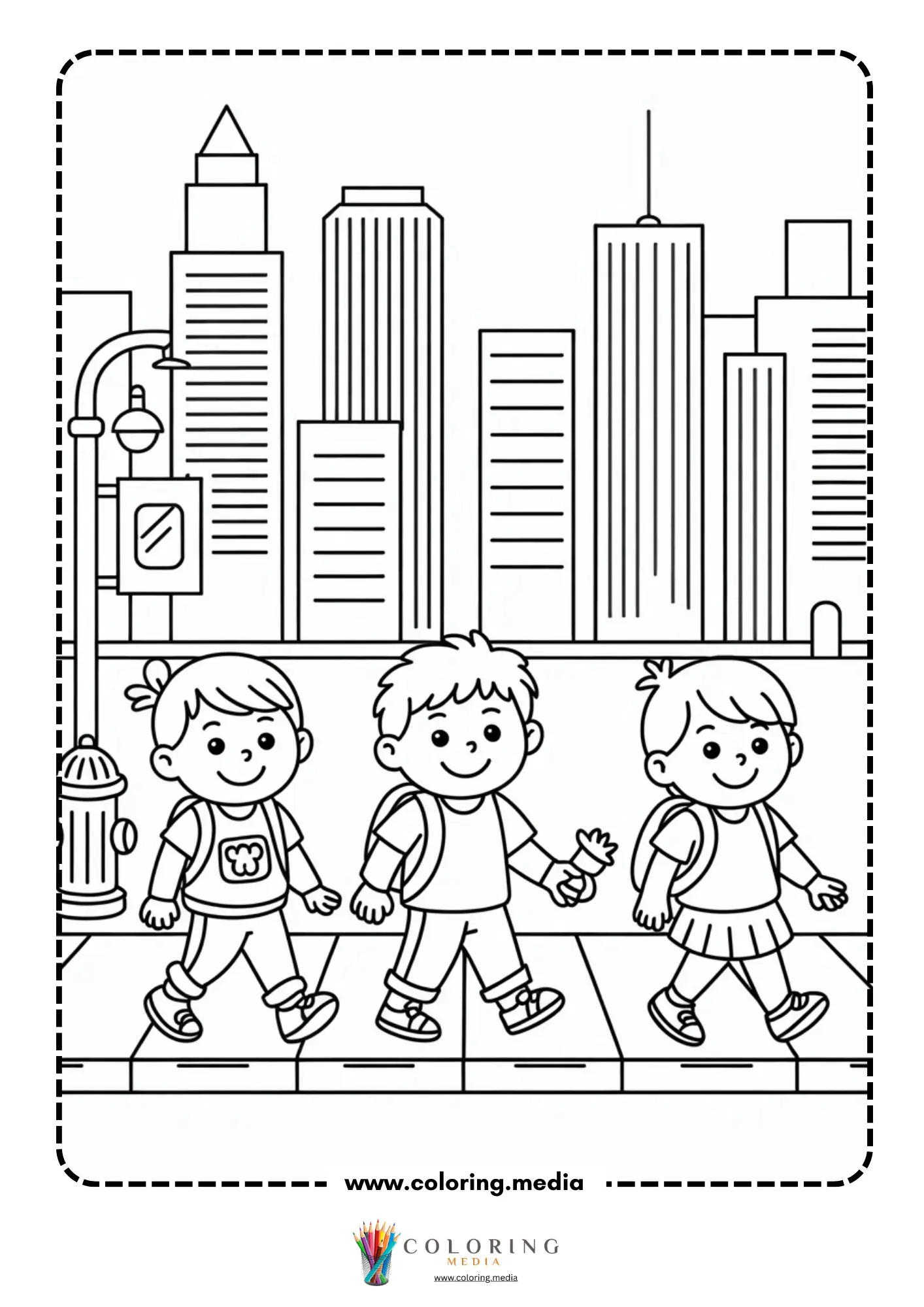
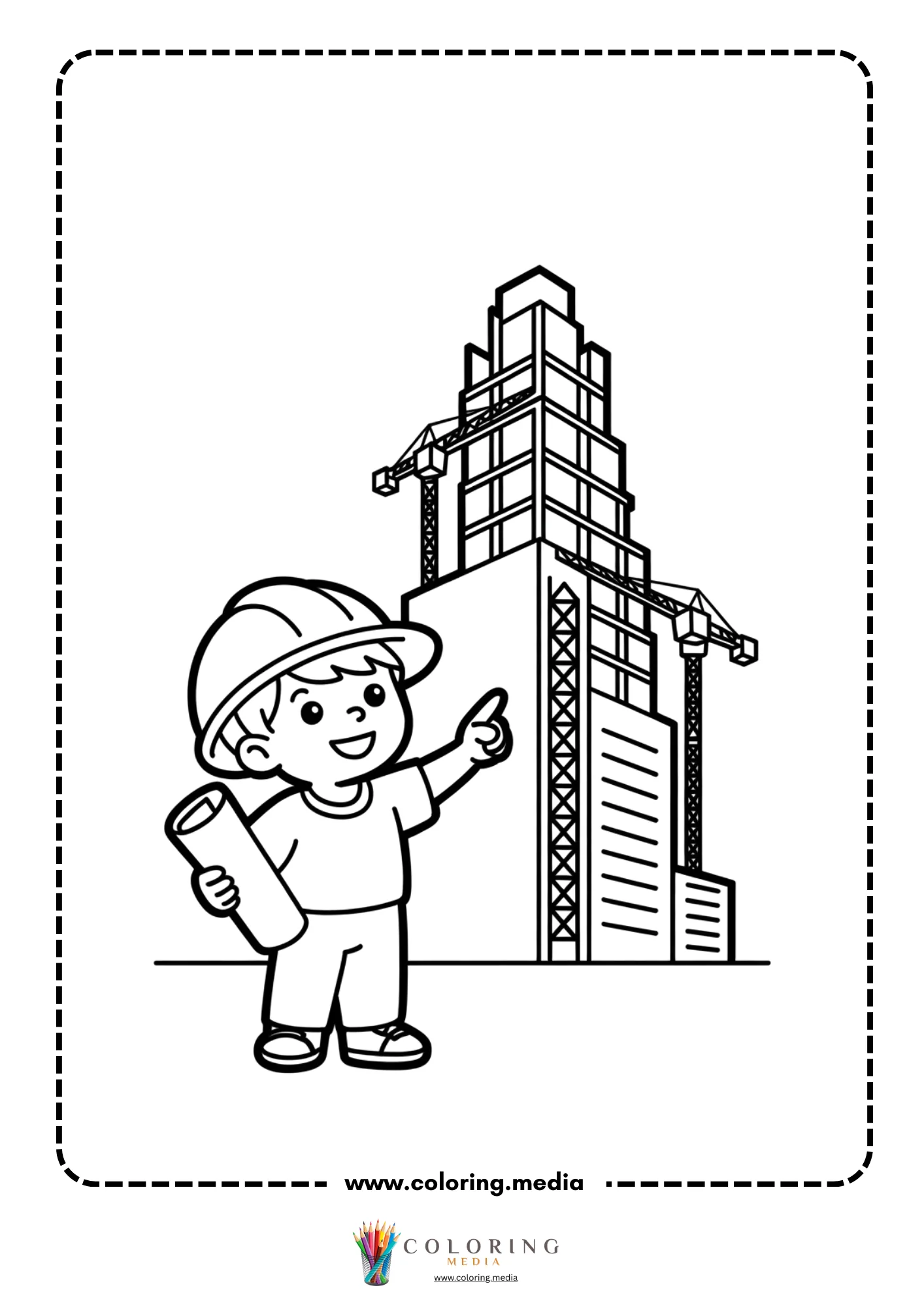
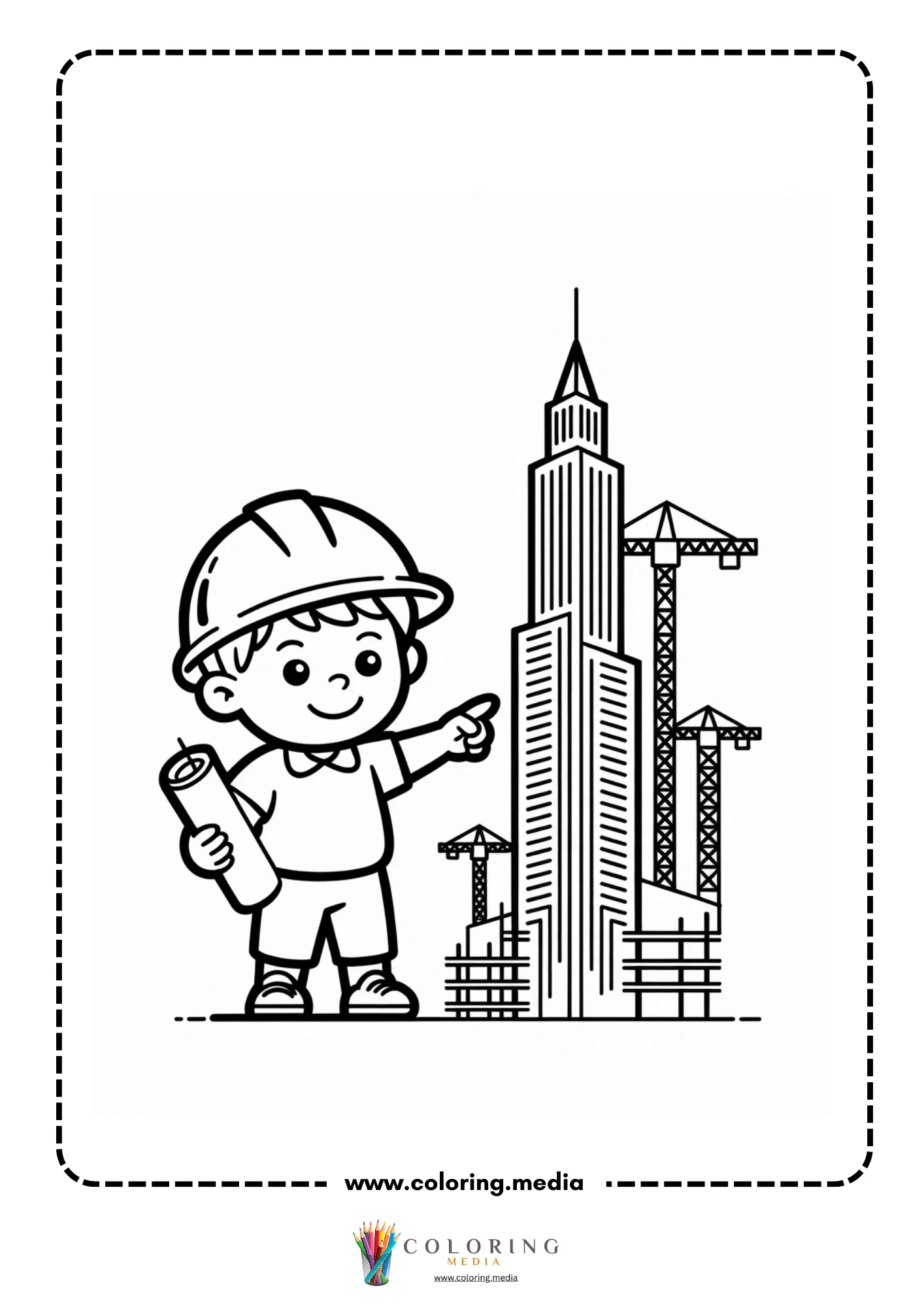
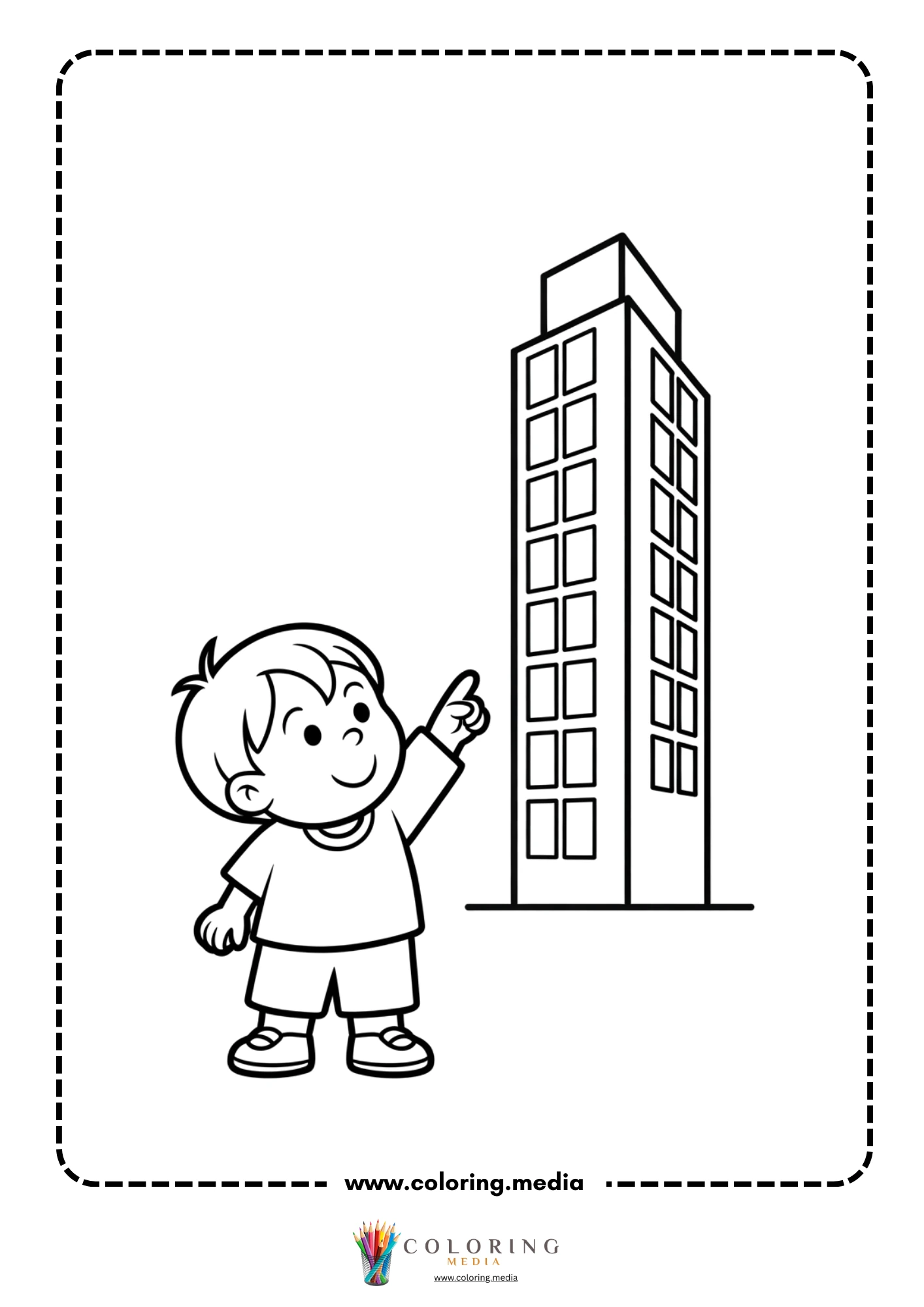
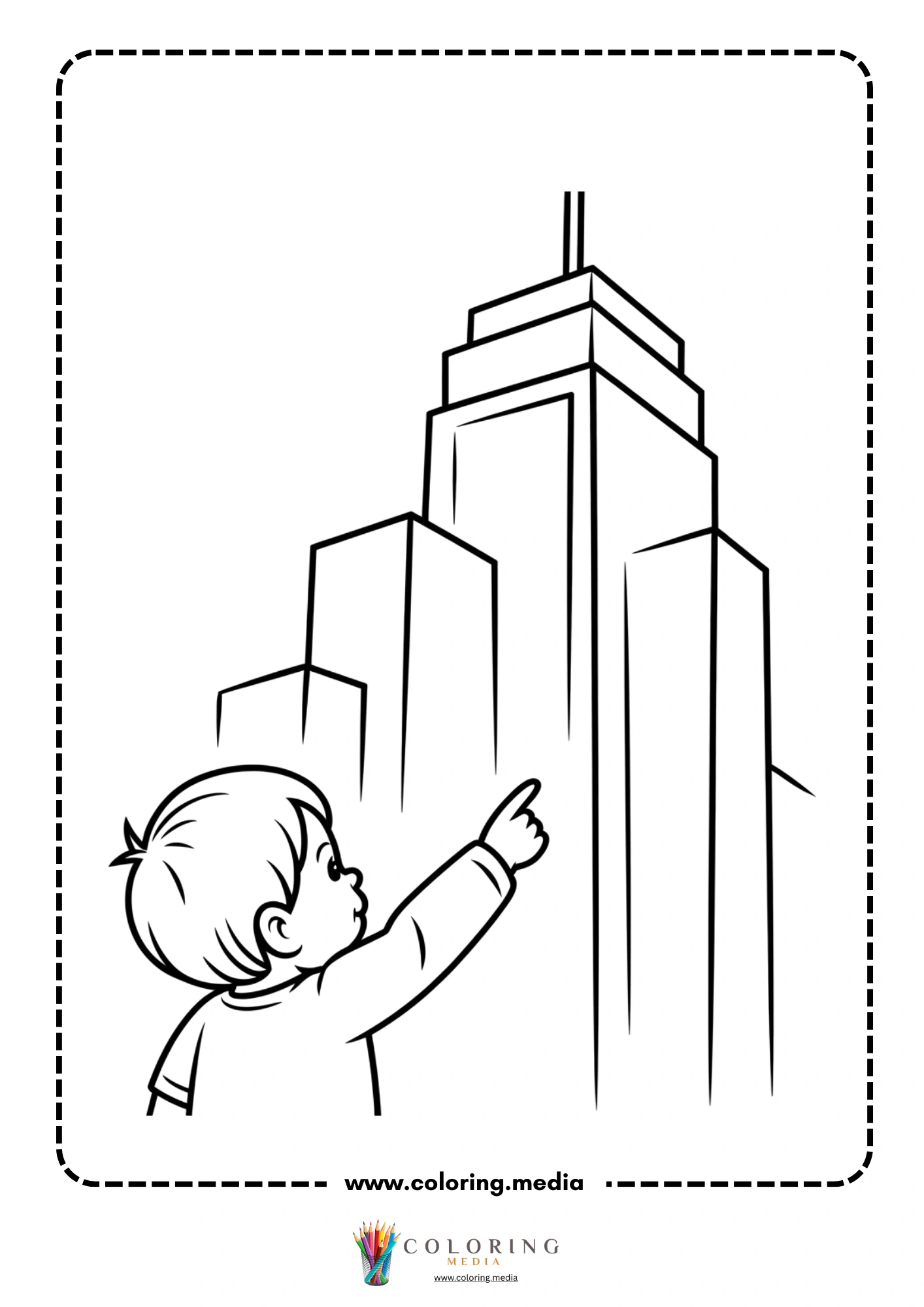
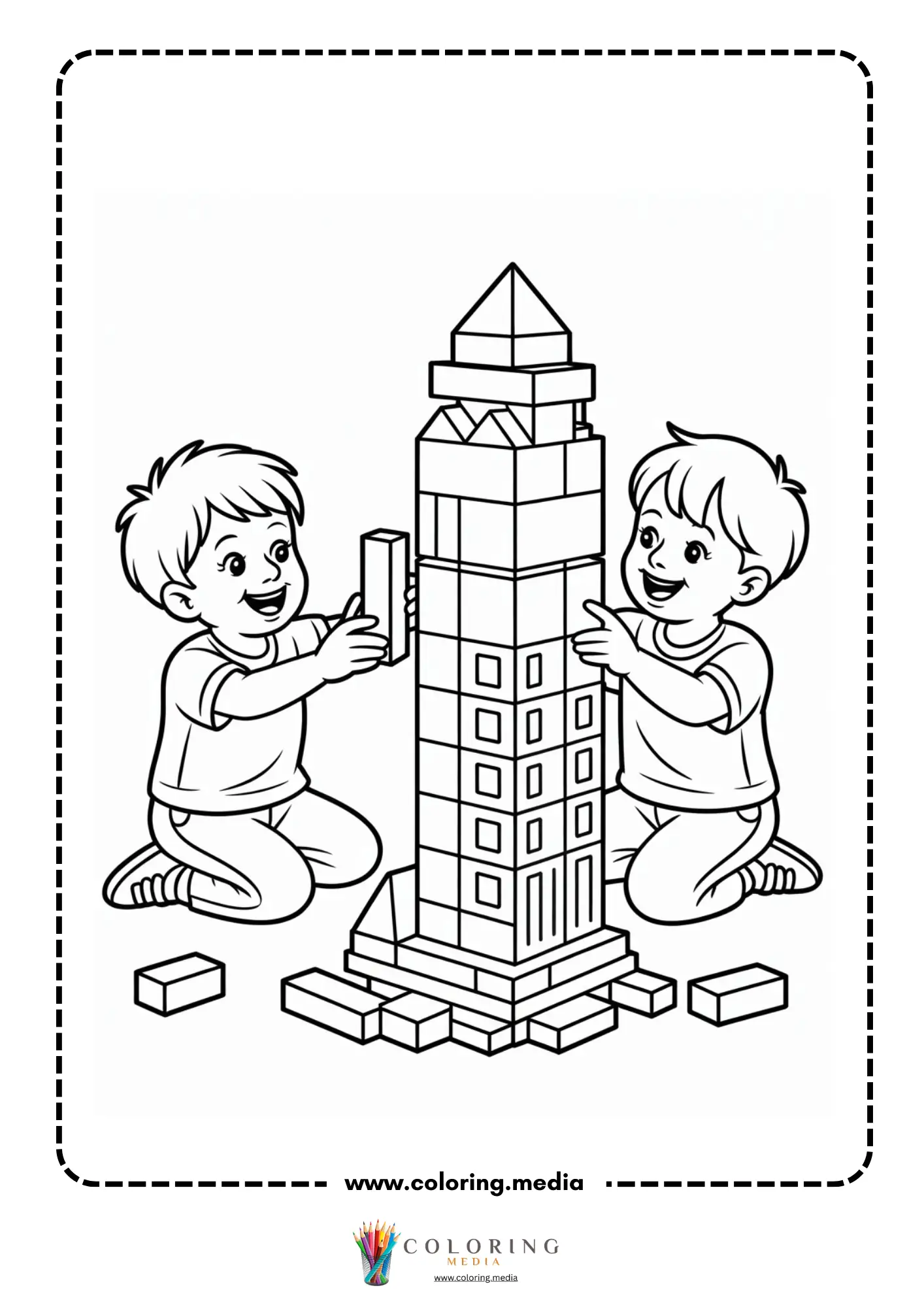
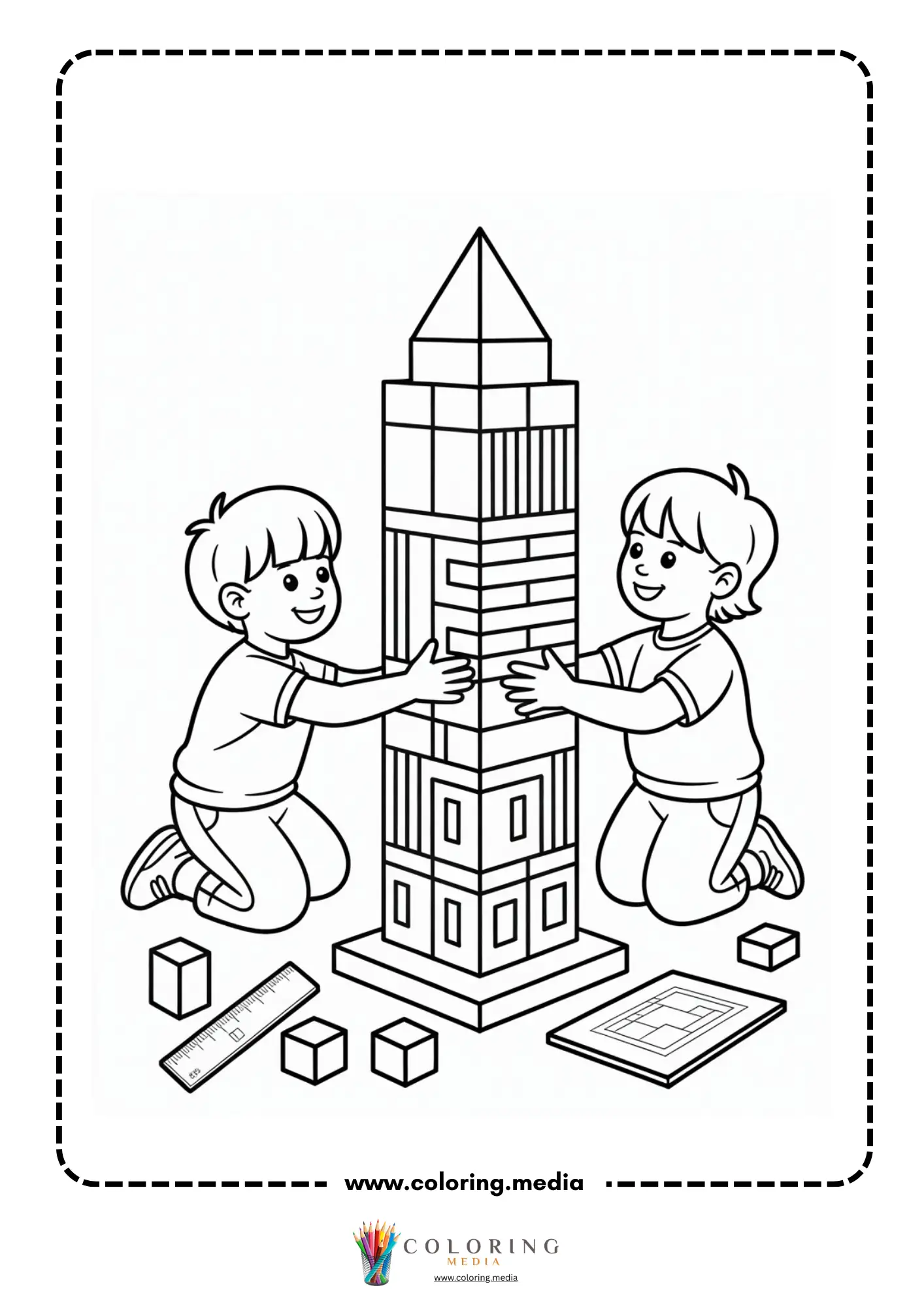
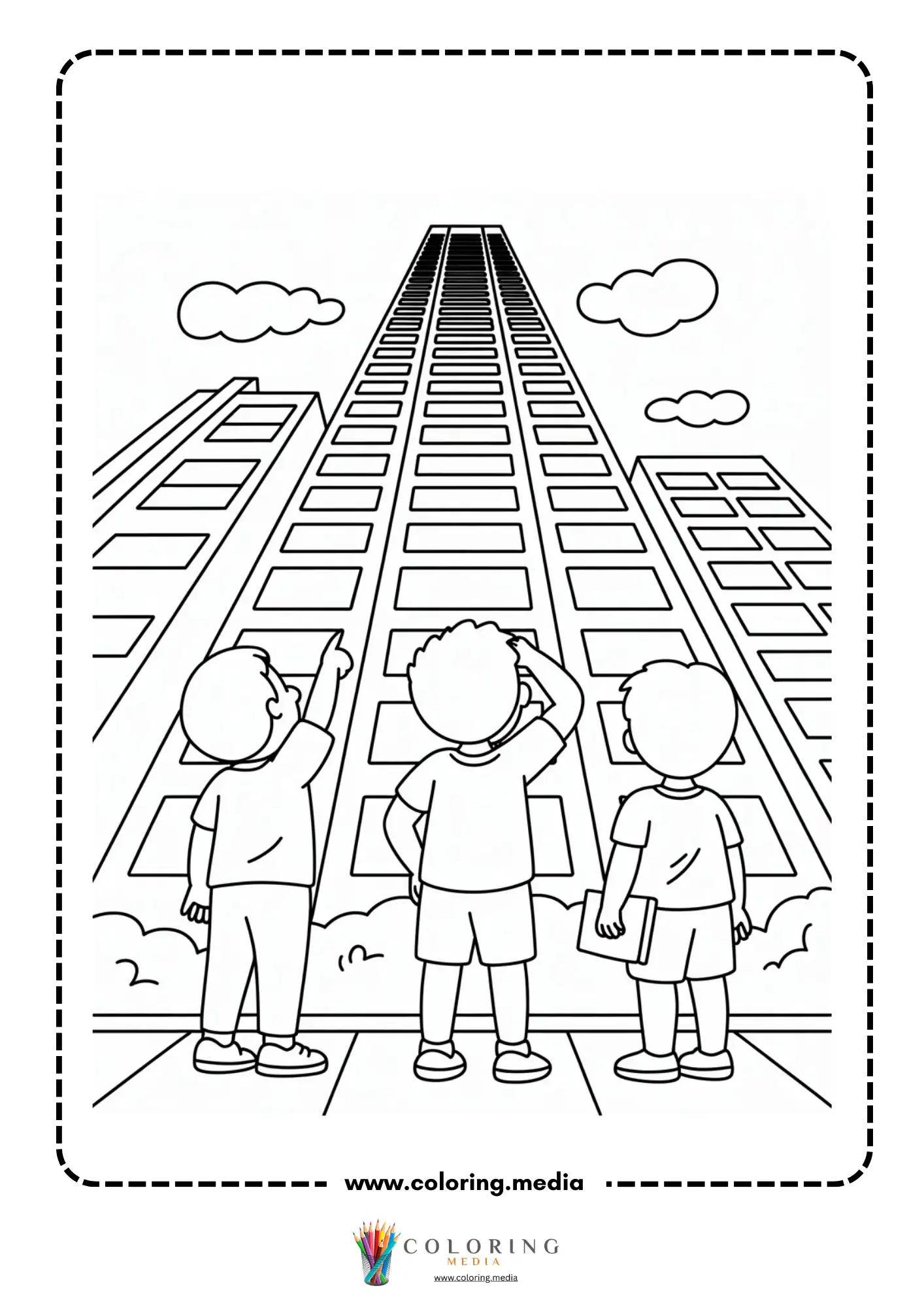
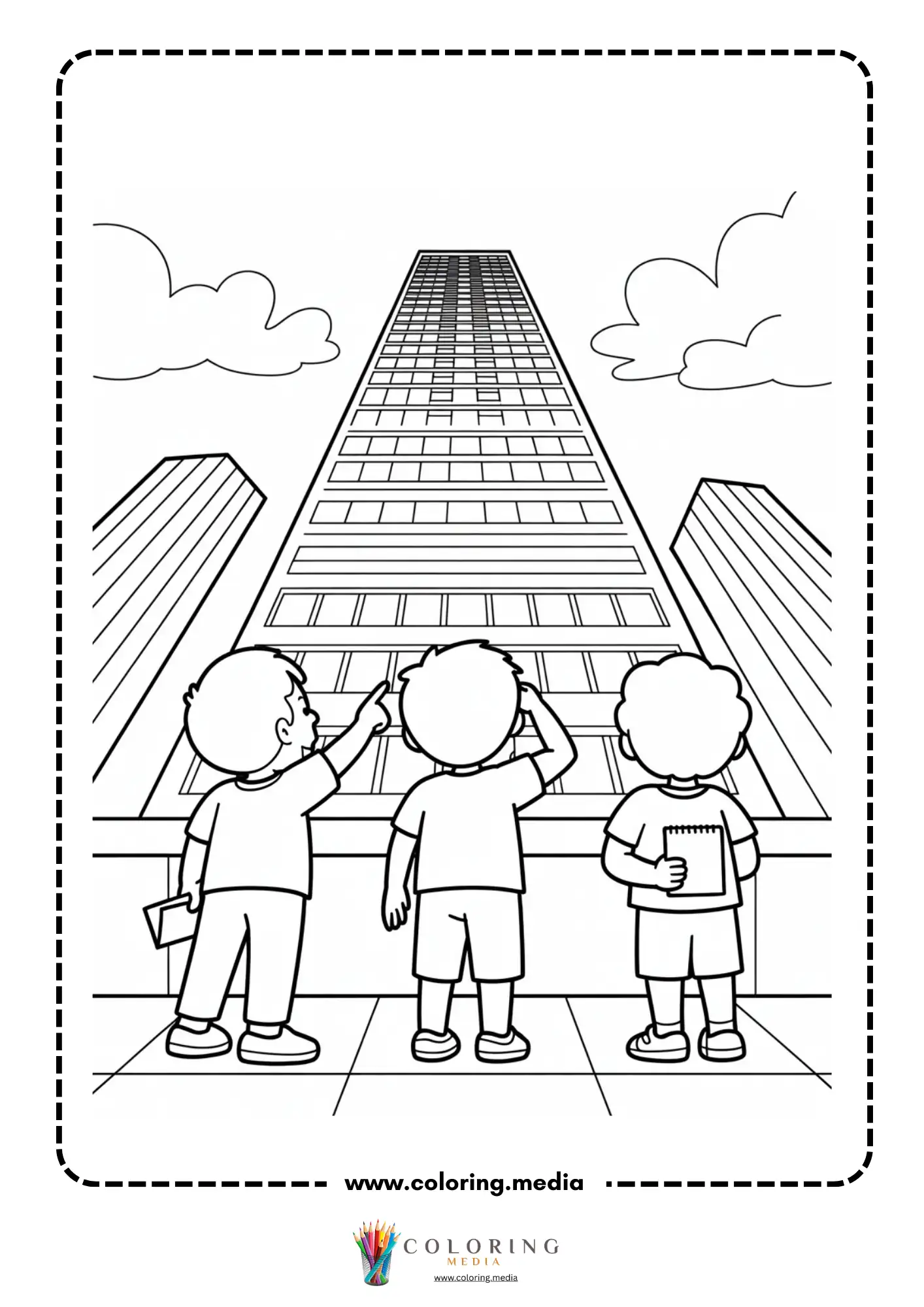
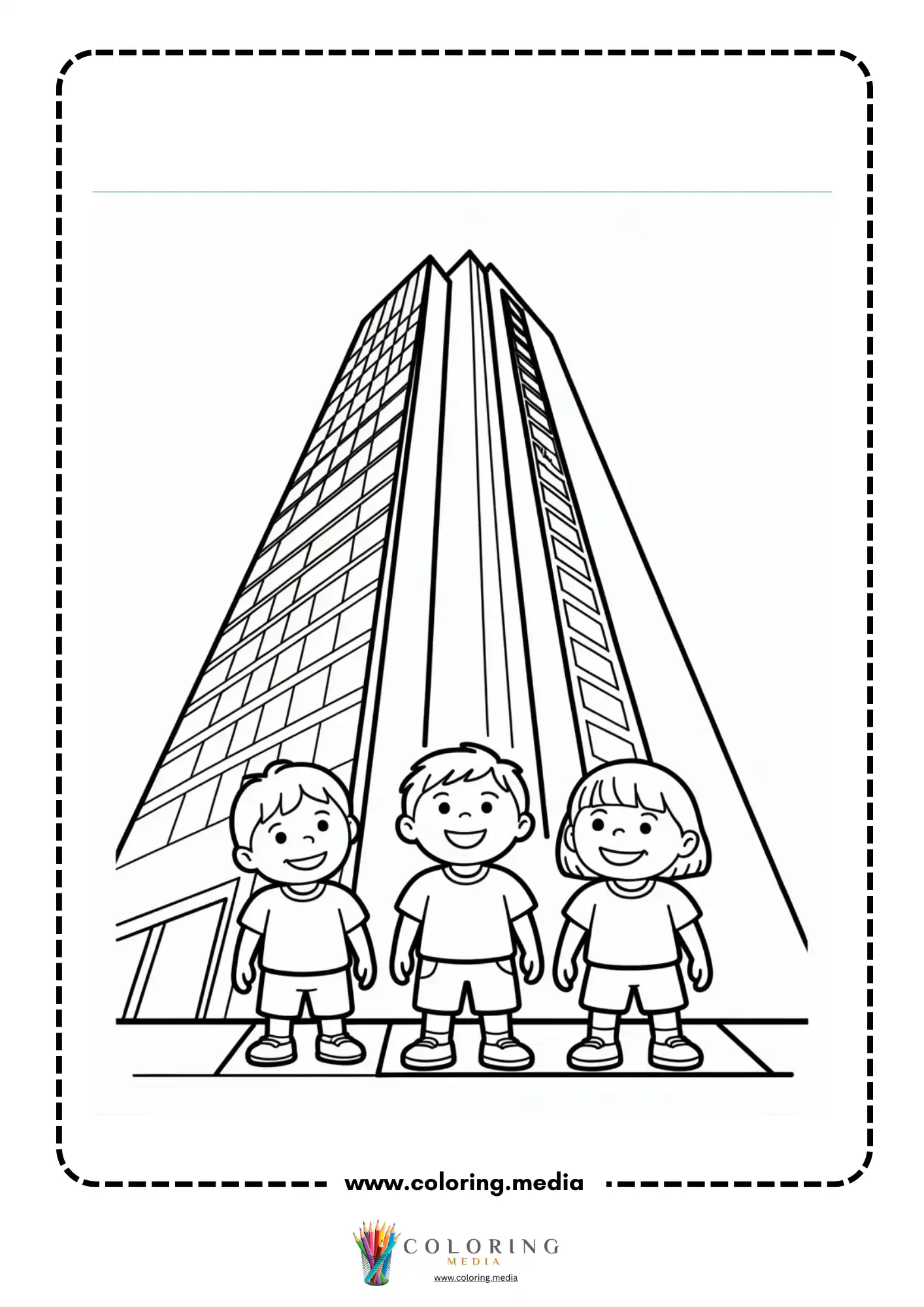
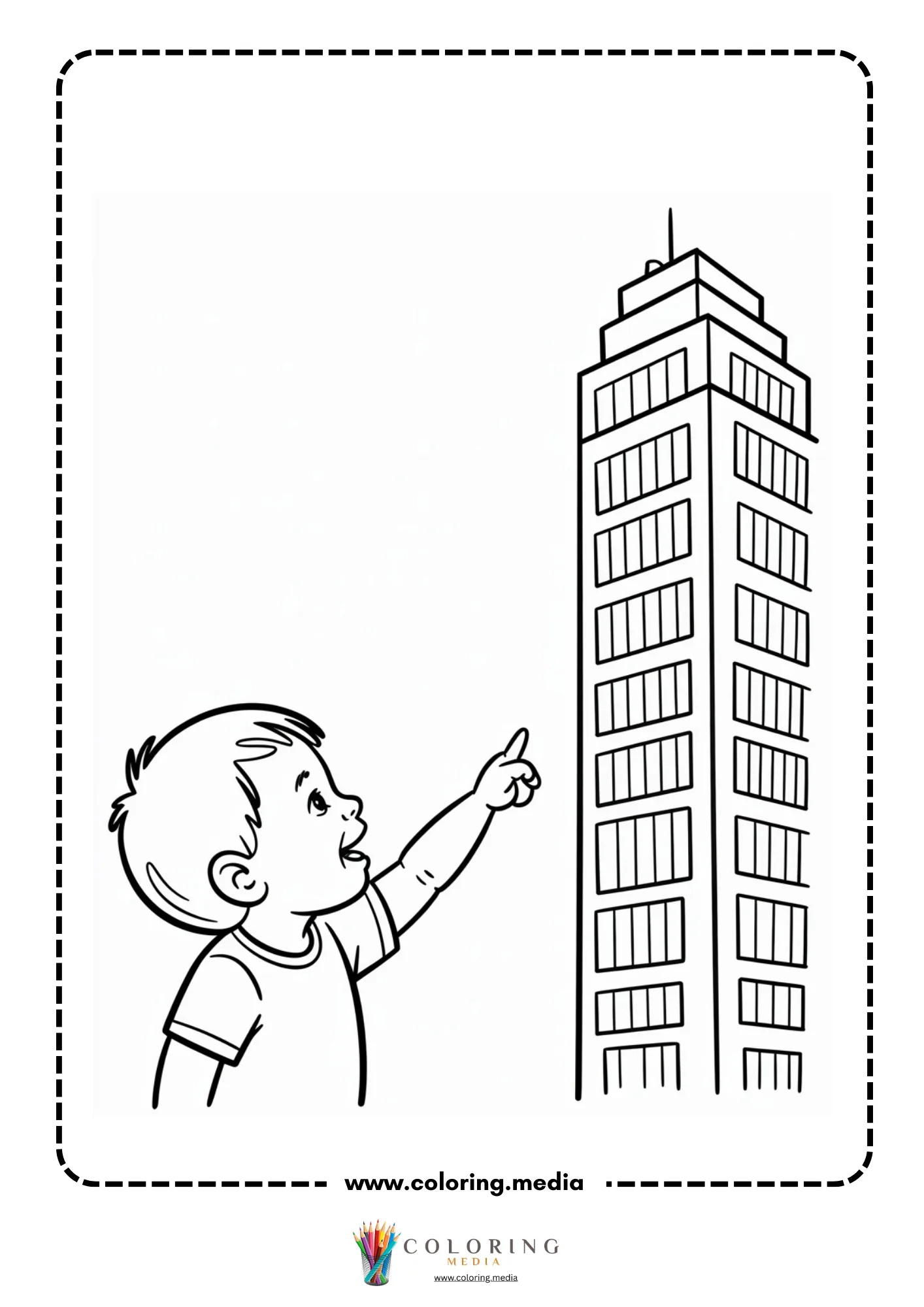
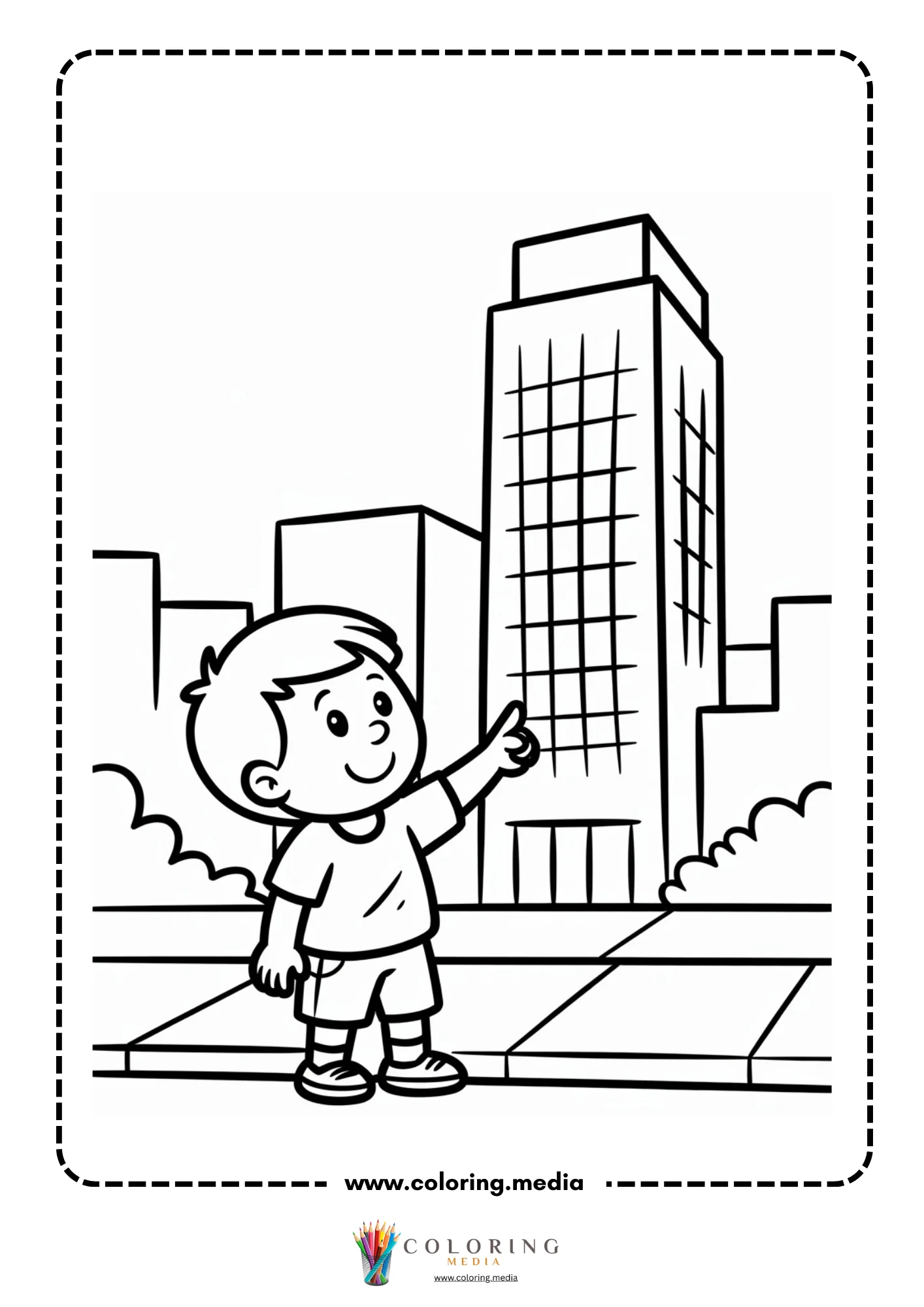
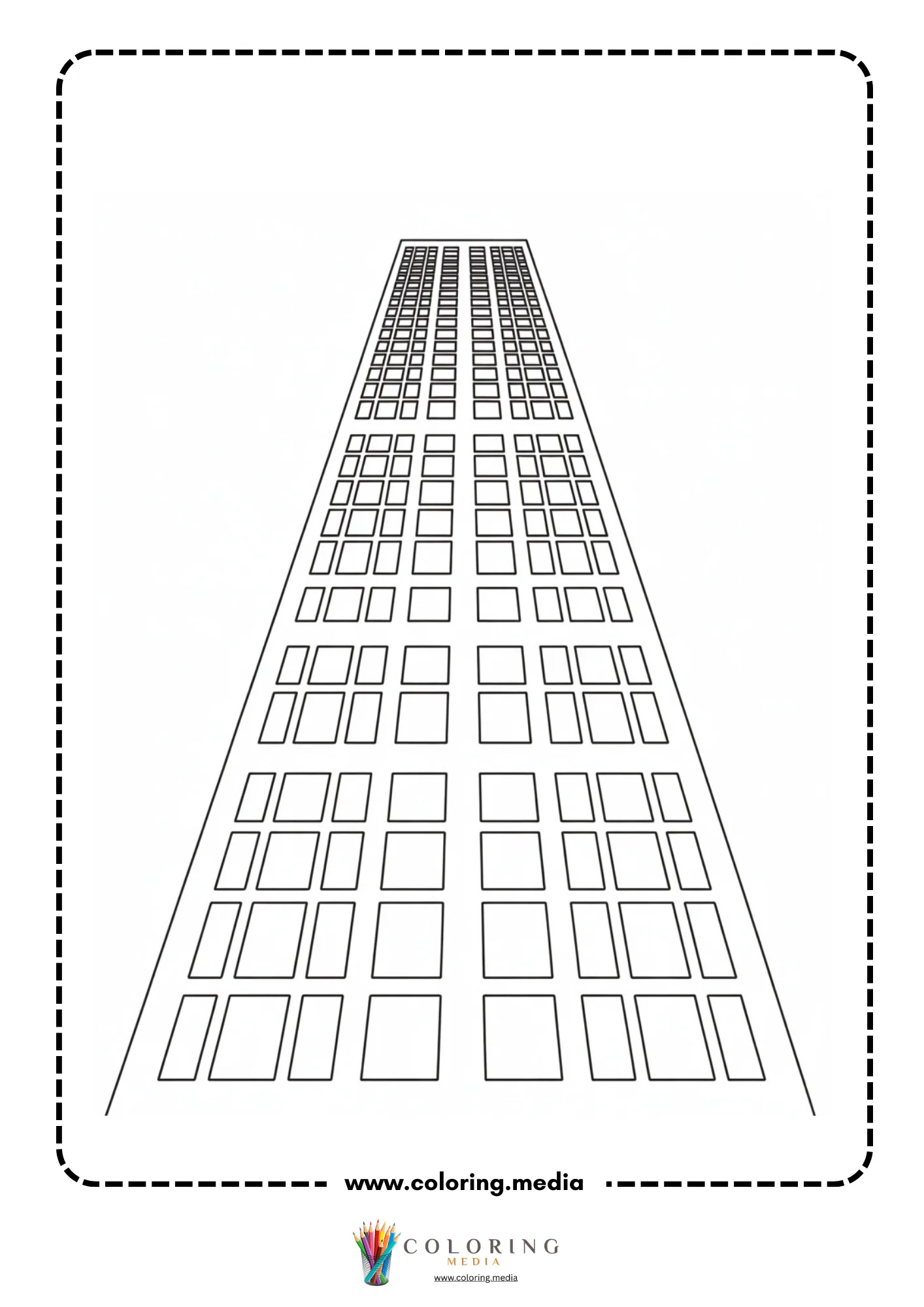
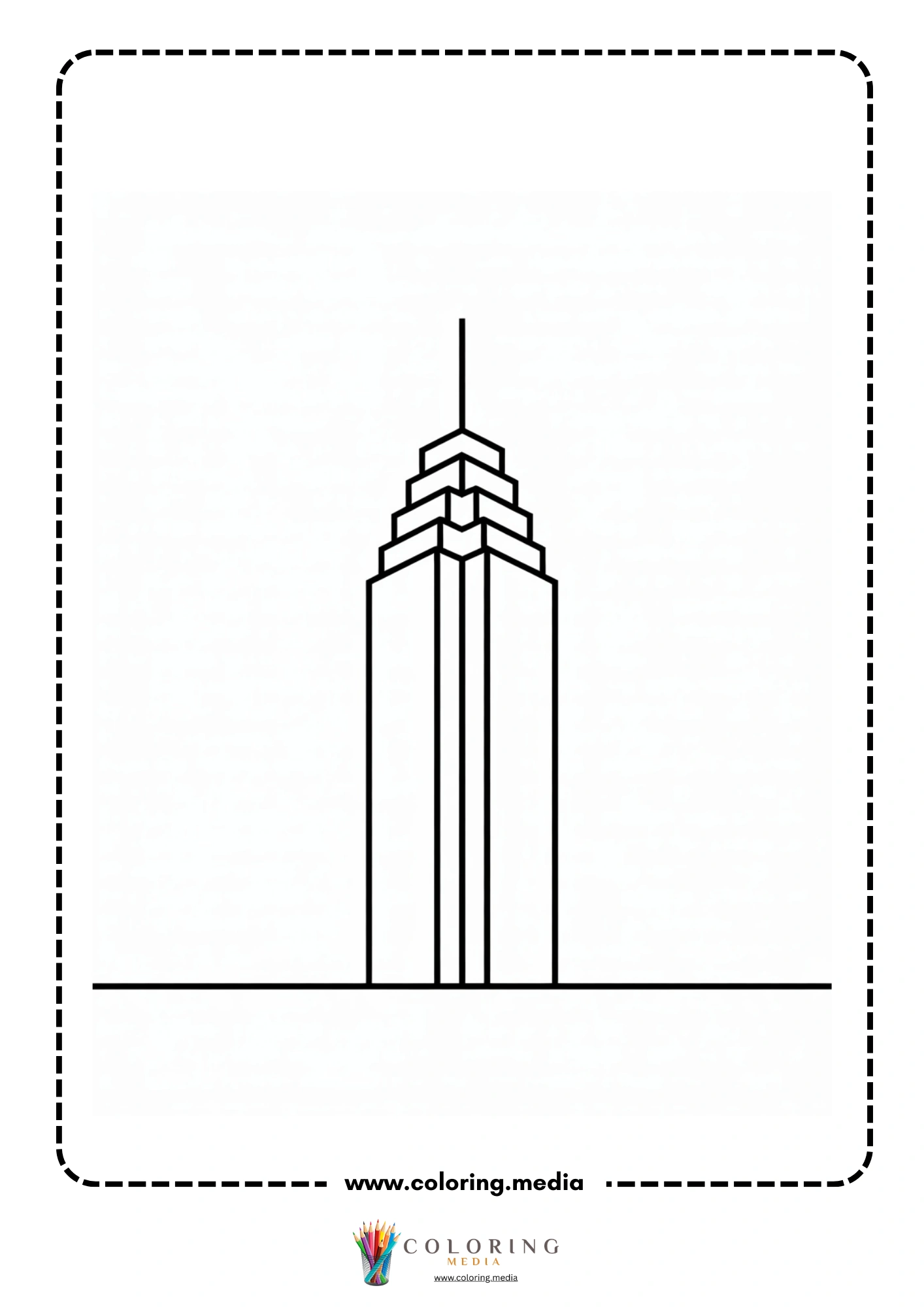
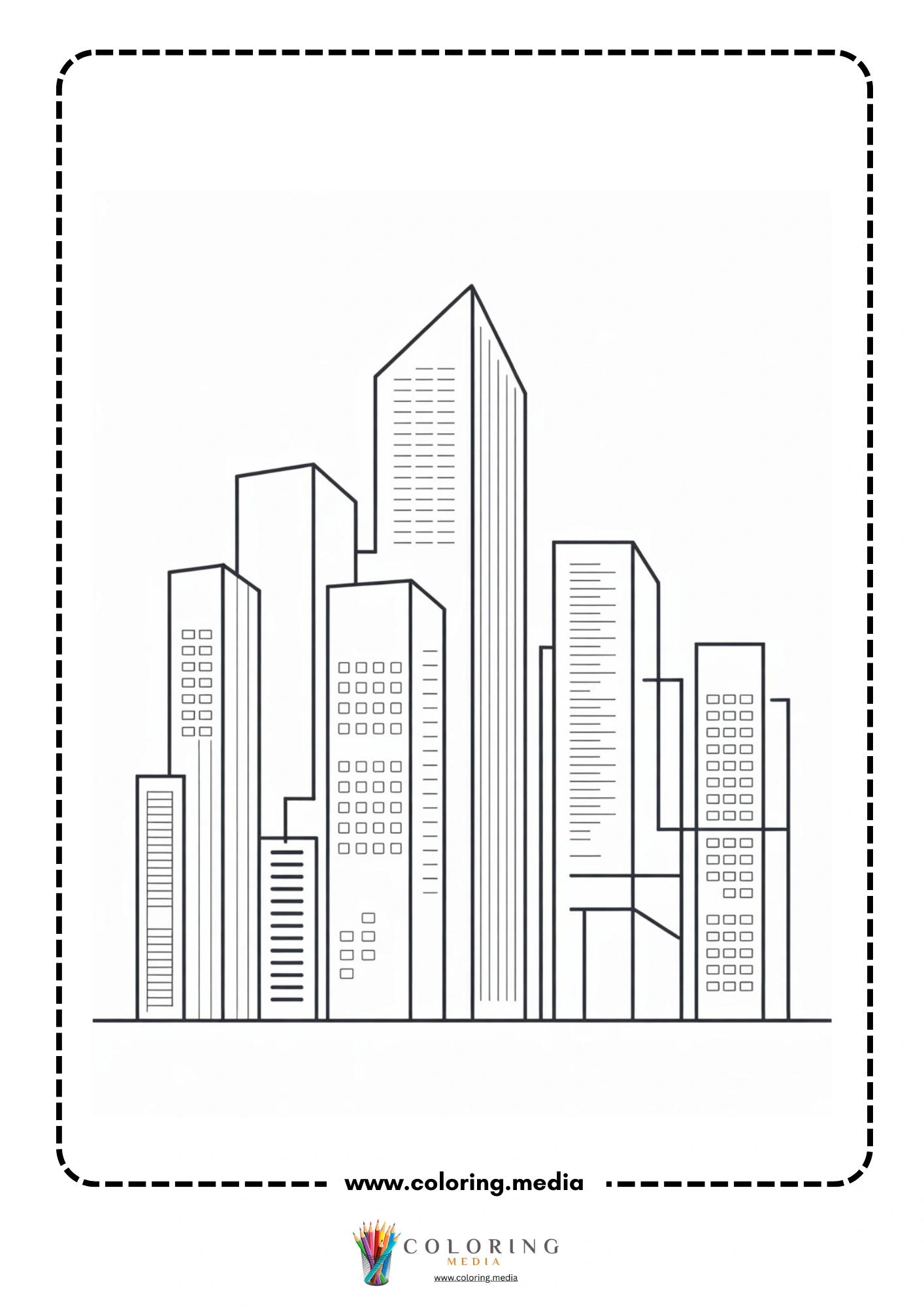
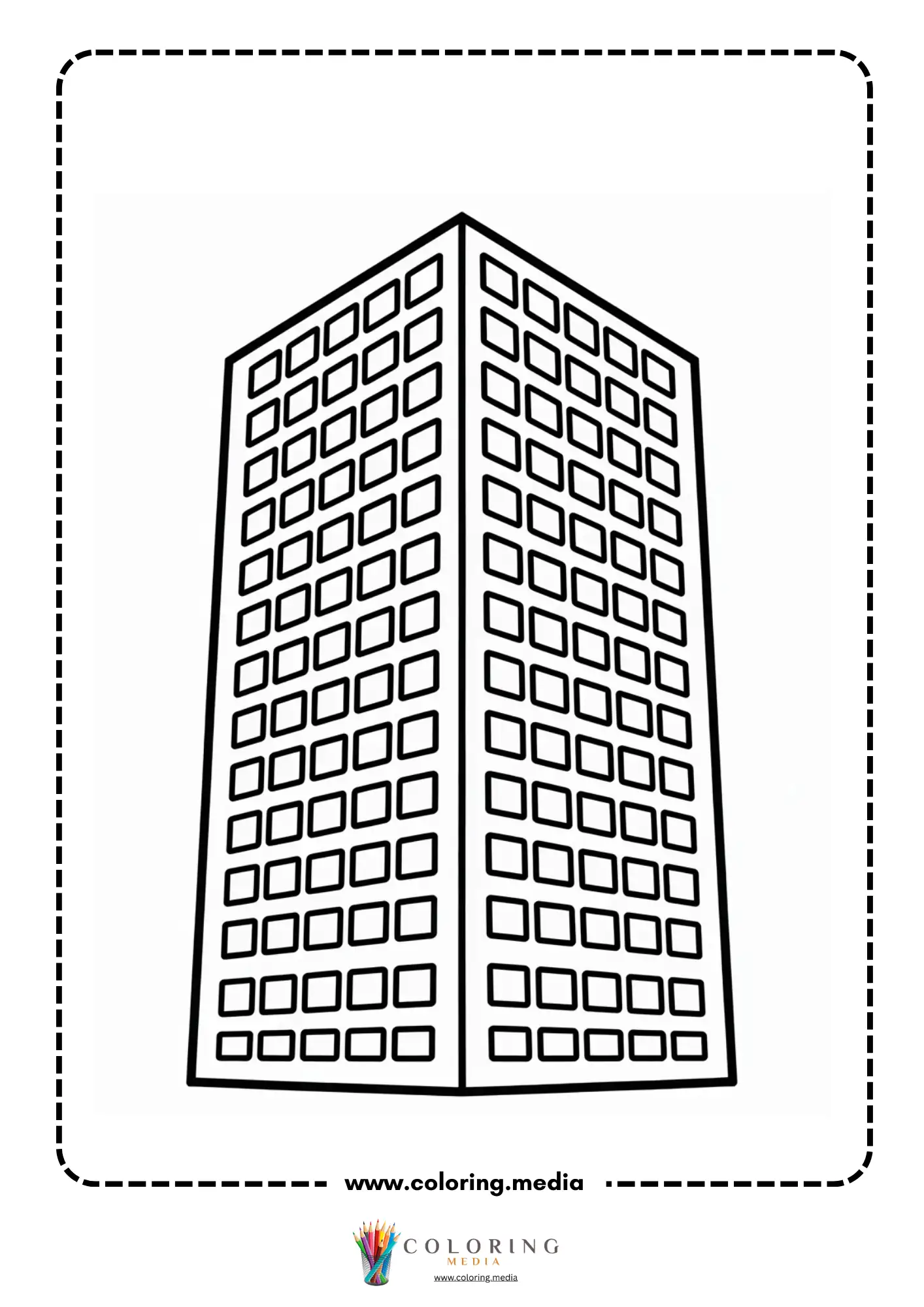
The twenty-six pages move across a spectrum from simple to architecturally ambitious. Several pages show a single tower design against a blank sky — a tall rectangular building with a repeating window grid, or a tapered modern tower with a pointed spire. Others frame the skyscraper within a city block, with smaller buildings around it for scale, and a few pages include child characters standing at the base looking up, which instantly communicates the scale difference between a person and a building that can be hundreds of meters tall. The line style is clean architectural cartoon throughout, with 2–3mm outlines on the main structure and finer lines for window rows.
The geometric nature of skyscraper facades — regular grids of windows, symmetrical spandrel panels, vertical fins — makes these pages particularly satisfying for systematic color schemes. Everything here is free to download and easy to print.
Free Printable Skyscraper Coloring Pages
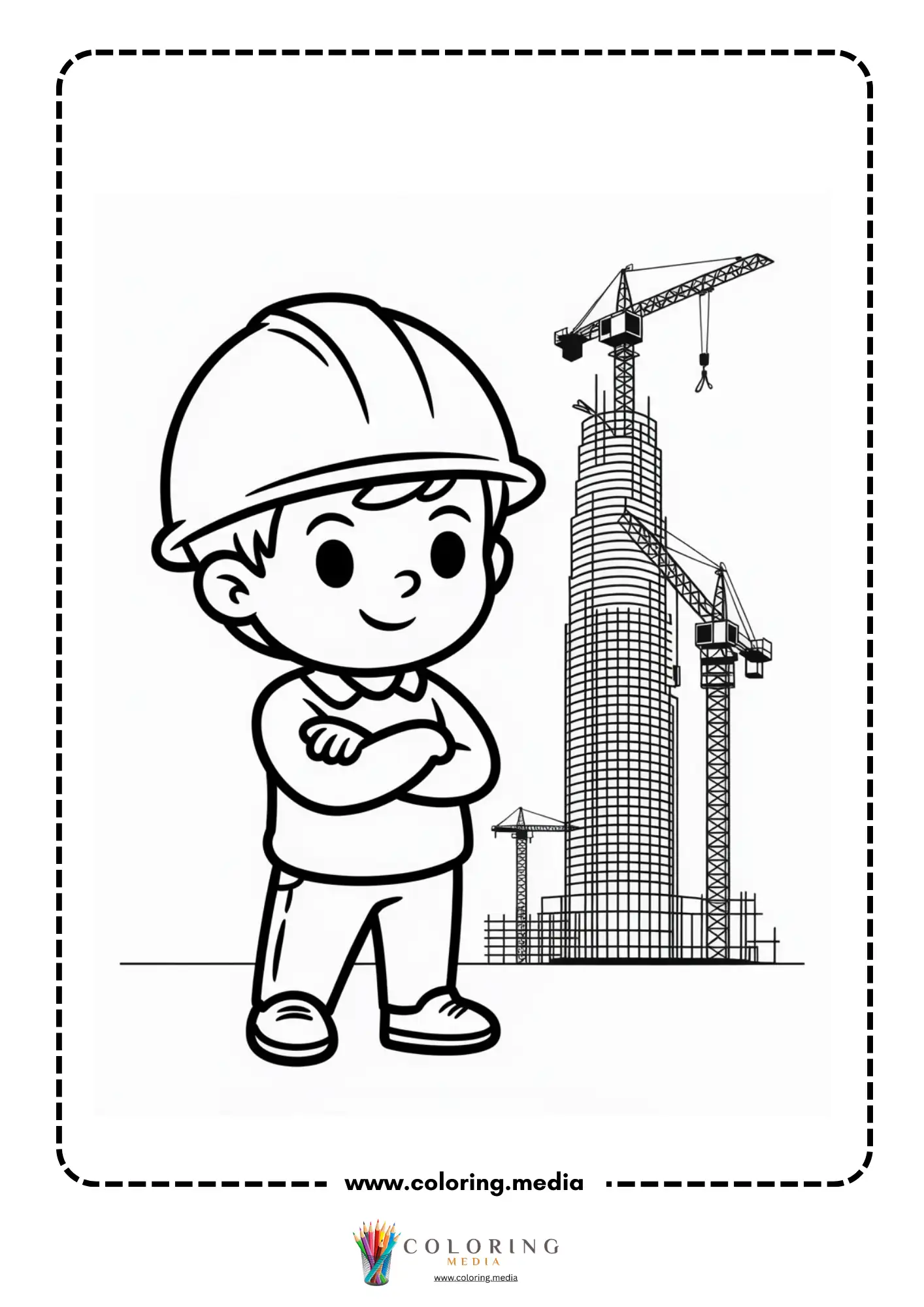
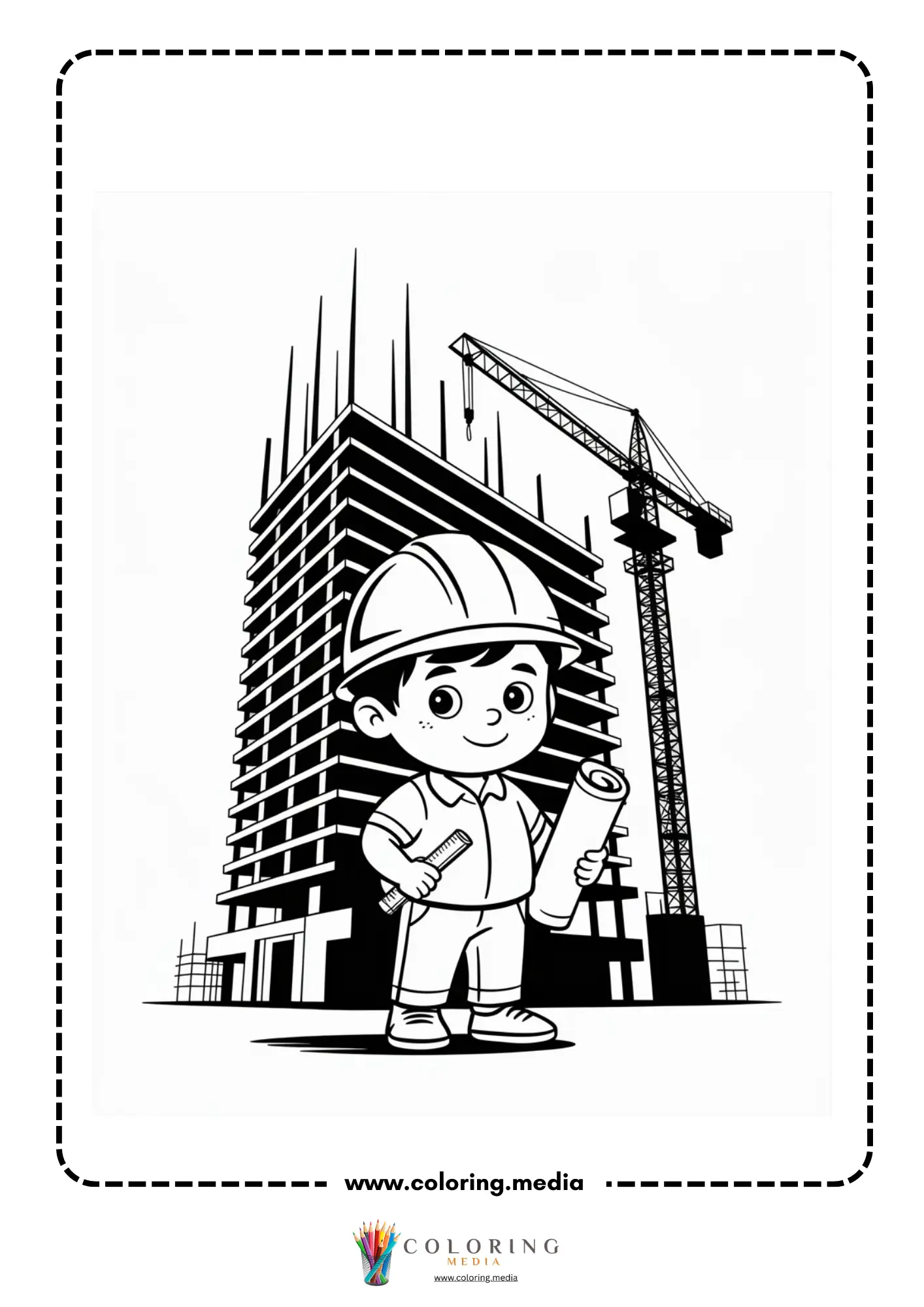
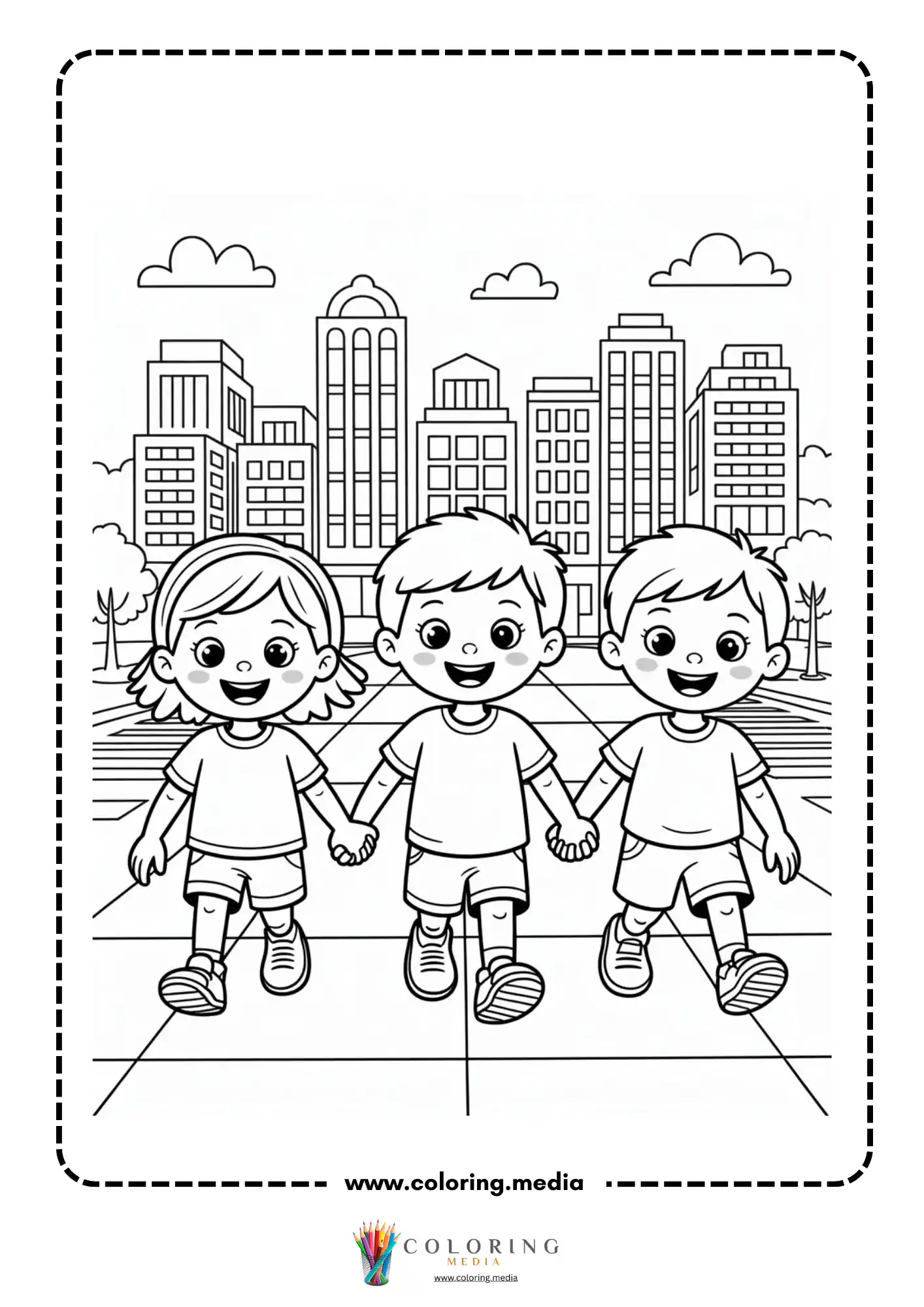
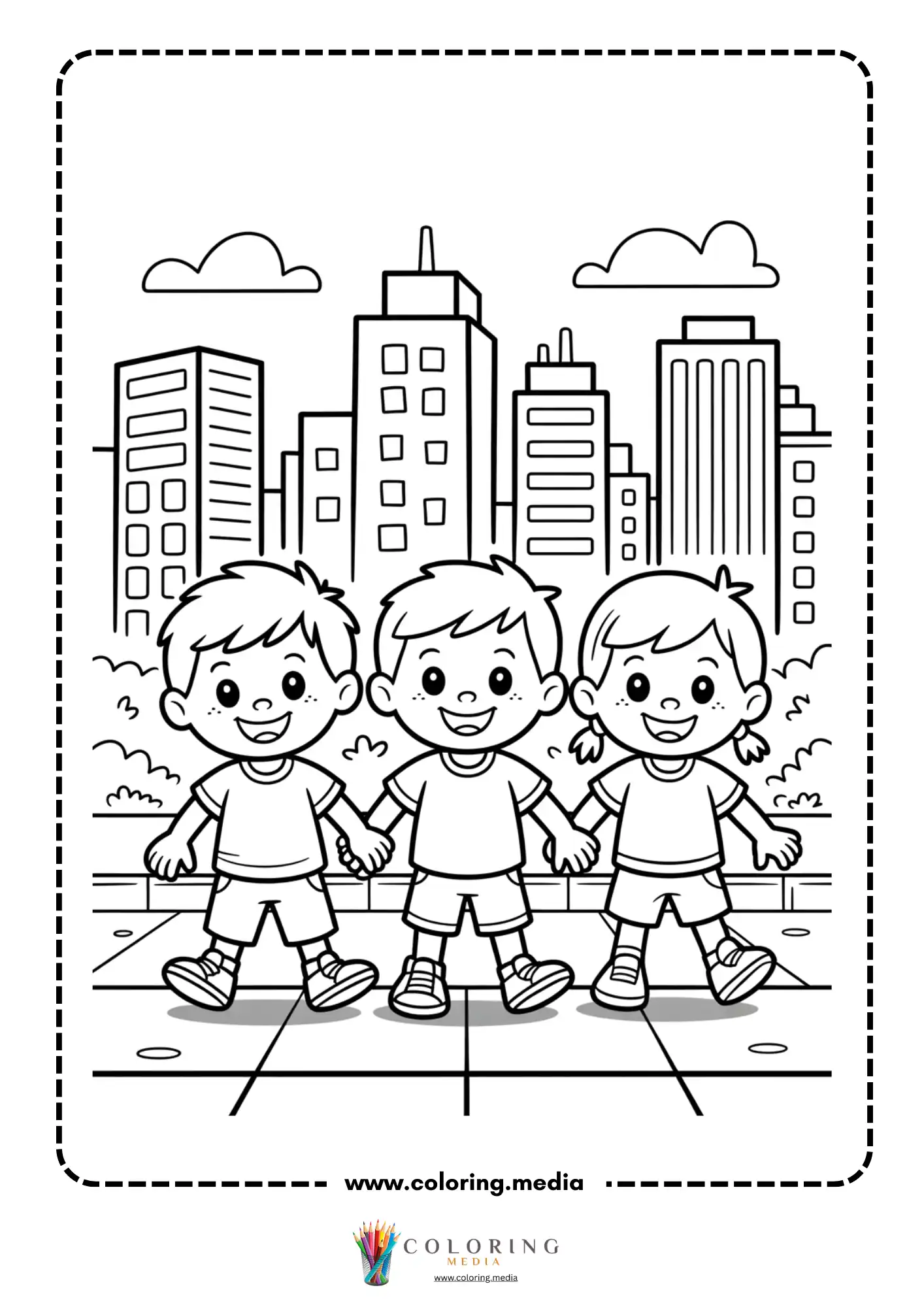
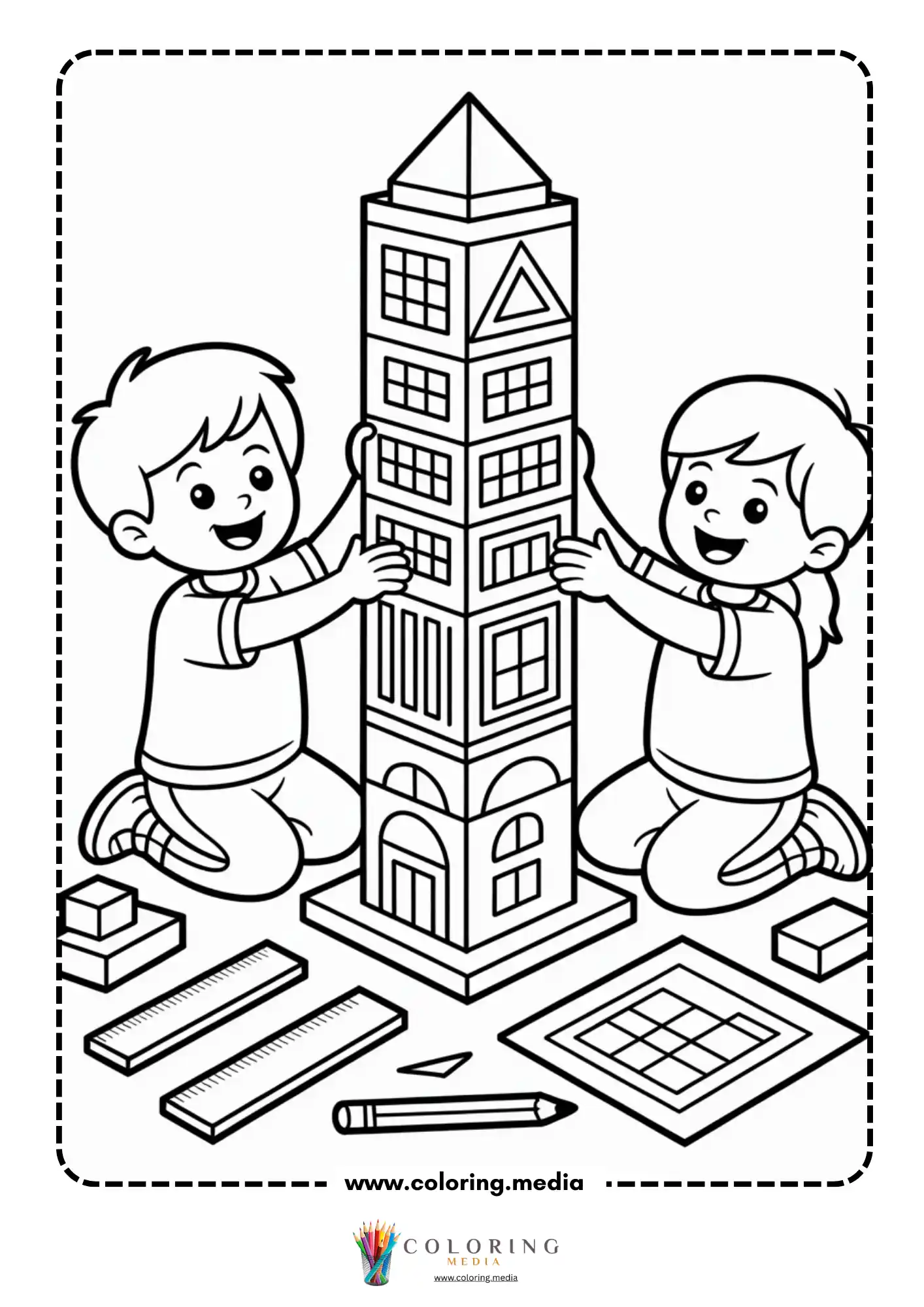
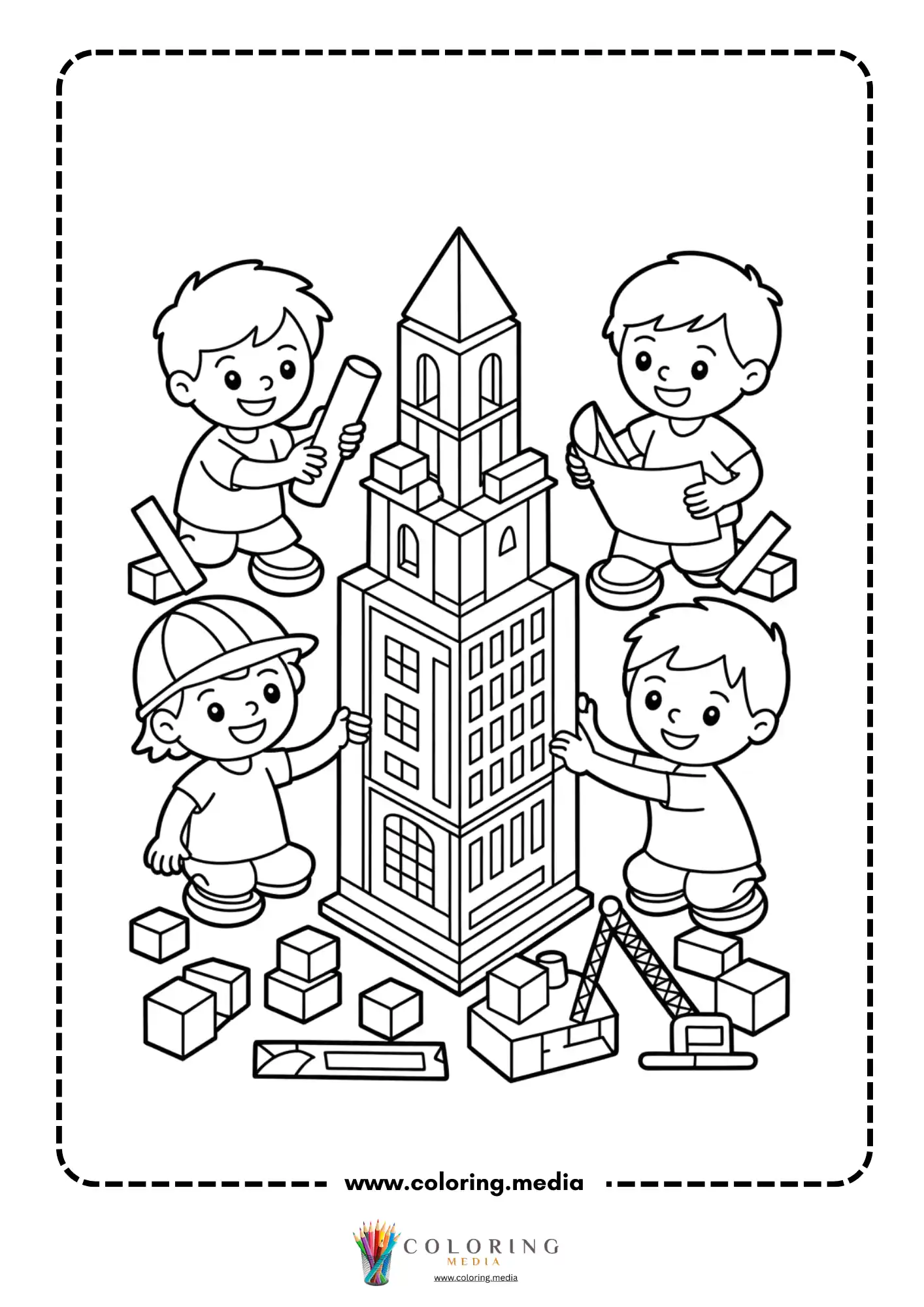
This collection includes 26 printable skyscraper coloring pages featuring single tower designs with varying profiles including tapered, stepped, and cylindrical forms, repeating window-grid facades that reward systematic coloring approaches, urban skyline scenes with multiple buildings at different heights, child characters at the base of towers for scale reference, construction workers with skyscraper backgrounds, and stylized geometric tower silhouettes. The range from simple architectural outline to detailed urban scene makes this set useful for both quick coloring activities and extended art projects. All pages print on A4 or US Letter paper.



Who Are These Skyscraper Coloring Pages Best For?
Kindergarteners can handle the simpler tower profiles with large wall areas and relatively wide window grids. The child-at-the-base pages are also accessible for this age, since the dominant subject is a recognizable human figure with a large building as background. These pages work well alongside a conversation about tall buildings the child has seen or a counting activity using the window rows.
Early elementary students (grades 1–3) get the most from the detailed multi-story facades. A second-grader who decides to color every floor of windows in a different color, creating a striped tower effect, is working on pattern recognition, planning, and fine motor control simultaneously. The urban skyline pages also provide a more complex composition to plan and execute.
Art-focused classrooms and homeschool programs will find the geometric repetition of these pages particularly useful for systematic color exploration. Skyscraper facades are essentially structured grids, which makes them ideal for color theory exercises — alternating complementary colors, creating gradient patterns floor by floor, or designing a building skin that reads as a pattern when viewed from a distance.
Interesting Skyscraper Facts to Share While Coloring
The first building considered a skyscraper was the Home Insurance Building in Chicago, completed in 1885. At 10 stories and 42 meters, it would be modest today, but it was revolutionary for its use of a steel frame — rather than thick load-bearing walls — to support its weight. This innovation made unlimited height theoretically possible.
Modern skyscrapers are designed to sway in the wind, sometimes several meters at the top. The Burj Khalifa sways up to 1.5 meters in high winds. This flexibility is intentional — a completely rigid structure would accumulate stress and eventually crack under wind loads.
High-rise buildings have their own weather systems. Strong winds hit a skyscraper and are deflected downward, creating powerful ground-level gusts called the ‘canyon effect’ in dense city blocks. The upper floors of a very tall building can experience different temperatures and wind speeds from the lobby.
Window washing a skyscraper is a specialized profession. Workers use motorized scaffold systems called building maintenance units, suspended from tracks on the roof. Washing all the windows of a large skyscraper typically takes several weeks and runs continuously — by the time the last window is cleaned, the first ones are dirty again.
Supertall buildings (over 300 meters) require their own structural engineering solutions. One approach is the outrigger system, where massive diagonal braces connect the central core to exterior columns, like the spokes of a bicycle wheel, dramatically increasing stability without adding bulk to the facade.
Creative Skyscraper Coloring and Craft Ideas
Systematic Window Coloring Choose two or three colors and apply a rule — every third floor one color, the rest another — for a striped tower effect.
Day vs. Night Version Color one copy of the same building in daylight blues and greys, then color a second copy at night with a dark background and lit-up yellow windows.
Skyline Design After coloring individual towers, trace the silhouettes onto a single long strip of paper and arrange them into a custom city skyline.
Architectural Style Comparison Color one boxy International Style tower and one tapered or curved modern tower. Research one real example of each style and write the building name below each coloring.
Floor Plan Invention Choose a 10-story building from the pages and invent what each floor is used for — lobby, offices, restaurant, gym — write the floor directory on the back.
Scale Drawing If the building in the page is drawn at 1 cm = 10 meters, measure its height in the drawing and calculate the real height in meters.
Population Estimate For a building with visible windows, count the windows on one floor, estimate the number of floors, and calculate approximately how many offices or apartments the building might contain.
Dream Skyscraper Design Design your own skyscraper from scratch — profile shape, facade pattern, special features, purpose — and draw it next to one of the coloring page buildings for comparison.
How to Print These Skyscraper Coloring Pages
Each file downloads as a single PDF at 300 dpi, formatted for A4 and US Letter paper. Print from Adobe Reader or a browser with ‘fit to page’ enabled. Standard copy paper is fine for all media. For the detailed window-grid pages, fine-tip colored pencils give the most control within narrow window frames. Select black-and-white print mode to save ink.
Explore More STEM Coloring Pages
If you enjoyed these pages, you may also like:
Building Coloring Pages
Bridge Coloring Pages
Construction Coloring Pages
Simple Machines Coloring Pages
STEM & Technology Coloring Pages