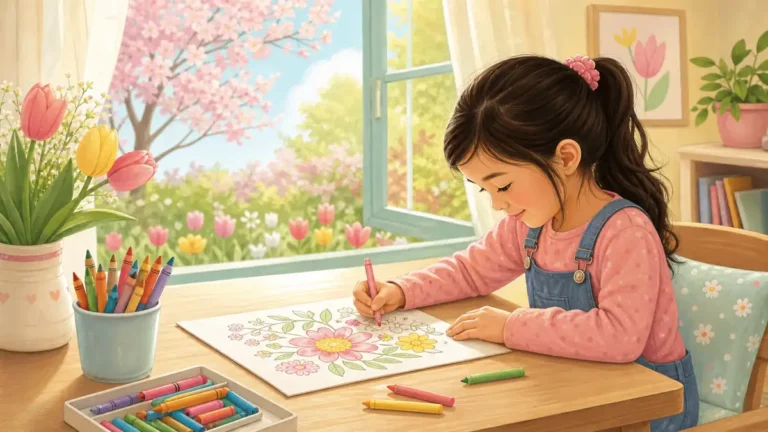

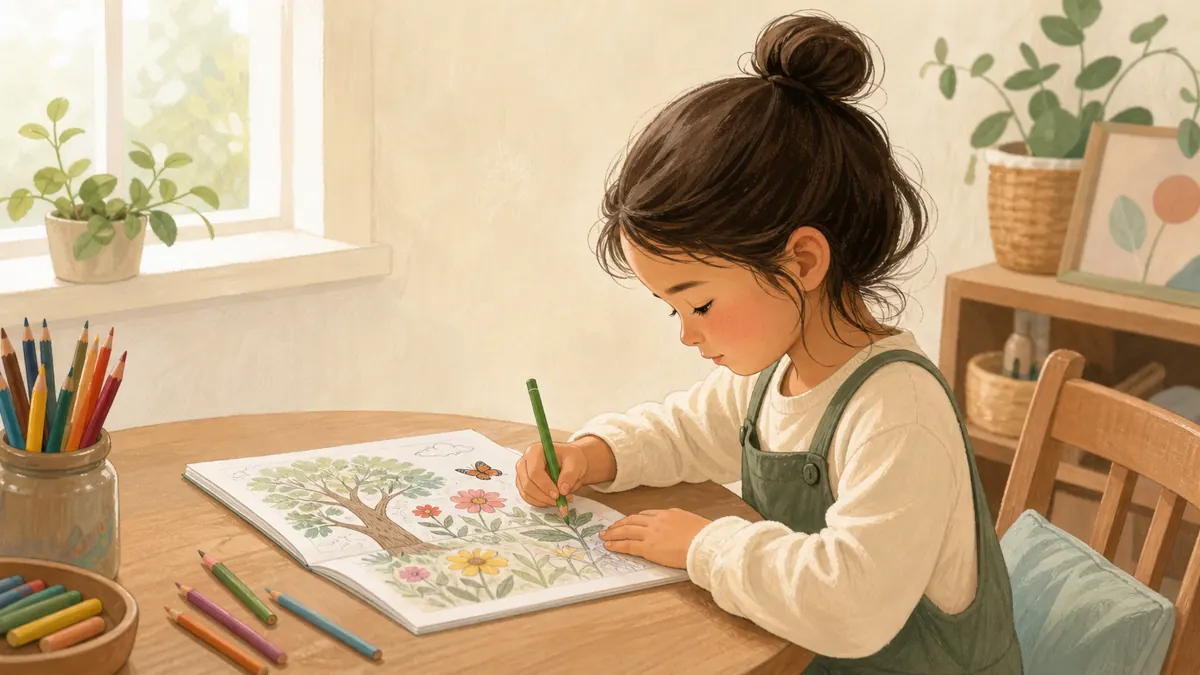

Mindful coloring for kids is one of the most accessible, evidence-backed ways to teach children emotional self-regulation — the ability to recognize and manage their own emotional states. Unlike meditation or breathing exercises, which many children find abstract and frustrating, coloring requires just enough focused attention to quiet mental noise without demanding the stillness that young nervous systems struggle to sustain. The result is a calm, focused state that parents, teachers, and therapists increasingly recognize as one of the most effective screen-free emotional regulation tools available for children ages 3–12.
What Mindful Coloring Actually Is
Mindful coloring is simply coloring done with deliberate attention — noticing the colors chosen, the pressure of the crayon, the sound of coloring, the shapes being filled. It’s the opposite of absent-minded coloring done while watching TV or waiting for something else to happen. The “mindful” part isn’t a technique children need to learn; it emerges naturally when a child is engaged with a page they find genuinely interesting and is free from other demands on their attention.
For children, this means the bar for mindful coloring is low: a quiet space, a page they chose, and a few minutes without interruption. No instruction in mindfulness is required. The focused attention develops naturally from the activity itself.
The Science Behind Coloring and Emotional Regulation
The calming effect of coloring is not anecdotal — it has documented neurological underpinnings. Three mechanisms explain why coloring works as a regulation tool:
Activating the Prefrontal Cortex
The focused visual-motor attention required by coloring activates the prefrontal cortex — the part of the brain responsible for executive function, including the regulation of emotion. When a child is in emotional dysregulation (the fight-flight-freeze state that produces tantrums, meltdowns, and shutdowns), the prefrontal cortex is essentially offline. Engaging it through a focused, non-threatening task like coloring helps bring it back online — restoring the child’s capacity to think, choose, and regulate.
Reducing Amygdala Activation
Simultaneously, the calm, repetitive motion of coloring reduces activation of the amygdala — the brain’s threat-detection center, which is hyperactive during emotional dysregulation. This dual effect (prefrontal activation + amygdala quieting) is physiologically similar to what occurs during meditation, which is why researchers have described coloring as a form of accessible mindfulness practice for populations who struggle with formal meditation.
Bilateral Stimulation
The back-and-forth motion of coloring provides gentle bilateral stimulation — alternating activation of left and right brain hemispheres — that research on trauma and anxiety has shown to be inherently calming. This is the same principle behind EMDR (eye movement desensitization and reprocessing) therapy, though in a far gentler, more accessible form.
Mindful Coloring for Emotional Regulation
Using Coloring as a Calm-Down Tool
Coloring is most effective as a regulation tool when introduced before the child reaches peak dysregulation — at the first signs of rising frustration, anxiety, or overwhelm rather than after the meltdown is fully underway. A child in full meltdown cannot use coloring; a child who is beginning to escalate often can.
Practical implementation:
- Identify the early signs of escalation specific to your child (increased voice volume, physical tension, withdrawal)
- Offer coloring as an option at that early stage — not as a command, but as an invitation: “I see you’re having some big feelings. Would you like to come color for a bit?”
- Have the coloring station ready with the child’s current favorite theme — friction at the point of need (searching for pages, finding crayons) defeats the purpose
- Sit nearby rather than walking away — companionable presence during calming is more effective than solitary regulation for most children under 8
For a complete guide to building a calm-down space with coloring, see our article on how to build a calm-down corner with coloring pages.
Coloring for Anxiety
Childhood anxiety — whether generalized, social, or situational — responds well to coloring because the focused attention of coloring interrupts the rumination cycle that feeds anxious thoughts. A child who is anxious cannot think their way out of anxiety, but they can color their way to a calmer state from which thinking becomes possible again.
For anxious children, intricate patterns and detailed scenes are often more effective than simple pages — the greater detail demands more focused attention, leaving less cognitive space for anxious thought. Nature pages, detailed animal scenes, and mandala-style patterns are the most commonly recommended for anxiety regulation.
Coloring for Big Feelings
Sadness, frustration, anger, and disappointment are part of normal childhood emotional experience. Coloring provides a non-verbal processing channel for these feelings — a child who can’t yet articulate what they’re feeling can color. The finished page often reflects the emotional state (dark colors for difficult feelings, bright colors when the feeling has passed) in a way that provides both the child and parent useful insight.
For specific guidance on using coloring for emotional processing, see our guide to coloring activities for big feelings and relaxation techniques for kids using coloring pages.
Coloring for Transitions
Transitions — moving from one activity to another, arriving somewhere new, anticipating something anxiety-provoking — are among the highest-stress moments in a child’s day. A brief coloring activity during a difficult transition (5–10 minutes of coloring on arrival at a new place, before a medical appointment, during the transition from school to home) can significantly reduce the dysregulation that transitions typically produce.
Positive Affirmation Coloring
Coloring pages that include affirming messages — “I am brave,” “I am kind,” “I can do hard things” — combine the calming effect of coloring with explicit positive self-messaging. These pages are most effective when introduced during calm times rather than during dysregulation, building a reservoir of positive self-concept that children can draw on during difficult moments.
For resources on this approach, see our guide to positive affirmation coloring pages for kids.
Mindful Coloring in Different Contexts
At Home
Home is where mindful coloring habits are most durably established. The goal is to make coloring the default calm-down and regulation tool rather than screens, which provide stimulation rather than regulation. A consistent coloring station in a calm area of the home — accessible to the child without adult permission — is the most effective home implementation.
Daily mindful coloring sessions (10–20 minutes, at consistent times: after school, before bed, during quiet time) are more effective than occasional coloring. The habit of reaching for a coloring page when emotionally dysregulated develops through repetition, not instruction.
In the Classroom
Classroom applications of mindful coloring are most effective at high-stress transition points: the arrival routine (morning work coloring as the class assembles), before tests or challenging academic tasks, and after lunch recess (the most dysregulating transition of the school day). Teachers who use coloring as a post-recess transition activity consistently report calmer, more focused classes in the first 15 minutes of afternoon instruction.
For classroom-specific coloring approaches, see our guide to classroom coloring pages for teachers.
In Therapeutic Settings
School counselors, therapists, and pediatric mental health professionals increasingly incorporate coloring into therapeutic sessions with children — not as therapy itself, but as a processing tool that makes conversation accessible. Children who are too dysregulated, anxious, or defended to answer direct questions often find that coloring while talking lowers the activation enough for genuine conversation to occur. The page gives the hands something to do, the eyes somewhere to look, and the nervous system enough engagement to allow the thinking brain to function.
Choosing Pages for Mindful Coloring
Not all coloring pages are equally effective for mindfulness and regulation purposes. The most effective pages share several characteristics:
Complexity Matched to the Child’s Regulation State
A child who is only mildly dysregulated can engage with a moderately complex page. A child who is more activated needs a simpler page with bold, achievable areas to color. The error many adults make is offering an inappropriately complex page at the wrong moment — the frustration of a page that’s too detailed for a child’s current state escalates rather than calms.
Our easy coloring pages are most appropriate for high-activation states. More detailed nature and animal pages are appropriate for lighter regulation needs or daily mindfulness practice.
Theme Affinity
A child who is passionate about animals will calm more effectively with an animal page than with an abstract pattern. A child who loves fantasy will engage more deeply with a dragon or fairy scene. The child’s personal interests are more important than any theoretically superior page design — intrinsic motivation drives the focused attention that produces the calming effect.
Our animal coloring pages, nature pages, and fantasy pages cover the most common child interest categories for mindful coloring.
Nature and Organic Forms
Research on adult coloring and mindfulness consistently finds that nature scenes and organic forms — rather than geometric or abstract patterns — produce the strongest calming effect. Children’s coloring research mirrors this finding: leaves, flowers, animals, and natural landscapes reliably produce calm, focused states. Our nature pages and flowers and plants pages are the most frequently recommended for therapeutic and mindfulness applications.
Building a Mindful Coloring Routine
The most effective implementation of mindful coloring for kids is as a consistent daily routine rather than an emergency intervention. A regulation tool that children reach for automatically because it’s a familiar, positive habit is far more effective than one introduced only during crises.
Daily Anchor Points
Build mindful coloring into the two or three highest-stress transition points in the day:
- After school: A 15–20 minute coloring session as the transition from school stimulation to home calm — one of the most consistently reported effective uses by parents
- Before bed: Coloring in the final 20–30 minutes before sleep as a screen replacement and nervous system wind-down
- Quiet time: Mid-day coloring for homeschool families as a restorative independent activity
The Coloring Station
The physical setup matters. A calm-down corner or coloring station that is:
- Positioned away from screens and high-traffic areas
- Stocked with the child’s current favorite theme pages (rotated regularly for novelty)
- Equipped with quality coloring tools — colored pencils for older children who prefer them, washable crayons for younger — that the child finds satisfying to use
- Accessible to the child without asking permission
…produces far more spontaneous mindful coloring than a supply buried in a drawer that requires adult retrieval.
Mindful Coloring Across Ages
Toddlers and Preschoolers (Ages 2–5)
For very young children, the mindfulness benefit of coloring is implicit rather than explicit — they aren’t practicing mindfulness, but the focused attention coloring requires produces the same neurological state. Simple bold pages, gentle narration from a nearby adult (“I see you’re choosing blue. That’s a beautiful color.”), and unhurried time are the only ingredients needed. Our easy pages are appropriate for this age range.
School Age (Ages 5–10)
School-age children can begin to understand the connection between coloring and their own emotional state — “I noticed I felt better after coloring when I was upset. Did you notice that too?” This metacognitive awareness transforms coloring from a calming accident into a deliberate self-regulation skill. This age group benefits from more complex pages that require genuine focused attention — our animal and nature pages work well.
Tweens (Ages 10–12)
Tweens are often resistant to activities they perceive as “babyish,” but many are also in the most emotionally turbulent developmental period they’ve experienced so far. The approach for this age: frame coloring as an art activity or stress relief practice rather than a “calming down” tool. More sophisticated coloring options — detailed animal illustrations, botanical scenes, architectural patterns — respect the developmental need for complexity.
Frequently Asked Questions
Does coloring actually help kids calm down?
Yes — the calming effect of coloring has documented neurological underpinnings. Focused coloring activates the prefrontal cortex (responsible for emotional regulation) while simultaneously reducing amygdala activation (the brain’s threat/stress response). This dual effect produces a physiological state similar to meditation, without requiring children to sit still and breathe — a significant accessibility advantage. Coloring is most effective as a regulation tool when introduced at the early signs of emotional escalation rather than at peak dysregulation.
What types of coloring pages are best for mindfulness?
Nature scenes, organic forms (plants, animals, natural landscapes), and patterns that require focused attention without being so complex they produce frustration are most effective for mindfulness. The child’s personal interest in the page theme matters more than any design principle — a child who loves dragons will calm more effectively with a dragon page than with a theoretically superior nature mandala. Match complexity to the child’s current emotional state: simple pages for high activation, more detailed pages for light regulation or daily practice.
How is mindful coloring different from regular coloring?
Mindful coloring involves deliberate attention to the coloring experience — noticing colors, pressure, shapes, the sound and feel of the crayon. Regular coloring done while watching TV or as background activity doesn’t produce the same regulation benefit because the attentional focus is divided. In practice, any coloring done in a quiet space without screen competition tends to become mindful naturally — children don’t need instruction in mindfulness technique to achieve the attentional state that produces the calming effect.
At what age can children start mindful coloring?
The calming benefits of focused coloring are accessible from age 2 — toddlers who color with chunky crayons on bold pages in a quiet space are experiencing the same neurological regulation benefits as older children. Explicit mindfulness instruction (noticing your breathing while you color, choosing colors deliberately) is appropriate from around age 6–7 when children have enough metacognitive awareness to observe their own internal states. Before that age, the benefit is implicit and doesn’t require any instruction.
Can coloring replace professional mental health support for anxious children?
No — coloring is a complementary regulation tool, not a clinical intervention. For children with significant anxiety, ADHD, trauma, or emotional dysregulation challenges, professional support (pediatric therapist, child psychologist, school counselor) provides the assessment and evidence-based treatment that coloring cannot. Coloring can be an effective daily regulation practice alongside professional treatment but should not delay parents from seeking professional help when a child’s emotional challenges are significantly impacting their daily functioning.
How often should kids do mindful coloring for emotional regulation?
Daily practice is significantly more effective than occasional use. A 10–20 minute daily coloring session — particularly at high-stress transition points like after school or before bed — builds the neural association between coloring and calm that makes the activity effective as a regulation tool. Children who color only during crises don’t develop the habit association that makes coloring their automatic first response to dysregulation; children who color daily begin reaching for the crayons proactively when they feel themselves becoming overwhelmed.
Mindful coloring is one of the most accessible emotional regulation tools available for children — no training, no equipment, and no screen required. Browse our nature, animal, flowers and plants, and easy pages at coloring.media to build your child’s mindful coloring collection, and visit our Tips & Techniques hub for practical implementation guides.