
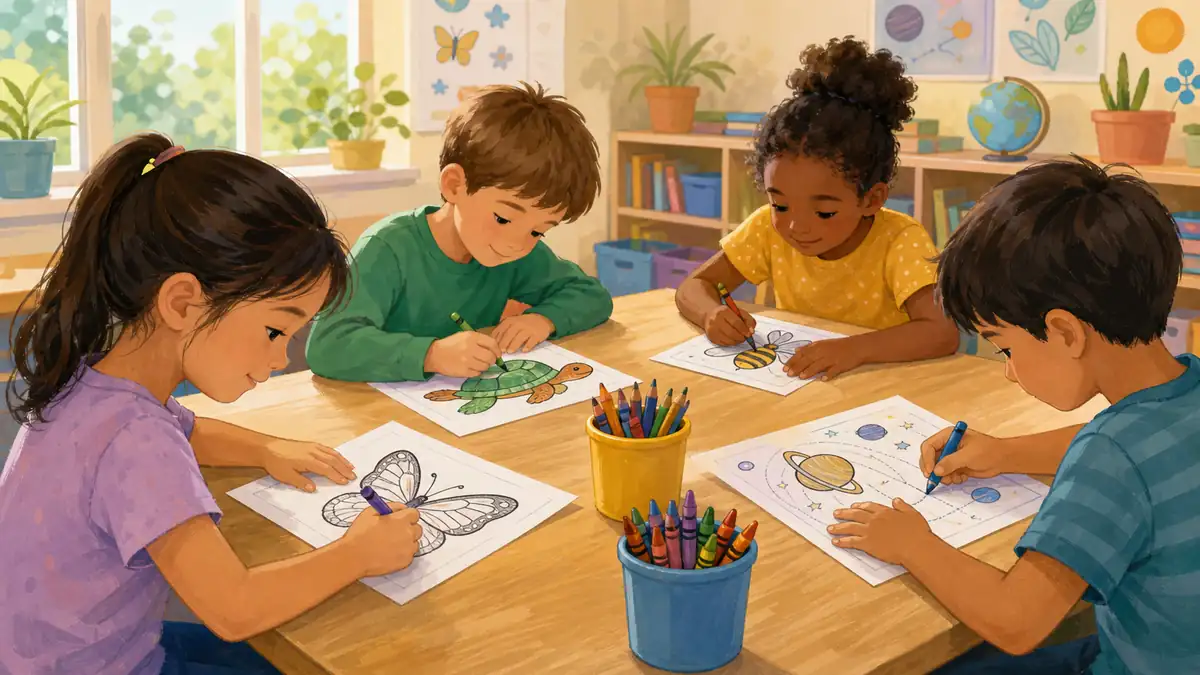

Classroom coloring pages for teachers are one of the most versatile, zero-prep tools in the elementary toolkit — they function as morning work, early finisher activities, anticipatory sets for new lessons, sub plan staples, and curriculum-connected art integration all from a single printed page. When chosen intentionally and paired with explicit instruction, they deliver genuine academic value in a format that reliably engages even the most reluctant learners.
Why Classroom Coloring Pages Work (The Pedagogy)
Skeptics sometimes frame coloring as low-value seat work — something to keep children busy rather than learning. The research says otherwise. Dual coding theory (Paivio, 1986) demonstrates that content processed through both verbal and visual channels is retained significantly better than content processed verbally alone. Educational coloring adds a third channel — kinesthetic — creating triple-encoded memory that is more durable and more easily retrieved than content from lecture, reading, or worksheet instruction alone.
The most effective classroom uses of coloring pages share two qualities: they connect directly to current curriculum content, and they include a thinking component (labeling, writing, discussion) that moves the activity from passive to active. A butterfly life cycle coloring page used the same week as the science unit, followed by a labeling and narration activity, produces measurably stronger retention than the same page used as disconnected busy work.
For classroom-specific activity ideas beyond coloring, see our art activities for the classroom guide.
Classroom Uses for Coloring Pages
Morning Work
Morning work is the highest-volume classroom use for coloring pages — and for good reason. A curriculum-connected coloring page as morning work:
- Provides immediate, independent engagement as students arrive
- Creates a calm, focused transition into the school day
- Primes students for the day’s instructional content when connected to the unit
- Requires zero teacher setup or management once the routine is established
The key to effective morning work coloring is thematic connection — a science page during the science unit, a seasonal nature page during the corresponding month, an alphabet or math page during phonics or number sense instruction. Random pages produce calendar-filler; connected pages produce curriculum reinforcement.
For detailed morning work coloring resources, see our guide to coloring pages for morning work in kindergarten.
Early Finisher Activities
Early finishers are one of the most persistent classroom management challenges — students who complete assigned work quickly need meaningful, independent activities that don’t disrupt other students still working. Coloring pages are ideal early finisher activities because they:
- Are immediately available without teacher intervention
- Have a natural variable duration — more detail = more time
- Can be made curriculum-connected so they function as enrichment, not filler
- Produce no noise and require no collaboration that might distract others
An early finisher coloring station — a folder or box of pages at varying difficulty levels — is one of the most effective classroom management structures available. Students who finish early select a page independently, color it, and add a self-directed writing task (write three facts about what you colored) without any teacher involvement.
See our full guide to coloring activities for early finishers for setup and page recommendations.
Sub Plans
Sub plans that include coloring pages are more successful than those that don’t — substitute teachers get reliable independent engagement, and the activities don’t require content expertise the sub may not have. A sub plan coloring activity works best when it:
- Is curriculum-connected enough to feel purposeful, not punitive
- Includes a simple writing extension the sub can facilitate (“write one sentence about each thing you colored”)
- Is organized and pre-printed rather than requiring sub setup
Our full guide to no-prep coloring activities for sub plans covers the complete sub plan coloring setup.
Lesson Introduction (Anticipatory Set)
One of the most pedagogically powerful — and underused — classroom applications of coloring pages is as an anticipatory set before instruction begins. Presenting students with a coloring page of the unit’s main concept (a food web, a life cycle, a map of a historical region) before the lesson creates visual exposure to the content’s structure before any verbal instruction. This pre-exposure significantly improves comprehension and retention when the formal lesson follows.
Anticipatory set coloring is most effective when the teacher asks students to make predictions while coloring (“Based on what you see, what do you think this diagram shows?”) before revealing and explaining the correct content.
Lesson Consolidation
The inverse of the anticipatory set: a coloring page used after instruction as a kinesthetic consolidation activity. After teaching a lesson on the butterfly life cycle, students color and label the diagram from memory or with reference to their notes. The physical act of coloring and labeling engages different memory systems than note-taking alone and produces stronger consolidation of the lesson content.
Assessment Alternative
For visual-kinesthetic learners, a completed and labeled coloring page demonstrates understanding in a format that worksheets and written tests don’t allow. A student who can correctly color and label a plant anatomy diagram, a food chain, or a life cycle sequence has demonstrated comprehension as clearly as a student who writes correct answers on a test — and in a format that may more accurately reflect what they actually know.
Coloring-based assessment works best when combined with a brief oral component: the student describes what they colored in 2–3 sentences, demonstrating that the visual knowledge is also verbally accessible.
Art Integration
Art integration — teaching academic content through art-making — is one of the most research-supported instructional approaches for elementary students, with documented benefits for both academic learning and creative development. Coloring pages as art integration require no art expertise from the teacher: the page provides the structure, the student provides the creative execution, and the academic content comes from the curriculum connection.
For broader classroom art integration approaches, see our guide to art activities for the classroom.
Classroom Coloring Pages by Subject
Science Classroom Coloring Pages
Science is where coloring pages deliver their greatest academic value in the classroom — because so much of scientific content is invisible, abstract, or too large or small to observe directly. A student who colors a labeled diagram of the water cycle, a plant cell, or a food web builds a visual-spatial understanding of the concept that reading alone cannot provide.
High-value science coloring categories for the classroom:
- Life cycles: Butterfly, frog, plant, chicken, and other common elementary science topics — our life cycle coloring pages cover the most-studied species at the K–5 level
- Ecosystems and habitats: Food chains, biomes, plant and animal relationships
- Earth science: Weather systems, rock types, seasons, geological processes
- Biology: Plant anatomy, human body systems, animal classification
Explore our full science and nature coloring pages library for classroom science content.
For STEM-specific classroom applications, see our guide to STEM activities using coloring pages.
Literacy Classroom Coloring Pages
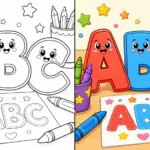
Alphabet and letter coloring pages are most valuable in kindergarten and early first grade — the critical window for letter-sound relationship development. A student who colors an alphabet page while the teacher names the letter, sound, and picture cue receives multimodal input that produces stronger letter recognition than drill alone.
Literacy coloring page applications:
- Phonics instruction: Our alphabet coloring pages pair each letter with a picture cue for phonics integration
- Word work extension: Color a page featuring the week’s word wall letter or phonics pattern
- Reading response: Color a character or scene from the current read-aloud, then write one sentence about it
For structured literacy instruction using coloring pages, see our guide to how to teach letters with coloring pages.
Math Classroom Coloring Pages
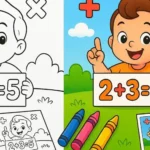
Color-by-number activities tie math computation directly to a visual reward — solving the math problem reveals the image. Pattern pages make repeating sequences visual and colorable. Geometry pages provide the shapes vocabulary foundation for formal geometry instruction.
Math coloring applications:
- Number recognition and counting: Our math coloring pages cover number concepts across the K–3 range
- Color-by-number: Requires correct computation to produce the intended image
- Pattern work: Repeating pattern pages that students identify and extend
For structured classroom math applications, see our guide to how to teach numbers with coloring pages.
Social Studies Classroom Coloring Pages
Social studies coloring pages — community helpers, maps, cultural celebrations, historical figures — make abstract social concepts visible and concrete for elementary students. A student who colors a page depicting community roles develops a spatial understanding of community structure that verbal description alone doesn’t provide.
Our people and family coloring pages provide human-centered social studies content for the elementary classroom.
Seasonal and Holiday Coloring Pages
Seasonal classroom coloring pages serve a dual purpose: they connect the indoor learning environment to the natural world outside, and they provide low-stakes, high-engagement activities during the disrupted periods around holidays and seasonal transitions.
Our seasonal coloring pages are organized by month and season for easy classroom calendar planning.
Classroom Management with Coloring Pages
Setting Up a Coloring Station
A dedicated classroom coloring station removes friction and makes the activity immediately accessible without teacher setup. A functional station includes:
- Page supply: Pre-printed pages in a labeled folder or box, organized by type (early finisher, morning work, themed) and restocked weekly
- Coloring tools: Shared crayon boxes or colored pencil sets accessible without asking permission
- Extension prompts: A simple laminated card with 3–4 choices (“Color and label. Write 3 facts. Write a sentence. Draw what comes next.”) that students select from without teacher direction
- Display space: A section of wall or bulletin board where finished work can be posted — displays reinforce that coloring is a valued activity, not filler
Coloring as Transition Management
The minutes between activities — while the teacher manages a small group, handles a disruption, or transitions the class — are among the highest-risk moments for off-task behavior. A standing expectation that students begin a coloring page (from the available supply) during these transitions eliminates the vacuum that produces noise and distraction.
Differentiation with Coloring Pages
Coloring pages differentiate naturally: the same page can be appropriate for a student who simply colors and a student who colors, labels, and writes three connected facts. The basic activity is inclusive; the extension layer challenges more advanced students without requiring separate materials. For additional differentiation, provide pages at varying complexity levels in the station — simple bold pages for students who need accessible entry points, detailed pages for students who need challenge.
Classroom Coloring Pages by Grade
Kindergarten
Kindergarten classroom coloring serves three simultaneous purposes: fine motor development (essential for writing readiness), literacy reinforcement (alphabet and phonics content), and calm focus practice (the sustained attention that formal schooling requires). Bold, simple pages with clear educational content are most appropriate. Our easy coloring pages and alphabet pages are the highest-use kindergarten classroom resources.
First and Second Grade
First and second grade are the most productive years for science and math coloring integration — students’ reading and writing skills are developing, but visual-kinesthetic content delivery is still more accessible than text-heavy materials. Life cycle diagrams, weather science pages, and number concept pages all deliver strong academic value at this level.
Third Through Fifth Grade
Upper elementary students benefit from more complex coloring pages that require careful attention and detail work — detailed ecosystems, multi-stage life cycles, geographic maps, and architectural diagrams. The academic content should be genuinely challenging at the grade level; pages that are too simple lose engagement quickly with this age group.
Classroom Coloring Pages Across the School Year
Back-to-School Season
The first weeks of school are when classroom routines are established — and a consistent morning work coloring routine established in September becomes a reliable daily structure by October. Our back-to-school coloring activities guide covers the specific pages and routines most effective for the opening weeks.
Seasonal Transitions
Each seasonal transition offers a natural opportunity for seasonal coloring pages that connect classroom content to the observable world:
- Fall: Our fall coloring activities guide covers the harvest, migration, and seasonal change themes most relevant for elementary science
- Spring: Our spring coloring activities guide connects spring themes to life cycle and plant science
- Earth Day: Our Earth Day coloring activities guide provides science-connected pages for April environmental education
Before School Breaks
The days before holiday breaks are among the most challenging for classroom management — student excitement disrupts focused instruction, and academic productivity plummets. Themed coloring activities paired with curriculum-connected writing or research tasks are one of the most reliable solutions: students are engaged and calm, and the activity has enough academic scaffolding to justify the instructional time.
Building a Classroom Coloring Page Library
A sustainable classroom coloring page library is built incrementally and organized for fast access:
- Start with anchor categories: Build out the categories you’ll use every year — seasonal pages for each month, life cycles for the science units you always teach, alphabet pages for kindergarten literacy
- Organize by use: Separate morning work pages (curriculum-connected, seasonal) from early finisher pages (varied themes, difficulty levels) from sub plan pages (self-contained, minimal instruction needed)
- Pre-print in batches: Print a month’s worth of morning work pages on the first of each month rather than printing day-by-day
- Rotate themes: Change the available early finisher pages every 2–3 weeks to maintain novelty and interest
Browse our full resource hub at Tips & Techniques for organized classroom coloring resources across all subjects and seasons.
Frequently Asked Questions
How do I use coloring pages in the classroom without it feeling like filler?
Connect the page directly to current curriculum content and add a thinking component. A science coloring page used the same week as the science unit, followed by labeling or a three-fact writing task, is curriculum-connected instruction. The same page handed out with no context and no follow-up is filler. The page is the vehicle; the curriculum connection and thinking extension are what make it educational.
What grade levels benefit most from classroom coloring pages?
Kindergarten through third grade see the greatest benefit because visual-kinesthetic content delivery is developmentally most powerful in this range — fine motor development, early literacy, and concrete science concepts all align with coloring page strengths. Fourth and fifth grade benefit most from complex, curriculum-connected coloring — detailed science diagrams, geographic maps, and art-integrated content — rather than the simple pages effective in earlier grades.
How often should I use coloring pages in the classroom?
Daily morning work coloring is appropriate and beneficial for K–2. Early finisher availability is most effective when constantly available. Curriculum-connected consolidation coloring is most valuable once or twice per unit — used more frequently than that, it loses the novelty that drives engagement. The goal is intentional use that produces genuine learning, not daily coloring as a management tool.
Can I use the same coloring page for different grade levels?
Yes — differentiate the expectation, not the page. A life cycle diagram page is appropriate for first grade (color and identify the stages), second grade (color, label, and write a sentence about each stage), and third grade (color, label, write a detailed explanation, and identify which stage is most vulnerable to habitat disruption). The visual-kinesthetic access point is grade-neutral; the cognitive demand of the extension task provides differentiation.
What coloring pages work best as sub plans?
Sub plan coloring pages work best when they are self-contained, have clear written directions, and include a simple extension task a substitute can facilitate. Seasonal pages, science diagrams with labeled spaces, and color-by-number math pages all work well because the activity instruction is built into the page design. Avoid pages that require prior content knowledge the sub may not have to explain.
How do I organize a classroom coloring page station?
A labeled box or folder with sections for morning work (weekly theme), early finishers (varied, restocked monthly), and themed special activities (seasonal, holiday) is the most functional structure. Add a laminated extension prompt card with 3–4 choices (label, write facts, draw what comes next) and a display area for finished work. Once the routine is established, students manage the station independently without teacher direction.
Are coloring pages useful for classroom assessment?
Yes — particularly for visual-kinesthetic learners for whom traditional written assessments underperform. A correctly colored and labeled diagram demonstrates comprehension as clearly as written answers. Combining the coloring page with a brief oral explanation (“tell me what you colored”) provides both visual and verbal evidence of understanding. This format is especially valuable as a formative assessment during a unit rather than a summative assessment at its end.
Classroom coloring pages work best when they’re treated as intentional instructional tools rather than time-fillers — connected to curriculum, paired with a thinking task, and organized for immediate independent access. Browse our full library of science, life cycle, alphabet, math, and seasonal coloring pages at coloring.media to build your classroom collection, and visit our Tips & Techniques hub for classroom-specific guides.