
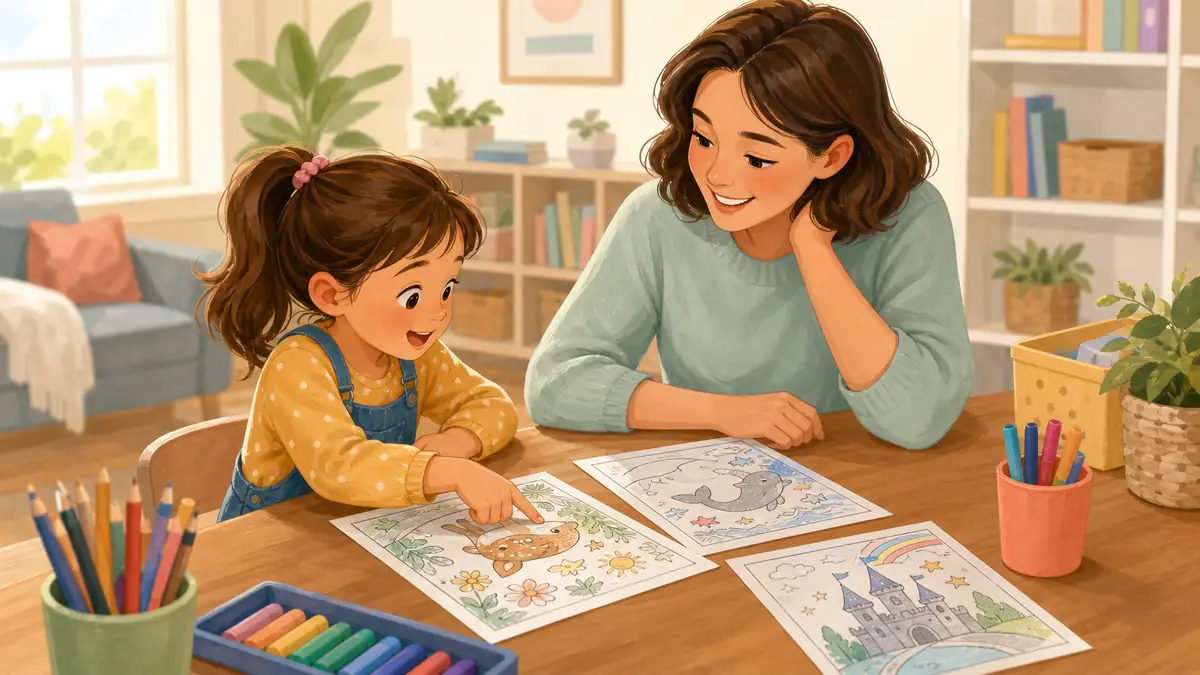

Choosing the right coloring page for your child’s age comes down to matching three things: the fine motor demand of the page to the child’s current grip capability, the cognitive complexity to their current attention and processing level, and the subject matter to what they genuinely care about right now. Get all three right and the child colors for 20–30 minutes without prompting. Get one wrong and the page gets abandoned in under five minutes. This guide gives you the decision framework to get it right every time.
The Three-Factor Framework
Factor 1: Fine Motor Demand
Fine motor demand is the binding constraint — it’s the factor most commonly misjudged and the one that most directly determines whether a page produces engagement or frustration. The test is simple: look at the smallest coloring area on the page. Can your child’s crayon fill that area while staying roughly within its boundaries given their current grip? If yes, the fine motor demand is appropriate. If no, the page is too detailed.
Quick reference by age:
- Ages 1–2: Coloring areas should be fist-sized or larger. One large image per page.
- Ages 2–3: Palm-sized areas minimum. 2–4 large elements per page.
- Ages 3–4: Thumb-to-palm sized areas. 3–6 elements per page.
- Ages 4–5: Thumb-sized areas achievable. 4–8 elements per page.
- Ages 5–7: Finger-tip sized areas manageable. Moderate detail appropriate.
- Ages 7–10: Fine detail achievable. Complex scenes appropriate.
- Ages 10+: Very fine detail appropriate. Intricate patterns and small sections.
Factor 2: Subject Interest
Subject interest is the multiplier — it doesn’t determine whether a page is developmentally appropriate, but it determines how long the child engages with one that is. A developmentally appropriate page on a subject the child doesn’t care about produces 5 minutes of coloring. The same page on a subject they’re passionate about produces 25 minutes. Always choose pages within the child’s current interest sphere rather than based on your judgment of what would be “good” to color.
The most reliable approach: ask the child before printing. “Should we print the dinosaur page or the dog page today?” This micro-decision gives them ownership of the activity before it starts.
Factor 3: Educational Alignment
For parents and teachers who want coloring to deliver educational value alongside developmental benefit, aligning the page to current learning content produces exponentially stronger outcomes than random page selection. An alphabet page for the letter currently being studied in phonics. A life cycle page during the science unit. A seasonal page during the current month’s nature study. The page theme aligns the coloring activity with active learning rather than working in isolation from it.
Decision Guide by Situation
“My child abandons pages quickly”
Two possible causes: the page is too detailed (fine motor demand exceeds capability), or the subject doesn’t match the child’s current interests. Test both: try a simpler page with the same subject first; if they still abandon it, try a page with high subject interest at the current complexity level. The fix is usually either reducing complexity or increasing subject alignment — rarely both.
“My child colors outside the lines and seems frustrated”
The page is too detailed for the child’s current fine motor level. Move down in complexity until the child is succeeding within outlines, then very gradually increase detail over weeks. Attempting to correct or guide a child to stay within lines that exceed their motor capability is counterproductive — it attaches negative emotion to the activity without addressing the root cause.
“My child is bored and finishes pages in under 5 minutes”
The page is too simple. Move up in complexity — larger page with more elements, more varied section sizes, or a more detailed subject. Children who finish too quickly and remain engaged are ready for more challenge; those who finish quickly and move on entirely may simply have low current interest in the subject.
“My child insists on the same page repeatedly”
This is developmentally normal and appropriate — young children repeat preferred activities because repetition is how they consolidate skills and find comfort in mastery. Don’t redirect it; print multiples of the page and let the child color it as many times as they want. The fine motor and engagement benefits accumulate with repetition.
Red Flags and Green Lights
Green Lights (Page Is Right)
- Child begins coloring without prompting within 30 seconds of receiving the page
- Child asks for another page when finished rather than moving to a different activity
- Coloring session extends beyond 15 minutes without adult redirection
- Child describes or narrates what they’re coloring while working
Red Flags (Page May Be Wrong)
- Child stares at page for more than a minute before starting — complexity may be overwhelming
- Child scribbles quickly across all sections without engagement — page may be too simple or wrong subject
- Child expresses frustration (“I can’t do it”) — fine motor demand likely exceeds current capability
- Child abandons page after coloring one small section — subject interest or complexity mismatch
For age-specific recommendations in detail, see our pillar guide on coloring pages by age: complete parent guide, plus our focused guides for toddlers, preschoolers, and kindergarteners.
Frequently Asked Questions
How do I know if a coloring page is too hard for my child?
Watch the first two minutes. If the child engages and attempts to color, it’s at or below their capability. If they stare, express frustration, or scribble randomly without engaging with the page’s structure, it’s too complex. The fastest diagnostic: look at the smallest section on the page and ask whether your child’s crayon can fit in it with reasonable precision. If not, the page needs more development time before it’s appropriate.
Should I always let my child choose their own coloring page?
Yes, within a curated selection. Offer 3–5 pages that are all developmentally appropriate for your child’s current level and let them choose from those options. Total free choice from a library of hundreds can produce decision paralysis; zero choice removes the motivation-boosting effect of ownership. The curated-choice approach gives you the developmental constraint and the child the engagement-driving ownership.
What if my child’s fine motor development seems behind for their age?
Use pages appropriate for their current motor capability rather than their chronological age — there’s no developmental benefit to forcing a child through pages that exceed their ability. If fine motor development seems significantly behind compared to same-age peers (particularly if it’s affecting handwriting or self-care tasks), mention it at the next pediatric visit. Occupational therapy for fine motor delays is effective and widely available; catching it early produces better outcomes.
Matching your child to the right page is a skill that takes a few observations to calibrate and then becomes intuitive. Browse our full library at coloring.media — organized by theme across all age-appropriate designs — and visit our Tips & Techniques hub for age-specific selection guides.