
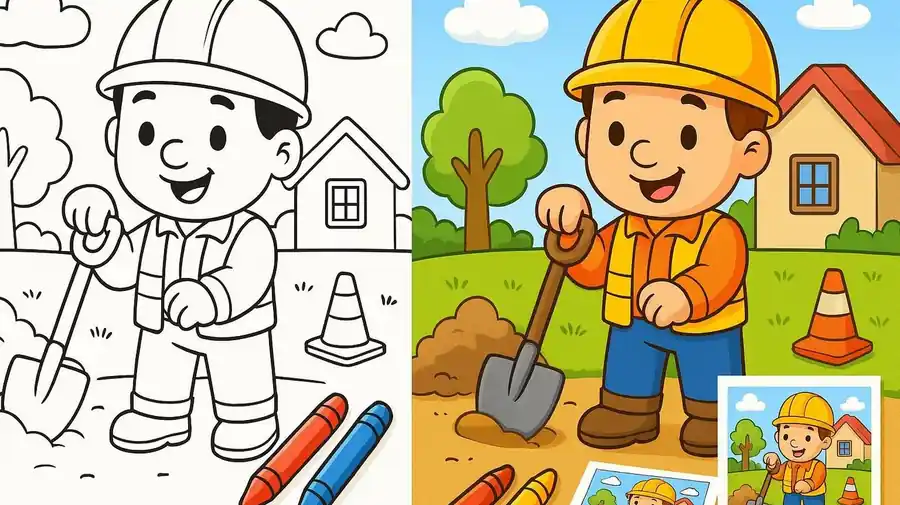
These 20 pages depict real community workers on the job — a police officer in front of a patrol car, a firefighter in full gear, construction workers at a building site, a mail carrier on a route, garbage collectors loading a truck, a gardener tending plants, a carpenter with tools, and more. The illustrations are semi-realistic cartoon style: detailed enough to show the equipment and clothing that distinguishes each role, simple enough that the figures are clearly readable for young children.
Community helper coloring pages have been a classroom staple for decades because they do double duty — children engage with the art while absorbing vocabulary and social knowledge about the people who keep a neighborhood running. Everything here is free to download and easy to print.
Free Printable Community Worker Coloring Pages
This collection includes 20 printable community worker coloring pages featuring scenes of workers including police officers, firefighters, construction workers, mail carriers, garbage collectors, gardeners, and carpenters — each shown in a setting that makes their tools and role immediately recognizable. Figures are drawn in a confident cartoon outline style with moderate scene detail. Print on US Letter or A4 paper.


Who Are These Community Worker Coloring Pages Best For?
Kindergarteners and early-elementary children (ages 4-8) are the primary audience. At this developmental stage, children are actively learning about the social world around them — who fixes the roads, who puts out fires, who brings the mail. Coloring these pages in class or at home gives children a concrete visual anchor for each role and a natural conversation hook with parents or teachers.
The moderate level of scene detail — background buildings, vehicles, and equipment visible alongside the central figure — makes these pages more interesting for 6-8 year olds than for toddlers, who may find the scene complexity a bit much. For preschoolers, the simpler single-figure pages in the set work best; for early-elementary children, the full scene pages are the more engaging choice.
These pages work particularly well as part of a community helpers unit in kindergarten or first grade. Assign one worker per day, read a brief fact aloud, then color the page — a simple five-minute routine that builds cumulative vocabulary over a two-to-three-week unit.
Interesting Community Worker Facts to Share While Coloring
Firefighters wear gear that weighs about 45 pounds. The jacket, pants, boots, helmet, and oxygen tank together are heavier than most 7-year-olds. That weight is why firefighters train physically every day — they need to be able to run, climb, and carry people while wearing all of it.
Mail carriers in the US walk an average of 4 to 8 miles per day on foot routes. A carrier who works a foot route for 30 years walks a distance roughly equal to circling the Earth several times over their career.
Garbage collectors handle more than 4 pounds of trash per person per day in the US — which adds up to about 292 million tons of municipal solid waste nationally per year. Without collection, cities would face serious public health problems within days.
Police officers complete 21-36 weeks of training at an academy before their first shift, covering law, physical fitness, firearms, first aid, traffic control, and crisis response. In many countries, the training is even longer.
Construction workers use over 30 different types of specialized tools on a typical build site, from concrete mixers and cranes down to levels, chalk lines, and nail guns — each designed for a specific task that a general tool would do less precisely.
Creative Community Worker Coloring and Craft Ideas
Career Interview After coloring a worker page, role-play an interview — one child asks questions, another answers as that worker. What do you do in the morning? What is the hardest part of your job?
Community Map Draw a simple neighborhood map on a large sheet and glue finished colored worker figures in the places where they would actually work — firefighter near the station, gardener in the park.
Thank-You Cards Color the page of the worker you want to thank, write a short note on the back, and deliver or mail it to a local fire station, police station, or post office.
Tool Matching Game Make a second set of small drawings of each worker’s main tool and match them to the correct colored worker page — stethoscope to doctor, hose to firefighter.
Community Puzzle Cut finished pages into simple puzzle pieces (4-6 large shapes), mix pieces from two different pages, and reassemble — a fine motor and recognition activity.
Workers Alphabet Book For each letter, find a community worker whose job starts with that letter and color a page to create a personal A-Z career alphabet book.
Uniform Details Before coloring, identify and label every piece of safety equipment visible on the page — hard hat, reflective vest, steel-toed boots — with small arrows and text.
What I Want to Be Color the page of the worker you might want to be, then write three sentences on the back explaining what that person does and why you find it interesting.
How to Print These Community Worker Coloring Pages
Each page downloads as a PDF formatted for US Letter and A4 paper. Standard copy paper works well for crayons and colored pencils. For classroom use where pages might get handled by multiple children, print on 24 lb paper for slightly better durability. Grayscale printing is fine — all illustrations are solid black outlines.
Explore More People & Community Coloring Pages
If you enjoyed these pages, you may also like:
Medical Coloring Pages
Medical Instrument Coloring Pages
People & Community Coloring Pages