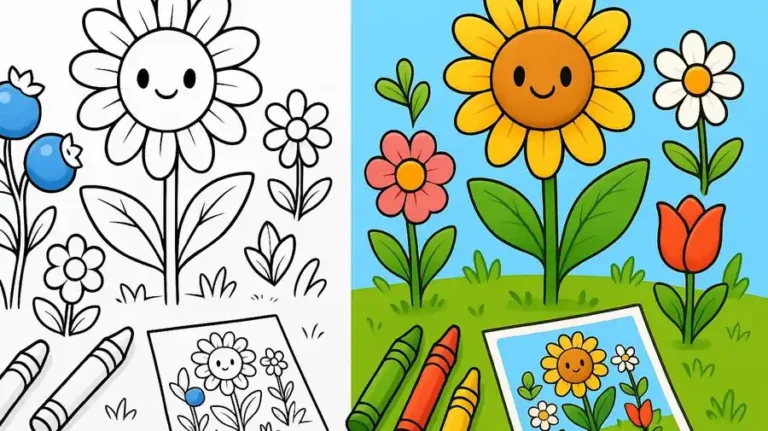

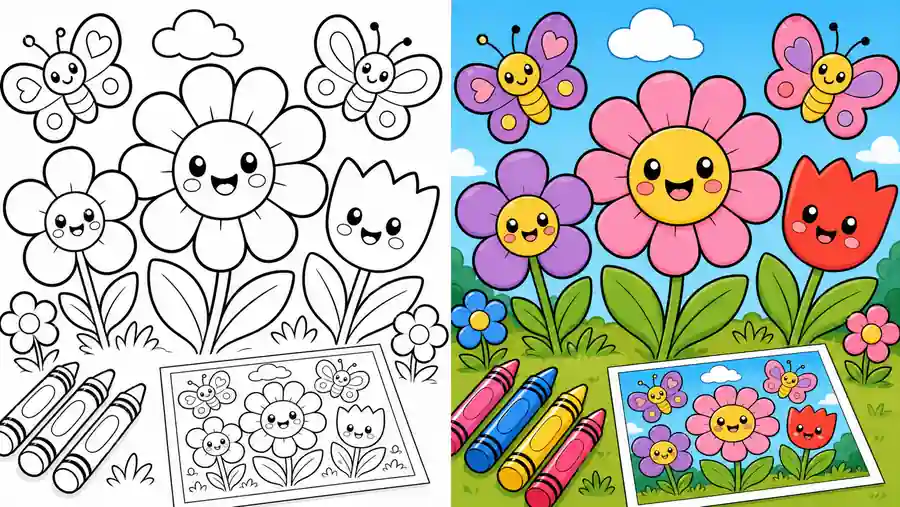
These floral pages lean into variety rather than repetition. Across 24 designs you get garden bouquets spilling out of the frame, single sunflowers and daisies in crisp isolation, clustered wildflowers with bumble bees hovering above, a bunny tucked among snowdrops, and a smiling rose that feels right out of an illustrated storybook. The outlines run about 3 to 4 millimeters thick — wide enough that filling a petal with a marker stays tidy, but narrow enough that the shapes read as real flowers rather than cartoon blobs. Each page is its own little scene.
The collection works well for kids who already know how to handle crayons with some control — roughly kindergarten age and into early elementary. There is enough detail in the leaf clusters and petal counts to keep an older child engaged without overwhelming a younger one who just wants to fill big cheerful shapes with pink. Everything here is free to download and easy to print.
Free Printable Bold & Easy Floral Coloring Pages
This collection includes 24 printable floral coloring pages featuring sunflowers with layered petals, daisy clusters growing from grassy ground, a bouquet of mixed garden flowers, roses in full bloom, snowdrop bells hanging in groups, a butterfly landing on a wildflower, a bee buzzing near a daisy, a cheerful bunny peeking through flowers, and a smiling personified rose. The designs print cleanly on standard A4 or US Letter paper as PDF files.


Who Are These Floral Coloring Pages Best For?
Kindergarteners are the core audience here. The outlines are thick enough that a five-year-old working with chunky crayons or washable markers can fill petals without getting frustrated, but the scenes have enough interior detail — leaf veins, petal layers, small background grasses — that there is something to think about while coloring. A child who has been coloring for a year already will find the level satisfying rather than too easy.
Early elementary kids, roughly ages six through eight, can use these pages as a chance to practice gradient shading or experiment with color mixing. A sunflower page becomes a study in yellows and oranges; a rose page invites red-to-pink blending. The 3 to 4 millimeter outlines do not require ultra-fine motor control, so these hold up well even if a child is still developing pencil grip strength.
For classroom or homeschool use, this set works well alongside a spring gardening unit or a lesson on plant parts. The mix of species — roses, daisies, sunflowers, snowdrops — gives enough botanical variety to spark a naming conversation without needing a single theme to tie everything together.
Interesting Floral Facts to Share While Coloring
Sunflowers are not actually one flower. What looks like a single bloom is actually made up of hundreds of tiny individual flowers packed together. The ring of yellow petals around the outside are each separate flowers too, called ray florets.
Roses have been cultivated for over 5,000 years. Ancient Chinese and Roman gardens both grew roses, and archaeologists have found fossilized rose impressions in rock that are 35 million years old. Modern roses are bred hybrids — wild roses typically have only five petals.
Bees see flowers differently than we do. Bees can see ultraviolet light, which is invisible to human eyes. Many flowers have UV patterns on their petals that act like runway lights, guiding bees straight to the nectar. What looks like a plain yellow daisy to us looks like a targeted landing zone to a bee.
Snowdrops can melt their way through frozen ground. They produce a small amount of heat as they grow, which is enough to push through a thin layer of ice or frost. This is why they are often the very first flower to appear in late winter, sometimes pushing up through snow.
Daisies close at night. The word “daisy” comes from the Old English phrase “daes eage,” meaning “day’s eye,” because the flowers fold their petals closed after sunset and reopen each morning when the light returns. It is one of the easiest flower behaviors to observe at home.
Creative Floral Coloring and Craft Ideas
Color-Match Bouquet Pick a real flower from the garden or a grocery store bunch and try to match its exact colors on the bouquet page using whatever supplies you have.
Seasonal Palette Challenge Color the same page twice: once in warm summer tones (yellow, orange, hot pink) and once in cool winter tones (white, pale blue, lavender). Compare how different the mood feels.
Pressed Flower Companion After coloring a daisy or rose page, press a real flower between two sheets of wax paper inside a heavy book. Once dried, display it next to the colored page.
Bee’s-Eye View Use a black light or UV flashlight on real flower petals while discussing how bees see ultraviolet patterns. Then color the bee page using only yellows and oranges to represent warmth and sunlight.
Garden Map After coloring several pages, arrange them into an imaginary garden layout on a table. Label which flowers would grow tall (sunflowers in the back), which would border a path (daisies), and which would climb a wall (roses).
Dot-Art Centers Use the eraser tip of a pencil dipped in paint to fill in the center of flowers with dots of contrasting color — dark brown dots on a sunflower center, yellow dots on a daisy center.
Story Scene The bunny-in-snowdrops page lends itself to a short story prompt: where is the bunny going, and what will it find on the other side of the flower patch? Color it, then write three sentences.
Texture Rubbings Place a textured surface — sandpaper, a leaf, rough fabric — under the page before coloring. The crayon will pick up the texture, giving the petals an organic, layered look.
How to Print These Floral Coloring Pages
Each page downloads as a PDF sized for both A4 and US Letter paper. Standard 20 lb copy paper works fine for crayons and colored pencils; if you plan to use markers, 32 lb paper or card stock will prevent bleed-through. If your printer is low on ink, printing in grayscale mode uses less toner and still produces clean, dark outlines that are easy to color.
Explore More Flowers & Plants Coloring Pages
If you enjoyed these pages, you may also like:
Bold & Easy Flower Coloring Pages
Bold & Easy Garden Coloring Pages
Bold & Easy Animal Coloring Pages
Flowers & Plants Coloring Pages